


More news on this day
Strong winds sweeping across the high desert near Lordsburg in southwestern New Mexico have derailed a freight train on a major cross-country rail line, briefly halting traffic through one of the region’s busiest freight corridors and drawing renewed attention to how extreme weather affects rail operations.
Get the latest news straight to your inbox!
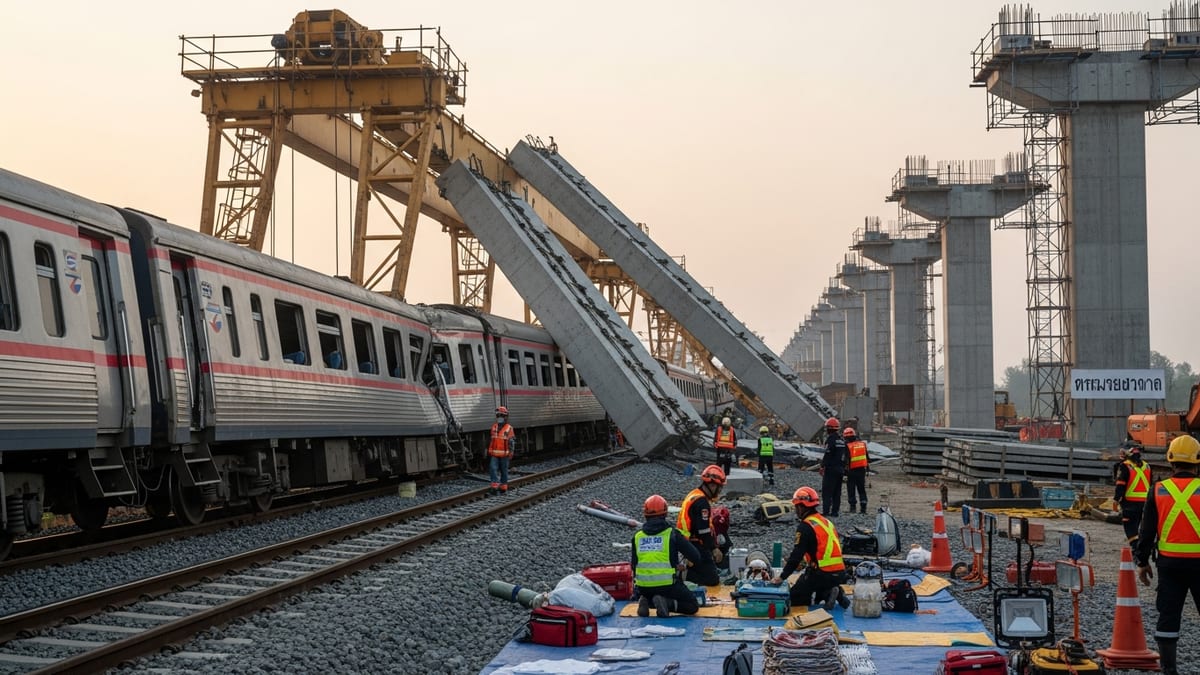
High desert winds linked to freight derailment
Initial reports from regional media and rail observers indicate that the train left the tracks near the Lordsburg area, a stretch of line that cuts across open desert terrain known for powerful wind events and sudden dust storms. The incident occurred on a section of track used heavily by transcontinental freight traffic, making the disruption particularly notable for long-distance rail movements between the West Coast and interior states.
Accounts from the scene describe railcars pushed off the rails in an area exposed to crosswinds, consistent with past wind-related rail incidents in the broader Southwest. Publicly available safety analyses note that long, lightly loaded freight consists, especially those carrying stacked containers or empty cars, can be especially vulnerable when strong lateral gusts coincide with higher operating speeds and elevated track structures.
Weather discussions and hazard outlooks issued in recent days for southwestern New Mexico have highlighted gusty winds and outflow boundaries from thunderstorms across Hidalgo County and surrounding areas, including the Lordsburg Playa. That pattern aligns with a seasonal monsoon environment in which collapsing storms can send powerful, localized downbursts racing across open basins, producing sharp, short-lived surges in wind speed.
While a formal determination of cause has not yet been published, the emerging evidence pointing to strong winds underscores a familiar risk for railroads crossing the open desert west of Lordsburg, where long, straight segments of track run with minimal natural shelter from terrain or vegetation.
Strategic freight corridor faces temporary disruption
The derailment occurred along a rail artery that forms part of a primary east–west freight route across the southern United States. Trains passing through Lordsburg connect major ports and logistics hubs in California and the Southwest with markets in Texas, the Gulf Coast, and beyond, making the line a critical link in national supply chains.
According to publicly available operational trackers and rail enthusiast reports, traffic was temporarily halted in the immediate aftermath as crews assessed the damage and began clearance work. Some trains were held at sidings on either side of the affected segment, while others appeared to be rerouted over alternative lines where capacity allowed, a common response when a single-track bottleneck emerges on a long corridor.
Past derailments along this broader transcontinental route have demonstrated how quickly rail carriers move to restore at least limited service, often by reopening one track while repairs continue on another. In a single-track area near Lordsburg, however, options are more constrained, so the focus typically turns to re-railing equipment, clearing damaged cars, and inspecting the roadbed for wind or impact-related structural issues before regular speeds can resume.
Freight customers with time-sensitive shipments transiting the Southwest are likely to experience delays or re-sequencing of loads as the network absorbs the disruption. Intermodal traffic, which includes containers destined for highway transfer, is particularly sensitive to schedule changes, prompting terminal operators and trucking partners to adjust pickup windows when events like this occur.
Wind risk on exposed desert rail lines
Rail safety assessments and meteorological studies over the past decade have repeatedly flagged the New Mexico high plains and adjoining desert basins as areas where thunderstorm outflows and gradient winds can create hazardous conditions for rail operations. Documentation from weather agencies highlights that downbursts in this region frequently produce gusts exceeding 40 miles per hour, with occasional storms generating much stronger bursts capable of lifting loose debris and kicking up dense walls of dust.
In open country near Lordsburg, where tracks often run atop low embankments or causeways, strong crosswinds can exert significant force on the broad side profiles of railcars, especially double-stack containers or high-sided empty cars. Case studies of past wind-related derailments in the central United States and Southwest show that when gust speeds and train dynamics align unfavorably, multiple cars can be tipped or shifted off the rails in rapid succession.
Engineering analyses describe wind-related derailments as complex events influenced by train length, loading patterns, car design, speed, and the exact angle of the wind relative to the train’s direction of travel. Even when overall network statistics show that such accidents are relatively rare compared with other causes, their consequences can be dramatic, particularly when they occur on bridges or elevated structures where fallen equipment is harder to recover.
For the Lordsburg area, planning documents and regional hazard profiles already list high winds and blowing dust as recurring transportation risks. The latest incident near the town appears to align with those concerns, highlighting how seasonal weather patterns can intersect with critical infrastructure at vulnerable points along long-distance routes.
Ongoing response and safety considerations
Railroad recovery from a wind-related derailment typically unfolds in stages. Heavy equipment is brought in to re-rail salvageable cars and remove damaged equipment from the right-of-way, while track inspectors examine rails, ties, ballast, and signaling components for hidden damage. Only once the track structure is verified, and in some cases partially rebuilt, will through traffic resume at reduced speeds, gradually returning to normal as confidence in the repairs grows.
Publicly posted safety literature from transportation regulators and research organizations emphasizes that freight rail remains one of the safest modes for long-distance cargo movement, even as climate variability introduces new stresses. As temperature extremes, convective storms, and wind events grow more erratic in some regions, railroads are adapting by refining weather monitoring, updating operating rules for high-wind conditions, and adjusting how and where lighter or more wind-sensitive equipment is marshaled into trains.
In the context of Lordsburg and similar high desert locations, enhanced monitoring of thunderstorm outflows and localized wind maxima is increasingly viewed as a practical mitigation tool. Real-time wind data near vulnerable structures, such as bridges and elevated embankments, can support operational decisions about speed restrictions or temporary traffic pauses when conditions cross predefined thresholds.
The latest derailment near Lordsburg adds another example to a growing body of evidence that extreme or rapidly changing weather can challenge even well-maintained railways. As investigators review data from this event, including weather observations and train-handling records, the findings are likely to inform future adjustments to operating practices across New Mexico’s busy freight corridors.