


More news on this day
Rail services to and from London Liverpool Street, one of the capital’s busiest commuter terminals, were brought to a standstill on Sunday after a significant trackside fire near Waltham Cross forced all lines to be suspended.
Get the latest news straight to your inbox!
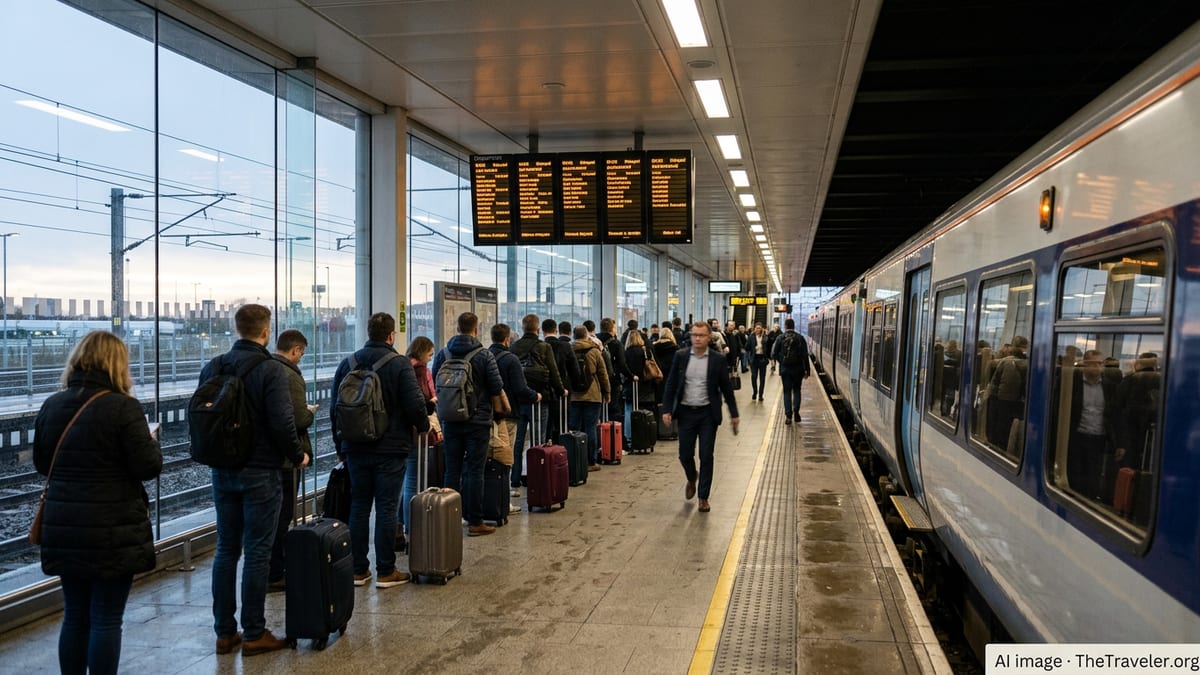
Fire breaks out near tracks north of London
Initial reports indicate that the incident began early on Sunday afternoon near the railway at Waltham Cross in Hertfordshire, on a key stretch of track used by commuter and regional services into London Liverpool Street. Coverage from multiple UK news outlets and rail operators describes a fire breaking out close to the line, sending smoke across the railway and prompting an immediate halt to train movements through the affected area.
Rail industry updates state that all lines were blocked while the fire was assessed and containment work took place. Images shared on social media platforms showed dark smoke rising near the tracks, with trains stopped short of the affected section and passengers reporting long waits on board and at intermediate stations.
The cause of the fire had not been confirmed in early reports, but the proximity to the running lines and signalling equipment led to a cautious operational response. Publicly available information suggests that services were held well back from the site while checks were carried out on both the infrastructure and overhead line equipment.
One of London’s busiest terminals brought to a standstill
London Liverpool Street is among the busiest mainline termini in the United Kingdom, handling large volumes of commuter traffic from Essex, Hertfordshire and East Anglia as well as services to Stansted Airport. Disruption to its approach routes typically has a rapid impact across the wider rail network, affecting not only long distance passengers but also thousands of daily commuters.
According to rail industry dashboards and journey planners, trains to and from the station were either cancelled, significantly delayed or diverted once the fire was reported. Services operated by Greater Anglia and other operators using the route were among those most affected, with some trains being terminated short of London and others being held at origin stations to prevent congestion.
The timing of the incident on a summer Sunday limited the usual weekday commuter pressures, but the station still serves leisure travellers, visitors and airport passengers throughout the weekend. Travellers heading into central London, particularly from the Lea Valley corridor and destinations such as Hertford East, Bishop’s Stortford and Cambridge, faced extended journey times and in some cases were advised not to travel until lines could be reopened.
Severe disruption for passengers across the East Anglia network
Information from train operators’ customer updates shows that disruption spread well beyond the immediate vicinity of Waltham Cross. Blocked tracks north of London forced a rapid recast of services, with some trains held outside the capital, others rerouted where possible, and many journeys cancelled outright while the incident was ongoing.
Passengers reported full concourses and busy platforms at key interchange points as travellers attempted to replan journeys at short notice. Replacement road transport was limited, and rail users were encouraged to consider alternative London terminals or different routes into the city where that was feasible.
Journey planners indicated that knock-on delays were expected to continue even after the fire itself was contained, as trains and crews were displaced from their usual diagrams. Some services were predicted to remain disrupted into the evening while the timetable was reset and rolling stock returned to its scheduled positions around the network.
Safety checks and infrastructure inspections under way
Publicly available rail operations information suggests that reopening the route required more than simply extinguishing the fire. Infrastructure managers typically carry out detailed inspections of track, signalling systems and any nearby equipment once a fire has occurred near the railway, particularly where heat or smoke may have affected cables, gantries or masts.
Until those safety checks were completed, services were unable to pass through the affected section at normal speeds. In some comparable incidents, lines have initially reopened with temporary speed restrictions while further technical assessments are carried out, and a similar approach was anticipated in this case as rail engineers worked to confirm the condition of the assets.
Specialist teams also review vegetation management and lineside conditions following such events, and early commentary around Sunday’s incident highlighted ongoing concerns about dry ground, scrub and trees close to the track during warmer months. Any findings from subsequent assessments are expected to inform future maintenance and resilience plans for this busy corridor into London.
What travellers should do if they are affected
Rail passengers planning to use London Liverpool Street and routes through Waltham Cross were advised to check departure boards and operator service updates before setting out. Ticket acceptance on alternative routes is commonly offered during significant disruption of this kind, and journey planners indicated that some passengers could travel via other London terminals or parallel lines where capacity allowed.
Those with pre-booked tickets, including airport connections, were encouraged by online guidance to contact train companies for refund or rebooking options if they chose not to travel while services were severely restricted. Advance-ticket holders in particular may be eligible for changes without additional fees when their booked service is cancelled or heavily delayed because of an incident on the line.
Travel industry observers note that the disruption underlines the vulnerability of major rail hubs to incidents many miles from central London. With Liverpool Street acting as a critical gateway for both domestic and international travellers, even a single fire near the tracks can have a disproportionate impact on mobility, making timely information and flexible alternatives essential for those caught up in the delays.