


More news on this day
Europe’s peak travel season is off to a turbulent start as 1,225 flight delays concentrated at the major hubs of London, Amsterdam and Paris ripple across airline networks, snarling connections and leaving passengers facing long queues, missed itineraries and mounting uncertainty about summer plans.
Get the latest news straight to your inbox!
Disruption Concentrates at Europe’s Busiest Hubs
The latest operational data for early June 2026 indicate that London’s airports, Amsterdam Schiphol and Paris Charles de Gaulle have emerged as focal points in a fresh wave of European flight disruption. Out of more than a thousand delays logged across the continent in a single 24 hour period, 1,225 were clustered around these three metropolitan systems, amplifying the impact far beyond their local catchment areas.
Tracking summaries point to London Heathrow and Gatwick, Amsterdam Schiphol and Paris Charles de Gaulle as among the most delay-prone hubs, reflecting their role at the heart of dense short haul and long haul networks. When disruption hits these airports, reactionary delays quickly spread to regional spokes serving smaller European cities and onward intercontinental services, compounding the original problem.
The current pattern builds on several days of elevated disruption across Europe, with previous tallies showing thousands of late departures and more than a hundred cancellations affecting airports from Madrid and Rome to Vienna and Dublin. Against that background, a single day count of 1,225 delays focused on London, Amsterdam and Paris is being viewed by aviation analysts as a clear sign that the continent has entered another unstable period for on time performance.
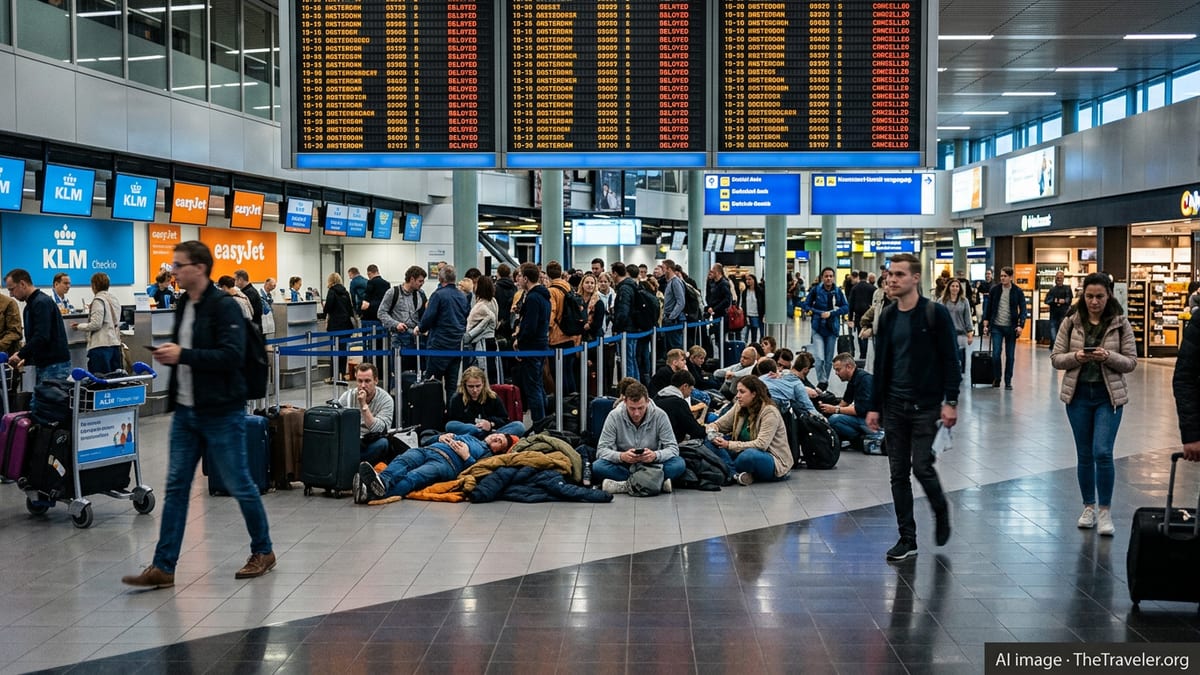
Publicly available passenger reports from terminals in all three cities describe congested departure halls, long lines at check in and security, and departure boards dominated by amber and red status alerts as delay minutes accumulated over the course of the day.
Weather, Staffing and Capacity Combine into a Perfect Storm
While no single trigger fully explains the concentration of 1,225 delays, a combination of factors appears to be driving the current phase of disruption. Network overviews for the first weeks of June highlight air traffic control capacity constraints and staffing pressures as leading causes of air traffic flow management delay across key sections of western European airspace, with France and neighboring states repeatedly identified as hotspots.
Weather has also played a recurring role. Earlier in the year, winter storms and snowfall led to significant schedule reductions at Amsterdam Schiphol and other northern European hubs, and the first strong convective weather systems of the summer are now testing updated traffic management procedures. Even on days without headline making storms, scattered thunderstorms, low visibility and shifting wind conditions can reduce airport throughput, creating backlogs that spill into peak periods.
At airport level, the finely balanced relationship between runway capacity, ground handling resources and terminal infrastructure leaves little room for error during the busy summer timetable. At London and Paris in particular, historically high traffic volumes combined with tight staffing margins in ground handling, security and air traffic services mean that relatively small disturbances can grow into larger operational challenges as the day progresses.
Experts note that the return of traffic to and above pre pandemic levels, alongside infrastructure and staffing that have not always kept pace, has created a structurally fragile system. When demand surges in June, the result is often a spike in late running flights, with hubs such as London, Amsterdam and Paris bearing the brunt.
Knock on Effects for Airlines and Travelers
The concentration of 1,225 delays at three key hubs carries particular significance for airlines that rely on tightly timed connections. Carriers based in the United Kingdom, the Netherlands and France use their home airports as central transfer points for both intra European and intercontinental traffic, meaning that an initial late departure can quickly cascade into multiple missed connections and aircraft out of position.
Operational snapshots from recent days show that large low cost and network airlines alike have been affected, with delays and cancellations recorded across short haul routes linking London, Amsterdam and Paris to cities such as Munich, Bologna, Athens and Dublin, as well as select long haul services. For travelers, this often translates into extended layovers, overnight stays and the need to rebook onward legs at short notice.
Consumer organizations are once again drawing attention to the protections available under European and United Kingdom passenger rights regulations, which can entitle affected travelers to meals, accommodation and, in some circumstances, financial compensation when delays exceed defined thresholds and are within the carrier’s control. However, entitlements vary depending on whether disruption stems from capacity constraints, staffing issues, weather or other operational factors.
Travel advisers recommend that passengers keep boarding passes, booking confirmations and receipts for essential expenses, and use airline apps or airport displays to monitor gate changes and revised departure times. In a network as interconnected as Europe’s, being prepared for potential misalignments in connections has become an essential part of summer trip planning.
Signals for the Rest of the Summer Season
The wave of 1,225 delays centered on London, Amsterdam and Paris arrives just as Europe moves into its busiest travel weeks, raising questions about what the rest of summer 2026 may hold. Recent European air traffic briefings show traffic edging above last year’s levels, with daily flight counts continuing to rise as airlines add seasonal frequencies and leisure demand peaks.
Industry monitoring indicates that, although network managers have introduced new capacity planning tools and weather based procedures designed to smooth traffic flows, persistent structural issues remain. Air traffic control staffing, aging infrastructure at some major hubs and constrained terminal capacity all limit the extent to which additional flights can be operated without increasing the risk of delay.
Analysts point to punctuality data from recent months, which show several of Europe’s largest airports including Amsterdam and Paris recording on time performance below the regional average, as evidence that the system is already operating close to its limits. Against this backdrop, the latest surge of delays at London, Amsterdam and Paris is being viewed less as an isolated event and more as a warning signal for the broader season.
For travelers planning journeys in the coming weeks, the emerging picture suggests that flexibility and contingency planning will be crucial. Building longer connection times into itineraries, traveling with carry on luggage where possible and checking flight status early and often are increasingly seen as practical ways to navigate what is shaping up to be another challenging European summer for air travel.