


More news on this day
Switzerland is sharpening its focus on slow, scenic rail journeys for the upcoming summer season, positioning panoramic trains, flexible passes and climate-conscious itineraries at the heart of its tourism offer.
Get the latest news straight to your inbox!
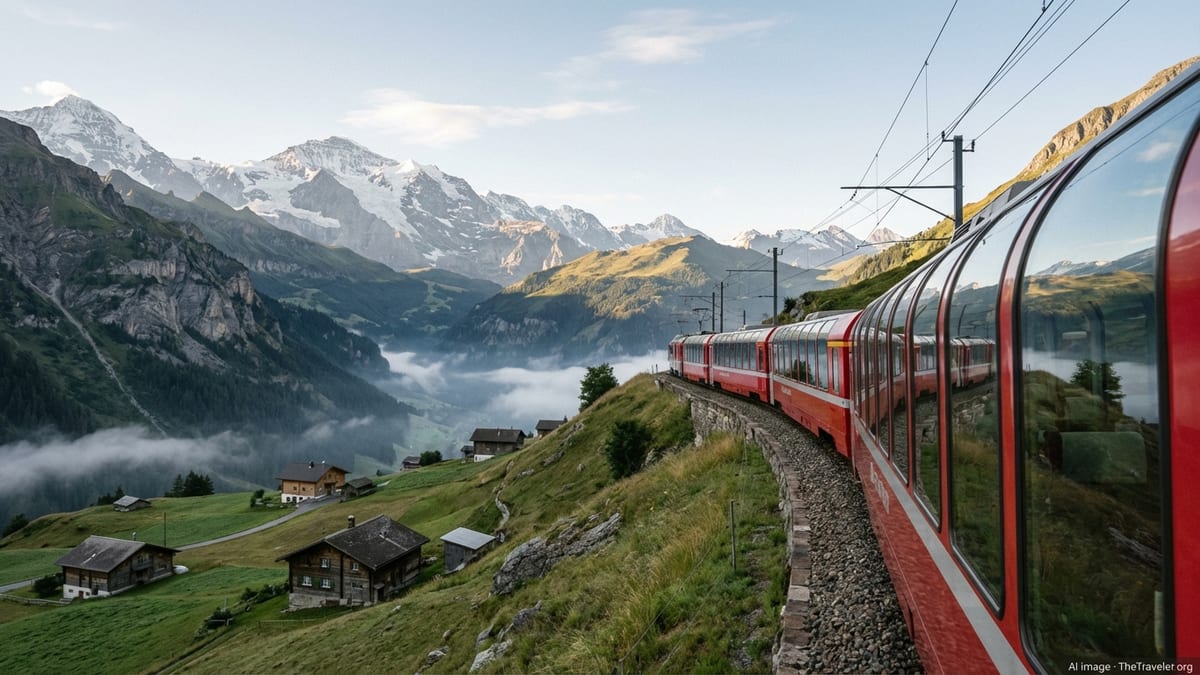
Panoramic Trains Turn the Alps Into an Open-Air Stage
Publicly available information from national and regional tourism bodies highlights an expanded push around Switzerland’s signature panoramic trains, which are being marketed as the backbone of new summer slow-travel itineraries. The Grand Train Tour of Switzerland brings together several of the country’s best-known routes into one continuous circuit, allowing visitors to link lakeside resorts, historic towns and high mountain passes without the need for a car.
Flagship services such as the Glacier Express and Bernina Express continue to anchor this offering, with summer schedules designed to maximise daylight hours and visibility of high-altitude scenery. Travel manuals and rail-tour brochures for 2024 and 2025 describe how these trains cross dramatic passes, glacier valleys and UNESCO-listed rail corridors in carriages fitted with large panoramic windows, so the journey itself becomes the main attraction.
Newer products are helping to refresh Switzerland’s rail image for returning visitors. The GoldenPass Express, which connects Montreux on Lake Geneva with Interlaken in the Bernese Oberland, is highlighted in recent rail travel guides as a key link for travellers seeking a single-seat journey between vineyards and high Alpine peaks. Tourism materials emphasize that combining these routes allows visitors to build multi-day rail trips that remain unhurried, with frequent stops in lakeside or mountain villages.
Alongside the headline trains, regional lines such as the Gotthard Panorama routes and the revitalised Treno Gottardo corridor are being promoted as slower, more scenic alternatives to base tunnels and high-speed lines. Coverage of European rail awards in late 2024 notes that marketing campaigns around these historic lines have specifically focused on encouraging travellers to choose the panoramic mountain route over the faster, less scenic option.
Slow Travel Meets Sustainability on the Swiss Network
Switzerland’s renewed emphasis on rail-based summer tourism is closely tied to environmental considerations. Research published in recent years on Alpine transport, along with data from infrastructure projects such as the Gotthard Base Tunnel, indicates that shifting passenger traffic from road to rail can significantly reduce greenhouse gas emissions and congestion in mountain regions. Officials and industry reports have long cited rail as a cornerstone of the country’s climate strategy, and tourism promotion now reflects that positioning.
Studies examining the impact of new trans-Alpine rail links suggest that shorter travel times and improved comfort have made it more realistic for visitors to complete cross-country journeys by train rather than rental car. Academic work on the Gotthard corridor in particular notes expectations of a measurable shift from car to rail for both domestic and tourist travel, reinforcing the environmental credentials of rail-based itineraries through central Switzerland.
Tourism sales manuals and trade presentations released in 2024 describe Switzerland’s public transport as a coordinated, largely electrified network where standard timetables connect mainline trains with boats, mountain railways, funiculars and buses. This integrated model is being leveraged in international marketing as a practical way for travellers to reduce their footprint while still reaching remote valleys and viewpoints that once required private vehicles.
Industry summaries of European rail and tourism awards also highlight Switzerland among the destinations recognised for creative approaches to sustainable mobility. Campaigns promoting slower, heritage-rich lines over newer, faster infrastructure are cited as examples of how storytelling around rail can support both environmental goals and regional economies that depend on visitors lingering rather than transiting quickly through.
Passes, Tickets and Seasonal Timetables: What Travellers Need to Know
For international visitors, the Swiss Travel Pass and Swiss Travel Pass Flex remain the principal tools for exploring the network, according to tourism board documentation and travel trade training materials. These passes cover nationwide public transport on most trains, buses and boats, with only a handful of panoramic routes and mountain lifts requiring seat reservations or supplements. Recent sales manuals detail how the passes can be used on the full Grand Train Tour, turning complex itinerary planning into a single-ticket experience.
Updated guides for 2025 and 2026 indicate that different panoramic services have distinct operating patterns. The Glacier Express typically runs at higher frequency during the summer season, with advance reservations strongly recommended at peak times, while the Bernina Express operates year-round but adds more departures in the warm months. The GoldenPass Express connects key resort hubs and is being promoted for travellers seeking flexibility, with the option to break journeys overnight in towns such as Montreux, Zweisimmen or Interlaken.
Visitors are also being encouraged to pay attention to seasonal international services. Information shared by Swiss Federal Railways and reported in national media notes that summer timetables add capacity on routes linking Switzerland with neighbouring countries, including leisure-focused connections to destinations in France and Italy. At the same time, infrastructure works can temporarily affect some cross-border trains, so slow-travel itineraries are best planned around up-to-date schedules and potential diversions.
Specialist rail tour operators and independent travel guides advise building in buffer time for connections when travelling on popular scenic routes, particularly during July and August. While Switzerland’s clockface timetable is known for its precision, high demand on some panoramic trains means that same-day seat reservations can be difficult to secure. Planning overnight stays along the way not only eases logistics but also aligns with the slow-travel ethos that Swiss tourism organisations are actively promoting.
From Glacier Valleys to Vineyards: Signature Summer Itineraries
New and updated brochures for summer 2024 and 2025 outline several model journeys that showcase Switzerland’s landscapes at a slower pace. One widely promoted route combines the Glacier Express between Zermatt and St. Moritz with the Bernina Express down to Tirano and onward connections to Lugano, turning a cross-Alpine crossing into a multi-day circuit from glacier views to palm-fringed lakeshores. Travel companies describe this combination as a way to experience both high-mountain engineering and Mediterranean-influenced culture in a single, rail-only trip.
Another emerging summer favourite links the Riviera-style promenades of Montreux with the hiking and adventure sports hub of Interlaken via the GoldenPass Express. Travel features in international media highlight how this route passes through vineyard-clad slopes, rolling pre-Alpine hills and dramatic rock gorges, often within a single day. By adding overnight stops in smaller towns en route, visitors can transform what was once a transfer between resorts into a highlight of the holiday.
Rail tourism materials also draw attention to less-known regional lines that lend themselves to slow exploration. The historic Gotthard mountain route, accessible via services branded as scenic or panorama trains, is promoted as a contrast to the faster base tunnel, looping through spiral tunnels and alongside lakes and fortress towns. In the Bernese Oberland and Central Switzerland, interlinked cog railways, funiculars and lake steamers make it possible to design circular day trips that start and end in the same base without retracing steps.
Overall, publicly available coverage portrays Switzerland as leaning into its reputation as “the rail country of Europe,” especially for summer visitors seeking low-impact journeys where snowcapped summits, deep valleys and mirror-still lakes are visible from the carriage window. With upgraded rolling stock, carefully coordinated timetables and a suite of national passes, the country is positioning slow rail travel not as a niche, but as the main way to experience its Alpine landscapes.