


More news on this day
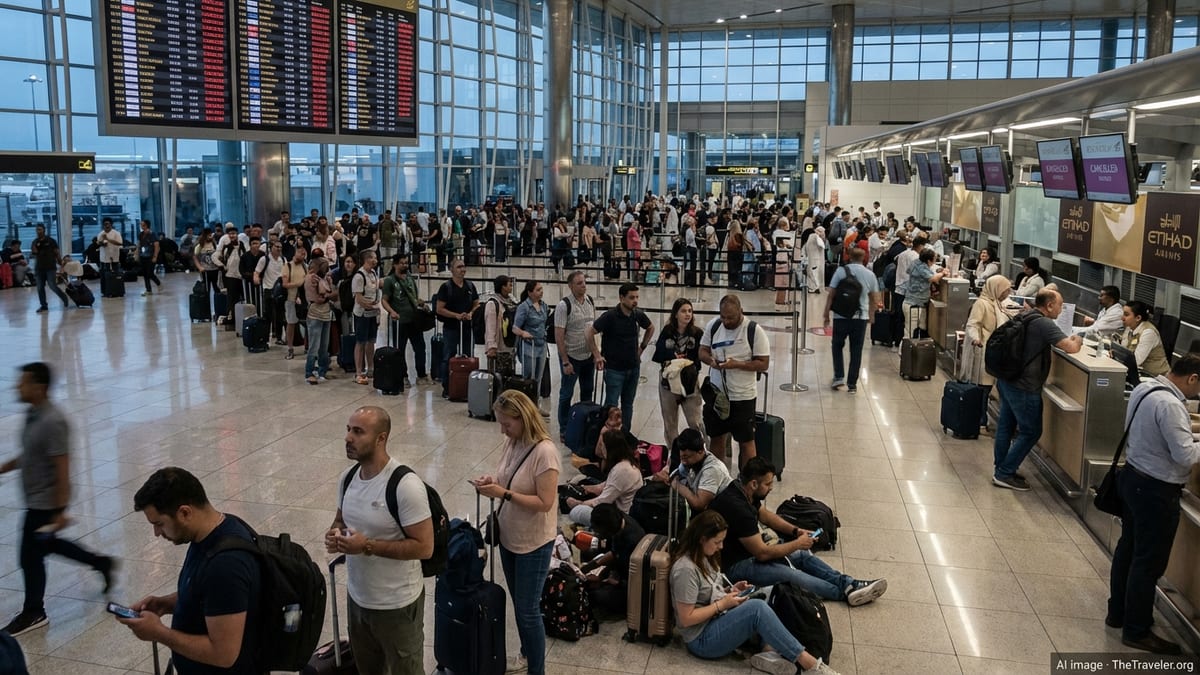
A new wave of flight disruption across Dubai and other key Middle East hubs has left travelers facing 611 delays and 66 cancellations in a single operating day, underscoring how regional conflict, airspace restrictions and infrastructure strain are reshaping global aviation flows in 2026.
Get the latest news straight to your inbox!
Concentrated Delays at the World’s Busiest International Hub
Operational data compiled by aviation analytics providers and regional media coverage indicates that Dubai International Airport and its sister hub at Al Maktoum have been among the hardest hit as the latest phase of the Middle East aviation crisis unfolds. While overall passenger numbers at Dubai have recovered strongly compared with the pandemic era, disruption spikes have become more frequent and more intense, with the most recent 24 hour period marked by 611 delayed departures and arrivals and 66 outright cancellations across the Dubai system and associated regional spokes.
Dubai’s position as the world’s busiest airport for international traffic magnifies the impact of any single day of disruption. Publicly available figures show that the airport still handled more than 31 million passengers in the first half of 2026, even as the region worked through one of the most challenging operating environments in its history. That resilience means that a delay or cancellation at a Gulf hub often reverberates quickly across Europe to Asia routes, affecting travelers who may not even realize their itinerary relies on a Middle East connection.
Earlier episodes this year, including weather disruptions such as dense fog in January that triggered widespread delays and diversions at Dubai and nearby Sharjah, highlighted how thin the margin for error has become. With aircraft and crews tightly scheduled, even short disruptions can cascade through the system, setting the stage for the type of single day performance shock seen in the latest crisis figures.
Conflict and Airspace Closures Tighten the Squeeze
The latest surge in delays and cancellations is taking place against the backdrop of an armed conflict in the Gulf region that began in late February 2026 and triggered a series of airspace closures and reroutings. Industry assessments from international airline and airport associations describe this as the most severe disruption to Middle East air connectivity since the height of the COVID 19 pandemic, with some days in March seeing more than a third of scheduled departures across the wider region fail to operate.
On the first weekend of the conflict, published coverage documented the temporary suspension of all flights at Dubai’s two airports as Gulf states restricted airspace following strikes involving Iran and its adversaries. Subsequent days brought a gradual resumption of limited operations, but at significantly reduced capacity, as airlines navigated closed or restricted flight information regions in parts of Iran, Iraq, Jordan, Qatar and Bahrain. Analysts note that Europe Asia traffic has been particularly exposed, because many carriers were already flying longer routes to avoid Russian airspace before the Gulf conflict further narrowed options.
Specialist airspace risk advisories issued in recent days continue to highlight missile and drone activity, and warn that rapid route changes or diversions remain possible. For flight operations teams, this environment translates into tight fuel planning, complex overflight permissions and last minute schedule adjustments. For travelers, it often appears in the form of rolling delays, aircraft swaps and late cancellations that aggregate into the kind of daily totals now seen at Dubai.
Strain Spreads Across Doha, Abu Dhabi and Other Hubs
The disruption is not confined to Dubai. Analysis by aviation data firms and airport trade bodies indicates that a cluster of major hubs from Doha and Abu Dhabi to Muscat and Riyadh has been operating under sustained stress since the conflict began. A regional assessment published in the second quarter of 2026 reported that nine leading Middle East airports collectively operated at just over half of their scheduled capacity through March and April, with one early conflict day seeing operations fall to roughly a third of planned flights before gradually recovering.
In practical terms, this has meant waves of cancellations on regional routes alongside more selective cuts on long haul services. Recent reporting shows airlines based in the United Arab Emirates adjusting schedules on routes to neighboring Gulf states and selectively suspending some connections where demand has weakened or operational complexity has increased. At the same time, government and tourism agencies continue to stress that airports across the UAE remain open and that core long haul connectivity is largely intact, even if on time performance has been volatile.
The uneven pattern of disruption reflects the hub and spoke nature of Gulf aviation. Carriers based in Dubai, Abu Dhabi and Doha handle a high proportion of global transfer traffic between Europe, Asia and Africa. When they trim flights or retime banks of connections, the ripple effects can reach airports as far afield as London, Mumbai and Sydney, even if those destinations are not directly affected by any local security or operational issue.
Passenger Impact: Missed Connections and Longer Journeys
For passengers, the headline numbers of 611 delays and 66 cancellations in a single day translate into missed connections, unplanned overnight stays and rebooked itineraries that can stretch trips by many hours. Industry observers estimate that millions of travelers have been affected by cancellations and severe delays on Middle East related routes since late February, with a significant share of those impacts concentrated on long haul journeys that depend on smooth transfers at Gulf hubs.
Publicly available travel advisories from Dubai’s tourism authorities and from individual airlines continue to urge passengers to check flight status frequently, allow extra connection time and ensure that contact details are updated for schedule change notifications. Some carriers have rolled out expanded disruption policies and travel insurance options, offering rebooking flexibility or accommodation support when delays extend into overnight territory, although the specifics vary by airline and ticket type.
Travel platforms tracking global on time performance note that while punctuality has improved from the levels seen in the early days of the conflict, Middle East hubs remain more susceptible than average to sudden spikes in disruption. That volatility is partly a function of geography, with routes threading around active conflict zones, and partly a function of scale, as tight banked schedules mean that a relatively small number of delayed arrivals can cascade into widespread missed connections.
Uncertain Outlook for the Remainder of 2026
Forecasts for the rest of 2026 point to a fragile equilibrium. Economic and aviation industry briefings suggest that demand for travel through Middle East hubs remains robust, underpinned by tourism, business links and migrant worker flows. At the same time, the combination of regional conflict, constrained airspace and limited spare capacity leaves little room for error. Any further escalation that triggers new closures or insurance restrictions could rapidly push delay and cancellation numbers higher again.
Airport operators and airlines in the region are working to rebuild schedules and restore confidence while operating within the evolving security environment. Data from the first half of the year shows that Dubai has already welcomed tens of millions of passengers despite the crisis period, a sign that travelers and carriers continue to view the hub as critical to global connectivity. Industry analyses emphasize, however, that sustained disruption around the Gulf would have wider implications for ticket prices, route economics and the competitive balance between different global hubs.
For now, travelers planning to connect through Dubai and other Middle East gateways are being advised by publicly available travel guidance to monitor advisories closely, consider longer layovers where possible and remain flexible about routing. As the day marked by 611 delays and 66 cancellations demonstrates, even a single operating cycle can be transformed by developments far beyond the terminal, with consequences felt across multiple continents.
Key sources for this article include recent reporting and operational updates from Gulf News, The National, Al Jazeera, Airports Council International Asia Pacific & Middle East, IATA economic briefings, Dubai Department of Economy and Tourism advisories, and third party airspace and disruption analytics from Cirium, FlySafe and Safe Airspace.
Gulf News: UAE flights today – cancellations and delays
The National: Middle East conflict triggers Gulf airspace closures
ACI APAC & MID: Middle East airports under stress
IATA: Global air traffic disruptions in strategic Middle East hub