


More news on this day
Rail passengers travelling between central Bangkok and Suvarnabhumi Airport faced severe delays on Wednesday after a derailed Airport Rail Link carriage blocked access to the system’s maintenance depot, sharply reducing train frequency while recovery efforts moved ahead.
Get the latest news straight to your inbox!
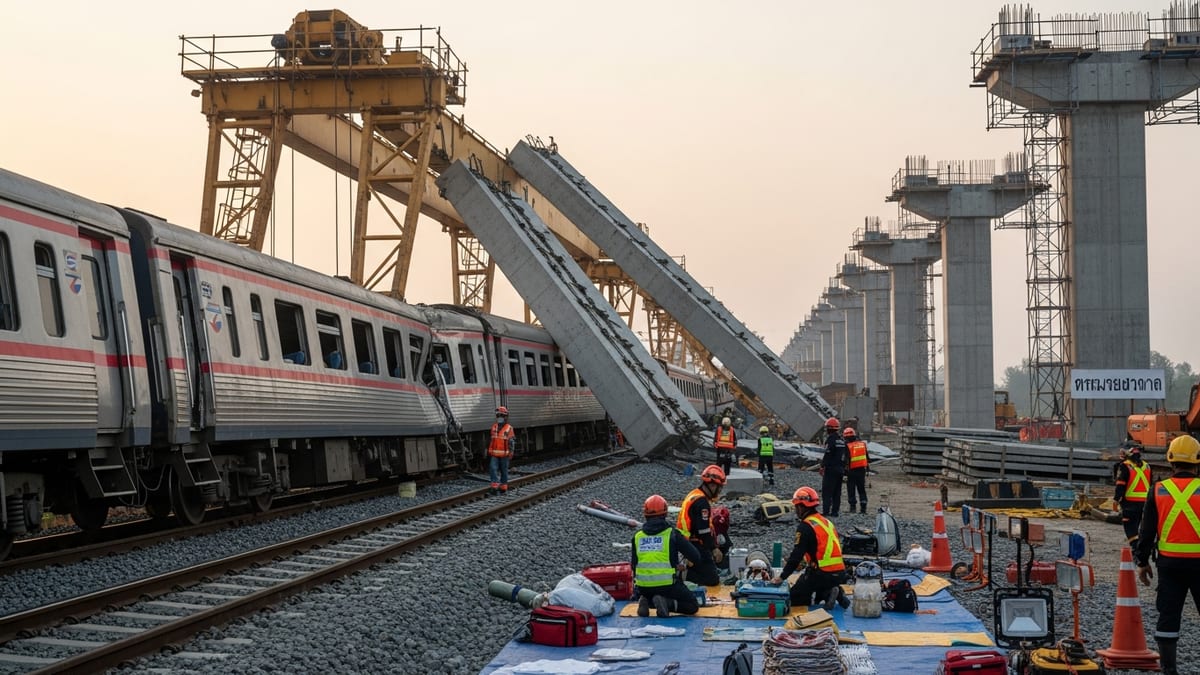
Derailment at depot chokes Airport Rail Link capacity
According to published coverage in Thai and English language media, a carriage on the Bangkok Airport Rail Link derailed at the entrance to its maintenance centre on the morning of July 22. The incident occurred off the main passenger line but at a critical junction used to bring trains in and out of service.
The derailed car blocked the track connection to the depot, leaving most of the fleet trapped inside. Publicly available reports indicate that only one trainset remained available on the main line linking Phaya Thai in central Bangkok with Suvarnabhumi International Airport.
With the rest of the trains unable to leave the depot, the Airport Rail Link operator shifted to a heavily reduced timetable. Trains that normally run every 10 to 15 minutes during peak hours dropped to intervals of around one hour, creating long queues at key stations and adding uncertainty for airport bound passengers.
Initial assessments from reports suggest that the derailment took place at low speed within the yard area, with no serious injuries reported. However, the location of the incident significantly complicated recovery, as specialized equipment was required to rerail the carriage and clear the throat of the depot.
Passengers urged to allow extra time and use road alternatives
Public advisories from transport operators and airport information channels urged travellers to build in substantial extra journey time if using the Airport Rail Link. Statements cited in local coverage recommended that passengers heading to Suvarnabhumi consider alternative modes such as taxis, ride hailing services, private cars or airport buses while rail capacity remained constrained.
Reports from Bangkok based outlets describe crowded platforms and packed carriages on the lone operating train, particularly at interchange hubs such as Phaya Thai and Makkasan. Some commuters reportedly opted to abandon rail travel altogether and shift to parallel road corridors like the motorway and elevated expressways.
Suvarnabhumi Airport remains one of Southeast Asia’s busiest hubs, handling tens of millions of passengers per year, and the Airport Rail Link is a key connector between the terminal and the city. The sudden loss of frequency therefore had an outsized impact on time sensitive airport trips, especially for outbound passengers working to flight check in deadlines.
Information made public by the rail operator emphasised that safety systems on the passenger line remained in place and that the main track continued to be inspected while the derailment site was isolated. Nonetheless, the disruption highlighted the limited redundancy in the current Airport Rail Link fleet and operations plan.
Recovery crews work toward same day reopening
Published reports indicate that engineering teams were dispatched quickly to the depot connection to stabilize and rerail the derailed carriage. Recovery work focused on lifting the car back onto the track, inspecting rail and switch components for damage and confirming that signalling and power equipment could resume normal operation.
The intention outlined in several news reports was to restore access to the depot and bring additional trains into service by later in the day. Officials described the situation as a temporary operational disruption rather than a long term infrastructure failure, and local media coverage suggested that full or near full service could resume once the derailed unit was cleared.
While no firm timeline was immediately available in early updates, some outlets reported expectations of normal headways returning by the evening travel period if inspections did not uncover wider damage. That outlook contributed to hopes that the disruption would be contained largely to a single day, though lingering knock on delays and residual crowding remained possible.
The episode also underscored the technical complexity of modern urban rail systems. Even a derailment confined to a yard or depot throat can have network wide consequences when it occurs at a strategic bottleneck, particularly on lines with relatively small fleets and no parallel tracks for bypassing affected sections.
Impact on Bangkok’s transport network and recent rail safety concerns
The Airport Rail Link is one piece of Bangkok’s dense and growing rail and road transport network, which includes BTS Skytrain, MRT, suburban rail and extensive highways. The derailment added new strain to a system that has faced several recent incidents and closures affecting public confidence and travel patterns.
Earlier this year, a serious collision between a freight train and a city bus near the Makkasan area, close to the Airport Rail Link corridor, led to casualties and a temporary closure of some rail operations in that district. That event prompted calls in Thai media for stronger safety management at rail level crossings and around urban rail infrastructure.
The latest derailment, although apparently less severe in human terms, reinforces scrutiny of rail maintenance practices, depot operations and contingency planning. Analysts quoted in prior discussions of Thai rail safety have pointed to the need for more robust monitoring of track conditions, upgraded signalling and better integration between different rail operating entities.
For Bangkok residents and visitors, the confluence of incidents serves as a reminder that even high frequency urban rail can be vulnerable to localized failures, and that alternative routes and backup plans remain important when moving through the capital, particularly to catch flights.
Future resilience and plans for airport rail upgrades
The disruption arrives at a time when Thailand is reevaluating its long term strategy for airport focused rail services. The existing Airport Rail Link has been in operation for more than a decade, and national planners have been pursuing an upgraded high speed line intended to connect Don Mueang, Suvarnabhumi and U Tapao airports using a shared corridor in parts of Bangkok.
Public documents and recent reporting on the three airport high speed project describe ambitions to significantly increase capacity and reduce journey times between key aviation gateways. However, that initiative has encountered delays and contractual challenges, and the conventional Airport Rail Link remains the primary rail connection to Suvarnabhumi for the foreseeable future.
Transport commentators in local coverage suggest that incidents such as the depot derailment could influence future investment priorities, including potential fleet expansions, additional passing loops or alternative depot access points to increase operational resilience. Some discussion has also focused on coordination between rail and bus operators to ensure rapid deployment of replacement services during disruptions.
For now, the focus remains on stabilizing operations, clearing the derailed carriage and restoring the familiar pattern of frequent trains between downtown Bangkok and Suvarnabhumi Airport. Travellers over the coming hours are likely to monitor information channels closely for confirmation that regular Airport Rail Link services have resumed.