


More news on this day
Air travel across Dubai and the wider Gulf is facing a new wave of disruption as intensified US-Iran attacks trigger missile alerts, airspace restrictions and fresh rounds of flight cancellations affecting Kuwait, Bahrain, Qatar and beyond.
Get the latest news straight to your inbox!
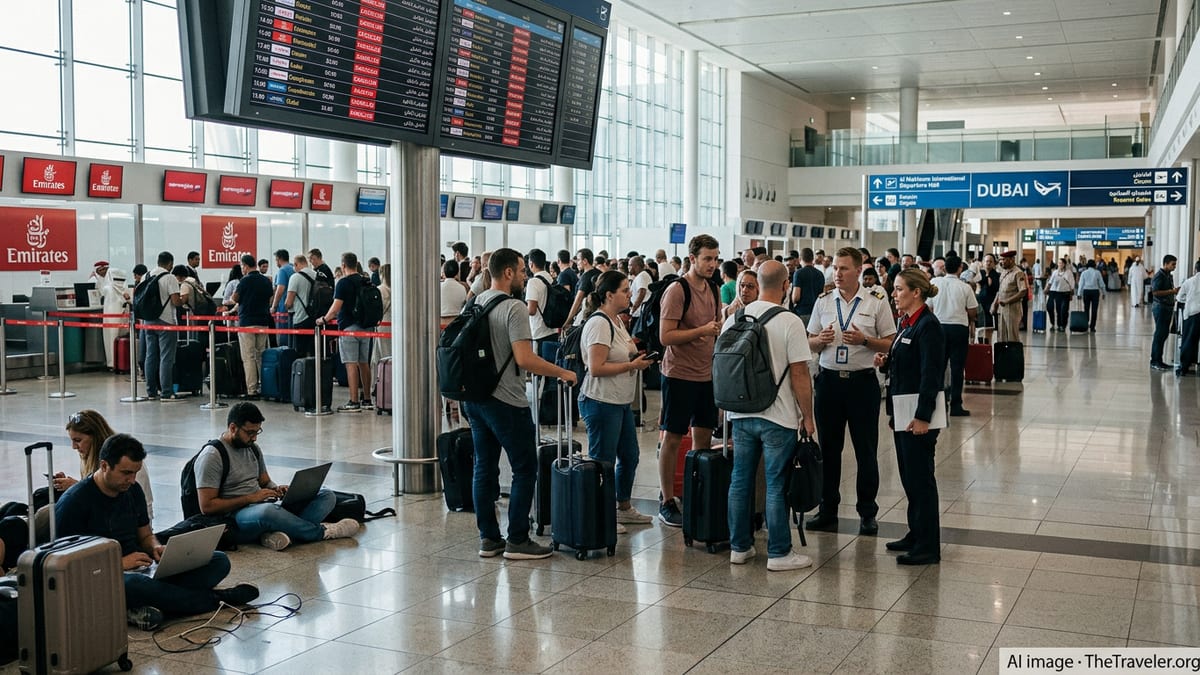
Targeted Gulf hubs see mounting cancellations
Published coverage from regional outlets shows that airlines based in the United Arab Emirates are again trimming schedules on key short-haul routes as the security situation deteriorates. Services linking Dubai and Abu Dhabi with Kuwait City, Bahrain and parts of Saudi Arabia have been particularly affected, with dozens of flights scrubbed since the start of the week.
Reports from Gulf-focused aviation trackers indicate that Emirates, Etihad Airways, flydubai and Air Arabia have all suspended or reduced services to Kuwait in recent days, following Iranian strikes that were reported near US-linked facilities in the country. Similar action has been taken on select Bahrain routes, where navigation systems and aviation infrastructure have repeatedly been targeted during the current escalation.
According to recent tallies carried by UAE newspapers, at least 16 flights operated by UAE carriers were cancelled on Monday alone, with rolling adjustments to schedules continuing into Tuesday and Wednesday. Airlines are advising passengers that operations remain subject to short-notice change as they respond to evolving risk assessments and airspace notices.
Despite the disruption, long-haul operations through Dubai International Airport and Abu Dhabi’s Zayed International Airport remain broadly intact. Most cancellations are concentrated on short regional sectors that cross or approach areas considered at higher risk of missile or drone activity.
International airlines reroute and avoid sensitive airspace
The impact of the US-Iran confrontation is extending beyond Gulf-based carriers, as European and Asian airlines modify routings to keep aircraft clear of Iranian and adjacent airspace. Travel industry reports describe a patchwork of detours around Iran, Iraq and parts of the Arabian Gulf, lengthening flight times on some Europe-to-Asia and Europe-to-Australia services.
Coverage from Middle East travel desks notes that several European flag carriers have adjusted or suspended certain rotations to Dubai, Riyadh, Doha and Beirut on specific days, citing operational and security considerations. Some airlines are maintaining service but flying longer, more southerly or northerly tracks to avoid airspace viewed as vulnerable.
Qatar Airways, which had previously curtailed services to Iran earlier in the conflict, continues to operate a reduced schedule in the region while relying on alternative routings where required. Other international operators have maintained links to Dubai and Abu Dhabi but are closely monitoring flight planning, with additional fuel uplifted in some cases to accommodate potential diversions.
The result for passengers is a more unpredictable operating environment. Flights that do operate may face longer block times and altered departure slots, even when they are not directly crossing active conflict zones, as air traffic control authorities manage constrained corridors in the wider Middle East.
US-Iran strikes drive fresh warnings for travelers
The renewed air campaign between the United States and Iran, including strikes on targets in Iran and attacks attributed to Iran or allied groups on sites in Bahrain, Qatar, Jordan and Kuwait, has prompted a series of updated advisories for those traveling through the region. Publicly available guidance from Western governments now explicitly warns of possible sudden airspace closures, diversions and cancellations affecting commercial flights.
In a recent worldwide caution, US authorities highlighted the risk of drone and missile activity around American interests in the Middle East, urging travelers to be prepared for last-minute changes to itineraries and to stay in close contact with airlines. Similar alerts from European governments advise passengers to allow extra time for security procedures and to keep flexible travel plans where possible.
Regional media in the Gulf also underline that civil aviation regulators and airlines may impose temporary restrictions at short notice when missile alerts sound or when military operations intensify. That can lead to aircraft being held on the ground, incoming flights diverted to secondary airports, or specific routes paused for hours or days while damage assessments and risk reviews are carried out.
Analysts tracking the conflict note that the heavy reliance of global networks on Gulf hubs such as Dubai, Doha and Abu Dhabi means that even localized disruptions can have knock-on effects for passengers traveling between Europe, Asia, Africa and Australia. Missed connections, rebookings and overnight delays are becoming more frequent for those with itineraries crossing the Gulf.
What passengers flying via Dubai and the Gulf should expect
Airlines across the region are encouraging customers transiting Dubai, Abu Dhabi and Doha to monitor flight status closely in the days ahead. Carrier websites and mobile apps are being updated regularly as schedules are trimmed, re-timed or restored in response to the shifting security picture and airspace availability.
Recent travel updates from major Gulf airlines emphasize that passengers whose flights are cancelled are typically being offered free rebooking on alternative dates or, in some cases, rerouting via different hubs. Refund options are also being made available on disrupted sectors, although processing times may vary given the volume of changes moving through reservation systems.
Travel industry guidance recommends that passengers consider building in longer connection times if routing through the Gulf while the confrontation continues. Those with tight layovers in Dubai or Abu Dhabi may be more exposed to missed onward flights if a regional sector is held on the ground or re-sequenced due to air traffic control restrictions.
Travelers are also being advised to ensure their contact details in airline bookings are current, so that they can receive real-time notifications about schedule changes, and to keep hotel and ground transport plans flexible. Travel insurance policies that cover war-related disruption remain limited, so passengers are urged to review policy wording carefully before departure.
Outlook for Middle East aviation as conflict grinds on
Industry observers say that, for now, Gulf aviation has avoided the full-scale shutdowns seen earlier in the 2026 Iran war, when multiple airspaces were closed and some hubs temporarily suspended operations. Airports in Dubai, Abu Dhabi and Doha are currently functioning, albeit with reduced frequencies on particular regional routes and a heightened focus on contingency planning.
However, airlines remain exposed to further shocks if the conflict spreads or if additional missile and drone attacks are directed at aviation infrastructure. Repeated strikes on navigation systems, radar installations or airport facilities in neighboring states could force carriers to divert traffic flows once again, raising costs and complicating crew and aircraft rotations.
Longer term, analysts expect continued pressure on yields and demand across Middle East networks if travelers opt to avoid the region while hostilities persist. The combination of higher fuel prices, extended routings and softer premium demand could weigh on carrier finances, particularly for airlines with heavy exposure to regional connecting traffic.
For now, the message from publicly available airline and government updates is that flights to and from Dubai and other Gulf hubs are still operating in significant numbers, but conditions remain fluid. Travelers planning journeys across the region in the coming days are being urged to stay informed, check for last-minute changes, and be prepared for an unpredictable ride through one of the world’s most strategically sensitive air corridors.