


Thailand attracts large numbers of foreigners as long-term residents, yet successful integration into Thai society remains uneven. This briefing evaluates how difficult it is for foreign residents to integrate, assessing language, social networks, work culture, and social attitudes to provide a practical, decision-grade “integration difficulty” picture for potential movers.
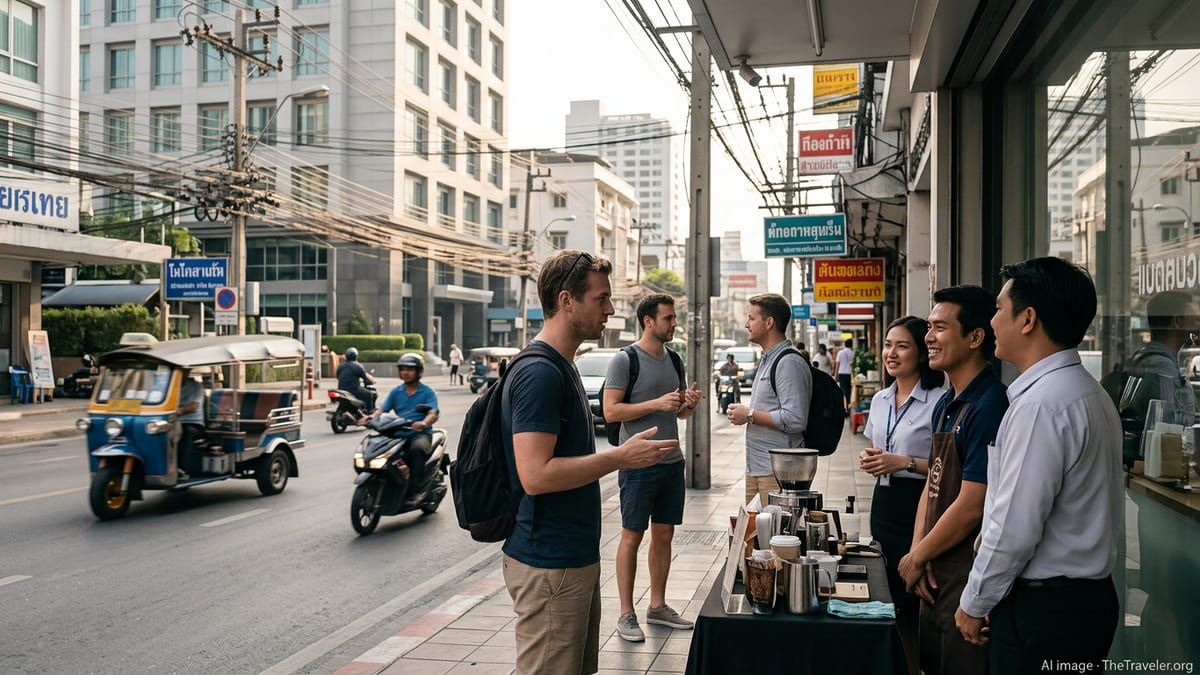
Defining Thailand’s Integration Difficulty Score
For relocation planning, “integration difficulty” refers to how hard it is for a typical foreign resident to build functional everyday life and meaningful local ties beyond an expatriate bubble. Core dimensions include language demands, access to mixed local–foreign social networks, inclusion in workplaces and institutions, and exposure to discrimination or structural barriers. Thailand scores mixed on these elements, combining high everyday friendliness with structural and linguistic hurdles that can significantly slow or cap deeper integration.
Survey-based evidence consistently ranks Thailand highly for “ease of settling in,” driven by local friendliness and a large existing foreigner presence. In major global expat rankings, Thailand often appears in the top quartile for categories such as local friendliness and finding friends, with particularly positive ratings from Western retirees and remote workers. At the same time, qualitative and academic studies highlight that many foreigners remain socially and linguistically peripheral, feeling accepted as long-term guests but not fully included as peers or insiders.
On a relative scale, Thailand’s overall integration difficulty could be described as moderate: significantly easier than in many non-English-speaking countries with stricter social norms, but more challenging than in countries where English is widely used in administration and everyday life. The balance of easy initial settlement and harder long-term integration is crucial for relocation decisions beyond the first 12 to 24 months.
Thai Language Barrier and Structural Monolingualism
Thai is a tonal language with its own script and grammar, and most foreigners report it as substantially harder to learn than major European languages. Tonal distinctions, unfamiliar consonant clusters, and a different writing system increase the time required to achieve operational proficiency. Recent educational research on foreigners in Thailand notes that listening comprehension in Thai is often the most difficult skill, with respondents rating listening difficulty at a high level on a five-point scale and identifying it as the main barrier to effective communication with locals in everyday settings.
From the Thai side, the national education and language policy treats Thai as the central medium of instruction and public life, with English formally positioned as a foreign language rather than a second language. Academic work on migrants in Bangkok describes an effectively monolingual environment in government services, mass media, and local community affairs, even in large cities. While some middle-class Thais and younger university-educated people speak conversational English, communication outside international business districts and tourist zones relies heavily on Thai.
This combination of a linguistically demanding local language and a predominantly monolingual public sphere structurally raises the integration difficulty score. Foreign residents who do not invest in Thai language study often report dependence on bilingual intermediaries in situations involving landlords, local officials, medical staff, schools, or neighborhood-level problem solving. For families, low parental Thai proficiency can limit engagement with teachers and local parents, increasing social distance.
On the positive side, Thai society generally responds supportively to foreigners who attempt to speak Thai, even at basic levels. Residents who achieve intermediate Thai often report a marked shift in how they are treated, moving from transactional interactions to more reciprocal relationships. However, reaching that point usually requires sustained study over several years, so from a policy perspective language remains a high-friction component of integration.
English Proficiency and the Expatriate Bubble Effect
English proficiency in Thailand is comparatively low by global standards. Recent international English proficiency indices place Thailand in the “very low” band, ranking it near the bottom globally and among the weaker performers in Asia. This has clear integration implications. In everyday contexts such as local markets, public offices, non-tourist healthcare facilities, and neighborhood associations, English is often insufficient to resolve anything beyond basic transactions.
Low English proficiency among the general population encourages the development of expatriate bubbles in major cities and resort areas. Foreign residents cluster around neighborhoods with international schools, English-friendly services, and existing foreigner communities. Within these bubbles, foreigners can live largely in English, using bilingual staff, digital platforms, and international service providers. While this sharply lowers initial settlement difficulty, it effectively postpones or even blocks deeper integration in Thai social structures.
Several recent sociolinguistic studies of migrants in Bangkok note that many long-term residents build their social life almost entirely around other foreigners and a small group of highly fluent Thai colleagues or partners. Participants described a sense of permanent foreigner status, with comments indicating that without Thai language fluency, they did not expect to be fully accepted as “one of us” by Thai peers. This pattern suggests that Thailand is welcoming at a surface level but offers limited pathways to full integration for those who remain English dependent.
For relocation planning, this dynamic means integration difficulty is highly bifurcated. Foreigners who are content to operate within international enclaves may perceive integration as relatively easy, while those seeking broad participation in local society without strong Thai language skills encounter substantial friction.
Social Networks, Friendships, and Community Integration
Social connectedness is a central component of any integration difficulty score. Large expat surveys consistently rate Thailand highly for local friendliness and ease of making friends, especially in the first year. Foreign residents commonly report frequent casual interactions, informal invitations to social meals, and supportive neighbors. This aligns with broader characterizations of Thai social norms that value politeness and hospitality in initial encounters.
However, research and long-term anecdotal evidence draw a distinction between friendliness and deep integration. Many foreign residents describe strong networks with other foreigners, moderate ties with Thai colleagues, and relatively few close Thai friendships beyond partners and in-laws. Language limitations, different communication styles, and unspoken social hierarchies contribute to this pattern. Academic work on migrants in Thailand notes that some foreigners internalize a stable identity as “permanent outsiders,” expecting cordial but bounded relationships with Thai communities.
In practice, three factors have the largest impact on social integration difficulty: workplace structure, family configuration, and location. Foreigners employed in mixed Thai–international workplaces where everyday collaboration is required report significantly better integration outcomes, as do those partnered with Thai nationals. Conversely, retirees or remote workers living in high-tourism zones with limited Thai-language interaction often remain peripheral to local communities, relying mainly on other expatriates for companionship and information.
Community organizations, religious institutions, and local volunteer initiatives can provide integration pathways, but participation typically requires at least basic Thai and familiarity with local norms. Foreign residents who actively seek out these settings tend to experience lower integration difficulty over time, while those who remain in commercially oriented expat circuits maintain higher difficulty levels.
Workplace Culture and Professional Integration
Professional integration in Thailand involves adapting to a relatively hierarchical work culture that places considerable weight on age, seniority, and formal status. Cross-cultural management research on Thailand highlights concepts such as respect for hierarchy and conflict avoidance, which can contrast sharply with more direct communication norms common among Western professionals. These differences do not prevent integration but add a layer of behavioral adaptation that raises the difficulty score for foreign employees and managers.
In many Thai organizations, key decisions are centralized and communicated indirectly, and public disagreement with superiors is avoided. Foreign professionals unaccustomed to these norms may initially perceive a lack of transparency or initiative, while Thai colleagues may view direct critique as confrontational. Successful integration typically requires learning how to give feedback diplomatically, read nonverbal signals, and build consensus informally before meetings. This learning curve can be steep without structured cultural orientation.
Language again plays a role. In domestic-facing firms and public institutions, Thai is usually the working language, and promotions into senior roles may be effectively closed to foreigners who cannot operate fully in Thai. In regional headquarters, multinational companies, and international schools, English is more common, and foreign professionals may integrate more readily into bilingual or multicultural teams. Nonetheless, even in these settings, Thai language skills and understanding of local etiquette strongly influence access to informal networks and decision-making circles.
Professional integration is therefore medium-difficulty. Foreigners can obtain employment and function effectively in many sectors, but achieving deeper inclusion, influence, and long-term career advancement often hinges on adaptation to Thai workplace culture and, ideally, at least intermediate Thai proficiency.
Social Attitudes, Discrimination and Legal Context
Social attitudes toward foreigners and minorities are a critical component of integration difficulty. Thailand does not have comprehensive, strongly enforced anti-discrimination legislation based specifically on race or nationality in the same way that some Western jurisdictions do. Research on racism and social hierarchies in Thailand points to persistent colorism and status-based distinctions, although these patterns are complex and often directed more at internal regional and class differences than at foreigners specifically.
For many Western or East Asian foreign residents, everyday treatment tends to be broadly positive, sometimes even privileged, especially in urban centers. However, there are recurring reports of differential pricing for foreigners in some attractions and services, as well as occasional stereotypes about foreigners’ behavior. At the other end of the spectrum, low-wage migrant workers from neighboring countries can face significantly higher levels of social stigma, police scrutiny, and labor exploitation, highlighting that integration conditions are highly stratified by nationality, occupation, and perceived socioeconomic status.
Thailand’s framework on gender and sexual diversity has made gradual progress, with legal measures that prohibit some forms of discrimination based on gender identity and sexual orientation, and with public opinion surveys indicating generally favorable attitudes toward LGBTQ people alongside persistent microaggressions and workplace challenges. For foreign LGBTQ residents, this environment usually feels more tolerant than hostile, but not fully equal in practice. Religious minorities generally enjoy constitutional freedom of worship, though certain regions and contexts may present localized tensions.
Overall, the discrimination component of Thailand’s integration difficulty score can be described as moderate and highly segmented. Middle-class foreigners in professional roles generally experience low direct hostility but some structural limits, while low-income migrants and visibly marginalized groups encounter more significant barriers. Prospective residents should assess integration conditions through the lens of their own identity, occupation, and socioeconomic position, rather than assuming a single uniform experience.
Regional and Demographic Variations in Integration Difficulty
Integration conditions in Thailand vary significantly by region and city size. Bangkok and major provincial centers such as Chiang Mai, Pattaya–Chonburi, and Phuket host large foreign communities, more English-capable service providers, and employers with experience managing international staff. In these areas, foreigners can usually navigate daily life with limited Thai and access at least partial support networks, although participation in local civic structures still favors those with Thai proficiency.
In smaller cities and rural areas, the pattern reverses. Foreign residents often report stronger neighborly support and curiosity from locals but encounter higher linguistic barriers and fewer international-standard services. Public offices, schools, and healthcare facilities may have minimal English capacity, raising the integration difficulty for foreigners who need to interact frequently with local institutions. Conversely, foreign residents who have Thai language skills or Thai family connections often achieve deep integration in these locations, with dense local social ties and participation in community events.
Demographics also matter. Younger foreign professionals and students may adapt more readily to informal socializing patterns and technology-based communication, while older retirees can find the language-learning burden and digital administration systems more challenging. Families with school-age children experience integration partly through the education system. Enrollment in local Thai schools tends to promote family-level integration into Thai social networks, while international schools provide a more globalized bubble with slower integration into the surrounding community.
These variations mean that Thailand’s national integration difficulty score masks wide local spreads. Integration is typically easier in large, internationally oriented urban centers for the first years, while long-term sociocultural integration may ultimately be deeper but harder-earned in smaller communities for those who invest in language and relationships.
The Takeaway
Thailand’s integration difficulty profile is characterized by an apparent paradox: the country is widely perceived as welcoming and is rated highly for ease of settling in, yet structural and linguistic factors make deep, long-term integration challenging for many foreign residents. The combination of a demanding local language, low national English proficiency, and a largely monolingual public sphere sets a relatively high bar for full participation in local institutions and networks.
For foreign residents willing to commit to Thai language learning, adapt to hierarchical workplace norms, and actively seek out mixed Thai–foreigner social settings, integration difficulty is moderate and tends to decrease significantly after the first several years. For those who remain English dependent and socially centered on expatriate enclaves, integration may feel easy at a superficial level but remains shallow, with persistent barriers to influence, belonging, and resilience in times of crisis.
Decision-makers evaluating relocation to Thailand should therefore distinguish clearly between “ease of arrival” and “depth of integration.” Thailand scores well on the former but only average on the latter, with marked differences by region, occupation, and resident profile. Incorporating structured language training, cross-cultural coaching, and realistic expectations into relocation plans can materially reduce the integration difficulty score and support more sustainable long-term stays.
FAQ
Q1. How hard is it to integrate into Thai society without speaking Thai?
Integration without Thai is feasible at a basic level in major cities and expat areas, but deeper participation in local communities, institutions, and workplaces remains limited, so long-term integration difficulty is significantly higher.
Q2. How long does it typically take for a foreign resident to feel integrated in Thailand?
Many residents report basic comfort within 6 to 12 months, but achieving stronger integration that includes Thai friendships, local institutional navigation, and workplace adaptation often requires 3 to 5 years, especially with language study.
Q3. Is discrimination against foreign residents a major barrier to integration?
For most middle-income professionals and retirees, overt discrimination is limited, but structural barriers, social hierarchies, and differential treatment in some services exist and can constrain full inclusion, particularly for lower-wage migrants.
Q4. Do children of foreign residents integrate more easily than adults?
Children enrolled in Thai or bilingual schools generally integrate faster through language acquisition and peer networks, while those in international schools often integrate into globalized communities more than into Thai society specifically.
Q5. Is workplace culture in Thailand difficult for foreign professionals to adapt to?
Adapting to hierarchical structures, indirect communication, and conflict avoidance can be challenging initially, but with cultural orientation and experience, many foreign professionals adjust and function effectively.
Q6. Are integration conditions very different outside Bangkok and major cities?
Yes, smaller cities and rural areas offer fewer English-language services and more reliance on Thai, which raises integration difficulty for non-Thai speakers but can enable deeper integration for those with language skills or local family ties.
Q7. How important is Thai language proficiency for career advancement?
In domestically oriented organizations and public-sector roles, Thai proficiency is often essential for advancement, while in multinational companies and international schools, progression is possible with English but still benefits from Thai skills.
Q8. Can a foreign resident realistically become fully accepted as part of the local community?
Some long-term residents with strong Thai, stable local relationships, and often Thai family connections achieve high levels of acceptance, but many remain viewed as long-term guests rather than full insiders.
Q9. Does Thailand’s large expat community make integration easier?
A large expat community simplifies initial settlement and provides support networks, but it can also encourage living in an expatriate bubble, which reduces incentives and opportunities to integrate deeply with Thai society.
Q10. What are the main steps a foreign resident can take to reduce integration difficulty?
Key steps include sustained Thai language study, active participation in mixed Thai–foreigner social spaces, engagement with local institutions, and structured preparation for Thai workplace norms and social hierarchies.