


Thailand and Mexico have emerged as two of the most prominent global hubs for digital nomads seeking lower living costs, warm climates, and established remote‑work communities. For relocation planning, however, it is essential to move beyond reputation and assess how the two countries compare specifically on cost structures, day‑to‑day lifestyle conditions for remote work, and realistic personal safety profiles in 2024–2026. This briefing provides a side‑by‑side, decision‑grade comparison to support digital nomads and remote professionals evaluating a medium‑term or long‑term move.
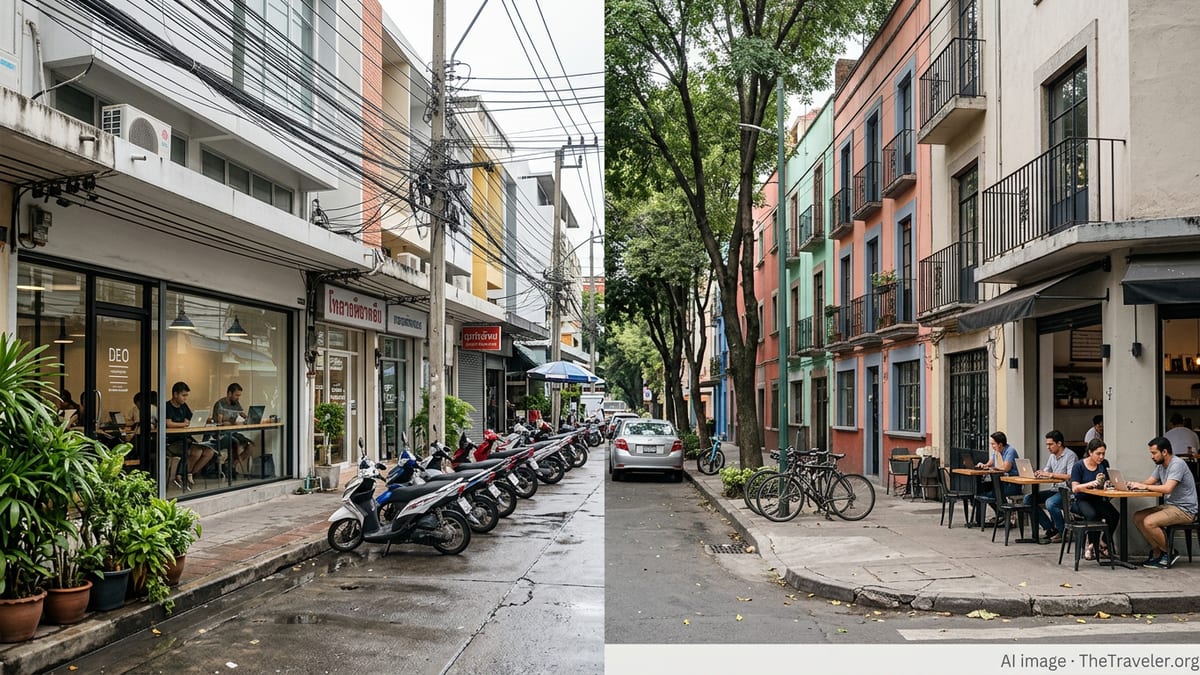
Overall Cost Profile for Digital Nomads
Digital nomads in both Thailand and Mexico generally experience a substantial discount relative to major North American or Western European cities, but Thailand tends to be moderately cheaper at comparable comfort levels. Aggregated digital nomad cost trackers in early 2026 show typical all‑in monthly budgets (including rent, utilities, food, transport, and incidentals) for a single nomad at roughly 850 to 1,100 USD in Chiang Mai and about 1,050 to 1,250 USD in Bangkok, compared with around 1,300 to 1,450 USD in Mexico City and approximately 1,250 to 1,350 USD in Playa del Carmen for broadly similar mid‑range lifestyles.
Global cost comparison platforms that benchmark cities on a consistent basket of goods indicate that large Mexican cities are usually between 20 and 40 percent more expensive than Thailand’s main digital nomad centers at like‑for‑like standards of living. Recent comparisons, for example, put total monthly living costs for a single person at around 950 to 1,000 USD in Bangkok versus roughly 1,300 USD in Mexico City, and place Mexico City about 40 percent more expensive than Chiang Mai. This broad differential is driven largely by higher housing and restaurant prices in Mexico, partially offset by somewhat lower public transport costs.
For relocation decisions, the key financial takeaway is that both countries allow remote workers to reduce costs dramatically compared with large Western cities, but Thailand remains the lower‑cost environment for most categories that matter to nomads, especially rent and everyday food. Mexico delivers better time‑zone alignment with North America but usually at a 15 to 35 percent higher cost base for a comparable lifestyle tier.
Housing and Daily Living Costs
Accommodation represents the single largest line item for most digital nomads, and here the Thailand–Mexico gap is especially visible. In early 2026, typical monthly rents for a modern studio or small one‑bedroom apartment in central Chiang Mai or a nomad‑favored part of Bangkok often fall in the 350 to 600 USD range, depending on building quality and amenities. In Mexico City’s central districts commonly used by remote workers, such as Roma, Condesa, and Polanco, equivalent units more commonly fall between roughly 650 and 1,000 USD per month, with beach destinations like Playa del Carmen or Puerto Vallarta also tending to price above Thai urban centers at similar quality levels.
Food and everyday consumption follow a similar pattern. In Thailand, reliance on inexpensive local prepared food can keep monthly grocery and dining costs for a single nomad in the vicinity of 250 to 350 USD without aggressive budgeting. In Mexico, broadly comparable patterns of eating out and supermarket purchases are more likely to produce a 350 to 450 USD monthly spend. Local restaurant meals and street‑food options remain inexpensive in both countries, but Thailand’s price floor is typically lower for basic dishes and non‑alcoholic beverages.
Transport costs differ in structure rather than in absolute burden. Thailand’s major cities rely heavily on motorbike taxis and ride‑hailing, which remain inexpensive per trip but can accumulate where public transit coverage is limited. Mexico City’s metro and bus system is substantially cheaper per ride than Bangkok’s modern rail lines, yet higher reliance on taxis and ride‑shares in beach or secondary Mexican cities can raise monthly mobility costs. For most digital nomads, transport is a relatively small share of total spending compared with rent and food, but Mexico’s higher housing costs still make its overall monthly budget heavier.
Work Environment, Connectivity, and Lifestyle Practicalities
Both Thailand and Mexico offer mature ecosystems for remote work, including coworking spaces, cafes with reliable connectivity, and neighborhoods where nomads cluster. For most mainstream cities in both countries, fixed broadband speeds are sufficient for video conferencing and cloud‑based work, with typical urban connections reported in the 50 to 100 Mbps range and above for mid‑tier packages. Thailand has a reputation among nomads for particularly inexpensive mobile data, with common prepaid packages in the range of 200 to 500 Thai baht per month for generous data allowances, which can be attractive for location‑independent workers using tethering or mobile hotspots.
From a daily work‑lifestyle standpoint, Thailand’s digital nomad centers such as Chiang Mai, Bangkok, and certain islands tend to concentrate coworking spaces, cafes, gyms, and laundry services within compact walkable or short‑ride areas. Mexico offers a similar clustering in districts like Roma and Condesa in Mexico City or central zones of Playa del Carmen, but distances and urban layouts often require more reliance on ride‑sharing or longer walks between amenities. For most nomads, both countries can support structured work routines, yet Thailand’s denser service concentration and lower incidental costs can make a car‑free lifestyle slightly easier to sustain.
Time‑zone alignment is the main non‑financial lifestyle differentiator. Thailand operates on Indochina Time, which is several hours ahead of Europe and many hours ahead of North America, pushing live calls with Western clients into late evenings. Mexico, by contrast, aligns closely with US and Canadian time zones, which can significantly reduce schedule strain for nomads with North American employers or clients. This time‑zone advantage is a crucial practical lifestyle factor for remote workers managing frequent synchronous communication.
Personal Safety and Crime Patterns
When comparing safety, the nature of risk differs more than the overall level of day‑to‑day danger experienced by digital nomads. Surveys and crime perception indices typically place Thailand as moderately safer than Mexico in terms of violent crime, particularly homicide and armed robbery, whereas Mexico continues to contend with high levels of organized crime and localized violence. However, most nomads live and work in specific urban districts that are substantially safer than national averages, and direct exposure to the most severe risks can remain low for those who follow conservative safety practices.
In Thailand, reported crime concerns for foreigners are more concentrated around non‑violent issues such as petty theft, bag snatching, scams, nightlife‑related incidents, and traffic accidents. Road safety is a notable and often underappreciated risk; Thailand regularly records high rates of road fatalities relative to its population, with motorbike crashes a particular threat. For digital nomads who use motorcycles as their primary transport, personal risk management (helmets, avoidance of night driving, and defensive riding) can have greater safety impact than general crime rates.
Mexico presents a more complex security landscape. National statistics and foreign travel advisories continue to highlight widespread violent crime in certain regions, including homicide, kidnapping, and carjacking. Yet the experience of digital nomads in urban enclaves like central Mexico City or established coastal towns is usually more benign, characterized mainly by concerns about pickpocketing, opportunistic theft, and occasional robberies rather than direct entanglement in organized crime. Many long‑term residents report feeling broadly secure in well‑policed, higher‑income neighborhoods while emphasizing the need for situational awareness and conservative routines, particularly at night.
Practically, this means that a typical digital nomad living in a central area of Bangkok or Chiang Mai may perceive an environment with relatively low violent crime but significant traffic and nightlife‑related risks, while one based in Mexico City’s central districts or major resort towns may perceive a higher ambient risk backdrop that is mitigated by sticking to safer areas, vetted accommodation, and cautious mobility choices. Relocation decisions should consider not only national crime data but also how specific neighborhoods and personal routines can shape real‑world exposure.
Safety in Day‑to‑Day Nomad Life
For digital nomads, the critical question is not only macro crime statistics but also how safe typical daily activities feel: commuting to coworking spaces, working from cafes, returning home at night, and using ATMs or mobile devices in public. In Thailand’s main nomad hubs, walking alone at night in busy areas is commonly reported as feeling relatively secure, with most issues concentrated around theft of unattended belongings, alcohol‑related conflicts, and occasional scams. Police presence tends to be visible in tourist and commercial districts, and petty crime levels, while present, are generally manageable with standard precautions.
In Mexico’s major nomad neighborhoods, the pattern is more nuanced. Many residents describe daily life as stable and uneventful, provided they avoid specific high‑risk zones and obviously risky behavior such as displaying valuables or walking alone late at night in quiet streets. However, there is a heightened emphasis on protective habits: choosing well‑lit routes, using registered taxis or ride‑hailing at night, and being cautious about ATM use. Reports of pickpocketing and phone theft are more frequent than in most Thai cities, and some nomads opt for additional security measures such as apartment buildings with controlled entry, guards, or private shuttles in certain regions.
Health and environmental safety factors also differ. Thailand’s urban centers, particularly Bangkok, can experience seasonal air quality issues that may affect those with respiratory sensitivities, and road safety risks are significant. Mexico faces its own air quality challenges in certain cities, along with local concerns about water quality in some regions that may push nomads toward filtered or bottled water. Neither country is free of environmental risk, but Thailand’s most acute non‑crime safety threat for nomads is often traffic, while Mexico’s is the uneven distribution of violent and property crime across regions.
Balancing Cost, Lifestyle Practicalities, and Safety
From a relocation‑planning perspective, Thailand generally offers a more favorable trade‑off between cost and perceived safety for many digital nomads. Lower rents, cheaper food, and broadly moderate crime rates in nomad‑heavy areas make it easier to maintain a comfortable lifestyle on modest remote‑work incomes. The main compromises are time‑zone misalignment with North America, potential air quality issues in some cities, and elevated road‑traffic risks, particularly for motorbike users.
Mexico, in contrast, provides stronger time‑zone compatibility with United States and Canadian employers, Spanish‑speaking immersion, and easier access to North America, but usually at higher monthly expenditure and with more complex security management. For nomads whose work requires frequent real‑time collaboration with North American teams, the productivity and work‑life balance benefits of Mexico’s time zones may outweigh the additional cost and security planning required. For those with primarily asynchronous work or clients based in Europe or Asia, Thailand’s cost advantage and generally lower violent‑crime exposure in nomad hubs may be more compelling.
Individual risk tolerance and lifestyle expectations are critical. Risk‑averse nomads prioritizing low violent‑crime environments, walkable lifestyles, and budget optimization are often better aligned with Thai cities such as Chiang Mai or central Bangkok. Nomads who value North American time‑zone alignment and proximity, are comfortable implementing more robust personal security routines, and have higher income levels to absorb cost differentials may find Mexico’s main hubs a better strategic fit.
The Takeaway
Evaluated strictly on cost, lifestyle practicalities for remote work, and safety, Thailand and Mexico each present strong yet distinct value propositions for digital nomads considering relocation in the mid‑2020s. Thailand tends to deliver lower baseline costs for housing and daily living, a dense ecosystem of nomad‑friendly services, and an everyday security environment in key hubs that most foreigners experience as relatively predictable, albeit with significant traffic‑related risk. Mexico generally offers better alignment with North American time zones and closer geographic ties to that region, but at higher cost and with a security environment that requires more active management, even in relatively safe urban enclaves.
Decision‑makers should approach the choice not as a question of which country is universally “better” but of which risk‑cost‑lifestyle balance aligns most closely with their income level, work schedule, and personal safety preferences. For some, maximizing savings and minimizing perceived violent‑crime risk will point toward Thailand. For others, maintaining normal working hours with North American teams and minimizing long‑haul travel time will justify Mexico’s higher costs and more complex security calculus. In both cases, on‑the‑ground neighborhood research and conservative safety practices remain essential components of a well‑planned relocation strategy.
FAQ
Q1. Which country is cheaper overall for a digital nomad, Thailand or Mexico?
Thailand is generally cheaper, especially for rent and food. Typical mid‑range monthly budgets in Thai hubs are often 15 to 35 percent lower than in comparable Mexican cities.
Q2. How much should a single digital nomad budget per month in Thailand?
A realistic mid‑range budget in cities like Chiang Mai or Bangkok is roughly 850 to 1,200 USD per month, depending on accommodation standards and discretionary spending.
Q3. How much should a single digital nomad budget per month in Mexico?
In areas popular with nomads such as central Mexico City or Playa del Carmen, a comparable lifestyle usually requires about 1,200 to 1,600 USD per month.
Q4. Where are rents typically lower: Thailand or Mexico?
Rents are typically lower in Thailand. Modern studios in central Thai cities often cost 350 to 600 USD, while equivalent apartments in Mexican hubs usually start around 650 USD and go higher.
Q5. Which country offers better internet and connectivity for remote work?
Both countries provide adequate internet for most remote work. Thailand stands out for very inexpensive mobile data, while Mexico’s fixed broadband in major cities is also generally strong.
Q6. Is Thailand safer than Mexico for digital nomads?
Crime perception and data often rate Thailand as safer, especially regarding violent crime. However, road accidents and motorbike safety are more prominent risks in Thailand.
Q7. How serious are safety concerns for digital nomads in Mexico?
Mexico faces higher national crime levels, but nomads in central urban districts mostly encounter risks like petty theft. Serious incidents are less common when conservative safety routines are followed.
Q8. Which country is better for working North American hours?
Mexico is generally better for North American hours, sharing similar time zones with the United States and Canada, which reduces the need for late‑night or early‑morning calls.
Q9. Are daily living conveniences comparable between Thailand and Mexico?
Yes. Both offer coworking spaces, cafes, and services in nomad districts. Thailand tends to have denser clusters of amenities at lower prices, while Mexico often requires slightly higher budgets.
Q10. How should safety influence my final choice between Thailand and Mexico?
Risk‑averse nomads often prioritize Thailand’s lower violent‑crime environment in key hubs, while those comfortable following stricter security routines may accept Mexico’s higher risk in exchange for time‑zone and proximity advantages.