


Mexico and Thailand are two of the most established hubs for digital nomads, offering lower operating costs than North America or Western Europe and strong remote work ecosystems. For location‑independent professionals deciding between them, the key questions typically concern total monthly cost, day‑to‑day workability, and realistic safety conditions rather than tourism appeal. This briefing compares Mexico and Thailand on those three dimensions to support evidence‑based relocation planning.
Benchmarking Cost of Living for Digital Nomads
Both Mexico and Thailand offer significantly lower living costs than major Western cities, but the structure of expenses differs and can materially affect a digital nomad’s budget. Aggregated nomad budget trackers and recent city‑level comparisons suggest that typical solo nomad costs in Mexico’s main hubs (Mexico City, Playa del Carmen, Oaxaca, Guadalajara) often fall in the range of about 1,300 to 1,800 US dollars per month for a comfortable but not extravagant lifestyle. This usually assumes a private studio or one‑bedroom apartment in a central or popular area, regular eating out, and some paid workspace use.
For Thailand, recent data for Bangkok and Chiang Mai indicate that many digital nomads can live comfortably in the range of roughly 1,000 to 1,600 US dollars per month, with Chiang Mai often 15 to 30 percent cheaper than Bangkok for equivalent comfort levels. Multiple recent guides and on‑the‑ground breakdowns continue to report that Chiang Mai remains one of the lowest‑cost established remote work hubs, where a solo nomad can still achieve a comfortable standard of living in the 1,000 to 1,400 US dollar band, depending on housing standards and personal spending patterns.
Overall, Thailand retains a modest cost advantage at the lower‑to‑mid range of budgets, particularly outside Bangkok. Mexico’s key hubs are still cost‑effective relative to Western cities but are somewhat more exposed to price inflation and the premium effect of growing nomad and expat demand, especially in central districts of Mexico City and popular Caribbean coast towns.
Detailed Monthly Budget Structure: Mexico vs Thailand
Headline monthly figures can obscure how costs are distributed. The table below summarizes typical cost ranges for a solo digital nomad in major hubs of each country as of early 2026, based on recent nomad budget reports, rental platforms, and coworking price lists. These are indicative bands, not guarantees.
| Expense category | Mexico (CDMX / beach towns) | Thailand (Bangkok / Chiang Mai) |
|---|---|---|
| Private rental (studio–1BR) | 700–1,200 USD in central or nomad‑dense neighborhoods, often higher in beach enclaves | 450–900 USD, with Bangkok toward the upper range and Chiang Mai toward the lower |
| Utilities & mobile data | 70–130 USD (electricity, gas, water, high‑speed internet, SIM) | 60–110 USD, with higher electricity bills for strong air conditioning in Bangkok |
| Food (groceries + eating out) | 300–550 USD depending on reliance on restaurants and imported goods | 250–450 USD, leveraging abundant low‑cost local food options |
| Coworking / cafes | 120–250 USD for a coworking membership in major hubs | 80–200 USD, typically lower in Chiang Mai than Bangkok |
| Local transport | 80–150 USD, largely rideshare and metro/bus in big cities | 60–140 USD, mix of BTS/MRT (Bangkok), songthaews, scooter rental or rideshare |
| Discretionary (fitness, entertainment, short trips) | 150–300 USD | 150–300 USD |
In practice, a cost‑conscious nomad sharing accommodation or renting outside premium districts can compress these ranges in both countries. However, Mexico’s most popular enclaves, particularly in Mexico City’s central districts and on the Caribbean coast, increasingly command rents at or above the top ends of the ranges shown. Thailand’s secondary cities and Chiang Mai in particular continue to offer more headroom for keeping rent and food costs low without heavily compromising comfort.
For nomads earning in strong currencies, both destinations remain financially viable. Thailand generally offers better cost efficiency for those targeting sub‑1,500 US dollar monthly budgets, while Mexico becomes more competitive for those comfortable spending closer to 1,800 to 2,500 US dollars per month in exchange for larger or more premium housing, greater restaurant reliance, and higher domestic travel costs.
Workday Lifestyle and Infrastructure for Remote Work
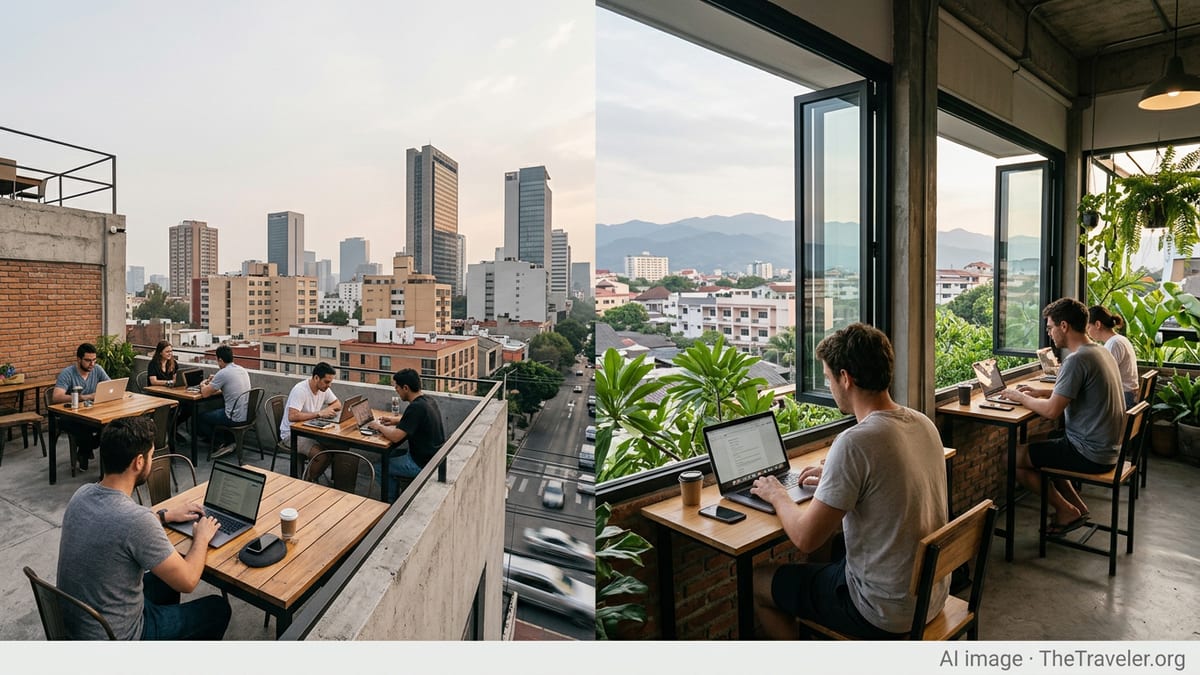
Workday lifestyle for digital nomads revolves around internet reliability, access to suitable workspaces, noise levels, climate comfort, and daily logistics. Both Mexico and Thailand now host dense coworking networks, laptop‑friendly cafés, and communities of remote professionals, though the feel of day‑to‑day work differs.
In Mexico’s key hubs, residential internet speeds of 50 to 200 Mbps have become standard in mid‑range and modern apartments in central districts, with frequent fibre offerings. Power stability is generally good in major cities, though temporary outages can occur and may be more common in smaller towns or during storms. Coworking memberships in Mexico City, Guadalajara, and coastal hubs are often priced in the mid‑range globally, and many spaces target hybrid remote workers with solid ergonomic setups, phone booths, and corporate‑style infrastructure.
Thailand’s urban and nomad hubs similarly provide reliable high‑speed connections, with widely reported ranges of 100 to 500 Mbps in coworking spaces and modern serviced apartments. Coworking memberships tend to be cheaper on average than in equivalent Mexican cities, especially in Chiang Mai, and the density of laptop‑friendly cafés with strong Wi‑Fi is high. Frequent air conditioning, particularly in Bangkok, provides climate comfort at the expense of higher electricity usage. In practice, nomads in both countries report minimal connectivity barriers for typical online work, though Thailand may offer a slight advantage in price‑to‑quality ratio for workspaces in nomad‑dense neighborhoods.
Daily routines also respond to climate. Several Mexican hubs, including Mexico City and some highland cities, offer mild climates conducive to walking commutes, while many coastal towns have hotter, more humid conditions that push people toward midday indoor work and evening activity. In Thailand, heat and humidity are pervasive for much of the year, especially in Bangkok, which encourages reliance on air‑conditioned spaces and can shape commuting choices and time spent outdoors. For remote workers sensitive to heat, this is a meaningful lifestyle variable when selecting neighborhoods and housing types.
Safety Environment: National Trends vs Nomad Hubs
Safety is the area where headline statistics can be most misleading for digital nomads. On national homicide metrics, Mexico remains a higher‑risk country than Thailand, although Mexico’s authorities reported a decline in the national homicide rate to roughly the high‑teens per 100,000 inhabitants in 2025. This remains several times higher than typical Western European levels and substantially above Thailand’s rates, which international crime datasets generally place in the very low single digits per 100,000 inhabitants in recent years.
However, violent crime in Mexico is highly concentrated by state and municipality, with certain regions affected by organized crime and others experiencing significantly lower rates. The practical risk profile for a nomad living in central districts of Mexico City, Mérida, or selected middle‑class neighborhoods in other large cities is substantially different from that of residents in conflict‑affected areas. Nonetheless, high‑impact incidents, including targeted violence and bystander exposure, occur in urban environments and along some intercity routes, and opportunistic crime such as robbery and mugging is a realistic risk in many Mexican cities.
In Thailand, severe violent crime against foreigners is statistically rare in most major destinations relative to Mexico and many other emerging‑market hubs. Petty theft, scams, and occasional incidents associated with nightlife areas are more typical concerns. Regulatory enforcement around firearms, as well as the lower prevalence of organized criminal violence in day‑to‑day urban life, contributes to an overall lower baseline of lethal violence in Thai cities compared with Mexican ones. That said, serious isolated incidents do occasionally occur, and digital nomads should still apply routine urban safety practices.
For decision‑making, the key distinction is not that one destination is “safe” and the other “unsafe,” but that Mexico requires more granular, neighborhood‑level risk assessment and stricter behavioral precautions, while Thailand offers a lower‑risk baseline in most urban areas used by nomads. Risk tolerance, preferred lifestyle, and willingness to adopt conservative security routines therefore play a central role in choosing between the two.
Local Crime Patterns and Everyday Security Practices
Digital nomads are not exposed evenly within each country. In Mexico, international remote workers tend to concentrate in specific districts such as central neighborhoods of Mexico City, well‑known areas of Guadalajara, and tourism‑oriented coastal zones. Within these enclaves, visible policing, private security, and a constant flow of visitors often reduce but do not eliminate exposure to robberies, pickpocketing, and opportunistic crime. Moving outside these enclaves, especially at night, usually increases risk substantially, and local residents are often more exposed to systemic violence than short‑term foreign workers.
Common safety practices for Mexico include avoiding public displays of wealth, using registered taxis or reputable rideshare apps, minimizing solo late‑night street movement, and being cautious at ATMs and in crowded public transport. Some nomads also factor in building security features, such as controlled access, front‑desk staff, and secure parking or rideshare pickup points, as part of their housing selection criteria.
In Thailand, digital nomads cluster in central Bangkok neighborhoods with strong transport access and in Chiang Mai’s central and western districts. Everyday risks concentrate more around road safety, scams, and petty theft than violent crime. Scooter accidents, in particular, represent a non‑trivial risk for remote workers who adopt motorbikes without prior experience or appropriate protective equipment. Alcohol‑related incidents and late‑night disputes in entertainment areas can also affect personal security, though these risks are more behavior‑dependent than structural.
Standard precautions in Thailand focus on traffic safety, careful scooter use, basic property protection, and awareness of nightlife areas. Many nomads feel comfortable walking in central areas after dark in both Bangkok and Chiang Mai, though habits vary. Overall, Thailand’s everyday risk profile is typically perceived as more predictable and manageable than that of many large Mexican cities, especially for those who maintain moderate nightlife exposure and avoid high‑risk behaviors.
Perceived Safety, Community, and Psychological Comfort
Beyond measurable crime statistics, perceived safety and psychological comfort strongly influence digital nomad satisfaction. Qualitative reports from long‑term nomads indicate that Thailand’s hubs, particularly Chiang Mai, often feel orderly, predictable, and low‑tension during daily routines. This is reinforced by relatively low rates of overt street crime in central districts and by a public environment that, while busy, is not generally associated with visible organized crime activity.
In Mexico, perceptions are more polarized. Many nomads report feeling secure and at ease within specific city districts and social circles, especially in gentrifying neighborhoods with substantial expat and professional populations. At the same time, the visibility of armed security personnel, media coverage of violence, and local conversations about crime can create a constant background awareness of risk. For some, this becomes an acceptable trade‑off for the benefits of living in Mexico’s urban centers. For others, it leads to low‑grade anxiety and reconsideration of long‑term stays.
Community density also matters. Both Mexico and Thailand host large, established nomad and expat communities offering peer advice on safe neighborhoods, trusted landlords, and local security practices. Thailand’s longer history as a budget‑nomad destination, especially in Chiang Mai, has produced a particularly structured ecosystem of meetups, coworking communities, and informal support networks. Mexico’s nomad communities have expanded rapidly in recent years and now offer comparable support in key hubs, although the learning curve around safety can be steeper for new arrivals unfamiliar with Latin American urban dynamics.
From a relocation‑planning standpoint, individuals who are highly sensitive to background security risk or who prefer to walk extensively and use public transport at all hours may find Thailand, especially Chiang Mai, more psychologically comfortable. Those comfortable with a more complex security environment and motivated by Mexico’s urban scale, time zone alignment with North America, and language interests may consider the trade‑offs acceptable, provided they adopt robust precautions.
The Takeaway
Evaluating Mexico versus Thailand for digital nomads on cost, lifestyle, and safety yields a nuanced picture rather than a simple winner. On cost, Thailand generally offers a modest but clear advantage for budget‑conscious nomads, particularly in Chiang Mai and secondary cities, where total monthly spending for a comfortable lifestyle often undercuts equivalently comfortable setups in Mexico’s most popular hubs. Mexico remains affordable compared with Western benchmarks, but rising rents and demand in nomad‑dense districts have eroded some of its earlier cost advantage.
On workday lifestyle, both countries provide sufficiently robust infrastructure for remote work, including reliable high‑speed internet, ample coworking spaces, and laptop‑friendly cafés. Thailand tends to deliver better value for money on workspace and everyday food costs, while Mexico offers larger big‑city environments with diverse urban lifestyles and strong time zone compatibility for those working with North American clients or employers.
On safety, the contrast is starker. Thailand’s major nomad hubs operate within a relatively low‑crime environment by global urban standards, with main risks centering on traffic, nightlife, and petty theft. Mexico combines pockets of relatively safe, affluent districts used by many nomads with a national context of higher violent crime and organized criminal activity. This requires careful neighborhood selection, consistent security practices, and a higher tolerance for background risk.
For digital nomads whose primary objective is minimizing cost and structural safety risk while maintaining an efficient work environment, Thailand is generally the more straightforward choice. Mexico becomes attractive for those prioritizing proximity to North America, Spanish‑speaking environments, and large‑city dynamics, and who are prepared to manage a more complex security environment and slightly higher average costs in exchange.
FAQ
Q1. Which country is generally cheaper for digital nomads, Mexico or Thailand?
Thailand is typically cheaper for a similar lifestyle, especially in Chiang Mai and secondary cities, where rent and food costs undercut equivalent neighborhoods in Mexico’s main hubs.
Q2. How much should a solo digital nomad budget per month in Mexico?
A realistic comfortable budget in major Mexican hubs is often around 1,300 to 1,800 US dollars per month, depending on rent, dining habits, and workspace choices.
Q3. How much should a solo digital nomad budget per month in Thailand?
In Thailand, many nomads live comfortably on roughly 1,000 to 1,600 US dollars per month, with Bangkok at the higher end and Chiang Mai at the lower end.
Q4. Is day‑to‑day safety significantly different between Mexico and Thailand?
Yes. Thailand’s main nomad hubs generally have lower levels of violent crime, while Mexico requires stricter precautions and careful neighborhood selection due to higher national crime rates.
Q5. Are coworking spaces more affordable in Mexico or Thailand?
Coworking spaces tend to be more affordable in Thailand, particularly in Chiang Mai, whereas similar quality spaces in Mexico City or popular beach towns usually cost more.
Q6. Which country offers more stable internet for remote work?
Both countries provide broadly reliable high‑speed internet in major hubs, and connectivity alone is rarely a deciding factor between Mexico and Thailand for digital nomads.
Q7. How does traffic and transport affect lifestyle in Mexico compared to Thailand?
Mexico City and Bangkok both have congestion and require planning commutes; Thailand adds extensive scooter use, which lowers costs but introduces additional road safety risk.
Q8. Is petty crime a major issue for digital nomads in either country?
Petty crime exists in both destinations. In Mexico it coexists with higher levels of serious crime, while in Thailand issues are more often limited to theft, scams, and nightlife incidents.
Q9. Which destination is better for highly cost‑sensitive nomads?
Thailand is usually preferable for highly cost‑sensitive nomads aiming for sub‑1,500 US dollar monthly budgets without heavily compromising comfort or workspace quality.
Q10. How important is neighborhood choice for safety in Mexico and Thailand?
Neighborhood choice is critical in Mexico, where risk varies sharply by area. In Thailand, neighborhood choice still matters but usually affects convenience and noise more than baseline personal safety.