


More news on this day
Storms on both US coasts disrupted Thanksgiving travel on Thursday, November 26, 2026, triggering hundreds of flight cancellations, thousands of delays and expanded fee waivers from major airlines during one of the busiest holiday periods in recent years.
Get the latest news straight to your inbox!
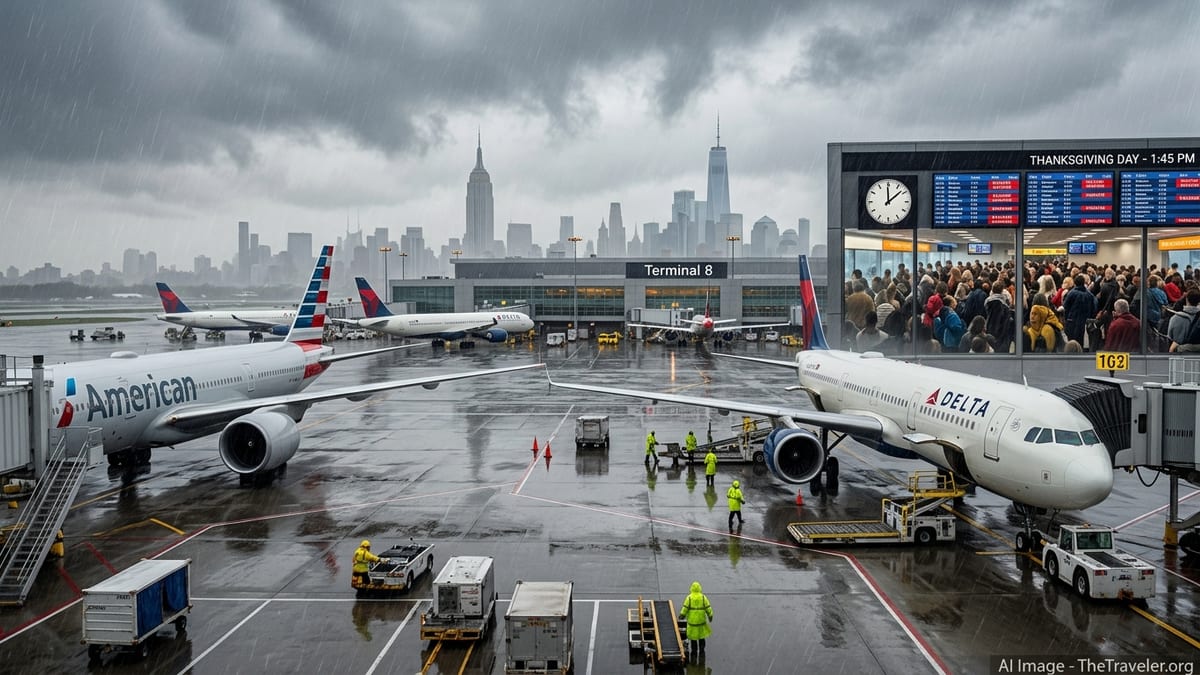
Coastal nor’easter hits during near‑record Thanksgiving travel
The main disruption for air travelers came from a strong nor’easter that moved up the Eastern Seaboard on Thanksgiving Day, bringing heavy rain, coastal flooding and gusty winds from the Carolinas into New England. Federal forecasts had already warned of 1 to 3 inches of rain in many Mid‑Atlantic and Northeast metro areas, with locally higher totals and multiple rounds of tidal flooding along exposed shorelines on Thursday, November 26, 2026.
States along the coast, including New Jersey, entered the holiday under formal emergency preparations. In New Jersey, a statewide state of emergency took effect on Wednesday evening, November 25, ahead of what officials described as potentially “moderate to major” coastal flooding and high winds expected on Thanksgiving Day. Emergency operations briefings from federal and state agencies highlighted a risk of inundated roads in low‑lying neighborhoods, hazardous surf and scattered infrastructure damage, particularly around Thursday’s high‑tide cycles.
Nationally, the storm intersected with what federal transportation officials had projected to be the heaviest Thanksgiving flight schedule since before the 2008 financial crisis, with more than 400,000 commercial departures expected between November 22 and 30. Independent analyses drawing on Transportation Security Administration data suggested that around 6 million people were likely to fly for the holiday and that roughly 18 million passengers would pass through airport checkpoints during the core travel window, close to but marginally below the 2025 record. In practice, the result on Thanksgiving was a network operating near capacity but with slightly more slack than in 2025, which helped limit the scale of knock‑on disruption when storms hit key hubs.
Flight cancellations concentrated in storm‑exposed hubs
Data from multiple flight‑tracking platforms on Thursday pointed to several hundred cancellations and well over a thousand delays within, into or out of the United States. One widely cited tally reported about 400 Thanksgiving‑day cancellations at US airports and more than 2,200 delays, while a separate disruption analysis that used a narrower definition of “disrupted” flights counted 396 cancellations and around 1,050 delays for November 26. Although methodologies differ, all of the major trackers showed a sharp spike in disruption relative to a typical late‑November Thursday.
Impacts were not evenly distributed. Airports directly under the heaviest rain bands or in areas with the strongest crosswinds were among the hardest hit. Data snapshots during the afternoon and evening of November 26 showed elevated cancellation and delay rates at some Mid‑Atlantic hubs, notably in the Baltimore–Washington region, with ripple effects at New York City’s three main airports and at Boston Logan. In these locations, low clouds, reduced visibility and wet runways forced controllers to slow arrival and departure rates, sometimes imposing brief ground stops for specific carriers or route flows while intense bands of weather passed over the field.
Even where formal nationwide ground delay programs did not stay in place for long, the need to space aircraft further apart in heavy precipitation and gusty winds translated into longer taxi queues, holding patterns near busy hubs and late‑arriving aircraft for subsequent legs. Since most US carriers run rolling daily schedules, a delay or cancellation early on Thanksgiving could affect several downstream flights from the same aircraft, including late‑evening departures and early‑morning services on Friday, November 27.
West Coast atmospheric river brings surf, flooding and access issues
At the same time, a separate Pacific system and associated atmospheric river brought hazardous conditions to sections of the California and Pacific Northwest coasts. Forecast centers had warned in the days before Thanksgiving that a plume of deep subtropical moisture would push into the region between Thursday and Saturday, driving heavy rain, elevated surf and coastal flooding in parts of Northern and Central California and the Oregon coast.
By midweek, tide gauges around the San Francisco Bay Area were already near monthly records, and the National Weather Service highlighted the risk that 20‑ to 25‑foot waves in Northern California could overtopping sea walls or break onto sections of coastal highways. Video from Pacifica, south of San Francisco, circulated widely after a large wave tore down part of the town’s pier. Further south, sections of the San Diego coastal rail corridor were temporarily shut as waves and high water threatened trackside infrastructure, illustrating how the same ocean conditions affecting airport access roads also disrupted parallel long‑distance rail and regional transit links.
For aviation, the West Coast storms created more localized operational constraints than the East Coast nor’easter. San Francisco International and nearby Bay Area airports reported periods of low ceilings and gusty winds that required specific arrival and departure patterns, reducing the number of movements possible per hour. Airports around Seattle and Portland monitored wind shear and crosswind risks as fronts came ashore. As of Friday, November 27, there were no indications of major, prolonged airport closures directly attributable to the atmospheric river, but passengers still faced scattered delays and sometimes challenging conditions travelling to and from coastal terminals during high‑tide and heavy‑surf windows.
Major US airlines widen Thanksgiving weather waivers
In advance of the storms and as delays mounted, the largest US carriers activated or expanded weather waivers designed to give passengers more flexibility to adjust plans. American Airlines, Delta Air Lines, United Airlines and Southwest Airlines all published advisories in the days before Thanksgiving that applied to passengers booked to travel on Thursday, November 26, primarily through airports from Washington, DC, to Boston, with some waivers also covering Florida, the Southeast and select inland cities tied to separate weather systems.
Publicly posted summaries show that American’s Northeast waiver allowed eligible customers whose itineraries touched specified airports on November 26 to move their trips without a change fee, typically into dates between November 23 and 29, as long as the same origin and destination were kept and the same cabin of service was used. For passengers who could switch to flights within the waiver period while retaining their routing, American in many cases also waived fare differences, although the airline cautioned that higher fares could still apply if equivalent booking classes were no longer available. A separate alert covered Miami and neighboring Southeast airports for November 25, after severe thunderstorms there caused long delays and early cancellations before the main coastal storm reached the Mid‑Atlantic.
United’s Thanksgiving coastal storm waiver applied to travel on Thursday through a list of East Coast airports stretching from the Washington area to Boston. Under that policy, passengers ticketed on United or United Express services to, from or through the affected airports on November 26 could change to flights departing between November 25 and 28 without paying either a change fee or a fare difference, so long as they kept the same city pairs and cabin. United also dealt during the same week with residual effects from an earlier November technology outage that had briefly prompted the Federal Aviation Administration to halt flights bound for Hartsfield‑Jackson Atlanta International Airport while the carrier restored an internal calculation system, illustrating how operational disruptions not tied directly to weather can narrow margins for recovery when storms arrive later in the month.
Delta Air Lines and Southwest Airlines set out similar frameworks tailored to their networks. Delta’s advisory for the Thanksgiving coastal storm covered a roster of East Coast airports, including Boston and New York, and allowed passengers to shift travel within the published window without a change fee; in many cases, fare differences were waived when customers rebooked into the same cabin for flights on or before November 28. Southwest, which does not charge change fees in its fare structure, let travelers scheduled to fly through about half a dozen East Coast airports on November 26 rebook into other flights between the same cities within 14 days of the original date without paying a higher fare, subject to availability in the same fare class.
Other carriers took a more targeted approach. JetBlue, which has large operations in New York and Boston, had not yet posted a broad East Coast storm waiver on its public advisories page by late November 25, according to several contemporaneous checks, but did issue narrower travel alerts for specific airports as conditions evolved. Regional and ultra‑low‑cost carriers also released individual weather notices tied to their own route networks. Across all airlines, passengers whose flights were canceled outright by the carrier remained entitled under long‑standing US rules to a refund of the unused portion of their ticket if they chose not to travel, irrespective of the cause of the cancellation, while hotels, meal vouchers and other forms of assistance generally remained discretionary when weather was the main driver of disruption.
Recovery on Friday and what travelers should monitor next
By the morning of Friday, November 27, air‑traffic dashboards showed a noticeably improved picture compared with Thanksgiving Day. National operations reports from the Federal Aviation Administration and industry trackers indicated fewer than 100 cancellations and several hundred delays across US airports early in the day, with no broad nationwide ground stops or long‑running ground delay programs in place at the largest hubs. As the day progressed, those numbers rose, consistent with a busy post‑holiday Friday, but remained below the peaks seen during the height of the nor’easter.
This relatively quick stabilization reflected both the short‑lived nature of the most intense weather and the pre‑emptive steps taken by airlines, airports and air‑traffic managers. Many of the worst issues on Thursday were linked to temporarily reduced arrival and departure rates while intense rain and wind were overhead, rather than to long‑term damage to infrastructure, runways or navigational aids. Once the coastal low tracked offshore and winds eased on Thursday night and early Friday, controllers were able to relax some of the strictest spacing measures and airlines could reposition aircraft and crews that had ended the holiday stranded out of place.
Even with improving conditions, travelers heading home over the rest of the Thanksgiving period face lingering risks. Airlines are still working through a backlog of passengers who were rebooked from Thursday’s canceled or heavily delayed flights, particularly at hubs that saw the highest disruption rates. That backlog overlaps with strong demand on Sunday, November 29, which forecasters expect to be the single busiest air‑travel day of the 2026 Thanksgiving window. As a result, flights that appear on time in airline apps may still have very limited options for same‑day changes or standby travel, especially on Sunday afternoon and evening departures from major East Coast and transcontinental hubs.
Passengers due to fly during the final holiday weekend are being urged by airlines and regulators to keep a close watch on three elements. First, travelers should check both the status of their own flight and the status of the inbound aircraft scheduled to operate it, since delays often propagate along an aircraft’s full day of legs. Second, it is important to re‑check the latest travel advisories and waivers on the airline’s official channels to see whether an itinerary qualifies for a free date or time change; acting before flights fill can open up options on less busy days or earlier departures. Third, travelers whose flights are significantly delayed or canceled should retain documentation of notifications, boarding passes and any additional out‑of‑pocket costs, then review the conditions of carriage and customer service commitments that apply to their ticket and, where relevant, the consumer‑protection rules of the country in which their trip begins or ends.
Looking into the final weekend of November, meteorological outlooks point to a gradually improving pattern for much of the East Coast, with lingering showers and gusty winds in parts of New England, the Mid‑Atlantic and around the Great Lakes. In the West, additional Pacific systems are forecast to bring more heavy rain and mountain snow to sections of Washington, Oregon and the northern Rockies. These follow‑on disturbances are not currently expected to match the Thanksgiving Day nor’easter in terms of nationwide air‑travel impact, but they remain capable of triggering localized delays and scattered cancellations if visibility, ceilings or crosswinds temporarily fall outside preferred operating limits at key airports. For travelers, that means continued benefits in checking live flight information and updated advisories before leaving for the airport, especially when connecting through storm‑sensitive coastal hubs.