


More news on this day
Flight disruption across the United States is easing two days after a powerful Thanksgiving nor’easter brought heavy rain, strong coastal winds and pockets of flooding to the Eastern Seaboard on Thursday 26 November 2026, with live tracking data on Saturday 28 November indicating that most major airports are now operating close to normal holiday capacity even as a handful of East Coast hubs continue to clear residual delays.
Get the latest news straight to your inbox!
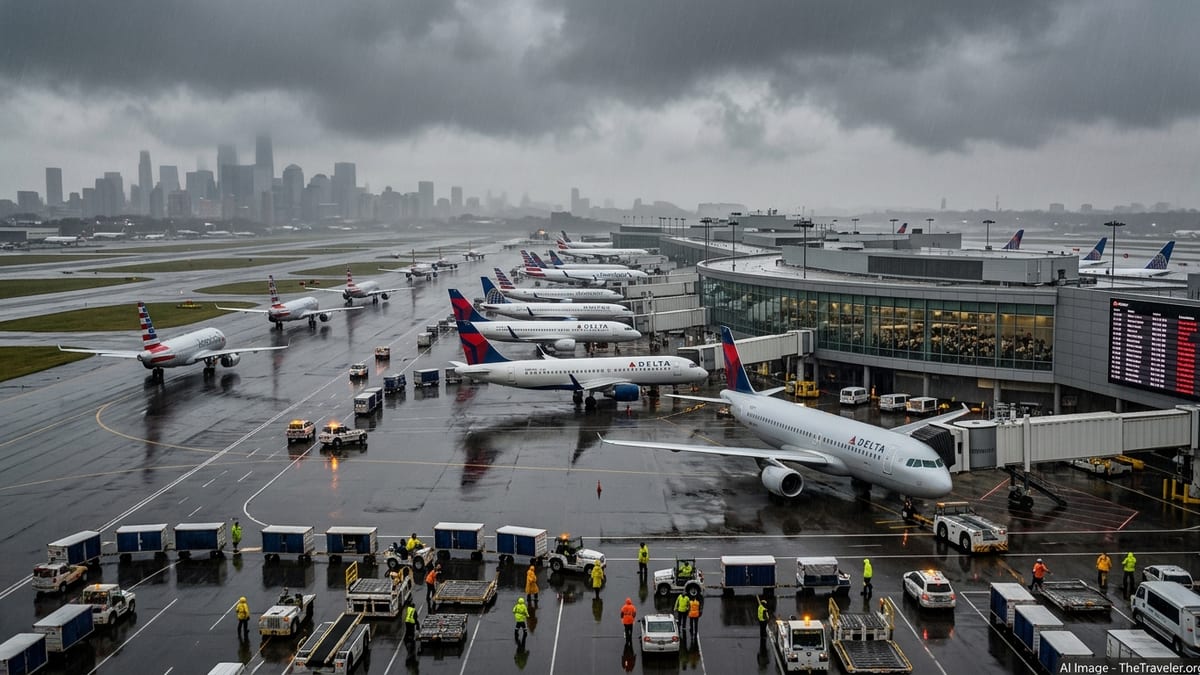
Storm impact peaked on Thanksgiving as delays concentrated along the East Coast
National Weather Service forecast discussions and federal briefings issued in the days before Thanksgiving highlighted the risk that a strong coastal low would track up the Eastern Seaboard on Thursday 26 November, bringing heavy rain, hazardous winds and coastal flooding from the Carolinas through New England. The scenario largely unfolded as expected, with the Weather Prediction Center flagging significant rainfall and the potential for flash flooding along parts of the Mid-Atlantic and Northeast corridor while local forecast offices warned of gusts frequently topping 40 to 50 miles per hour along exposed coasts at the storm’s peak.
Operationally, the worst aviation disruption was concentrated on Thanksgiving Day itself. Data compiled from real-time flight-tracking services such as FlightAware showed that by Thursday evening more than 2,000 flights within, into or out of the United States had been delayed, with several hundred cancellations nationwide. A disproportionate share of the impact was linked to East Coast hubs affected directly by the nor’easter’s rain bands and low clouds, including the New York, Washington and Boston metropolitan areas, although knock-on effects stretched to secondary airports connected to those networks.
By Friday 27 November, as the low moved northeastward and its core shifted offshore into the northwest Atlantic, conditions began to improve across much of the affected region. Federal Aviation Administration status feeds showed a return to more routine traffic management, with broad weather-related ground stops lifted at the major hubs and replaced by shorter arrival and departure delay programs used to smooth peaks in volume. Delays and cancellations remained higher than on a typical autumn Friday but had fallen substantially from Thanksgiving Day’s spike.
How key East Coast hubs and local travel were affected
Within the national picture, the most intense aviation pressure was felt at airports that sit directly along the Interstate 95 corridor and handle large volumes of domestic and international connections. At New York’s LaGuardia Airport, low cloud ceilings, strong crosswinds and heavy rain on Thursday reduced the number of arrivals controllers could safely handle each hour. FAA advisories showed several periods in which LaGuardia operated under ground delay programs, with extended departure queues as tower and approach controllers increased spacing between aircraft during the worst of the weather.
Newark Liberty International experienced a similar pattern, with flight-tracking data indicating multiple waves of delays of around an hour or more during the afternoon and evening of Thanksgiving as runways remained usable but throughput was reduced. John F. Kennedy International, which is more heavily weighted toward long-haul operations, saw intermittent clusters of disruption tied to changing runway configurations and crosswinds. Several long-haul arrivals landed behind schedule late Thursday and early Friday, which compressed departure banks later in the day and created localized misconnects for onward passengers.
Farther south, airports in the Washington region, including Reagan National and Dulles International, were affected as the storm moved through the Mid-Atlantic with bands of heavy rain and embedded thunderstorms. Area forecast discussions from the National Weather Service office covering Baltimore and Washington on Thursday morning highlighted a powerful coastal low bringing hazardous wind, tidal flooding and heavy rain, conditions that prompted temporary ground stops and reduced arrival rates at times. By early Friday, those restrictions had been lifted and operations had largely reverted to high-volume but manageable holiday levels, although airlines were still working through residual schedule imbalances.
Boston Logan and Baltimore/Washington International also operated under periodic weather-related constraints. At Logan, strong onshore winds, low ceilings and heavy rain led to an airport-volume ground delay program for parts of Thanksgiving Day, resulting in average delays of around half an hour for affected flights and longer waits for some services. In Baltimore, a combination of gusty winds and intense rainfall slowed ground handling and contributed to scattered delays even when arrival and departure rates were not formally restricted.
Context: earlier nationwide ground stop and broader travel volumes
The Thanksgiving nor’easter arrived less than two weeks after the FAA ordered a nationwide ground stop on Friday 13 November 2026 following instability in the telecommunications systems that underpin communications and radar feeds at air traffic control facilities. In a detailed question-and-answer document published on 15 November, the agency confirmed that operators canceled around 12,462 flights during that event, including more than 9,000 cancellations by major U.S. airlines, as a precaution while the system was stabilized and normal operations were restored.
Subsequent briefings from the U.S. Department of Transportation and the FAA emphasized that the telecommunications network itself remained operational but experienced instability that could have compromised the reliability of communications with aircraft if operations had continued as normal. While investigators are still examining the precise technical sequence that led to the outage, federal officials have described the episode as distinct from the later Thanksgiving weather disruption, even though both events affected airline schedules during the same month.
By the time the core Thanksgiving travel window opened in the week of 23 November, airlines had largely rebuilt their schedules following the November 13 ground stop. Nonetheless, federal on-time performance data for previous months show that a substantial proportion of delays in the U.S. system typically stem from carrier-related factors such as crew availability and late-arriving aircraft. After a nationwide disruption, those sensitivities can be more acute, particularly during peak periods when loads are high and spare capacity is limited. That context helps explain why some carriers opted for preemptive Thanksgiving cancellations on routes most exposed to the nor’easter and why localized delays persisted at certain hubs even after weather began to improve.
At the same time, overall holiday travel volumes have been strong. Forecasts issued before the holiday by AAA and other travel organizations projected that more than 80 million people in the United States would travel at least 50 miles from home between Tuesday 24 November and Monday 30 November, with a significant share opting to fly. Daily checkpoint figures compiled from Transportation Security Administration data show that in the week leading up to Thanksgiving, passenger throughput at airport security lanes was running above the prior week and close to, or slightly ahead of, the same period a year earlier, contributing to congested terminals and longer lines in many cities.
How closely the disruption matched forecasts and recent Thanksgiving patterns
From a forecast perspective, the evolution of the Thanksgiving nor’easter broadly matched the pattern anticipated by meteorologists in the days before the holiday. A short-range forecast discussion from the Weather Prediction Center valid from late Wednesday 25 November into Friday 27 November called for a strong coastal storm to track up the East Coast, bringing heavy rain, strong winds and significant coastal flooding. Local offices along the Mid-Atlantic and New England coasts issued a combination of coastal flood warnings, high wind warnings and storm warnings for adjacent marine areas, with state authorities in places such as New Jersey formally citing expected tidal flooding and hazardous winds in emergency preparedness orders.
In practice, rain was heavy at times along much of the I-95 corridor on Thanksgiving Day, with localized flooding reported in low-lying neighborhoods and along some coastal roads. News reports from affected communities described water encroaching on streets and properties coinciding with high tides, while utilities worked to restore power to customers as winds eased on Friday. The conditions were sufficient to disrupt some non-aviation holiday traditions as well, including an unprecedented postponement of the Macy’s Thanksgiving Day Parade in New York City to Saturday 28 November due to concerns over rain and high winds, a decision that underscored the strength of the storm’s impacts on the region.
When compared with other recent high-impact aviation events, current evidence suggests that this Thanksgiving’s storm-related disruption, while significant for affected travelers, remained moderate in scope. The several hundred cancellations and a few thousand delays recorded on Thanksgiving Day are notable for a public holiday when many airlines already operate reduced schedules, but they remain well below the cancellations tied directly to the November 13 ground stop and below the totals seen during some historic winter storms that have temporarily closed individual hubs for an entire day or more. Early delay and cancellation statistics for the Thanksgiving period point to a system that experienced a short, sharp weather shock followed by relatively rapid normalization once conditions allowed.
For year-on-year comparisons, definitive conclusions will depend on detailed Department of Transportation statistics that are typically published with a lag of several months. Preliminary TSA and flight-tracking indicators, combined with the timing of this year’s nor’easter, suggest a more complex operating environment than during some recent Thanksgiving seasons, with a major technical outage earlier in November followed by a coastal storm hitting on the holiday itself. At the same time, the overall pattern of a busy but largely functioning system outside the storm’s peak, especially on the days immediately before and after Thanksgiving, is broadly consistent with the experience of other recent years in which the Sunday after the holiday has emerged as the single busiest air travel day.
What travelers experienced and what to check if you are still flying this weekend
For passengers at the affected airports, the most visible effects of the nor’easter on Thursday included long gate waits, repeated departure-time adjustments displayed on terminal boards and occasional returns to the gate after pushback. Reports from New York, Washington and Boston described situations where boarding was completed and aircraft taxied out, only for crews to announce that updated air traffic control restrictions required them to hold in place while arrival and departure rates were revised. Although frustrating, those sequences reflected the way controllers balance safety and capacity when strong winds, low visibility or heavy precipitation reduce the number of operations the airfield can safely handle.
Where flights were canceled outright on Thanksgiving Day, rebooking was often constrained by the high load factors typical of the holiday period. Many airlines issued weather waivers for affected East Coast airports, allowing customers to change travel dates without additional change fees within specified windows, but the availability of alternative seats depended heavily on the route and time of day. Some displaced travelers were accommodated on later flights on Thursday once conditions improved, while others were rebooked onto services on Friday 27 or Saturday 28 November, in some cases requiring overnight stays.
U.S. carriers generally classify weather events as outside their control for the purposes of mandatory compensation, which limits automatic entitlements to hotel accommodation or meal vouchers. As a result, the level of support varied between airlines and situations. Some carriers provided meal vouchers, travel credits or assistance with hotel bookings where delays extended late into the evening, while many travelers turned to independent travel insurance or credit card protections to recover additional costs such as last-minute accommodation and local transport. The experience highlighted the importance for holiday passengers of understanding both airline policies and any third-party coverage in advance of travel.
As of Saturday 28 November, with the nor’easter now well offshore and the FAA’s telecommunications systems operating normally after the earlier ground stop, most remaining constraints in the U.S. aviation system relate to sustained high demand and the tail-end effects of Thursday’s disruption. TSA figures and industry forecasts indicate that Sunday 29 November is expected to be the busiest air travel day of the Thanksgiving period, with Monday 30 November also seeing elevated volumes. While no additional large-scale storm is currently forecast to affect the northeastern United States over the remainder of the weekend, localized delays and targeted cancellations remain possible as airlines reposition aircraft and crews to restore full schedule integrity.
Travelers still due to fly this weekend can reduce their risk of complications by monitoring their flight status closely from the evening before departure using airline apps or alert services, paying particular attention to any changes affecting the first segment of multi-leg itineraries. Allowing extra time for check-in and security screening, reconfirming terminal and gate information shortly before leaving for the airport, and keeping essential medications, valuables and a change of clothes in carry-on bags can help mitigate the impact of unexpected disruption. With the worst of the Thanksgiving nor’easter now past, most passengers can expect conditions resembling a typical, crowded holiday weekend, rather than an ongoing weather emergency, while remaining aware that individual flights at the busiest hubs may still experience residual delays.