


More news on this day
Heavy rain, strong winds and coastal flooding on Thanksgiving Day, November 26, 2026, have caused significant but uneven disruption across the U.S. air network, with more than 2,200 delays and over 400 cancellations reported by Thursday afternoon and the country’s largest airlines activating broad weather waivers to help travelers rebook without standard change fees.
Get the latest news straight to your inbox!
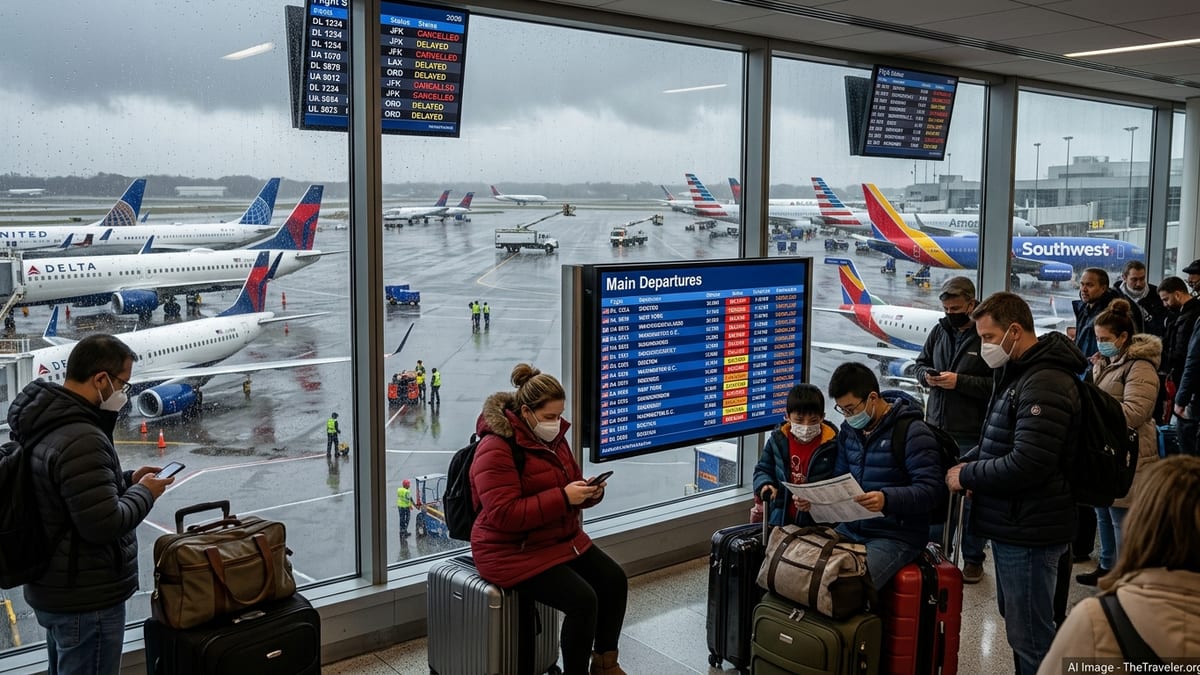
Storm-soaked holiday sharply impacts but does not shut down air travel
The Thanksgiving storm brought particularly severe conditions to parts of the East and West Coasts, combining periods of driving rain with coastal flooding and gusty winds from the Carolinas through New England and along sections of the California and Pacific Northwest shoreline. By Thursday afternoon, flight-tracking service FlightAware reported more than 2,200 delays and over 400 cancellations to or from U.S. airports, a mix of direct weather impacts and knock-on disruptions from earlier in the week.
On the East Coast, a fast-moving coastal system delivered heavy rain and strong gusts that inundated low-lying communities and downed trees and power lines, with flooding and wind issues reported from the Mid-Atlantic into New England. Those conditions forced air traffic controllers to reduce arrival and departure rates at major hubs including the New York City area, Boston, Washington and Philadelphia. Slower acceptance rates at these airports translated into longer taxi times, airborne holding and periodic ground delay programs, contributing to nationwide disruption even at airports where local weather remained relatively calm.
Across the country, an atmospheric river and unusually high tides created a different risk profile for coastal California and parts of the Pacific Northwest. Forecast charts from federal emergency and weather agencies highlighted heavy rain, elevated surf and potential flooding along the San Francisco Bay shoreline and sections of the Southern California and Oregon coasts. While the worst of the marine impacts were felt away from terminal buildings, airport operators at San Francisco and other key West Coast gateways monitored drainage systems, airfield standing water and onshore crosswinds, all of which can slow operations or temporarily limit use of certain runways.
Record Thanksgiving flight schedule meets slightly softer passenger volumes
The storm arrived during what federal regulators describe as the busiest Thanksgiving flight schedule in 16 years. A U.S. Department of Transportation and Federal Aviation Administration forecast issued on November 23 projected more than 417,000 flights nationwide between November 22 and November 30, 2026, across U.S. carriers and their regional partners. That flight count exceeds any Thanksgiving-period schedule since the late 2000s, reflecting both airline fleet expansion and the restoration of many routes cut earlier in the decade.
Passenger numbers, while still extremely high, are projected to fall just short of last year’s record. Forecasts from travel organizations and federal security agencies suggest around 81.5 million people will travel at least 50 miles from home between the Tuesday before Thanksgiving and the Monday after, a marginal 0.1 percent decline compared with 2025. Within that total, the Transportation Security Administration expects to screen roughly 17 to 18 million passengers at U.S. airport checkpoints over the core Thanksgiving window, with more than 3 million travelers forecast on Sunday, November 29, which is expected to be the single busiest air travel day of 2026.
The combination of slightly lower passenger counts but more scheduled flights means average aircraft are projected to be modestly less full than during last year’s peak days, though still very busy on the heaviest dates. For travelers, that can translate into a small advantage when rebooking after a disruption, as additional frequencies and marginally lower load factors create more opportunities to shift to another same-day departure compared with a schedule that is both record-busy and tightly packed.
National system stabilizes on Friday as airlines work through backlogs
Despite the storm’s sharp impacts on Thanksgiving itself, early data on Friday, November 27, indicated that the U.S. air traffic system was beginning the post-holiday weekend in relatively stable condition. An analysis of the Federal Aviation Administration’s status feeds early Friday afternoon Eastern time showed no active nationwide ground stops, formal ground delay programs or airport closures at the 20 to 30 major hubs tracked on widely used delay dashboards. Cancellations had fallen to well under 200 by mid-afternoon, and delays were in the low hundreds rather than the thousands seen on Thursday.
That improvement reflects both the fast-moving nature of the coastal system and advance contingency planning by airlines and air traffic managers. Many of Thursday’s delays were driven by reduced arrival rates at specific hubs during the worst of the rain and wind, rather than by long-lasting infrastructure damage or airport closures. Once the most intense bands of weather moved offshore and winds eased slightly, controllers were able to lift some traffic flow restrictions, enabling carriers to run closer to normal schedules even as they repositioned aircraft and crews that had been out of place.
Residual disruption remains a risk through the weekend, particularly for travelers connecting through airports that experienced the heaviest weather on Thursday. Airlines are still working through a backlog of rebooked customers whose original flights were canceled or missed because of cascading delays. In practice, that can mean that even when real-time dashboards show a flight operating on time, available seats for same-day changes or standby travel may be very limited, especially on popular Sunday evening departures.
Major U.S. airlines widen weather waivers on key Thanksgiving routes
In anticipation of the coastal storm and in response to Thursday’s disruptions, the four largest U.S. carriers have issued or expanded weather waivers that relax normal change rules for affected passengers. American Airlines, Delta Air Lines, United Airlines and Southwest Airlines have all published advisories covering clusters of Northeastern and Mid-Atlantic airports for travel on Thanksgiving Day, with some policies also extending to Florida and parts of the Southeast where heavy rain and thunderstorms affected operations earlier in the week.
American’s advisory for the Northeast allows eligible customers whose itineraries touch specified airports on Thursday, November 26 to rebook travel in the same cabin through Sunday, November 29, 2026, with change fees waived. In many cases, fare differences are also waived when customers move to flights within the permitted date range and keep their original origin and destination, although some itineraries may still incur a fare difference depending on availability. American has also issued a separate waiver for Miami and several other Southeast airports covering Wednesday, November 25, where hazardous weather disrupted local operations.
United Airlines’ Thanksgiving coastal storm waiver applies to a list of airports from Washington through Boston on November 26. Customers booked on United or United Express flights to, from or through these airports on Thanksgiving can change to alternative flights departing between November 25 and November 28, 2026, without paying a change fee or fare difference, provided they travel in the same cabin and retain the same origin and destination. United has also faced residual disruption from an earlier-week technology outage that triggered a temporary ground stop for flights bound for Atlanta, underscoring how non-weather operational issues can compound the impact of a later storm during peak travel periods.
Delta Air Lines and Southwest Airlines have issued similar but not identical policies. Delta’s coastal-storm advisory lists a group of East Coast cities where winds and rain were forecast to be strongest on Thanksgiving; affected customers are permitted to move travel within a defined window while keeping their city pairs, with change fees waived and, in many cases, fare differences relaxed. Southwest, which does not charge traditional change fees and uses a different fare structure from its network rivals, is allowing customers booked on impacted flights to switch to other services between the same cities within its waiver dates without paying a fare difference, subject to seat availability. In all cases, travelers whose flights are canceled outright by the airline remain entitled to a refund of the unused portion of their ticket if they choose not to travel, but options such as hotel vouchers or meal credits are generally reserved for disruptions that are within the airline’s control rather than weather-related.
Weather outlook through the weekend and what travelers should verify
Forecasts from federal meteorological agencies for Friday, November 27, and Saturday, November 28, 2026, point to a gradually improving picture in many areas, but with ongoing local risks that could still affect flights. As the Thanksgiving coastal low pulls away into the Atlantic, lingering showers, low clouds and gusty winds are expected to persist over parts of New England and the Mid-Atlantic, particularly around the Great Lakes and interior Northeast. In the West, an advancing low-pressure system and accompanying fronts are projected to bring further heavy rain and mountain snow to parts of Washington, Oregon and the northern Rockies, including higher-elevation passes that can influence regional air traffic patterns.
These conditions are not currently forecast to produce the same degree of widespread disruption seen on Thanksgiving Day unless embedded storm bands strengthen more than expected. However, localized visibility reductions, low ceilings and crosswinds at specific hubs can still prompt air traffic control to temporarily reduce arrival and departure rates, resulting in pockets of delay. Travelers connecting through New York, Boston, Seattle, Portland or other coastal and mountain-adjacent airports should therefore continue to build in extra time and monitor both local weather and the FAA’s national status tools on the day of travel.
Coastal flooding and high surf hazards may also linger into the weekend, particularly along exposed sections of the Mid-Atlantic and New England seaboard and in parts of California’s coastline where king tides coincided with heavy rain. While these marine risks are primarily a concern for residents and road users rather than for aviation safety, they can affect access routes, parking lots and public transport links serving certain coastal airports. Travelers driving to or from airports near tidal inlets or oceanfront highways should check local advisories and allow additional time in case of detours or road closures during periods of peak high tide.
For those due to fly home over the coming days, officials and airlines are advising a few specific checks. Passengers should consult their airline’s app or website on the morning of travel to confirm both the status of their own flight and that of the inbound aircraft operating it, since delays often propagate from one leg to the next. It is also important to review the latest travel advisories or waivers on the airline’s site to see whether their itinerary qualifies for a free date or time change; acting early typically provides more rebooking options, particularly on Sunday, November 29, when demand is highest. Finally, travelers whose flights are significantly delayed or canceled should keep records of notifications and receipts and review their fare rules, as entitlement to refunds or additional support depends on whether the disruption is categorized as weather-related or due to factors within the airline’s control.