


More news on this day
Weather disruption from the powerful Thanksgiving nor’easter that soaked the U.S. East Coast on Thursday 26 November 2026 is now easing, with federal data and live industry trackers on Saturday 28 November indicating that nationwide flight delays and cancellations have fallen well below the holiday peak and that most major airports are operating closer to normal Thanksgiving‑weekend capacity, even as some East Coast hubs continue to clear residual congestion.
Get the latest news straight to your inbox!
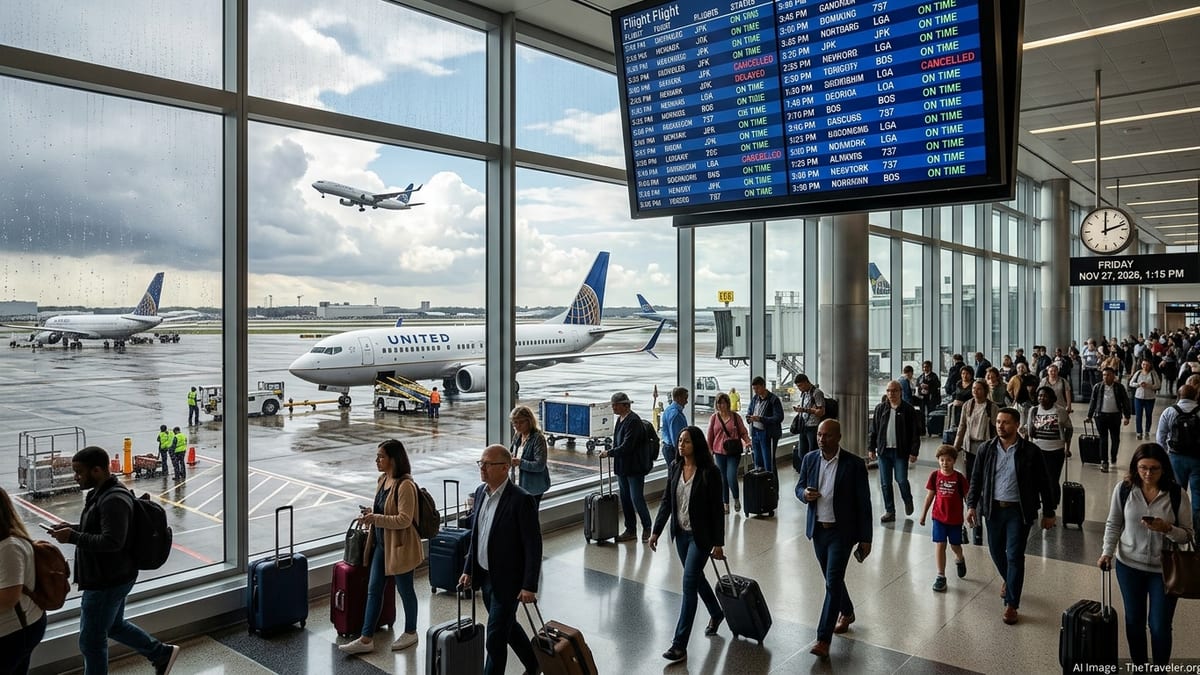
Storm impact peaked on Thanksgiving Day before a rapid national improvement
The coastal storm that forecasters had flagged for several days as a Thanksgiving travel risk intensified along the Eastern Seaboard on Thursday 26 November, bringing periods of heavy rain, strong winds and pockets of coastal flooding from the Carolinas into New England. Federal briefings and National Weather Service outlooks ahead of the holiday highlighted the potential for hazardous conditions along the Interstate 95 corridor and at major airports from Washington to Boston, particularly around the core Thanksgiving travel window.
By Thursday afternoon and evening, those forecasts were reflected in aviation data. FlightAware and similar tracking services reported more than 2,200 delays and over 400 cancellations for flights within, into or out of the United States on Thanksgiving Day, with the majority linked to weather affecting East Coast hubs. That tally represented a clear spike compared with surrounding days but remained below the levels seen during the nationwide ground stop earlier in the month, and also below the most disruptive historic winter storms that have closed individual airports for entire days.
Federal Aviation Administration status feeds and independent dashboards that aggregate that data show a markedly different picture by Friday morning 27 November. As the low tracked northeastward and the core of the system moved offshore into the northwest Atlantic, the number of flights affected at any given time fell to the low hundreds for delays and around 100 cancellations nationwide. The FAA was no longer posting broad weather‑driven ground stops for major hubs, and instead listed mostly routine traffic‑management initiatives such as minor arrival and departure delay programs used to regulate volume at busy airports.
Through Saturday 28 November, when many travelers continue their return journeys, the overall trend has been one of gradual normalization. Real‑time trackers focused on Thanksgiving week report that only a very small number of large U.S. airports are currently subject to formal delay programs, and that most flights at key hubs are departing within typical holiday thresholds of around 15 to 30 minutes of schedule. For passengers, that means the national picture now resembles a busy but generally functioning holiday weekend, rather than an ongoing weather emergency.
How major East Coast hubs were affected
Among U.S. airports, those in the New York and Washington regions and in Boston saw some of the most concentrated Thanksgiving disruption, both because of their exposure to coastal weather and because they are dense connecting nodes within airlines’ domestic and transatlantic networks. Local advisories and live delay trackers show that New York’s LaGuardia Airport experienced periods of low cloud ceilings, gusty crosswinds and saturated arrival streams on Thursday, leading the FAA to implement time‑limited ground delay programs and airlines to apply their own temporary holds.
During the peaks of the storm, departure queues at LaGuardia and Newark Liberty International lengthened as tower and approach controllers increased spacing between aircraft in strong winds and rain. At times, individual flights faced waits of an hour or more, particularly for departures bound for other busy East Coast or Midwestern hubs where weather or volume was also constraining capacity. Flight‑tracking data for Newark indicate multiple waves of delays in the 60‑ to 90‑minute range on Thursday, with some knock‑on effects into late evening departure banks.
John F. Kennedy International, which is more heavily weighted toward long‑haul and transatlantic services, showed a slightly different pattern. Rather than continuous disruption, tracking sites logged intermittent clusters of delays tied to crosswinds that at times exceeded 20 knots and to low cloud decks moving across the airfield. Those conditions occasionally forced runway configuration changes and adjustments to arrival and departure sequences. Several long‑haul arrivals landed behind schedule on Thursday and early Friday, which in turn compressed departure banks later in the day and contributed to isolated late‑night misconnects for onward passengers.
Farther south, Washington Reagan National and Washington Dulles International were affected as the system moved through the Mid‑Atlantic with bands of thunderstorms and periods of heavy rain. FAA advisories show that Reagan National was briefly placed under ground stops and reduced arrival‑rate programs during the most intense convective activity on Thursday. By early Friday morning, those restrictions had been lifted for both Washington‑area airports and operations had mostly reverted to typical high‑volume holiday conditions, although airlines were still repositioning aircraft and crews that had been displaced by Thursday’s delays and cancellations.
Boston Logan and Baltimore/Washington International also saw substantial weather‑related pressure. Data from Thanksgiving Day show that Logan operated under an airport‑volume ground delay program at times, with average delays of around half an hour and some flights waiting more than an hour. In both Boston and Baltimore, a combination of strong onshore winds and heavy rain produced localized flooding in nearby neighborhoods and contributed to slower ground operations, even when runways remained open to traffic.
Interaction with the earlier nationwide ground stop
The nor’easter struck less than two weeks after the Federal Aviation Administration ordered a rare nationwide ground stop on Friday 13 November 2026, following a telecommunications failure that affected communications and radar feeds at air traffic control facilities across much of the National Airspace System. Official FAA questions‑and‑answers published on 15 November state that the ground stop lasted for around four hours and forty‑five minutes before being fully lifted, during which operators canceled approximately 12,462 flights, including more than 9,000 cancellations by major U.S. airlines.
Subsequent technical briefings and congressional research summaries have described the November 13 event as stemming from instability in the timing systems of the FAA’s internal telecommunications network, linked to ongoing modernization work. While investigators have stressed that their analysis is still under way, and that not all cancellations can be attributed directly to the outage, the impact on airline networks was substantial. Airlines had to reposition aircraft and crews, clear large backlogs of passengers and work through maintenance tasks that had been deferred during the ground stop period.
By the time the Thanksgiving travel period began in earnest, carriers had restored the vast majority of their planned schedules. However, Department of Transportation performance data for prior months show that a significant proportion of delays in the U.S. system routinely stem from air‑carrier factors such as crew availability, maintenance checks or late‑arriving aircraft, which can compound when weather reduces airport capacity. Industry operations specialists note that residual sensitivities in staffing and fleet positioning after a major nationwide disruption can leave airlines with less margin to absorb new shocks, particularly during peak travel weeks when flights are heavily booked.
This backdrop helps explain why some airlines and routes experienced secondary cancellations and rolling delays on Thanksgiving Day even after weather at particular airports had started to improve. Once the nor’easter reduced arrival and departure rates at multiple East Coast hubs simultaneously, carriers had to make choices about which flights to operate with the resources available and which to cancel outright. The result was a pattern in which some travelers faced repeated departure‑time changes before eventually departing, while others were rebooked onto later flights on Thursday, Friday or Saturday as seats opened up.
How the disruption aligns with forecasts and recent Thanksgiving periods
In the run‑up to the holiday, federal and private forecasters had consistently warned that a coastal storm would intersect with peak Thanksgiving travel volumes. An FAA forecast released on Tuesday 24 November projected the busiest Thanksgiving skies in more than a decade and urged passengers to leave additional time for airport formalities and to monitor flight status closely. National Weather Service outlooks issued early in the week highlighted a risk of heavy rain, strong coastal winds and localized flooding from the Southeast to New England on Thanksgiving Day, followed by a gradual improvement as the low moved away from the coast on Friday and Saturday.
Early evidence from flight‑tracking services and from live dashboards that compile FAA National Airspace System status suggests that the way disruption unfolded broadly matched those expectations. The highest concentration of delays and cancellations occurred on Thursday at East Coast hubs, particularly New York, Washington, Boston and Baltimore/Washington International, with secondary effects at airports that feed into those networks. Once the nor’easter’s most intense phase shifted offshore, delay metrics fell relatively quickly and by late Friday the national picture more closely resembled a busy but manageable holiday schedule.
When compared with other recent high‑impact aviation events, this Thanksgiving’s storm‑related disruption stands out as significant but not extreme. The several hundred cancellations logged on Thanksgiving Day are notable for a date when many airlines already operate a reduced schedule, but they remain well below the nationwide cancellation totals tied to the November 13 ground stop. They also fall short of numbers recorded during some previous winter storms that forced full‑day shutdowns at individual hub airports, producing multi‑day waves of missed connections and equipment dislocation across the country.
For travelers evaluating whether this Thanksgiving was better or worse than in previous years, it is too early for definitive year‑over‑year statistics, which will rely on Department of Transportation data published with a delay. However, the combination of a major pre‑holiday technical disruption and a coastal storm hitting on Thanksgiving Day itself appears to have created a more complex operating environment than airlines and passengers faced in several of the immediately preceding holiday seasons. The rapid decline in delays after the storm’s peak suggests that once weather and systems allowed, airlines and air traffic control were able to restore a high proportion of scheduled capacity.
What travelers experienced and what to check if you are still flying
For passengers on the ground, the nor’easter’s most visible effects were long waits at gates, rolling departure‑time changes and, in some cases, diversions or returns to the gate after taxiing out. Traveler reports from New York, Washington and Boston on Thursday described situations where boarding was completed and aircraft pushed back, only for crews to announce that updated air traffic control restrictions required them to remain in holding areas or return to the stand while arrival rates were adjusted. Such sequences can be particularly frustrating for passengers, but they reflect the way airports and controllers must balance safety and volume when weather reduces usable runway capacity.
Where flights were canceled outright on Thanksgiving Day, rebooking presented its own challenges. With Thanksgiving departures and returns already heavily booked, many flights had limited spare seats for disrupted travelers. Airlines issued formal weather waivers covering affected East Coast airports, allowing most customers to change their plans without additional fees within defined date ranges, but the availability of alternative flights depended on route and time of day. Some passengers were rebooked onto later flights on Thursday once conditions improved, while others were moved to services on Friday 27 or Saturday 28 November.
Airlines’ policies for customer care during weather events also shaped the on‑the‑ground experience. U.S. carriers generally treat weather as outside their control for the purposes of mandatory cash compensation, meaning that statutory entitlements to hotel stays or meal vouchers are limited. Many airlines did offer voluntary assistance such as meal vouchers, hotel discounts or travel credits on a case‑by‑case basis, particularly where delays extended late into the evening. Travelers with independent travel‑insurance policies or credit‑card protections often turned to that coverage to recoup additional accommodation or subsistence costs.
As of Saturday 28 November, travelers with flights booked for the remainder of the Thanksgiving period are facing a more stable but still busy environment. Live FAA and Transport Security Administration data indicate that Sunday 29 November is expected to be the single busiest air‑travel day of 2026 by passenger throughput, and that Monday 30 November will also see sustained high volumes. While no new large‑scale storm is forecast to affect the northeastern United States in the immediate 48‑hour outlook, residual aircraft and crew imbalances mean that localized delays and a smaller number of targeted cancellations remain possible at the airports that bore the brunt of Thursday’s storm.
For those yet to travel, the most practical step is to monitor flight status closely through airline apps or alert services from the evening before departure, paying particular attention to any schedule changes affecting the first leg of a multi‑segment itinerary. Allowing extra time for check‑in and security screening, confirming terminal and gate assignments shortly before leaving for the airport, and packing essential medications and a change of clothes in carry‑on bags can help mitigate the impact of unexpected delays. With the nor’easter now well offshore and national aviation systems operating normally after the earlier ground stop, remaining constraints for most travelers through Monday are likely to stem from high demand and the tail‑end effects of Thursday’s disruption rather than from new weather or systems shocks.