


The Picasso Museum is one of Barcelona’s most visited cultural sights and an essential stop for understanding how the young Pablo Picasso became the artist the world knows today. Tucked into a cluster of medieval palaces in the atmospheric El Born district, it is compact enough for a half-day visit yet rich enough to reshape how you see his work. This guide walks first-time visitors through everything you need to know, from tickets and opening hours to what to look for in the galleries and how to fit the museum into a wider Barcelona itinerary.
Get the latest updates straight to your inbox!
Why the Picasso Museum Matters in Barcelona
The Museu Picasso in Barcelona is not a greatest-hits collection of famous paintings pulled from different decades. Instead, it is one of the world’s most important archives of Picasso’s formative years. The museum holds more than 4,000 works, with a particular focus on the period between 1895 and 1904, when Picasso lived in Barcelona on and off as a teenager and young adult. Many visitors are surprised to find fewer blockbuster Cubist canvases and more sketchbooks, studies and early portraits that reveal a technically brilliant student pushing against academic rules.
This focus makes sense when you remember that Barcelona is where Picasso attended the La Llotja art school, drank coffee with other modernists at the Quatre Gats café and painted the streets, taverns and friends that would later feed into his Blue Period. In the galleries you can move chronologically from astonishingly precise academic studies painted when he was just 14 to the darker, emotionally charged works of his early twenties. Seeing this progression in one place gives first-time visitors a much clearer understanding of how he evolved than a single famous painting hanging in isolation.
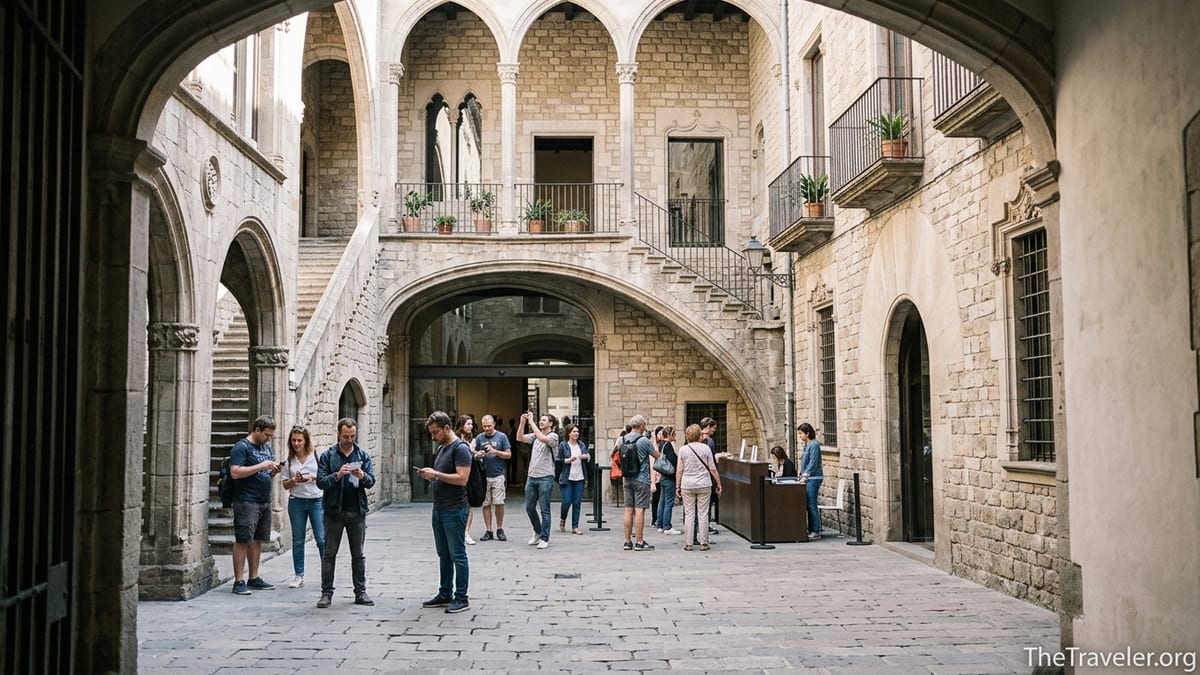
The museum is also deeply tied to the city itself. Picasso donated many works specifically to Barcelona and personally supported the museum’s founding in the 1960s as a gesture of thanks. Housed today in a row of five connected Gothic palaces on Carrer de Montcada, the building is part of the experience. Stone courtyards, arched staircases and shaded loggias remind you that you are in the medieval heart of the city, just a few minutes’ walk from the Basilica of Santa Maria del Mar and the lively bars and boutiques of El Born.
For a first-time visitor to Barcelona, this mix of intimate architecture, focused collection and strong local story makes the Picasso Museum less overwhelming than a national gallery yet more meaningful than a generic modern art stop. It is an ideal companion to the Gaudí landmarks such as the Sagrada Família and Casa Batlló, giving you a second, very different lens on Catalan creativity at the start of the 20th century.
Location, Opening Hours and How Long to Spend
The museum sits in the El Born neighborhood, just northeast of the Gothic Quarter. The main entrance is on Carrer de Montcada, a narrow stone street lined with historic townhouses. From the Jaume I metro station on Line 4, the walk takes about 8 to 10 minutes through pedestrian alleys; from Barceloneta station, allow 12 to 15 minutes via Passeig de Colom and Via Laietana. Several city bus lines stop nearby on Via Laietana and Passeig Picasso, so it is easy to combine the museum with visits to Parc de la Ciutadella or the waterfront.
As of 2026, the Picasso Museum typically opens from mid-morning until early evening, with extended hours some days and a weekly closure on Mondays. Exact hours can vary by season and on public holidays, so it is important to check the official site shortly before your visit, especially if you are traveling in August or around major dates such as January 1, May 1, June 24 and December 25, when many Barcelona museums close. In practice, most travelers find that arriving mid-morning between 9:30 and 11:00 or mid-afternoon after 15:00 offers a good balance between energy levels and crowds.
Plan on 1.5 to 2 hours for a first visit if you move steadily through the permanent collection and pause at major works. Travelers who enjoy reading wall texts or sketching often stay closer to 3 hours. A common pattern for first-time visitors is to book a 10:00 or 10:30 timed entry, spend two hours inside, then walk five minutes to Santa Maria del Mar for a quick look at the basilica and an early tapas lunch on Passeig del Born. Another option is a late-afternoon slot around 16:30 or 17:00, followed by an early dinner in El Born and an evening stroll back to the Gothic Quarter.
Remember that even with a timed ticket you may queue for security checks and cloakroom drop-off. Leave a small margin if you have another booked activity such as a guided tour of the Palau de la Música Catalana later in the afternoon. Also note that bags above a certain size must be checked, so arrive with a small daypack rather than full luggage if you can.
Tickets, Prices and Free Admission Windows
The Picasso Museum uses timed entry tickets that you select in advance for a specific day and half-hour window. In 2026, a standard adult ticket booked online is typically around 12 euros, with a slightly higher price at the on-site ticket desk. There are reduced fares for visitors such as students, people aged 18 to 25, seniors and the unemployed, and children under 18 can usually enter free with proof of age. Families traveling with teenagers often find that bringing a passport photo page or national ID card avoids any discussion at the entrance.
If you are planning to visit several major museums, it is worth comparing the cost of individual tickets with multi-museum passes. The Articket Barcelona pass, for example, bundles admission to six leading art museums, including the Picasso Museum and the Museu Nacional d’Art de Catalunya, for a flat fee that is usually under 40 euros for adults. For a traveler planning a three-day culture-heavy stay, this can be better value than buying single tickets, especially if you also want to see MACBA or the Fundació Miró.
Free admission is a significant draw, but it comes with conditions. The museum offers free entry on the first Sunday of each month and on selected open-door days tied to city festivals and International Museum Day. In addition, there is a free late-afternoon window on certain Thursdays during the cooler months. These free slots must still be booked in advance, typically four days before the visit, and they disappear quickly. For example, if you hope to visit free on the first Sunday in October, you should be online the preceding Wednesday when the museum releases those timed tickets, as many local residents and budget-conscious travelers do the same.
For most first-time visitors with limited days in Barcelona, the trade-off is straightforward. A paid ticket at 12 euros lets you choose a calmer time of day and avoid the worst crowding. On the first Sunday of a spring or autumn month, rooms can feel as busy as a popular Gaudí house in high season, and lines may form outside even for people with reservations. If your schedule is very tight, consider paying for a less popular time slot, such as a weekday afternoon outside school holidays, to avoid spending precious hours in a queue.
What to See Inside: Key Works and Suggested Route
The permanent collection is arranged largely chronologically, so the recommended route is to follow the sequence rather than jump between rooms. You begin with Picasso’s earliest academic studies from his teenage years, including portraits and figure drawings that show astonishing technical control. Even travelers who arrive mostly curious about Cubism often find these rooms memorable because they overturn the cliché that Picasso could not paint “realistically.” Look closely at the delicate shading on faces and the confident outlines of hands and feet.
As you progress, the mood shifts into the Blue Period, heavily influenced by his time in Barcelona’s poorer quarters and in Paris. While the most famous Blue Period works are now in museums elsewhere, the Barcelona collection includes paintings and drawings of melancholic figures, street scenes and interiors that convey the same emotional weight. Many first-time visitors comment afterward that these rooms feel like the emotional heart of the museum, even if they had never heard of the individual works before stepping inside.
One of the museum’s highlights comes later: the complete series of 58 canvases Picasso painted in response to Diego Velázquez’s “Las Meninas.” These works, created in the 1950s, deconstruct and reimagine the classical Spanish masterpiece in a riot of different styles and color palettes. The museum dedicates multiple rooms to the series, allowing you to walk along the walls and see how Picasso experimented with composition, cropping and mood. Even if you have never seen the original “Las Meninas” at the Prado in Madrid, this sequence is a powerful introduction to his mature style.
Along the way, do not overlook the ceramics and prints. In smaller side rooms and display cases you will find playful plates, jugs and lithographs that reveal Picasso’s sense of humor and his delight in everyday objects. First-time visitors who thought they were “not really into ceramics” often change their minds after seeing a row of plates where the curve of the rim becomes the outline of a face. If you are short on time, it can still be worthwhile to step briefly into each side gallery rather than skipping straight to the known highlights.
Practical Visit Tips: Crowds, Cloakrooms and Accessibility
The Picasso Museum is one of Barcelona’s busiest museums, often second only to major football and Gaudí attractions in annual visitor numbers. To avoid the worst of the crowds, aim for a weekday outside school holidays and book the first or last timed entry of the day. On peak summer Saturdays, midday slots can feel congested in the narrower rooms, especially when several tour groups converge. If your schedule forces you into a busy time, expect a slower pace and be ready to weave gently between small clusters of visitors.
Photography rules can change, but generally non-flash photography is allowed in many parts of the permanent collection and restricted in temporary exhibitions. Guards may ask visitors to put phones away in very crowded rooms to keep traffic moving. If you want to sketch, bring a small notebook or sketchpad; large easels or wet media are not usually permitted. There is a cloakroom for backpacks, umbrellas and bulky coats, and leaving your bag there often makes navigating the galleries more comfortable.
The museum is spread across several historic buildings, but there are lifts and accessible routes between floors, and staff are used to helping visitors with mobility needs. Some courtyards and staircases have uneven stone surfaces typical of medieval architecture, so comfortable, non-slippery shoes are wise. Families with strollers can enter, though in the most crowded hours it may feel easier to use a baby carrier inside the galleries and leave the stroller in the cloakroom area. Children under 14 must be accompanied by an adult at all times, which staff enforce in practice.
Audio guides and guided tours are worth considering, especially for first-time visitors not deeply familiar with Picasso’s life. The official audio guide usually offers a concise route of key works that takes about 60 to 75 minutes, which can help structure your visit if you are feeling jet-lagged. Some independent companies also offer English-language small group tours that combine an hour in the museum with a short walking tour of El Born. These can be good value if you like context and local anecdotes but prefer not to manage tickets and timing yourself.
Fitting the Museum Into Your Barcelona Itinerary
Because the Picasso Museum is compact and centrally located, it is easy to plug into a range of itineraries. One classic first-time route starts in the Gothic Quarter at Barcelona Cathedral, then winds through Plaça del Rei and Plaça Sant Jaume before crossing Via Laietana into El Born for a timed late-morning museum visit. After the galleries, you walk five minutes to Santa Maria del Mar and continue on to lunch around Passeig del Born or in the atmospheric streets near the old Born market hall. This combination gives you a full picture of medieval Barcelona’s core in a single day.
Another popular pairing is the Picasso Museum with Parc de la Ciutadella and the beach. You might book an early afternoon ticket, spend two hours inside, then stroll ten minutes to the park for a boat ride on the small lake or a rest on the grass under the palm trees. From there, it is about 15 minutes on foot to Barceloneta beach for a drink at a chiringuito before sunset. For families or mixed-age groups, this balance between an indoor cultural visit and relaxed outdoor time can keep everyone happy.
If you are in Barcelona for only two full days and already have bookings for the Sagrada Família and Park Güell, consider visiting the Picasso Museum at the start or end of your stay rather than trying to squeeze it into the same day. A realistic two-day plan could be Gaudí sites and Eixample on day one, then Gothic Quarter, El Born and the Picasso Museum on day two. Remember that some Gaudí houses and the basilica require strict timed arrivals, while the museum offers a little more leeway, so it often works best as the flexible element in your schedule.
For travelers focusing on art, you can easily build a themed day with the Picasso Museum in the morning, a long lunch in Poble-sec, and the Museu Nacional d’Art de Catalunya in the afternoon for Romanesque frescoes and Catalan modernism. Alternatively, combine it with MACBA in the Raval district for a contrast between early 20th-century work and contemporary art, using the metro or a short taxi ride between venues. In each case, the key is to avoid packing three or four museums into a single day, as visual fatigue will blunt your enjoyment by mid-afternoon.
Beyond the Museum: Exploring El Born Around Carrer de Montcada
Part of the charm of visiting the Picasso Museum is the surrounding neighborhood. El Born is one of Barcelona’s most atmospheric districts, a mesh of narrow streets where medieval merchants once lived above their warehouses. Today, those same buildings host design boutiques, small galleries, wine bars and independent restaurants. Stepping out of the museum into the courtyard, you are only a few minutes’ walk from some of the city’s most evocative corners.
After your visit, take time to wander along Carrer de Montcada itself, where other Gothic palaces sit shoulder to shoulder with contemporary shops. Many first-time visitors simply follow the small crowds downhill toward the basilica, then detour into side streets lined with artisan jewelry stores and studios. It is an excellent area to pick up locally designed ceramics, prints or textiles that feel more personal than mass-produced souvenirs along La Rambla.
Food options around the museum are abundant. For a quick bite, you will find cafes on nearby Carrer de la Princesa serving sandwiches, coffee and pastries. If you would like to linger, the blocks around Passeig del Born offer tapas bars that open around 13:00 for lunch and again in the evening. It is easy to plan a timed ticket for 11:00 or 11:30, exit around 13:00 and settle almost immediately at a table for shared plates of patatas bravas, grilled octopus or bombas. In the evening, reservations are a good idea, especially on weekends and during summer.
El Born also rewards a slower second look. If you have time before or after the museum, consider a short stop at the El Born Centre de Cultura i Memòria, housed in the transformed iron market building that reveals archaeological remains of the 18th-century city. Another worthwhile pause is the shaded park around the nearby Parc de la Ciutadella, especially in the late afternoon when the light turns warm and locals gather for music, yoga or impromptu picnics. Combining these stops with your museum visit turns a single attraction into a layered experience of the neighborhood.
The Takeaway
For first-time visitors to Barcelona, the Picasso Museum offers a clear, concentrated look at how the city shaped one of the 20th century’s defining artists. Its strength lies in the deep coverage of Picasso’s early years and in the remarkable Las Meninas series, all housed within medieval palaces that make the visit feel intimate rather than monumental. When you pair that content with the lively streets of El Born just outside the door, the result is one of the city’s most satisfying half-day experiences.
To make the most of your visit, treat tickets and timing as seriously as you would for Gaudí’s landmarks. Book a timed entry online, weigh whether a 12 euro paid slot is worth more to you than the crowded free windows, and allow at least two relaxed hours inside. Think in real blocks of time, factoring in a short walk from the metro, security checks and a coffee stop afterward. With that modest planning, the Picasso Museum can be a highlight of your trip rather than a rushed box to tick.
Finally, remember that the museum is not about ticking off a few famous masterpieces. It is about watching an artist learn to see, and seeing how a particular city, at a particular moment, helped shape that vision. If you move through the galleries with curiosity rather than a checklist, you will come away not only with a deeper appreciation of Picasso but also with a richer understanding of Barcelona itself.
FAQ
Q1. How much time do I need for the Picasso Museum in Barcelona?
Most first-time visitors are comfortable with 1.5 to 2 hours inside the museum, which allows time to see the full permanent collection and the Las Meninas rooms without rushing. Art enthusiasts who read every panel or stop to sketch may prefer closer to 3 hours, especially when temporary exhibitions are on.
Q2. Do I need to book Picasso Museum tickets in advance?
Booking ahead is strongly recommended. The museum uses timed entry slots and popular times often sell out days in advance, especially weekends, first Sundays of the month and free-admission windows. Buying online before you arrive in Barcelona gives you more choice of times and usually a slightly better price than purchasing at the door.
Q3. When is the Picasso Museum free to visit?
The museum offers free entry on the first Sunday of each month, on a handful of special open-door days linked to city festivals and International Museum Day, and during limited late-afternoon hours on certain Thursdays outside the summer season. Even for free days you must still reserve a time slot in advance; free tickets typically open four days before the visit date and go quickly.
Q4. What is the best time of day to visit for smaller crowds?
The calmest times are usually weekday mornings right after opening and late afternoons on non-free days. Midday on weekends and the first Sunday of the month can be very busy, with tour groups and families filling the narrower galleries. If your schedule is flexible, try to choose a Tuesday, Wednesday or Thursday morning outside school holidays.
Q5. Is the Picasso Museum suitable for children and teens?
Yes, many families enjoy the museum, especially with older children and teens who have some interest in drawing or history. The early academic works and playful ceramics can be engaging for younger visitors, though very small children may tire quickly in crowded rooms. Under-18s generally go free, so it can be a low-risk way to introduce kids to a major artist.
Q6. Are there many famous Picasso paintings on display?
The collection focuses on Picasso’s formative years and on specific series rather than on a broad survey of his most famous late works. You will not see every iconic painting you may recognize from posters, but you will see outstanding early pieces, important Blue Period works and, above all, the complete Las Meninas series. For many visitors, this focused view is more revealing than a single famous canvas.
Q7. Is the museum accessible for visitors with reduced mobility?
Although the museum occupies several historic palaces, it offers lifts, ramps and adapted routes between floors, and staff are used to assisting visitors with mobility needs. Some courtyards and stairways have uneven stone surfaces, so comfortable shoes are important. If you have specific accessibility questions, it is wise to check the latest information on the official site or contact the museum before your visit.
Q8. Can I take photos inside the Picasso Museum?
Non-flash photography is generally allowed in parts of the permanent collection, though restrictions may apply in temporary exhibitions and very crowded rooms. Tripods, flashes and bulky equipment are not permitted. Always follow instructions from gallery staff, as rules can change and certain works may be temporarily off-limits to photography.
Q9. What should I combine with the Picasso Museum in one day?
A common and convenient combination is the museum with the nearby Gothic Quarter and El Born sights. You might visit Barcelona Cathedral and Plaça del Rei in the morning, book a late-morning or early-afternoon slot for the Picasso Museum, then continue to Santa Maria del Mar and Passeig del Born for food and a stroll. Another option is to pair the museum with Parc de la Ciutadella and the waterfront for a mix of culture and outdoor time.
Q10. Is a guided tour or audio guide worth it for first-time visitors?
Many first-time visitors find that an audio guide or guided tour adds useful context about Picasso’s life in Barcelona and the evolution of his style. The official audio guide offers a structured route through key works in about an hour, while independent small-group tours often combine the museum visit with a short walking tour of El Born. If you prefer not to plan your own route or want stories behind the paintings, these options can be worthwhile.