


I thought I knew Picasso before I stepped into the Picasso Museum in Barcelona. I had the familiar mental slideshow: fractured Cubist faces, Guernica’s screaming horse, the confident old master who seemed to bend the 20th century to his will. But walking through the museum’s cool Gothic halls, moving chronologically from his teenage sketchbooks to the edge of Cubism, I realized how flat that version of Picasso really was. The rooms told a more complicated story: a young migrant, an obsessive student, and a restless experimenter who failed far more than the posters in souvenir shops ever let on.
Get the latest updates straight to your inbox!
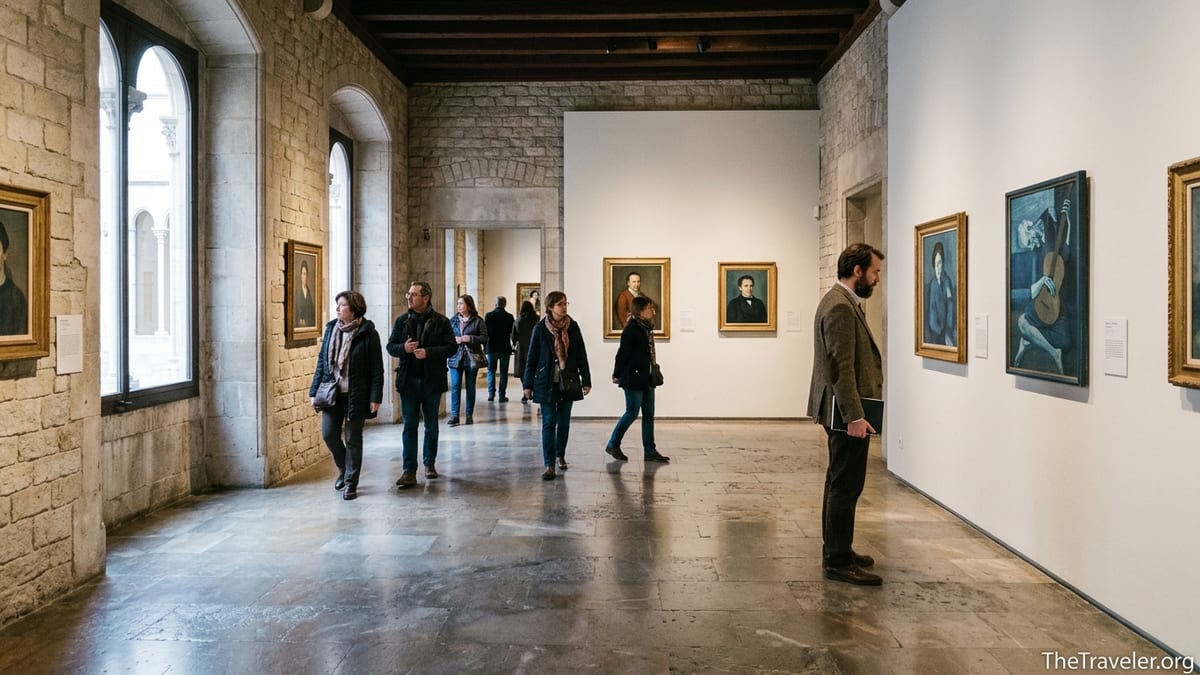
Meeting Picasso in the Gothic Quarter
The Picasso Museum in Barcelona hides in plain sight among five interconnected medieval palaces in the city’s Gothic Quarter. On a weekday morning, you join a slow-moving line of visitors under sandstone arches, just a few minutes’ walk from the buskers and cafe terraces of Carrer de Jaume I. Tickets hover around 15 euros for adults, though early morning and late evening slots often feel calmer, especially outside peak summer. Inside, the city noise fades. Stone courtyards, worn staircases and quiet cloisters set the tone: this is not the bright, white-cube temple of a superstar, but something closer to a walk through time.
That physical setting matters. Picasso moved to Barcelona as a teenager in 1895, living and studying only a few streets from where the museum now stands. It is hard not to feel that echo when you step into the first galleries. These are not the Picasso most people come for. No fractured faces. No weeping women. Instead, glass cases hold sketchbooks; walls show academic studies and oil portraits so polished that some visitors glance twice at the labels, checking that they really were painted by a boy of 13 or 14.
In the first room, I watched a teenager from the United States stand frozen in front of a charcoal study of a plaster cast. His parents murmured something about talent. He shook his head and said quietly, “He was my age.” That sentence landed harder than any biography. Until that moment, Picasso’s early years had felt remote and inevitable, as if genius simply descended one day. Seeing the work up close, in the same neighborhood where he had once rushed between school and studio, suddenly turned the legend into a life.
From the start, the museum feels less like a gallery of highlights and more like a guided walk through the artist’s first 25 years. If you have only seen Picasso as the icon of modern art, this close-up view of his formative decades can be disorienting. That disorientation is exactly what makes a visit here so powerful.
From Prodigy to Person: Academic Studies and Family Portraits
Most travelers know that Picasso was a prodigy, but the museum’s early rooms force you to face what that actually looked like. Here are meticulously shaded plaster busts, classical nudes, and studies of hands and feet that would not look out of place in a 19th century academy. They are disciplined, almost severe. The labels trace how his father, the painter and art teacher José Ruiz Blasco, drilled him in traditional techniques. It feels less like spontaneous genius and more like relentless training, like watching a world-class pianist still doing scales.
One wall of family portraits changed how I understood those years. In a room that many visitors pass through quickly, there is a series of paintings where Picasso tested different approaches to the same familiar faces: his mother in a dark dress, his sister in profile, his own self-portrait with intense, almost defiant eyes. You can literally see him arguing with the conventions he had just mastered. One canvas clings to academic realism, another softens into looser brushwork, and a third flattens the space in a way that hints at modernism to come. It is like watching someone quietly renounce a language they are already fluent in.
Travelers often arrive with famous masterpieces in mind, but here the power lies in what does not quite work. There are slightly awkward compositions, portraits where the anatomy is correct but the emotion is off, and experiments in symbolism that feel heavy-handed. Standing in front of these, I realized how unfair my mental shortcut had been. I had imagined Picasso’s early life as a straight, ascending line toward Cubism, when in reality it was all hesitant curves and stumbles, painted in cramped student studios under leaky Barcelona ceilings.
For anyone who has ever tried to learn something new, this part of the museum hits close to home. You begin to see Picasso not as an inevitable genius but as a young man in a specific city at a specific moment, wrestling with teachers, expectations and rent. The prodigy turns into a person.
Barcelona’s Shadows: The Blue Period in Real Space
The deeper you walk into the museum, the bluer the rooms become, both literally and emotionally. The Blue Period paintings that follow are some of the most haunting in the building. Reproductions do not prepare you for their physical presence. In one gallery, elongated figures of beggars and blind men stretch across tall canvases, the blue pigments shifting from slate to greenish turquoise depending on where you stand. Museum staff keep the light low to protect the works, which only intensifies the atmosphere. Conversations drop to a murmur.
Text panels quietly point out what the paintings do not show: the months Picasso spent shuttling between Barcelona and Paris, the suicide of his friend Carlos Casagemas, the nights in cheap boarding houses and cafes that fed these scenes of poverty and isolation. There is a canvas of a mother clutching a child, faces reduced to simple planes, bodies wrapped in heavy cloaks that look more like stone than fabric. The label mentions approximate dates and locations, but in the room you feel something beyond biography. This is a young artist taking the misery around him and pushing it through a narrow channel of color and line, trying to make sense of it.
Walking here, you also become acutely aware of prices and proximity. Just outside, in the Gothic Quarter, souvenir stalls sell bright prints of Guernica and Cubist portraits, while cafe menus list 3 euro coffees and 5 euro glasses of wine. Inside, you stand in front of paintings born from nights when Picasso could barely afford food. The contrast is jarring. It forces you to think of these blue canvases not only as timeless expressions of melancholy but as products of specific, fragile circumstances: cramped rooms, shared cigarettes, unpaid bills.
For many visitors, this is the moment the “early Picasso” label breaks open. The Blue Period is still early if you judge by his long lifespan, but emotionally it feels fully formed. You start to understand that Picasso’s early years were not a harmless prelude. They carried a weight and darkness that would echo, in different forms, through everything he did afterward.
Experimenting Toward Cubism: Between Barcelona and Paris
After the monochrome gravity of the Blue Period, the next rooms feel like a slow reintroduction of air. Colors return. Compositions start to fracture. Small canvases and sketches trace his experiments with Iberian sculpture, African art and the angular faces that would eventually explode in works like Les Demoiselles d’Avignon. What surprised me was how tentative much of it felt in person. It is one thing to read that Picasso revolutionized the way we see space. It is another to stand in front of the studies and half-finished ideas that led there.
The museum’s chronological layout helps you sense how compressed his early evolution really was. In the space of only a few rooms, you move from academic portraits painted in Málaga and Barcelona to works that lean so far into flat planes and distorted anatomy that they practically shout at the 19th century. Wall texts mention rough dates: around 1906, 1907, 1908. You start mentally counting on your fingers. He was in his mid-twenties, already burning through styles at a pace that would exhaust most careers.
Here the physical act of walking becomes part of the story. The museum forces you to cross thresholds between palaces, up short flights of stairs, along narrow corridors, mimicking the artist’s own shuttling between Barcelona, Madrid and Paris. One minute you are looking at a small oil painted when he was still living with his family; the next you are in front of a canvas created in a Montmartre studio, where rent was low but the stakes were high. The shifts in architecture mirror the shifts in style more powerfully than any diagram in an art history book.
In one corner, a display of simple line drawings of acrobats and circus performers sits opposite bolder, more fractured compositions. It feels like watching someone test how far they can stretch a figure before it breaks. For travelers, this section offers a rare privilege: to stand at the cliff edge just before Cubism, sensing the jump before history names it.
Seeing the City Through Picasso’s Eyes
Leaving the museum, blinking into the Mediterranean light of Carrer de Montcada, it is hard not to see Barcelona differently. The city’s stone alleys, wrought-iron balconies and crowded taverns suddenly feel like part of an invisible archive, the physical backdrop to Picasso’s formative years. If you walk a few minutes toward the old drinking spot Els Quatre Gats, where he met writers and artists, the connection deepens. You start to read the city less as a postcard and more as a stage set that shaped a restless young painter.
Practical details shape this experience too. Many visitors pair the museum with a guided Gothic Quarter walk or a visit to nearby contemporary galleries, turning it into a half-day itinerary that costs less than a modest restaurant lunch. Prices shift by season, but budget-conscious travelers often book timed tickets in advance and aim for late afternoon slots, when cruise ship crowds thin and you can linger longer in front of key works without being jostled. Small things like this matter, because what the museum really offers is not just images but time: time to stand, look and notice how your own assumptions about Picasso begin to crack.
For me, that shift crystallized in a very simple moment. In one of the upper galleries, standing by a window that looks down into a quiet courtyard, I realized that my mental map of Picasso had always started in Paris. Barcelona had been a footnote. After this visit, the order flipped. I now see Paris as the place where an already complicated, Barcelona-hardened painter detonated. The museum had quietly moved the center of gravity of his life back to the streets where he first skipped classes, copied Old Masters in local collections and dared to make his own rules.
Once you start looking at the city this way, other details jump out. A faded tile sign on a corner building recalls an old art supplier. A bar displays vintage photographs of bohemian gatherings that could almost be lifted from the museum’s wall texts. In a city saturated with Instagram-ready views, the Picasso Museum gives you something rarer: a way to imagine Barcelona as seen from inside the mind of a young, ambitious, sometimes desperate artist.
Beyond Barcelona: Connecting Málaga and Paris to the Early Years
Walking through the Barcelona museum also changed how I thought about other Picasso sites in Europe. In Málaga, his birthplace on Spain’s southern coast, the Picasso Museum and the Casa Natal in Plaza de la Merced emphasize the roots that preceded his Barcelona years. Their collections cover everything from early academic studies to ceramics and late variations on Old Masters, all set in a city that shaped his first memories: the light off the harbor, the smell of the sea, the presence of his father’s studio. Having seen the teenage drawings in Barcelona, I could suddenly picture the boy who made them running around Málaga’s narrow streets years earlier.
For travelers tracing Picasso’s life, the route between Málaga, Barcelona and Paris becomes more than a list of museums. Málaga offers the origin story: the child of a provincial art teacher immersed in Andalusian light. Barcelona shows the transformation from student to risk-taker, compressed into a decade of intense growth. Paris, especially the Musée Picasso in the Marais, fills in the long arc of the rest of his life, with thousands of works that follow him through Cubism, politics, love affairs and old age. Visiting Barcelona first recalibrates your expectations for the others. Instead of seeing Málaga as a quaint prelude and Paris as the main event, you start to read all three cities as chapters in a single, messy, continuous experiment.
On a practical level, these places connect easily. Budget airlines link Málaga and Barcelona in about an hour and a half, and high-speed trains or short flights take you from Barcelona to Paris in a few more. Travelers who plan ahead often build a “Picasso triangle” into broader Spain and France itineraries, combining museum visits with local food, beaches in Málaga or the Costa Brava, and longer stays in Parisian neighborhoods near the Marais. You can keep costs reasonable by choosing smaller guesthouses a street or two away from main squares, using city transit passes, and booking museum time slots in advance.
Yet the biggest payoff is not logistical. It is the realization that Picasso’s early years were not confined to a single city or style. They were a moving target stretched across ports and train lines, shaped by family decisions, economic pressures and political tides. Walking through the Barcelona museum provides the clearest spine for that story, but the echoes continue in Málaga’s plazas and Parisian attics.
The Takeaway
Before I walked through the Picasso Museum in Barcelona, I treated Picasso’s early years as a polite introductory chapter, something to skim before turning to the Cubism that supposedly mattered. The museum rearranged that narrative completely. Room by room, it revealed an artist who was less a magician than a worker, less a fixed genius than a young migrant wrestling with training, grief, poverty and ambition in real time.
For travelers, this has practical consequences. Visiting the museum is no longer just about ticking off a famous name. It becomes a lens for understanding Barcelona itself, from the narrow Gothic alleys he once navigated as a student to the cafes where he sketched and argued late into the night. It also reframes other destinations: Málaga shifts from sunny detour to crucial prologue, and Paris becomes the arena where a long, already complicated story explodes into full view.
Most of all, the museum demonstrates the value of slow looking. It rewards those who step away from souvenir stands, accept the entrance fee and commit a few unhurried hours to walking through someone else’s formative years. Somewhere between the academic studies, the blue shadows and the first fractures of Cubism, the legend falls away. What remains is a young man in specific rooms in specific cities, making risky choices with paint. Once you have walked those galleries, it becomes difficult to see either Picasso or his early years the same way again.
FAQ
Q1. Where is the Picasso Museum that focuses most on his early years?
In terms of depth on his formative decades, the Picasso Museum in Barcelona offers the most concentrated look at his youth, from academic training to the brink of Cubism.
Q2. How much time should I plan for a visit to the Picasso Museum in Barcelona?
Most visitors spend between 1.5 and 3 hours inside, depending on how closely they read labels and whether they pause in each gallery or focus on specific periods.
Q3. Do I need to book tickets in advance?
Booking ahead is strongly recommended, especially in spring, summer and on weekends, as timed slots frequently sell out and walk-in lines can be long.
Q4. Is the museum suitable for travelers who are not art experts?
Yes. The chronological layout and clear wall texts make the story accessible, and seeing early academic work first helps newcomers understand later experiments.
Q5. Can I visit the museum with children or teenagers?
Many families do. Older children and teens often respond well to the idea that Picasso was their age when he produced some of the early drawings and portraits on display.
Q6. How does the Barcelona museum differ from Picasso sites in Málaga and Paris?
Barcelona focuses on his early and blue period years, Málaga emphasizes his origins and ties to his birthplace, and Paris presents a broad overview of his entire career.
Q7. What is the best time of day to visit to avoid crowds?
Early morning opening hours and late afternoon slots on weekdays tend to be quieter, though this can vary with school holidays and cruise ship schedules.
Q8. Are there combined experiences with the Gothic Quarter or other nearby attractions?
Yes. Many travelers pair the museum with a guided walk through the Gothic Quarter or visits to nearby galleries and historic sites within a short walking distance.
Q9. Is the museum accessible for visitors with reduced mobility?
The museum occupies historic palaces, but it has made significant efforts to add elevators, ramps and adapted routes. It is advisable to check current access details before visiting.
Q10. Can a visit change how I think about Picasso even if I have seen his work elsewhere?
Many visitors report that seeing his early academic studies, family portraits and Blue Period canvases in sequence profoundly reshapes their understanding of his life and art.