


Booking an airport transfer with Kiwitaxi can feel like ticking a chore off your list: choose a car, enter your flight, pay, and forget about it. Yet again and again, travelers arrive at airports from Antalya to Phuket and discover that the transfer they thought was “all taken care of” is not quite what they expected. The problem is rarely the service itself. More often, it is small booking details that were overlooked before arrival: where exactly to meet the driver, how long they will wait, what counts as “standard luggage,” or how late you can cancel without a penalty. Understanding those details in advance can mean the difference between a smooth arrival and an expensive last-minute taxi scramble.
Get the latest updates straight to your inbox!
Why Kiwitaxi Bookings Trip People Up
On the surface, Kiwitaxi is straightforward: it is an international airport transfer booking service where you reserve a private car or minivan in advance and pay a fixed price for the route you choose. You get a voucher, the driver meets you, and you head straight to your hotel. The complexity starts when you look closely at that voucher and the terms behind it. Small phrases such as “standard luggage,” “waiting time,” or “meeting point indicated in the voucher” carry real consequences if you misunderstand them.
Consider a couple landing in Barcelona after a transatlantic flight. They booked a Comfort class sedan through Kiwitaxi weeks earlier and assume the driver will somehow “find them” in the arrivals hall. In reality, the voucher says the driver will wait at a specific café before the customs exit. The travelers do not notice this line; they walk outside to smoke, wander the terminal, and only check their phones after 40 minutes of confusion. By the time they reach the designated café, the driver has marked them as a no-show and left. Their only option is a metered taxi that costs more than the original fixed fare.
Stories like this are common because people treat a prebooked transfer like a regular street taxi: flexible, informal, and always there. Kiwitaxi works more like a prearranged appointment. The service regulates how long drivers wait, how they meet passengers, and what is included. Travelers who skim the booking details often only learn about those rules when it is too late to adjust.
The good news is that most problems are avoidable. If you know which parts of the booking to examine carefully, you can typically prevent surprise surcharges, disputes about luggage, or missed connections, even in busy destinations like Istanbul, Bali, or Tenerife where arrivals are chaotic and language barriers are real.
Meeting Point & Waiting Time: Small Print, Big Impact
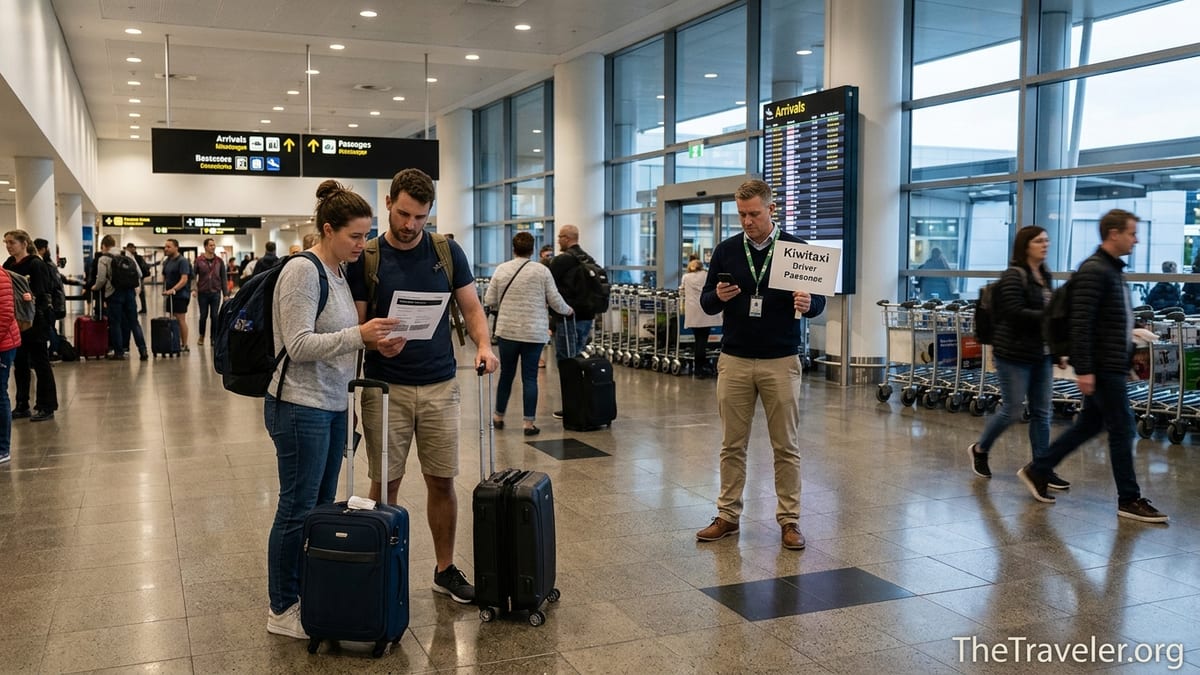
One of the most overlooked parts of a Kiwitaxi booking is the exact meeting point. According to the company’s terms, the driver meets you at the pickup location and waits holding a sign with your name, but the exact spot is defined in the voucher rather than generically “at arrivals.” At many airports, that location is a specific exit door, a designated transfer desk, or a named area, such as a café or column number inside the terminal. If you only look for your name among the cluster of drivers at the main sliding doors, you might miss them entirely.
Waiting time is just as important. For airport pickups, Kiwitaxi generally allows about an hour of driver waiting from the scheduled arrival or time specified in the voucher, while hotel pickups typically include a much shorter waiting window, often around 15 minutes from the time listed in your order. If you land in Rome and linger in duty-free, then queue at immigration without checking the time, you might unknowingly burn through that hour. At smaller airports where baggage comes quickly, a 40-minute delay at passport control can already put you near the limit.
Imagine a family arriving in Antalya on a summer Saturday. Their plane lands on time, but the queue at passport control snakes through the hall. By the time they collect their bags and reach the arrivals area, 65 minutes have passed. The driver, who waited the contractual hour and tried calling the number on the booking, has already left to pick up their next clients. For the family, it feels like the driver did not show up. From the operator’s perspective, it was a no-show. Knowing the waiting time from the voucher in advance would have nudged them to move more purposefully or at least respond quickly to the driver’s call.
The takeaway here is simple: before you fly, open your Kiwitaxi voucher and note two things on your phone or on paper: the exact written meeting point and the included waiting time. Share that with everyone in your group. When you land, get connected to mobile data or airport Wi-Fi and keep your phone available. Many drivers will try to call or message you through the number provided if they cannot spot you; answering quickly can prevent a cancellation even if you are a few minutes late or standing on the wrong side of the terminal.
Luggage, Sports Gear, and What “Standard” Really Covers
Another detail that often causes friction is what counts as standard luggage and what requires advance notice. Kiwitaxi’s guidance is that a car is allocated for a specific number of passengers and a typical amount of luggage. “Standard” usually means one medium suitcase and one small carry-on per person in a sedan. Anything bulky or unusual, such as skis, a snowboard bag, a bicycle, a golf bag, or oversized suitcases, needs to be mentioned at booking so that the right vehicle class can be assigned.
Picture a group of four friends heading to a ski resort near Geneva. They choose a Micro or Economy class vehicle on Kiwitaxi because the price looks attractive, assuming they can simply lay their four large suitcases and four long ski bags across the seats. In practice, a small hatchback or compact sedan allocated to that booking cannot safely or legally carry that volume. When the driver arrives and sees the load, they must either refuse the transfer or call dispatch for a last-minute upgrade to a minivan, usually with an extra on-the-spot charge. What was meant to be a budget-friendly transfer suddenly becomes more expensive and stressful.
Similar issues arise with baby strollers, folding wheelchairs, and musical instruments. One parent might book a standard sedan from Lisbon Airport to Cascais, thinking the folded stroller “doesn’t count” as luggage, only to find that it occupies as much space as a suitcase. Meanwhile, other passengers in the group also brought full-sized checked bags. The driver may manage to fit everything, but only by stacking items higher than they are comfortable with, or they may insist on leaving an item behind for safety reasons.
The practical solution is to review what you plan to bring and compare it to the capacity of the chosen car class. If your group of three is traveling with two surfboards in Bali or a complete set of golf clubs in the Algarve, choose at least a minivan or contact Kiwitaxi support before booking to verify that the vehicle class you want can handle your items. When in doubt, describe your luggage in simple terms: number of suitcases, their approximate size, and any special gear. That short extra step before you pay can save you from repacking on the curb at midnight after a long flight.
Child Seats, Animals, and Other Extras You Must Arrange
Many travelers with children or pets assume that certain extras are automatically available or included in the price. With Kiwitaxi, those extras are possible but generally must be prearranged. Child seats are a classic example. On many routes, you can request an infant seat, child seat, or booster as an added service at the time of booking, sometimes for an extra fee. What you cannot do is arrive in Dubai, Bangkok, or Tenerife and expect the driver to magically produce a correctly sized seat if you never selected that option or notified support.
Real-world complaints from travelers in different destinations show the consequences of this oversight. A family might book a transfer from a Tokyo airport, assuming that “family friendly” cars will carry child restraints by default. When the car arrives, the driver only has the standard seatbelts. The parents face a difficult choice: accept the ride without the level of safety they expected, or cancel on the spot and try to find an alternate service, often at higher last-minute prices.
Transporting animals is another area where specific conditions apply. Under Kiwitaxi’s terms, pets must usually be in appropriate carriers that do not exceed regular luggage size and must be declared in advance. Showing up at Prague Airport with a large dog on a leash and no carrier, without mentioning the pet in the booking, is almost guaranteed to create problems. Some local carriers do not transport pets at all, while others require protective covers on seats and may charge a cleaning fee for shedding or accidents.
If you are traveling with a toddler, a cat, or a small dog, treat their accommodation as a core part of the booking, not an afterthought. Before you finalize the transfer, check if the class of car you are choosing offers child seats as an add-on and whether there is a note about pets. If the booking form is unclear for your route, write to customer support with your date, route, and details, and get confirmation in writing. Keep that confirmation with your voucher on your phone. That way, if a driver arrives unprepared, you have solid grounds to request a resolution or a replacement vehicle.
Flight Details, Delays, and Communication With Your Driver
Kiwitaxi strongly relies on the flight information you enter when booking. Drivers and dispatchers use your flight number to track arrival times and adjust their schedule if the plane lands earlier or later. Problems arise when travelers mistype their flight numbers, enter the wrong arrival time, or change flights without updating the booking. In those cases, the system cannot adjust automatically, and the driver will show up based on the original details while you are still in the air or already on your way home.
Imagine a traveler flying from London to Istanbul. They initially book a Kiwitaxi transfer tied to a midday flight but later rebook onto an evening departure. They assume that once they have new airline tickets, everything “updates” across their trip. In reality, Kiwitaxi still sees the original flight number and time, and the driver arrives in the early afternoon, waits, and leaves. When the passenger lands at midnight and calls support, the driver’s waiting time is already spent on the earlier, incorrect schedule.
Delays are another common trigger for misalignment. If your airline’s app shows a substantial delay long before departure, Kiwitaxi advises that you inform the driver or customer support as soon as possible using the contact details provided just before the transfer date. While many carriers will monitor flight trackers themselves, they cannot see every update for every route and airline in real time. A quick text or call can be enough for dispatch to push your pickup time and avoid the driver marking you as a no-show after waiting in vain.
The mobile phone number on your booking also matters more than many people realize. The terms specify that the number should be switched on and available for incoming calls or messages around the time of the trip. If you arrive in Cancún with your phone in airplane mode and no roaming, the driver has no way to coordinate if they cannot find you at the meeting point. Using a travel eSIM or enabling roaming for at least the arrival day is often worth the small cost, given how much peace of mind it provides during that first hour on the ground.
Payment, Cancellations, and What “Free” Really Means
Many travelers treat transfer bookings as something they can cancel right up until the last minute. Kiwitaxi offers relatively flexible cancellation terms compared with some local taxi companies, but there are still time limits and conditions. Standard practice for common car classes such as Micro, Economy, or Comfort is that you can cancel without a fee up to a certain cut-off before the trip, usually within the range of half a day. Closer to pickup time, partial or full penalties can apply, particularly on busy routes where a driver has already been assigned and may have turned down other work to accommodate your booking.
For example, suppose you prepay a private transfer from Lisbon Airport to Lagos several weeks in advance because it is high season and you want the certainty of a fixed price. Two days before travel, you decide to rent a car instead. If you cancel more than the stated number of hours before pickup, you can usually expect a full or near-full refund to your original payment method. But if you forget to cancel until the morning of travel, Kiwitaxi will likely treat it as a late cancellation and keep part or all of the fare as a service fee, even if the driver has not yet left for the airport.
Payment methods and currencies are another subtle point. Kiwitaxi allows you to pay online in the currency shown at checkout or, for some bookings, pay cash to the driver on arrival. With cash payments, any conversion usually follows local exchange rates at the destination, which can differ from what you expected when you saw the price quoted in your home currency. A traveler from the United States might see a fare listed roughly equivalent to 60 dollars when booking a transfer in Thailand, then be asked for a round amount in local currency on arrival, slightly more or less than what their card would have charged due to exchange rate movements.
To avoid surprises, read the payment section of your voucher carefully. Note whether you have already paid in full or only a deposit, and whether anything is due in cash at the end of the ride. If you value maximum flexibility, choose a fully prepaid option with a clear cancellation window and set a reminder to review your plans before that deadline. If you prefer to limit your upfront commitment, accept that a pay-on-arrival booking may expose you to exchange rate quirks and stricter rules if you cancel at short notice.
Real-World Booking Scenarios to Learn From
It helps to look at a few concrete booking scenarios and how small details change the outcome. Take a solo traveler flying to Phuket for a beach holiday. She chooses Kiwitaxi over hailing a taxi because she does not want to negotiate prices at midnight. She books an Economy class sedan, enters her flight number, and pre-pays. In the comments field, she writes that she will not have checked luggage. The driver’s waiting time is one hour, and because she passes quickly through immigration with only a backpack, they are already on the road 25 minutes after landing. The transfer costs only slightly more than a regulated airport taxi, but the experience is smoother and less stressful.
Contrast that with a small group heading to a villa outside Split. They book a Minibus class because they are eight people but do not mention that they will each bring two large suitcases and several boxes of supplies for a long stay. When the minibus arrives, the driver realizes the luggage volume is far beyond what the vehicle can carry safely. Dispatch scrambles to send a second car at an additional charge, or the group is forced to leave boxes behind and return later by local taxi. If they had accurately counted and described their luggage, they could have reserved two vehicles from the start or upgraded to a larger category.
Another example involves a family traveling with an infant from Athens to a coastal resort. They correctly request an infant seat when booking, paying the modest additional fee, and they receive confirmation on the voucher. At pickup, the driver initially arrives without the seat. Because the family has the confirmation in writing, they contact Kiwitaxi support immediately. A replacement car arrives with the promised seat, and although they wait a bit longer than planned, they do not pay extra and retain the right to complain if the delay causes them tangible loss. Without that explicit note on the booking, their position would be weaker.
Finally, consider a business traveler landing in Milan on a tight schedule for a meeting. She books a transfer with Kiwitaxi, but on the day of travel, her original flight is canceled and the airline rebooks her on a later service. She is juggling emails and work issues and never updates her transfer booking. The driver shows up at the time indicated on the voucher, waits the agreed hour with no response to calls, and leaves. When she lands later, she finds emails from Kiwitaxi about a no-show and a partially or fully forfeited fare. The lesson is simple yet often ignored: when any major piece of your trip changes, treat your transfer like a separate reservation that also must be updated.
The Takeaway
Kiwitaxi can be an effective way to secure a reliable, fixed-price transfer almost anywhere in the world, especially when you are arriving late at night, carrying bulky luggage, or traveling with children. Most negative experiences trace back not to the concept of prebooked transfers but to travelers skipping the fine print on their booking and assuming that the service will flex like a city taxi.
Before you finalize any Kiwitaxi reservation, pause and read your voucher line by line. Note the precise meeting point, the included waiting time, the luggage assumptions, and any extras such as child seats or pet carriage rules. Double-check that your flight number and arrival time are correct, ensure your phone will be reachable on landing, and understand the cancellation window tied to your payment choice. Applying this bit of discipline takes only a few minutes when you book, yet it can save you from missed pickups, awkward disputes with drivers, and unexpected extra costs in the arrivals hall.
Ultimately, an airport transfer is part of the first impression you form of a destination. By treating your Kiwitaxi booking like a small contract rather than a casual taxi hail, you stack the odds in favor of a calm, predictable arrival where the only surprise is how quickly you are on your way to enjoy your trip.
FAQ
Q1. Where will my Kiwitaxi driver meet me at the airport?
The meeting point is specified in your voucher and may be a particular exit, column, desk, or café, not just “arrivals,” so read it carefully before you travel.
Q2. How long will my Kiwitaxi driver wait for me after landing?
For airport pickups, drivers typically wait around an hour from the time stated in the voucher, while hotel pickups often include a shorter waiting time, so check your specific booking.
Q3. What happens if my flight is delayed?
If your flight is delayed, drivers may adjust based on flight tracking, but you should also inform Kiwitaxi or the driver as soon as you learn of a significant delay to avoid being marked a no-show.
Q4. How much luggage is included in a standard Kiwitaxi booking?
Standard bookings usually allow one medium suitcase and one small carry-on per person in a sedan; extra or bulky items may require a larger vehicle class or advance approval.
Q5. Can I bring skis, bikes, or other sports equipment on a Kiwitaxi transfer?
Yes, but you must mention large or unusual items when booking so that an appropriate vehicle is assigned, otherwise the driver may refuse them or charge for an on-the-spot upgrade.
Q6. Are child seats included automatically in Kiwitaxi transfers?
No, child seats are generally an optional extra that you must request during booking; if you do not add them in advance, the driver may not have any on board.
Q7. Can I travel with a pet on a Kiwitaxi transfer?
In many cases you can, provided the pet is in a suitable carrier and you declare it in advance, but local rules and vehicle policies vary, so confirm before paying.
Q8. How flexible are Kiwitaxi cancellation terms?
You can usually cancel for free up to a certain number of hours before pickup for common car classes, but late cancellations or no-shows may incur partial or full charges.
Q9. Do I have to pay anything extra when I arrive?
If you chose a prepaid option, the fare is typically fully covered; if you selected cash payment or added extras locally, you may need to pay the driver in the local currency on arrival.
Q10. What should I do if I cannot find my driver at the meeting point?
Stay at the exact meeting location shown on your voucher, ensure your phone is on, and contact the driver or Kiwitaxi support immediately; leaving the area makes it harder to resolve and can lead to a no-show classification.