


More news on this day
Fast-moving wildfires along British Columbia’s Okanagan Lake have prompted a provincial state of emergency and forced more than 20,000 people to evacuate, disrupting peak summer tourism and casting uncertainty over one of Canada’s premier wine regions.
Get the latest news straight to your inbox!
State of Emergency as Bald Range Fire Races Toward Lakeside Communities
Publicly available information indicates that British Columbia declared a provincewide state of emergency on August 8, 2026, after the Bald Range wildfire, burning above Okanagan Lake, expanded rapidly and cut across key corridors near Summerland and Peachland. Reports describe the fire as fast moving, with perimeter maps from the B.C. Wildfire Service showing burned areas pushing down-slope toward lakeside neighbourhoods and reaching the shoreline in places.
Coverage from national and international outlets notes that more than 20,000 residents and visitors have been ordered to leave or placed under evacuation orders in a region that is heavily dependent on summer travel. Entire neighbourhoods in and around Summerland have been cleared, while nearby Peachland and rural areas toward Faulder and Prairie Valley have seen expanding alert and order zones as winds shift and embers jump containment lines.
Local emergency bulletins describe the Bald Range fire as out of control, with growth from a relatively small ignition on Friday evening to tens of square kilometres within just a few hours. Warm temperatures, low humidity and persistent drought over recent seasons have created highly volatile conditions in forested hillsides above the lake, echoing patterns seen during previous severe fire years in the Okanagan.
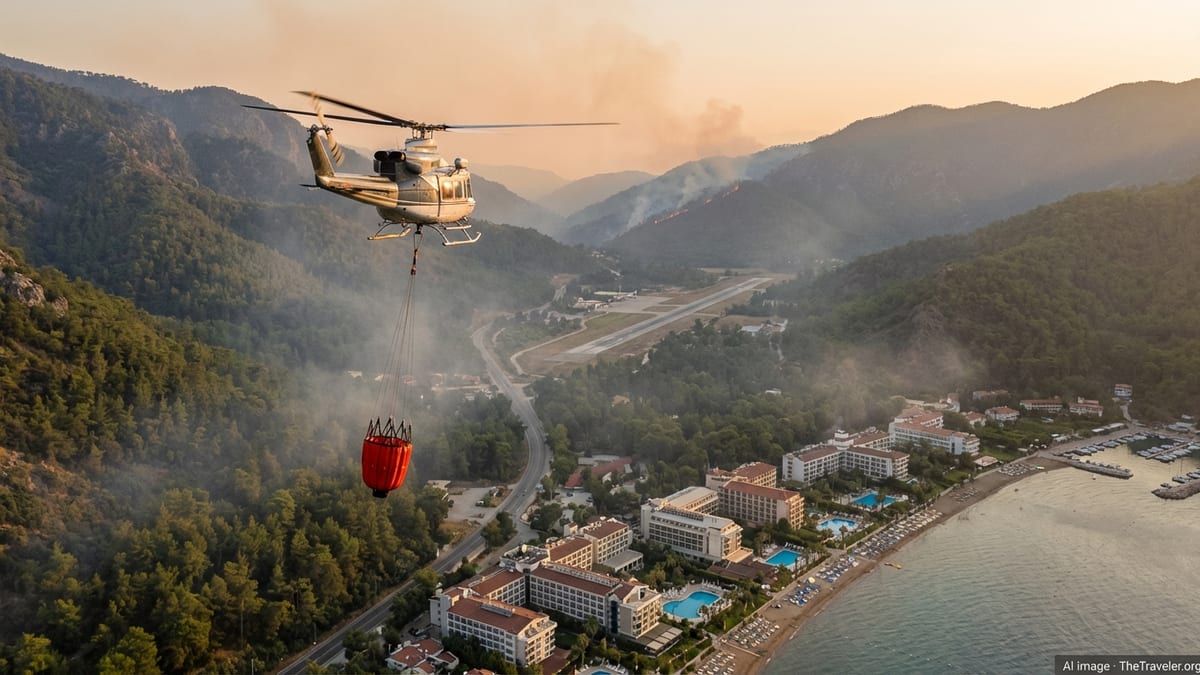
While fire crews work to establish containment on multiple flanks, air tankers and helicopters have been used to protect critical access routes and residential pockets. Evacuation routes along the lake have remained a central concern, with aerial rescues reported where roads were temporarily threatened or visibility declined due to heavy smoke.
Summerland and Surrounding Towns Empty Out at the Height of Tourist Season
The timing of the evacuations is particularly disruptive. August is typically the height of the tourism calendar in the South Okanagan, with lakefront motels full, campgrounds at capacity and wineries hosting tastings, weddings and events. This year, the same communities that usually absorb vacation crowds are instead handling lines of vehicles leaving under evacuation order.
Residents posting on community forums and regional information sites describe scenes of packed highways, full reception centres and a scramble for pet-friendly accommodation as entire streets leave simultaneously. Some evacuees are reported to have moved south toward Penticton or north toward Kelowna, while others have sought shelter further afield in the Interior or Lower Mainland as available rooms near the fire zone tighten.
The mass movement of people is already reshaping travel patterns across the valley. Regional tourism operators note that areas not directly under threat are seeing a mix of cancellations and last-minute bookings from displaced visitors. In some cases, hotels that would normally be hosting leisure travelers are instead accommodating evacuees and emergency personnel, reshuffling revenue expectations for the crucial late-summer window.
Communities beyond the immediate fire perimeter are also preparing for potential secondary impacts. Public advisories highlight the possibility of smoke incursions into major resort towns along Okanagan Lake, which can lead to beach closures, reduced outdoor activity and a sharp drop in day-use visits even in places where infrastructure remains untouched by fire.
Wine Country Faces Crop Risk, Staffing Gaps and Reputation Challenges
The Okanagan’s wine industry, concentrated along the benches and slopes above the lake, faces a complex set of risks as the Bald Range fire evolves. While not all vineyards lie within current evacuation zones, many are clustered near the hillside interface where fire behaviour can change quickly, prompting precautionary closures and relocations of staff.
Wine sector analysts and regional business associations note that even where vines and facilities are spared from direct damage, smoke exposure during key ripening periods can affect grape quality and future vintages. Past fire seasons in British Columbia and other wine regions have shown that extended smoke events can lead to difficult decisions about which lots are suitable for premium bottlings and which must be downgraded or discarded.
Short-term labour disruptions are another concern. Seasonal staff who typically support tasting rooms, harvest preparations and hospitality operations may themselves be under evacuation order or dealing with housing uncertainty. That can complicate everything from vineyard canopy management to event hosting, just as wineries rely on summer foot traffic and direct-to-consumer sales to balance annual budgets.
Industry observers also point to reputational impacts. The Okanagan has spent decades cultivating an image as a sunny, lakefront destination for wine and outdoor recreation. Repeated summers dominated by images of wildfires and smoke can influence traveler perceptions and long-term booking patterns, prompting some visitors to look toward alternative regions or seasons if they view August as increasingly unpredictable.
Travel Plans Upended as Visitors Weigh Safety, Ethics and Flexibility
The wildfires are arriving in what is already a packed travel period, leaving many visitors with active reservations in a difficult position. Online discussion boards and travel forums show would-be tourists asking whether to cancel trips outright, reroute to unaffected communities or postpone visits until conditions stabilize.
Publicly available travel advisories from provincial and regional agencies emphasize that conditions can change quickly and that travelers should avoid entering active evacuation zones or areas under travel restrictions. At the same time, some municipal statements and local business campaigns suggest that in destinations outside the immediate fire footprint, visitors who can travel safely still play a role in sustaining small businesses that rely on summer revenue.
For many households, the ethical dimension is as salient as the safety question. Prospective visitors express concern about competing with evacuees for scarce hotel rooms, campsite spots and short-term rentals. Accommodation providers in parts of the valley report redirecting available inventory to emergency support services, while others are offering flexible rebooking or credits for future stays to loyal customers.
Transport disruptions add another layer of uncertainty. Smoke can affect visibility on highways and in the air, while temporary closures around fire zones may lengthen travel times or require detours through unfamiliar routes. Travelers are being urged in public messaging to monitor conditions closely and to build contingency time into itineraries as the situation unfolds.
A Region on the Front Line of a Growing Wildfire Era
The current evacuations join a series of major wildfire emergencies that have affected the Okanagan over the past two decades, including the 2003 Okanagan Mountain Park fire and the 2023 McDougall Creek fire. Historical records and government assessments show that previous events led to thousands of evacuations, hundreds of homes lost and prolonged smoke episodes across the valley.
Climate assessments prepared for British Columbia point to longer fire seasons, more frequent extreme heat events and persistent drought stress across interior forests and rangelands. For tourism-reliant regions such as the Okanagan, those trends translate into a recurring tension between peak visitor periods and heightened fire risk, particularly in August when hot, dry conditions often converge.
Local planning documents and academic research on the province’s wine sector indicate that adaptation efforts are already underway, from fuels management near communities to investments in water storage, smoke monitoring and insurance coverage tailored to agritourism businesses. Yet the scale of the current evacuations underscores how quickly conditions can outpace preparations, especially along the wildland-urban interface where homes, vineyards and resorts sit close to forested slopes.
As the Bald Range wildfire continues to burn, the immediate priority for communities along Okanagan Lake remains protecting life and property. Longer term, the events of early August 2026 are likely to fuel renewed debate over land-use planning, emergency accommodation capacity and the future shape of tourism and wine production in one of Canada’s most visited interior landscapes.