


Few places ignite travel fantasies quite like Capri. The cliffs, the Blue Grotto, the bobbing yachts in Marina Grande all suggest a Mediterranean dream. Yet in recent years, Capri has also become shorthand for overtourism: dense day-trip crowds, high prices and long queues for everything from ferries to funiculars. So is Capri still worth visiting in 2026, or has the island tipped into tourist trap territory?
Get the latest updates straight to your inbox!
Capri Today: Beauty, Buzz and Big Crowds
Capri is not a quiet secret. On peak summer days, tens of thousands of visitors pour onto an island that measures barely 10 square kilometers. An OECD report on tourism in Campania notes that Capri has experimented with daily visitor caps in response to pressure on local infrastructure, a clear sign that the island’s popularity has outgrown its capacity in high season. In June 2024 the mayor even briefly banned new tourists from landing during a water crisis, underlining how fragile the balance has become between visitors and resources.
For travelers, this translates into very concrete experiences. Ferries from Naples and Sorrento run constantly between April and October, with summer schedules offering well over 20 daily crossings from Naples and around 10 from Sorrento. Typical one-way fares hover around 20 to 25 euros per person, plus seasonal port taxes. On weekends in July and August, it is common to find midday departures sold out well in advance and boarding areas at Molo Beverello in Naples or Marina Piccola in Sorrento packed shoulder to shoulder as multiple tour groups jostle for the same hydrofoil.
Once you land in Marina Grande, the bottlenecks continue. The funicular that links the port to Capri town, the main hub on the island, can draw snaking queues under the midday sun. Buses up to Anacapri, perched higher on the western side, often depart full, with standing room only at peak times. It is no exaggeration to say that between about 10:30 a.m. and 4:30 p.m. in midsummer, the most central parts of Capri feel less like a glamorous escape and more like a luxury shopping mall on a holiday weekend.
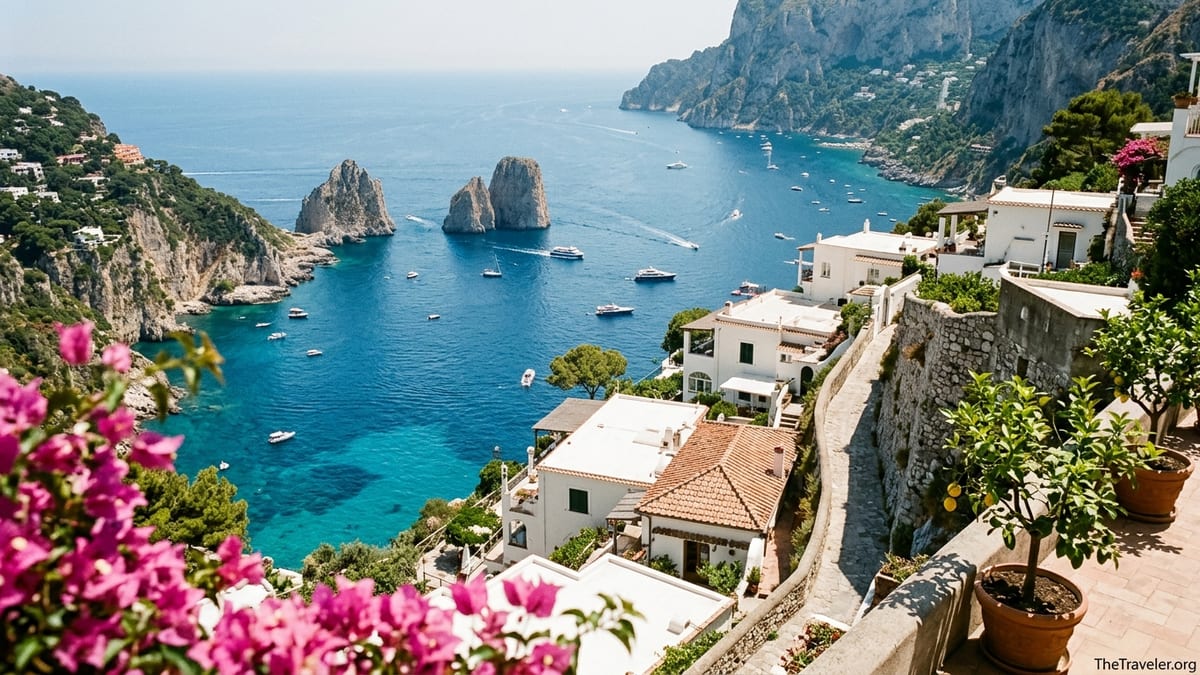
Yet in the middle of all that, the island’s physical beauty remains undeniable. From viewpoints like the Belvedere Tragara, the Faraglioni sea stacks rise from luminous water that shifts from cobalt to turquoise as clouds move overhead. Even travelers who later complain online about the crowds still call Capri “the highlight” of an Italy trip because those coastal vistas, terraced gardens and lemon-scented lanes deliver exactly the Mediterranean dream they imagined.
Prices, Logistics and the Real Cost of the Hype
Capri is expensive by Italian standards, and the cost becomes part of the crowd-control mechanism. Ferry tickets from Sorrento to Capri in 2026 generally start at roughly 21 to 25 euros one way on high-speed boats, with faster hydrofoils sometimes charging a few euros more on evening crossings. From Naples, expect a similar range, usually from about 19 to 25 euros for the 45 to 70 minute trip depending on the vessel and time of day. Adding return tickets for two people, plus port levies, it is easy to spend 90 euros or more before you have even bought a coffee on the island.
On arrival, more costs stack up. The funicular from Marina Grande to Capri town runs a few euros each way. Taxis, often the classic open-top Capri cabs, charge premium island rates; even a short hop between Marina Grande and Capri town can feel steep compared with mainland prices, and private transfers to Anacapri or the island’s luxury hotels can easily reach several dozen euros. A straightforward lunch of seafood pasta and a glass of wine in Capri town frequently runs 25 to 35 euros per person before dessert, and a simple espresso in a bar facing the famous Piazzetta might cost double what you would pay in nearby Naples.
Activities are not cheap either. The chairlift from Anacapri up Monte Solaro, a must for the island’s best panorama, costs in the region of 14 euros for a round trip. Shared boat tours that circle the island, often lasting around two hours and sometimes including a swim stop, tend to start around 20 to 30 euros per person. If you want a private skipper with a small gozzo-style boat for a couple of hours in July or August, you are likely looking at a few hundred euros, although groups of four or six often find that splitting the cost makes it comparable to a day of ferries and tours for everyone.
None of these prices are shocking for a high-demand Mediterranean resort, but Capri rarely offers “value” in the way a traveler might feel in nearby Sorrento or in a neighborhood trattoria in Naples. Many visitors come away feeling they spent a lot of money mostly to stand in lines and navigate crowds. The key question is whether you can tilt the equation back in your favor by how and when you visit.
When Capri Feels Overwhelming: Peak Season Pitfalls
The most common negative Capri stories share the same ingredients: a high-season day trip, late-morning arrival, and a focus on the island’s most popular spots at exactly the same time as everyone else. Travelers describe stepping off a packed ferry around 11 a.m., queuing 30 to 45 minutes for the funicular under a blazing sun, then emerging into Capri town to find every narrow street around the Piazzetta clogged with group tours following raised umbrellas.
From there, some try to reach Anacapri using the public bus system. In July and August, buses can be so crowded that a line of passengers is left behind at each departure. Those unwilling to wait are sometimes quoted 30 euros or more for short taxi rides, especially when demand surges in the early afternoon. What could feel like a leisurely island escape can quickly turn into a logistical puzzle: watching the clock to ensure you do not miss your return ferry while calculating how much buffer time you must leave to get down from Capri town through the funicular bottleneck.
Overtourism also takes a toll on specific attractions. The Blue Grotto, Capri’s most famous sea cave, is a perfect example. Reaching it involves either a boat trip around the island or a combination of bus and a steep walk down to the cave entrance. At the mouth of the grotto, visitors transfer into tiny rowboats that slip through a low opening in the rock. In calm, clear conditions, the experience can be magical. But in practice, high seas frequently close the grotto for days at a time, as travelers discovered repeatedly in summer 2024 when choppy water kept operations suspended for nearly a week in a row. When the cave is open during peak season, wait times bobbing in the sun outside the entrance can stretch into well over an hour.
For some visitors, especially those with limited time, mobility concerns, or low tolerance for crowds, these realities turn Capri into a “never again” destination. Stories circulate online of travelers who canceled longer Amalfi Coast plans after facing intense congestion in Capri and nearby hotspots, choosing instead to shift to quieter regions of Italy. If your idea of a holiday is unhurried strolling and uncrowded swims, a peak-season day trip to Capri may feel like poor value for the stress involved.
How to Experience Capri Without Being Crushed by Crowds
Capri is not inherently a tourist trap; it is an island with finite space hosting more people than it can comfortably absorb for a few hours each summer day. Travelers who have a positive experience usually make two strategic decisions: they visit outside of the absolute peak, and they organize their day to avoid moving with the pack. This does not eliminate crowds, but it changes how much of your time is spent fighting them.
Timing is the single biggest lever. From late June through early September, the busiest window is late morning to late afternoon. Arriving on the first or second ferry of the day from Sorrento or Naples, often between about 7:00 and 8:30 a.m., means landing in Marina Grande before most organized tours. At that hour, it is often possible to walk straight onto the funicular or catch a bus with minimal waiting. By contrast, arriving around 10:30 a.m. is almost a guarantee of queues and jostling.
Route planning also matters. Many seasoned visitors suggest heading straight to Anacapri on arrival and saving Capri town for late afternoon, after the day-tripper surge begins to depart. Anacapri, with its quieter lanes and whitewashed houses, feels more like a lived-in town than a luxury showcase. From the center, you can ride the chairlift up to Monte Solaro when lines are still short, take in a 360-degree view of the Bay of Naples and the Amalfi Coast, and then walk back down or linger at a café without the midday crush.
Another way to reshape the experience is to stay overnight on Capri. Accommodation prices are undeniably high, but spending one or two nights gives you access to the island at its best: early mornings before the ferries arrive and evenings after the last hydrofoils leave around 6 or 7 p.m. Locals estimate that a large majority of visitors leave by early evening, which means that by 8 p.m. the streets around the Piazzetta and Via Camerelle transform from jammed to merely lively. Dinner on a terrace overlooking the Faraglioni or a twilight walk to Punta Tragara feels like a different island compared with lunchtime chaos.
Hidden Corners and Alternatives to the Usual Capri Circuit
Even on a busy day, it is possible to step away from the thickest crowds by choosing the right corners of Capri. Instead of lingering around the luxury boutiques off the Piazzetta, follow side streets toward Villa Jovis or the Pizzolungo trail. Within 10 or 15 minutes of walking, designer shop fronts give way to residential lanes edged with stone walls, bougainvillea and glimpses of sea through iron gates. These areas still see visitors, but you are more likely to pass gardeners and locals doing errands than large tour groups.
On the western side of the island, the Punta Carena lighthouse area is a favorite for those who want to swim and sunbathe without the chic beach club prices of Marina Piccola. While there are basic services and a couple of simple bars, much of the rocky shoreline remains open to the public, with ladders leading into deep, clear water. Late afternoon here, as the sun drops behind Ischia, offers a completely different atmosphere from the midday frenzy near the main port.
For walkers, the Sentiero dei Fortini (Fortresses Path) runs along parts of the rugged coastline between a series of old defensive outposts on the western coast. This trail is far less trafficked than the main shopping streets, especially in the early morning. It demands decent footwear and a tolerance for steps and uneven surfaces, but rewards with sea views that rival any postcard of Capri while allowing you to hear waves and cicadas instead of loudspeakers and rolling suitcases.
That said, travelers who strongly dislike crowds sometimes find greater satisfaction on nearby islands that share Capri’s sea and climate with fewer visitors. Ischia, much larger and more residential, offers thermal spas and sandy beaches with a more relaxed, year-round feel. Procida, with its pastel harbor of Corricella, charms many visitors precisely because it lacks the luxury gloss of Capri. Ferries from Naples connect to all three islands, so you could easily choose Capri for a focused day of views and then base yourself on Ischia or Procida for a calmer stay.
Is Capri Worth It for You? Matching Expectations to Reality
Whether Capri is “worth it” depends less on the island itself and more on your expectations and travel style. If you imagine a sleepy, undiscovered fishing village, you will be disappointed. Capri today is a polished resort where global wealth converges: mega-yachts at anchor, flagship designer stores, and hotels whose nightly rates surpass many travelers’ weekly budgets. The infrastructure strains at times, and the island can feel like a stage set in which guests, staff and residents all play familiar roles.
On the other hand, if your goal is to see one of the most iconic coastal landscapes in Europe, and you accept that you will share it with thousands of other admirers, Capri can absolutely deliver a memorable day. Standing at the Belvedere of Villa San Michele in Anacapri, or watching late afternoon light catch the stone of the Faraglioni from a viewpoint near Via Tragara, it is difficult to argue that the island is overrated. The problem is not the scenery. It is the pressure of too many people trying to enjoy the same small spaces at the same times.
Consider your itinerary and budget. A traveler with ten days in southern Italy and a strong interest in landscapes might reasonably devote one to Capri, particularly in May, early June or late September when temperatures are pleasant and crowds slightly thinner. Someone visiting in late July with only three days based in Naples might decide that a relaxed day in the historic center, or a slower trip to Procida, offers a better balance of effort and reward. Families with young children or travelers with mobility limitations should pay particular attention to Capri’s steep streets, steps and reliance on crowded public transport up and down the hills.
In short, Capri is worth visiting if you treat it like an intense, curated experience rather than a casual seaside stroll. Plan around the peaks, be realistic about costs, and decide in advance what matters most: a view from Monte Solaro, a swim under the cliffs, an evening aperitivo in the Piazzetta once the day-trippers have left. You may still encounter lines and jostling, but you are more likely to leave with a set of strong memories rather than a single word: “overrated.”
The Takeaway
Capri in 2026 is both the dream and its own warning label. The island remains physically stunning, with cliffs that plunge into clear water, whitewashed towns and legendary viewpoints that draw travelers back decade after decade. At the same time, its popularity has pushed local infrastructure to the limit, prompting authorities to experiment with visitor caps and even, in crisis moments, to halt tourist arrivals altogether. For unprepared day-trippers arriving in the middle of a July afternoon, the experience can be more about surviving queues than savoring scenery.
If you arrive early or stay late, explore beyond the luxury storefronts, and accept Capri for what it is a compact, ultra-desirable island hosting far more guests than it was built for you can still find real magic here. Anacapri’s quiet backstreets, swims at Punta Carena, sunrise ferries across a glassy Bay of Naples, and evening walks once the last hydrofoil has gone all reveal facets of Capri that justify the hype. The island will probably never be a bargain or a secret again, but for many travelers, a carefully planned visit remains a highlight of southern Italy rather than a regret.
Ultimately, the question is not whether Capri is too crowded in an absolute sense. It is whether its crowds, costs and logistics fit your personal definition of a worthwhile travel day. Go in with clear eyes and a flexible plan, and Capri is likely to earn its place on your itinerary. Go expecting an untouched refuge, and you may find yourself looking wistfully across the water toward quieter shores.
FAQ
Q1. Is Capri still worth visiting in 2026 despite the crowds?
Yes, for many travelers Capri is still worth visiting if you plan carefully. The scenery, from the Faraglioni rocks to Monte Solaro, remains spectacular, but you should expect high prices and dense crowds in summer. Arriving on early ferries or staying overnight instead of doing a midday day trip can dramatically improve the experience.
Q2. When is the best time of year to visit Capri to avoid the worst crowds?
The shoulder seasons of May, early June and late September are generally the most comfortable compromise between good weather and manageable visitor numbers. July and August see the heaviest crowds and hottest temperatures, while March, April and October can be quieter but come with more unpredictable ferry schedules and possible attraction closures.
Q3. Is a day trip to Capri from Naples or Sorrento enough time?
A day trip is enough to see a slice of Capri, but it will be busy and rushed in peak season. If you catch an early ferry, focus on either Anacapri or Capri town plus a short boat tour, and avoid trying to do everything. Staying one or two nights allows you to enjoy mornings and evenings when most day-trippers are not on the island.
Q4. How much should I budget for a typical day on Capri?
As a rough guide, a return ferry from Naples or Sorrento, funicular or bus rides, a mid-range lunch, a chairlift or boat tour and a couple of coffees or drinks can easily total 120 to 180 euros per person in high season. Costs can be trimmed by choosing simpler cafés, skipping certain paid attractions, or splitting a private boat among several people.
Q5. Is the Blue Grotto really worth the time and money?
Opinions are mixed. On a calm, sunny day, the Blue Grotto’s glowing blue water can be unforgettable, but the cave often closes when seas are rough, and in summer waiting times outside the entrance can be long. The total cost of boat transfers and the short rowboat ride adds up quickly. If you have limited patience for queues or a tight budget, a general boat tour around the island may offer better value.
Q6. Are there quieter areas of Capri where I can escape the crowds?
Yes. Anacapri’s residential streets, the paths toward Villa Jovis and the Pizzolungo trail, and the Punta Carena lighthouse area are all notably calmer than the Piazzetta and main shopping streets. Visiting these spots early in the day or late in the afternoon makes it easier to enjoy Capri’s landscapes without constant jostling.
Q7. Is it better to stay overnight on Capri or base in Sorrento or Naples?
Staying overnight on Capri is more expensive but lets you enjoy the island when it is at its most pleasant: early mornings and evenings. Basing in Sorrento or Naples is usually cheaper and offers more dining and transport options, but it means dealing with ferry schedules and mid-day congestion. Many travelers choose to base on the mainland and spend one carefully planned day on the island.
Q8. How difficult is it to get around Capri if I have mobility issues?
Capri is challenging for travelers with limited mobility. The island is steep, with many steps and sloping streets, and public transport can be crowded. Taxis can reduce walking but are costly. If mobility is a concern, it is important to research hotel locations carefully and plan for extra time and budget to move around more comfortably.
Q9. Are there good alternatives to Capri with fewer crowds?
Yes. Nearby Ischia offers thermal spas, larger beaches and a more local, spread-out feel, while Procida charms visitors with colorful fishing villages and fewer luxury shops. Both are accessible by ferry from Naples and can be more relaxed bases for exploring the Bay of Naples, with Capri visited as a focused day trip if desired.
Q10. Do I need to book ferries and tours to Capri in advance?
In July and August, and on weekends in late spring and early autumn, it is wise to book ferries and popular tours ahead of time, especially morning crossings from Naples or Sorrento. In shoulder seasons and on weekdays, same-day tickets are often available but not guaranteed at peak times. Booking a day or two in advance reduces the risk of sold-out departures and helps you structure your time on the island.