


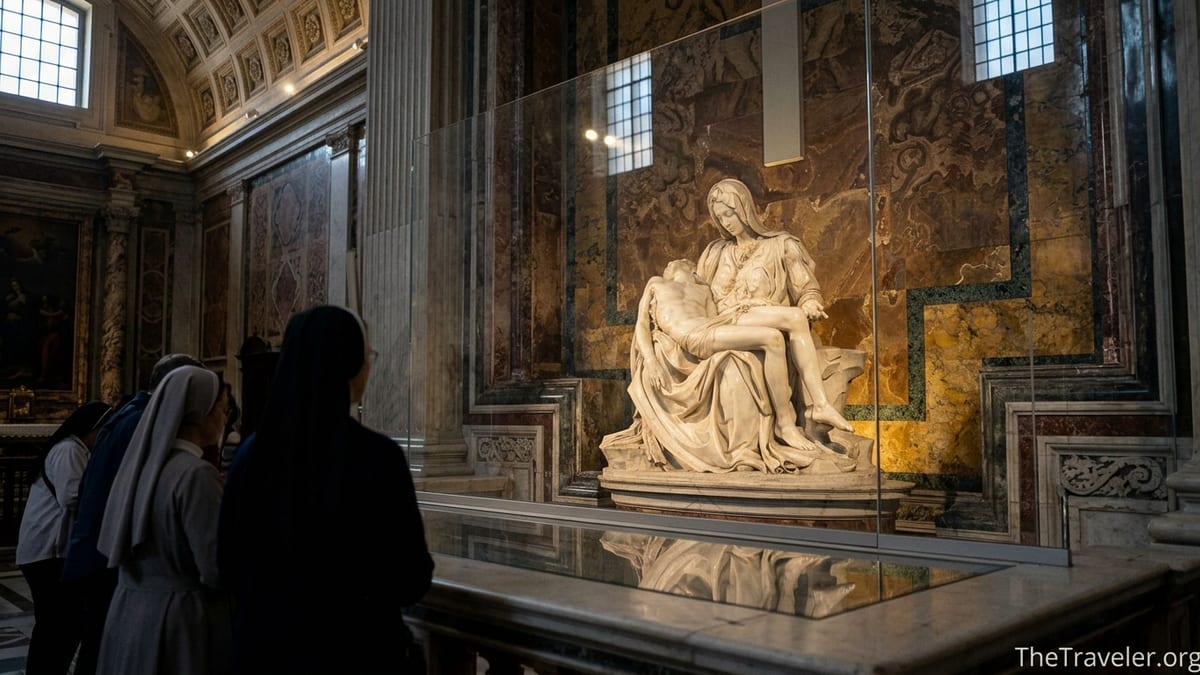
Walk into St Peter’s Basilica in Vatican City and before the vast nave, the glittering altars and Bernini’s soaring baldachin fully register, your eye is pulled to a quiet side chapel on the right. Behind clear security glass, Michelangelo’s La Pietà sits in cool marble stillness: Mary cradling the lifeless body of Christ. Created around 1498–1499 by a sculptor barely in his mid‑twenties, this single block of Carrara marble still stops millions of visitors in their tracks every year, often leaving them whispering, weeping or simply stunned into silence. Understanding why this sculpture remains so powerful can deeply enrich a visit to Rome, transforming a quick photo stop into one of the most affecting moments of a trip.
Get the latest updates straight to your inbox!
A First Encounter: Why Travelers Freeze in Front of La Pietà
Most visitors meet La Pietà less than five minutes after entering St Peter’s Basilica. Guided groups peel off to the right, individual travelers drift toward the subtle glow of the chapel, and almost everyone slows down as the white marble emerges from the dimness. Even if you have seen the sculpture in textbooks, on museum tote bags or in airport souvenir shops, the real thing often feels smaller than expected, yet far more intense. Travel writers frequently report that groups of chatty tourists fall abruptly quiet here, and it is common to see people step back from the railing with red eyes, surprised by their own reaction.
Part of the impact comes from how the sculpture is staged. Since a highly publicized hammer attack in 1972, the Vatican has kept La Pietà behind bulletproof glass. Today, a new barrier system with clearer, shatterproof panels allows visitors to see the work more sharply while still protecting it. The glass creates a slight separation that underscores the sense that this is not just another artwork in a busy church. It feels almost like visiting a patient in intensive care: close enough to see every detail, distant enough that you are hyper‑aware of your own breathing and footsteps.
Travelers often compare La Pietà to Michelangelo’s David in Florence, another must‑see Renaissance masterpiece. Yet where David, standing alone in the Galleria dell’Accademia, radiates heroic defiance, La Pietà radiates intimacy and loss. Visitors who have just rushed across Rome on the metro or queued in the hot Vatican colonnades suddenly find themselves facing a mother holding her dead son. The emotional whiplash can be intense. Many describe leaving the chapel and needing a few minutes in the side aisles of the basilica simply to process what they have seen.
Michelangelo’s Bold Vision: Youthful Mary, Silent Grief
When a French cardinal commissioned the sculpture in the late 1490s for a chapel in the old St Peter’s, he asked Michelangelo to create the most beautiful work in Rome. The subject was traditional: the Virgin Mary mourning her son after the Crucifixion. Yet Michelangelo made several daring decisions that still shape how modern viewers respond. Most striking is Mary’s face. Instead of an older woman worn down by suffering, she appears serenely youthful, with smooth cheeks and a calm, almost inward‑turned gaze. Art historians point out that Michelangelo believed inner virtue could preserve a person’s outward beauty, and here he makes that belief tangible in stone.
For travelers who are parents, the youthfulness often lands with particular force. Standing in the crowd, you may overhear whispered comments in multiple languages: how can a mother look so young while holding a grown man who has just died? That contradiction pulls you into the scene. Rather than screaming or collapsing, Mary receives the weight of Christ’s body with a restrained, monumental grace. Her left arm opens slightly outward, palm up, in a gesture that seems to both present her son to the world and ask, silently, how could this happen. That hand, which some visitors see only in photos later, is one of the sculpture’s most quietly devastating details.
The bodies themselves are also subtly unnatural, and that matters to the emotional effect. If Mary stood up, her proportions would be enormous compared with Christ’s more realistically scaled figure. Michelangelo enlarges her lap and drapery so she can cradle her son without his body looking cramped or sliding off. Most viewers do not consciously notice this manipulation of anatomy, but they feel its result: a perfect, stable triangle of forms that reads as both a real embrace and a timeless symbol. In practical terms, it means that even from twenty or thirty feet away behind the glass, visitors can clearly read the gesture and understand the relationship between the figures.
Marble That Feels Like Flesh: Technical Mastery You Can See
One reason La Pietà continues to move people who know nothing about Renaissance art is the almost unbelievable realism of the marble. Up close, through the glass, you can make out veins on the back of Christ’s hand, the tension in his neck, and the faint outline of fingernails. The marble surface shifts from polished smoothness on the skin to sharper, crisper folds on Mary’s drapery. Many modern visitors, used to seeing marble statues that are weathered or roughly carved, are startled by how soft this stone appears, as if Mary’s veil might rustle if a breeze moved through the chapel.
Art historians note that Michelangelo personally traveled to the quarries at Carrara in northern Italy to choose the block of marble for La Pietà, and contemporary accounts praise its exceptional quality. The stone’s fine grain allowed for delicate undercutting and highly finished surfaces. You can see this in the way light skims across Christ’s ribs or gets trapped in the deep folds between Mary’s knees. Travelers who visit in the morning, when indirect daylight filters through the basilica, often find that the sculpture looks almost cool and bluish; in the late afternoon, it can take on a warmer ivory tone under the interior lighting. Returning at different times of day is a luxury few tourists have, but for pilgrims staying nearby, it can be a rewarding way to experience the work’s changing moods.
The technical precision extends even to areas most visitors barely glimpse. During modern restorations of Michelangelo’s other Pietà sculptures in Florence, conservators using scaffolding and magnification have found subtle tool marks and adjustments carved into hidden folds and backs of figures. Reports from these projects highlight how obsessively Michelangelo refined surfaces, even where no client would see them. Knowing this can change how travelers look at La Pietà. Instead of just snapping a quick photo from waist height, try raising your gaze to Mary’s veil, the back folds of her cloak and the base under Christ’s feet. The entire block carries the same patient, microscopic attention, which may be why so many visitors describe the whole sculpture as feeling strangely alive.
Signature, Scandal and Survival: The Human Story Behind the Stone
Unlike Michelangelo’s other major works, La Pietà carries his signature. Across Mary’s chest, carved into the diagonal sash, are the Latin words identifying him as the sculptor. According to early biographers, Michelangelo added this line late, after overhearing visitors attribute the sculpture to a different, older artist. The story goes that he returned at night with a small lamp and chisel, carving his name so no one would ever doubt who had created such beauty. Whether every detail of that tale is literally true or partly polished by later writers, it adds a human dimension that modern travelers connect with immediately: even geniuses in their twenties can feel insecure about recognition.
The sculpture’s later history also shapes the way people respond today. In May 1972, a disturbed visitor attacked La Pietà with a hammer, shouting that he was Jesus Christ. In seconds, he knocked off Mary’s nose, broke her left arm at the elbow, and chipped multiple parts of the marble. Photographs from that day show horrified onlookers scooping fragments from the floor. The Vatican’s conservation team spent around ten months piecing the statue back together, in what was widely described as one of the most delicate restorations of a sculpture ever attempted. Since then, the sculpture has been displayed behind protective glass, and the basilica has gradually upgraded the barrier to more modern high‑security panels.
For visitors today, knowing this story can be deeply affecting. You are not just looking at a Renaissance masterpiece, but also at a survivor of modern violence and painstaking repair. Guides sometimes invite groups to try to spot the restored areas, though the work is so skillful that most people cannot. Understanding the attack also helps explain the current viewing conditions. Travelers occasionally complain online that you cannot get as close to La Pietà as to other sculptures in Rome, but once you know what happened in 1972, the distance feels not merely like museum policy, but like an act of care.
The sculpture’s journeys add yet another layer. In the mid‑1960s, La Pietà was shipped to New York for the World’s Fair, crated in a specially designed container and displayed to huge crowds, who passed it on a slow moving walkway. Older American visitors sometimes recall seeing it there as children, long before their first trip to Italy. Standing in St Peter’s today, many of them experience a powerful sense of return, like finally visiting a place from an old family story. That long, unlikely voyage from a Renaissance workshop to a twentieth‑century fairground and back to the Vatican quietly underscores how cherished this sculpture has been across cultures and generations.
Experiencing La Pietà as a Modern Traveler
On a practical level, most visitors encounter La Pietà as one stop in a tightly packed Vatican itinerary: an early‑morning entrance to the Museums and Sistine Chapel, followed by security for St Peter’s Basilic, perhaps capped with a dome climb. Yet carving out even ten focused minutes in front of the sculpture can change the tone of an entire day. Guides who work regularly in the basilica often recommend that travelers pause here before turning on audio tours or taking too many photos. Simply look from different angles, notice the interplay of polished skin and rougher stone, and let the silence of the chapel do its work.
The viewing distance means you have to be intentional about where you stand. Because the glass is slightly angled and reflective, especially under strong interior lights, reflections of tour groups and the opposite aisle can obscure the view if you go straight to the center. Seasoned travelers instead drift a little to the left or right of the chapel entrance, which tends to reduce glare and reveal more of Mary’s face. In high season, when queues to enter the basilica can stretch around the colonnades, it may be worth timing your visit for early morning opening or late afternoon, when the central nave is quieter and you are less likely to feel rushed at the rail.
For budget‑conscious travelers, it is worth emphasizing that seeing La Pietà is free. Entry to St Peter’s Basilica itself does not require a ticket, only a security check and adherence to the dress code that covers shoulders and knees. While guided tours can add layers of insight, solo visitors can still have a profound experience with a simple printed description or a note on their phone. Many people choose to sit for a few minutes on the pews opposite the chapel, watching how different visitors react: a backpacker in sandals leaning on the barrier with tears in his eyes, an Italian grandmother tracing a cross on her chest, a group of students falling abruptly silent. Observing these real‑world responses can help you appreciate that the sculpture’s power is not hypothetical. It plays out in front of you.
Meaning Beyond Religion: Why La Pietà Resonates Across Beliefs
Although La Pietà is a deeply Christian image, many non‑religious travelers and visitors from other faiths describe it as one of the most moving works of art they have ever seen. Part of this lies in its universal theme: a parent mourning a child. You do not need to know the Gospel narratives to feel the weight of Mary’s arms, or the finality in the slack angle of Christ’s wrist. Grief, love and vulnerability transcend doctrinal lines. This is especially tangible when a guide points out small details such as the indentations in the marble where Christ’s body presses into Mary’s robe, or the gentle incline of her head, which suggests both acceptance and unanswerable sorrow.
Modern experiences also color how people read the sculpture. Visitors who have endured recent loss sometimes speak of finding unexpected comfort in Mary’s calm expression, which does not erase pain but seems to hold it in a larger, quieter space. Others, living in what can feel like an aggressively fast and distracted world, simply find it shocking to encounter an image so wholly devoted to one still, unrepeatable moment. Unlike many Baroque altarpieces in Rome, there are no swirling angels, no theatrical gestures, no background story unfolding. Michelangelo distills everything into the relationship between two figures and lets viewers bring their own narratives.
Cultural familiarity plays a role as well. The image of a mother holding a dead child appears in news photographs from war zones, in films and in contemporary memorials around the world. Standing before La Pietà, travelers may recall such scenes, even unconsciously. Some art historians argue that this gives the sculpture a strangely modern edge, despite its Renaissance origin: it reads not just as a religious icon, but as a monument to human suffering itself. For many visitors, the experience of seeing La Pietà lingers long after they leave the basilica, surfacing unexpectedly when they encounter other images of loss and care in their daily lives.
The Takeaway
La Pietà endures not because it is famous, but because it keeps meeting people where they are. For some travelers, it is a moment of intense religious devotion inside the heart of Catholicism. For others, it is the discovery that a single piece of stone, shaped over five centuries ago by a young sculptor in Rome, can still feel more alive and emotionally precise than many things created today. Its technical perfection, its quiet drama and its remarkable survival through history all contribute to the same effect: the sense that you are in the presence of something both deeply human and just beyond full understanding.
As you plan a visit to Vatican City, it is easy to focus on logistics: skip‑the‑line tickets, museum routes, restaurant reservations nearby. Those details matter. Yet building in time to stand, unhurried, before La Pietà may prove to be the most memorable part of your day. In a city full of spectacular views and grand monuments, this relatively small sculpture, tucked into a side chapel behind glass, still has the power to rearrange how travelers think about art, faith and the fragile weight of a human body held in another’s arms.
FAQ
Q1. Where is Michelangelo’s La Pietà located and how do I see it?
La Pietà is in St Peter’s Basilica in Vatican City, just to the right of the main entrance. Entry to the basilica is free, though you must pass through airport‑style security and follow the modest dress code. Once inside, walk forward a few steps and look to the first large chapel on the right; the sculpture is behind a glass barrier at the back of that space.
Q2. How close can visitors get to La Pietà today?
Because of security measures, visitors view La Pietà from several meters away behind bulletproof and shatterproof glass. You cannot approach the sculpture directly or walk around it, but from the rail you have a clear frontal view. Moving slightly to the left or right of center can help reduce reflections on the glass and reveal more of Mary’s face and the folds of her robe.
Q3. Why is La Pietà behind bulletproof glass?
The sculpture has been behind protective glass since a 1972 incident in which a visitor attacked it with a hammer, damaging Mary’s face and arm. Conservators carried out an exceptionally delicate restoration using marble fragments gathered from the floor and carefully matched material. To prevent future attacks, the Vatican permanently separated the sculpture from direct physical contact using a secure glass barrier that has since been upgraded.
Q4. Do I need a ticket or guided tour specifically to see La Pietà?
No separate ticket is required to see La Pietà, and you do not need to book a special tour. Any visitor who passes through security into St Peter’s Basilica can walk to the chapel and view the sculpture for free. However, many travelers choose guided basilica or combined Vatican tours because guides can explain the history, symbolism and technical details that are not obvious from quick signage alone.
Q5. When is the best time of day to visit La Pietà?
Early morning, soon after the basilica opens, and late afternoon, about an hour before closing, are usually the calmest times. During these windows the central nave tends to be less crowded, so you are less likely to be jostled at the rail in front of the chapel. Light inside the basilica also shifts during the day, so some visitors enjoy how the sculpture looks cooler and more shadowed in the morning and warmer under interior lighting later on.
Q6. How long should I plan to spend in front of the sculpture?
Many visitors glance at La Pietà for a minute or two and move on, but allowing at least ten minutes can make a big difference. That extra time lets your eyes adjust to the lighting and encourages you to notice subtler details, such as the veins in Christ’s hands, the play of light on Mary’s veil and the calm geometry of their intertwined forms. If you are visiting with others, consider stepping back to a nearby pew and looking again from farther away.
Q7. Is La Pietà suitable for children or sensitive viewers?
Although the subject is a mother holding her dead son, the sculpture is not graphic or violent. Michelangelo avoids visible wounds and instead focuses on stillness and tenderness. Many families find it a thoughtful way to introduce children to Renaissance art and to themes of care and compassion. Parents who are concerned can prepare younger children by briefly explaining that the scene shows sadness and love rather than action or bloodshed.
Q8. Can I photograph La Pietà inside St Peter’s Basilica?
Personal photography without flash is generally allowed inside St Peter’s Basilica, and many visitors take photos of La Pietà from behind the rail. Using flash is discouraged both for conservation reasons and out of respect for the sacred setting. Tripods and professional lighting setups are not permitted without special authorization, so most travelers rely on handheld cameras or smartphones and take a few quick shots before putting devices away to simply look.
Q9. How does seeing La Pietà compare with seeing Michelangelo’s David?
Both are extraordinary, but they offer different experiences. David in Florence stands free in a dedicated gallery, larger than life and visible from all sides, which emphasizes heroic strength. La Pietà is smaller, seated and viewed from a distance in an active place of worship, emphasizing intimacy and grief. Many travelers who have seen both say that David impresses them, while La Pietà moves them more deeply on an emotional level.
Q10. Is it possible to see Michelangelo’s other Pietà sculptures in Italy?
Yes. In addition to the Vatican Pietà, Michelangelo carved at least two other major Pietà groups later in life. One, often called the Florentine or Bandini Pietà, is in the Museo dell’Opera del Duomo in Florence; another, the so‑called Rondanini Pietà, is in the Castello Sforzesco in Milan. These works are rougher and more unfinished than the Vatican version, and visiting them can give travelers a richer sense of how Michelangelo’s thinking about suffering and redemption evolved over decades.