


Pressed for time in Vatican City and wondering if Michelangelo’s La Pietà is really worth the detour, the security line, and the crowds inside St Peter’s Basilica? With a packed Rome itinerary, it is a fair question. La Pietà is free to see yet not always easy to appreciate in a rush. This guide looks at what the experience is actually like in 2026, how long it really takes, and when it makes sense to prioritize this masterpiece over other Vatican sights.
Get the latest updates straight to your inbox!
What La Pietà Actually Is and Why It Matters
La Pietà is a marble sculpture carved by a very young Michelangelo around 1498 to 1499 for a French cardinal’s funeral monument. Today it stands in the first chapel on the right as you enter St Peter’s Basilica. The sculpture shows the Virgin Mary cradling the dead body of Christ, a subject common in late medieval art, but Michelangelo’s version became famous for its idealized beauty and emotional restraint rather than overt drama.
For many travelers, this is the first major Renaissance masterpiece they see in Rome. Unlike the Sistine Chapel ceiling, which is painted high above you, La Pietà sits at human level, with visible veins, folds of marble that resemble soft fabric, and an almost portrait-like serenity in Mary’s face. Knowing that Michelangelo completed it in his early twenties adds to the sense of awe. It is also the only work he ever signed, carving his name across Mary’s sash after hearing people attribute it to another sculptor.
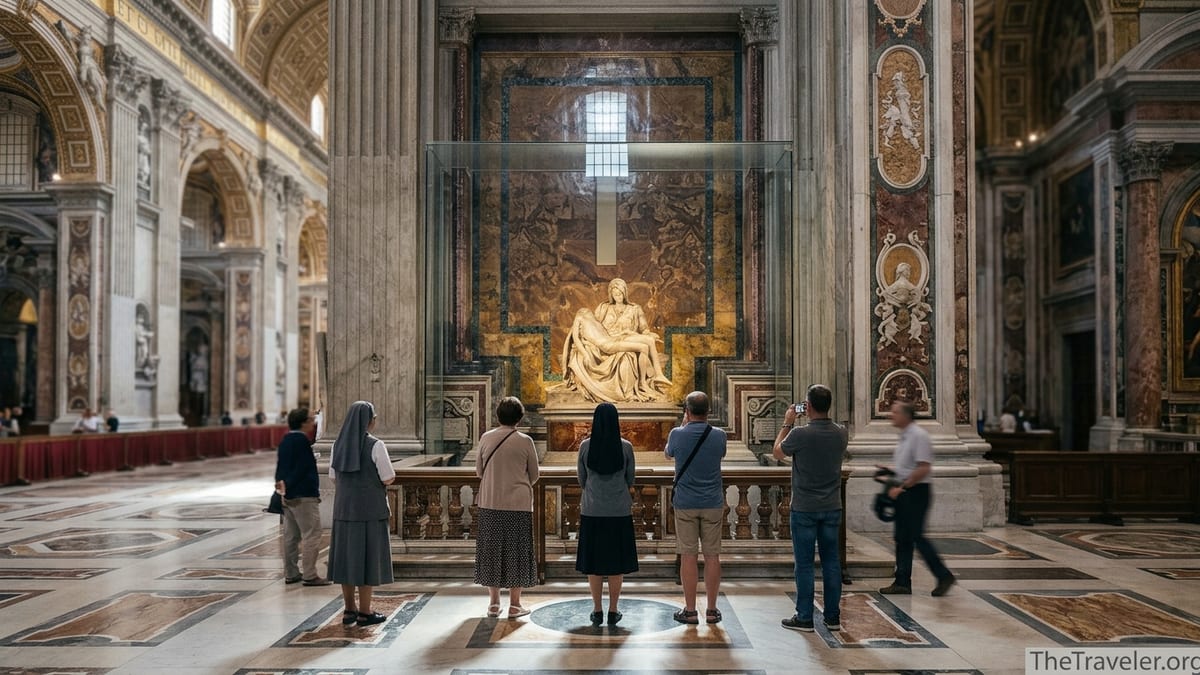
The sculpture’s modern story also shapes the viewing experience. In May 1972 a vandal attacked La Pietà with a hammer, shattering Mary’s nose, eyelid, and arm. Vatican conservators undertook a meticulous restoration and later placed the work behind thick bulletproof glass. Today you cannot walk up and circle around it as visitors did decades ago. You see it a few meters back, angled on its altar, through a glass shield that slightly softens the details but also ensures the sculpture’s survival.
That physical distance affects expectations. If you are imagining a quiet, intimate encounter in an empty side chapel, you may be disappointed. If you understand you are viewing a fragile masterpiece in an active pilgrimage site where visitor safety and crowd control come first, you are more likely to feel that even a brief look is meaningful.
How Much Time It Really Takes to See La Pietà in 2026
The sculpture itself takes only a few minutes to view. The real time cost comes from getting into St Peter’s Basilica. Entry to the basilica is free, but everyone must pass through airport-style security at the perimeter of St Peter’s Square. On a mid-morning in May or June, independent travelers commonly report waiting 45 to 90 minutes in the general security line. During quieter winter months, or late in the evening in low season, that can drop to 10 to 20 minutes.
If you are visiting in 2026, the general pattern is clear. Security queues are longest from roughly 9:30 a.m. to early afternoon and shortest at opening (around 7:00 a.m.) and again after 5:00 p.m. On Wednesdays when there is a papal audience in the square, access can be more complicated, and mid-morning waits can stretch well beyond an hour. Travelers aiming to see La Pietà on a Wednesday morning often find themselves funneled around barriers or delayed until the audience finishes.
There are paid ways to shorten the wait. Several tour operators sell combined Vatican Museums, Sistine Chapel, and St Peter’s Basilica tours with “skip the line” or “priority” wording. In practice, these don’t bypass security entirely, but groups are usually steered through separate security lanes near the museums or at the side of the square. Recent visitors who booked a morning “early Vatican Museums plus St Peter’s” tour in 2026 report total security waiting times around 15 to 30 minutes instead of more than an hour in the public line.
If you arrive on your own and want to minimize hassle, a realistic plan is to be at St Peter’s Square by 7:00 to 7:15 a.m. on a typical weekday outside peak holidays. Many travelers in 2026 describe walking through security in under 15 minutes at that hour, then spending another 30 to 45 minutes inside the basilica, including time in front of La Pietà and a slow walk down the central nave. That makes the entire experience about an hour, which is manageable even on a tight Rome schedule.
What the Viewing Experience Feels Like in Practice
Once you clear security and climb the steps into St Peter’s Basilica, La Pietà is immediately to your right in its own chapel. On a busy summer day, you will typically see a loose cluster of visitors in front of the protective glass, many lifting phones above heads for a quick photo. There is no separate line for the chapel itself. You gradually edge forward, stand at the rail for a minute or two, and then move aside for the next people.
Because the sculpture is behind glass and a few meters back, you do not get the same three-dimensional impact you would from, say, Bernini’s Ecstasy of Saint Teresa in the church of Santa Maria della Vittoria. You cannot walk around to see Christ’s back or the full sweep of Mary’s robes. Instead, the experience becomes about composition and expression: the sloping diagonal of Christ’s body, the strange youthful calm of Mary, and the triangular pyramid formed by her robe.
The atmosphere depends heavily on timing. Visit at 10:30 a.m. in June and you might share the space with several tour groups, each guide raising a small flag and speaking into a headset. You will probably hear phone shutters and see flashes from those who ignore the no-flash rule. Visit on a winter evening just before closing, when the basilica is quieter, and you may find only a handful of people in the chapel, giving you a few unhurried minutes to absorb the details, from the delicate veins in Christ’s arm to the polished sheen on the stone.
Travelers often compare it to seeing the Sistine Chapel. The Sistine requires a paid Vatican Museums ticket and several hours of walking through galleries before you even reach the chapel. La Pietà is free, but the price is dealing with security and the sometimes chaotic square. If you value sculpture, or if Michelangelo’s work is a key reason you came to Rome, most visitors report that even a brief, imperfect viewing of La Pietà still feels essential.
When La Pietà Deserves a Spot in a Very Short Itinerary
If you have half a day in Vatican City, including time for the Vatican Museums and Sistine Chapel, the question is not whether La Pietà is worth seeing but how to fit it in without burning out. In that case, the most efficient approach is often to book a morning guided tour starting around 8:00 a.m. that includes early entry to the museums and a direct passage into St Peter’s Basilica. These combined tours typically last three to four hours and cost in the region of 80 to 130 euros per adult in 2026, depending on group size and extras. You finish near the basilica with the guide pointing out La Pietà, usually with some context about the 1972 attack and the restoration.
For travelers with only two or three hours to spare, perhaps on a day filled with other Roman highlights, the calculation is tighter. If you are not a dedicated art enthusiast and you have already booked a timed ticket for the Vatican Museums, it might be more rewarding to spend your limited energy in the Raphael Rooms and the Sistine Chapel rather than sprinting through St Peter’s simply to check off La Pietà. Remember that the museums and basilica are different entries, with different lines and security checks. Attempting to do both in two hours often leaves people exhausted and underwhelmed.
On the other hand, if you are staying near the Vatican or passing through the area early in the morning, making a focused stop for La Pietà alone can be very efficient. An example itinerary that works well in practice: arrive at St Peter’s Square by 7:00 a.m., clear security by 7:15 or 7:20, head straight to the right-hand chapel to spend 10 to 15 quiet minutes in front of La Pietà, then wander the nave and step back outside by 8:00 a.m. From there you can walk to Castel Sant’Angelo, grab an early espresso at a nearby café, and continue your day elsewhere in Rome.
La Pietà is also a high priority for visitors with a personal or spiritual connection to the subject. Pilgrims, Catholics, and those who have experienced personal loss often describe the sculpture as unexpectedly moving, even when viewed from behind glass in a crowd. If that resonates with you, it probably deserves space in your day, even if that means cutting a lesser church or museum from your itinerary.
How to Time Your Visit to Maximize a Short Stop
With limited time, timing is everything. In 2026 the Vatican Museums typically open around 8:00 a.m. and close in the early evening, with some extended Friday hours in high season. St Peter’s Basilica generally opens earlier, around 7:00 a.m., and stays open until early evening. The heaviest basilica queues build between 9:30 a.m. and mid-afternoon. That means early morning or late afternoon are your best windows for a relatively quick and calm look at La Pietà.
If you are combining the museums and basilica in a single day on your own, a practical strategy is to visit the museums at opening time, exit around lunchtime, then take a break before approaching St Peter’s after 4:30 or 5:00 p.m. By then, many day tours and cruise ship groups have gone, and security lines can shrink significantly. Travelers in spring and early autumn frequently report late-afternoon waits of 15 to 25 minutes compared with over an hour in late morning.
On a super tight schedule, you can flip that plan: see La Pietà first at opening, then walk around the outside of the Vatican walls to join your timed Vatican Museums entry at 9:30 or 10:00 a.m. This works best if you are staying within a short metro or bus ride and do not mind a very early start. The advantage is a quiet basilica and a short line. The downside is an early wake-up and the need to watch the clock inside so you do not miss your museum slot.
One more nuance: clothing and security. Dress codes at St Peter’s Basilica are actively enforced in 2026. Shoulders need to be covered, and shorts or skirts should reach roughly to the knee. Security also bans large backpacks, glass bottles, and tripods. If you need to return to a hotel to drop a bag or change clothes because you forgot these rules, that extra backtracking can erase any time saved on careful scheduling. For a quick visit to La Pietà, plan your outfit and what you carry so you can go straight from the square through security.
Alternatives if You Decide to Skip La Pietà
Deciding that La Pietà is not the best use of your limited Vatican time does not mean missing out on all of Michelangelo or on powerful religious art. Inside the Vatican Museums, the Sistine Chapel ceiling and Last Judgment offer a completely different but no less significant side of Michelangelo’s genius. You can stand under the Creation of Adam, or in front of the Last Judgment wall, for as long as the guards allow, without the barrier of protective glass.
Elsewhere in Rome, there are other moving depictions of the Pietà theme that are much easier to see up close. In the small church of Santa Maria dell’Anima near Piazza Navona, a late-Gothic Northern European Pietà sits in a relatively quiet side chapel. In the Basilica of Santa Maria in Trastevere, mosaics and side altarpieces offer rich Marian imagery with far fewer crowds. These are not Michelangelo, but if your goal is a contemplative, emotional encounter rather than chasing a famous name, they often deliver more.
For sculpture lovers, Bernini’s Rome provides ample compensation. A focused morning visiting the Galleria Borghese, where Bernini’s Apollo and Daphne and David practically pulse with movement, can be far more satisfying than a stressed half-hour inside a crowded basilica. Travelers who decide to skip St Peter’s on a short stay often report that reallocating that time to the Borghese or to the Capitoline Museums leaves them feeling they made the right call.
There is also the simple pleasure of unstructured Rome. If squeezing La Pietà into your day means cutting an evening stroll through Trastevere, a relaxed meal in the Jewish Ghetto, or a sunset walk on the Janiculum Hill, the trade-off might not be worth it for you. Not every trip needs to include every masterpiece, and you are allowed to design a Vatican experience that matches your energy, interests, and tolerance for lines.
The Takeaway
Is La Pietà worth seeing if you have limited time in Vatican City? For most travelers, the answer is yes, but only if you approach it with realistic expectations and smart timing. The sculpture is undeniably one of Michelangelo’s greatest works, and its location in St Peter’s Basilica makes it both a spiritual symbol and an art-historical landmark. However, the experience is shaped by crowds, security, and the protective glass that now separates visitors from the marble.
If you can commit roughly an hour for security, a short walk through the basilica, and a few reflective minutes in front of La Pietà, preferably early in the morning or later in the afternoon, the visit is usually rewarding. It offers a concentrated encounter with Renaissance art and with the living, breathing reality of the Vatican as both a church and a major global destination.
If your time is so tight that seeing La Pietà would mean racing through every other part of the Vatican or sacrificing rest and enjoyment elsewhere in Rome, then it may be wiser to focus on the Vatican Museums and the Sistine Chapel, or to leave the basilica for a future trip. A thoughtful, unrushed experience of a few great works is almost always better than a frantic checklist of many.
Ultimately, La Pietà is worth prioritizing when its themes, its sculptor, or the setting of St Peter’s Basilica speak to you personally. With a bit of planning, even a short Vatican stop can include a meaningful moment in front of this damaged, restored, and still profoundly beautiful masterpiece.
FAQ
Q1. Where exactly is La Pietà located inside St Peter’s Basilica?
It stands in the first chapel on the right as you enter the main doors of St Peter’s Basilica, set behind a protective glass screen.
Q2. How long do I need to budget just to see La Pietà?
In 2026, most visitors should plan about one hour total, including security and a brief visit inside the basilica, if they arrive early or late in the day.
Q3. Do I need a ticket or reservation to see La Pietà?
No. Entry to St Peter’s Basilica and La Pietà is free and does not require a reservation, but you must pass through security and respect the dress code.
Q4. Can I get close to La Pietà for detailed photos?
No. Since the 1972 vandalism, La Pietà has been protected behind bulletproof glass and set a few meters back, so photos are from a moderate distance.
Q5. Is it better to see La Pietà before or after the Vatican Museums?
With limited time, many travelers visit La Pietà at basilica opening time, then walk to a timed Vatican Museums entry. Others prefer museums first and the basilica late afternoon.
Q6. What is the best time of day to avoid crowds at La Pietà?
Early morning around opening and later afternoon after 4:30 p.m. usually have shorter security lines and fewer tour groups inside the basilica.
Q7. Is La Pietà appropriate for children or non-art lovers?
Yes. The subject is solemn but not graphic, and even visitors without art background often find the sculpture impressive, especially when briefly introduced.
Q8. Can I see La Pietà on the same visit as climbing St Peter’s dome?
Yes. Many travelers visit La Pietà shortly after entering the basilica, then follow signs to the dome. You should allow extra time for the dome ticket line and climb.
Q9. What if I only care about Michelangelo’s paintings, not his sculptures?
If painting interests you more, you might prioritize the Sistine Chapel in the Vatican Museums. La Pietà is still significant but not essential for every traveler.
Q10. Is it reasonable to skip La Pietà if I have only one day in Rome?
It can be. If a rushed Vatican visit would crowd out other experiences you value more, focusing on a few highlights and saving La Pietà for another trip is a valid choice.