


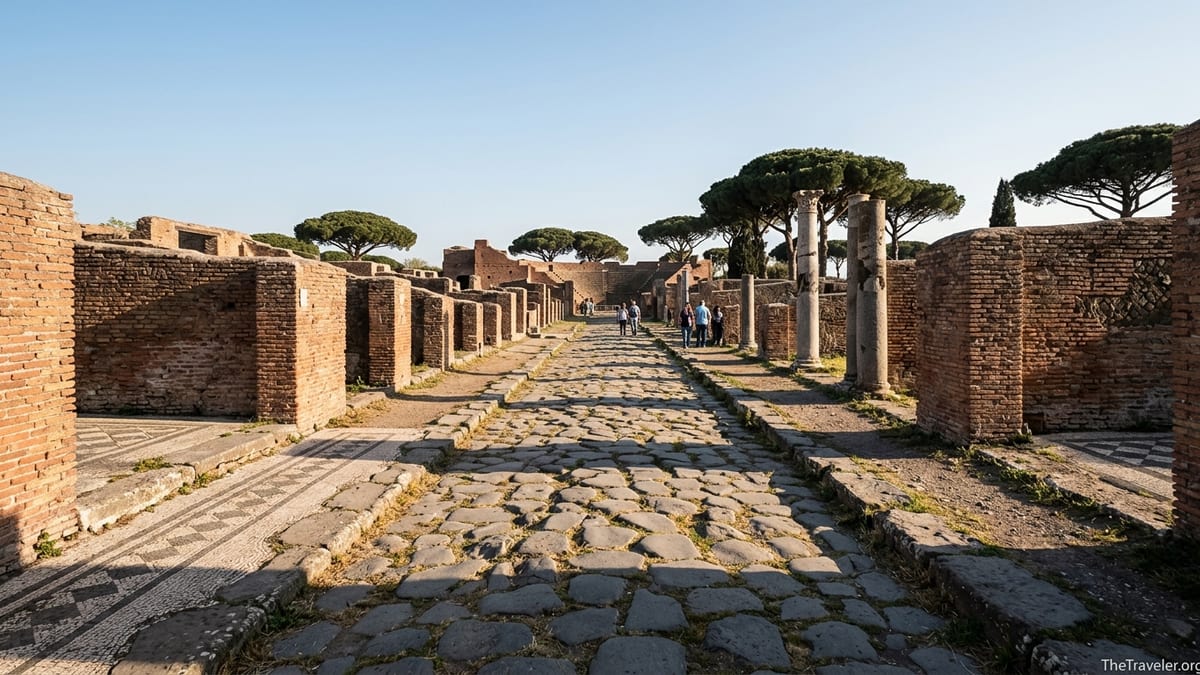
Just 30 kilometers southwest of central Rome, far from the queues at the Colosseum, the ruins of Ostia Antica stretch out in red brick and black-and-white mosaics beneath umbrella pines. Once the bustling harbor that fed a million Romans with grain, oil, and wine, this abandoned port city tells the quieter, practical side of ancient Rome’s story: warehouses instead of palaces, taverns instead of temples. Today, it is one of Italy’s most atmospheric archaeological parks, and an easy, affordable day trip that feels like stepping into a working Roman town frozen in time.
Get the latest updates straight to your inbox!
From River Mouth Outpost to Rome’s Lifeline
The name Ostia comes from the Latin word for “mouth,” a reference to its position at the mouth of the Tiber River where it met the Mediterranean Sea. Ancient writers remembered it as one of Rome’s earliest colonies, traditionally founded in the 4th century BC as a military outpost to defend the river and the city’s maritime access. In those early centuries, its role was simple but strategic: control the river entrance, watch for pirates, and protect Rome’s supply lines.
As the Roman Republic expanded around the Mediterranean, Ostia’s importance grew dramatically. By the 2nd and 1st centuries BC, Rome depended on overseas grain, especially from Sicily, North Africa, and later Egypt. Ships unloaded their cargo at Ostia, and barges ferried goods upriver to Rome’s riverfront warehouses. The city began to fill with long rows of horrea, or storehouses, and with the offices of shipping companies and customs officials whose jobs were to keep the capital fed.
Walking through Ostia Antica today, you can still trace this practical role in the ruins. Near the former riverfront, visitors can see the remains of massive brick warehouses with thick walls and raised floors that once stored grain. Instead of marble-clad imperial forums, the heart of this city was its working port infrastructure, designed to move thousands of tons of goods through efficiently and reliably.
For modern travelers, this is what sets Ostia apart from the ruins in central Rome. Rather than monuments celebrating emperors, you explore the infrastructure that allowed those emperors to rule. It is the story of Rome told not from the Palatine Hill, but from the docks, taverns, and apartment blocks of the people who kept the empire’s capital alive.
Claudius, Trajan, and the Engineering of a Mega-Port
By the 1st century AD, Ostia’s natural harbor at the river mouth was no longer enough for Rome’s needs. Storms on the Tyrrhenian Sea could easily damage ships and delay grain deliveries, and silting in the river channel made navigation increasingly difficult. To solve this, Emperor Claudius ordered the construction of an enormous artificial port a few kilometers north of Ostia, known to archaeologists today as Portus. Completed under Nero, it featured two long curving breakwaters and a monumental lighthouse guiding ships into a vast basin.
Trajan later transformed this already ambitious project by adding an inner hexagonal basin, an engineering marvel whose geometric outline is still clearly visible from the air. This new harbor, completed in the early 2nd century AD, could host a large fleet of merchant ships in relatively calm water, with canals connecting it directly to the Tiber. From there, small river craft carried grain and other goods into the city. In effect, Claudius and Trajan created a two-level port system: the deepwater facilities of Portus for ocean-going ships, and the river city of Ostia as the logistical hub.
For visitors interested in the full story of Rome’s maritime infrastructure, it is now possible to pair Ostia Antica with the archaeological area of the Imperial Ports of Claudius and Trajan near Fiumicino. Access to these sites often involves special tickets or guided visits, and they tend to feel even more off the beaten path than Ostia itself, with grassy embankments and the geometric outline of Trajan’s hexagon emerging around you. Together, Ostia and Portus show how Roman engineers reshaped the coastline to serve a hungry capital.
Yet even as Portus took over the bulk of deepwater traffic, Ostia did not wither immediately. The city adjusted, becoming more of a residential and commercial center tied to the new port complex, with merchants, shipowners’ offices, and service industries clustered around the river and canals. Standing today in the ruins of the Piazza delle Corporazioni, surrounded by faded mosaics advertising exotic ports of call, you can still imagine this world of contracts, cargo lists, and long-distance trade.
Daily Life in a Working Roman Port Town
Unlike sites that were destroyed in a single catastrophe, Ostia Antica preserves centuries of gradual development. This makes it a remarkable place to visualize everyday Roman urban life beyond the imperial labels. The town was laid out in a grid of streets, lined with apartment blocks, shops, workshops, and bath complexes that served a population of traders, dockworkers, soldiers, clerks, and their families.
One of the most striking features is the abundance of insulae, or multi-story apartment buildings. In Ostia they survive higher than in central Rome, in some cases rising two or three stories, with internal staircases still in place. When you walk into the House of Diana, for example, you are entering a real Roman apartment complex: narrow corridors, small rooms, and shared courtyards that once echoed with the noise of tenants cooking, talking, and hauling water. It gives a concrete sense of how ordinary urban Romans lived, far removed from the villas that tend to dominate popular imagination.
The city’s commercial life comes into focus at the Baths of Neptune, with their magnificent black-and-white floor mosaics depicting sea creatures and marine deities, and at the numerous tabernae, or shops, whose counters and storage jars are still visible. Travelers frequently pause at a particularly photogenic streetside bar, where the stone counter still has round cutouts for amphorae. You can imagine a dockworker in the 2nd century AD ordering a cup of wine and a snack after a shift on the warehouses, much as commuters today might stop for a quick espresso at a bar near Rome’s Termini Station.
Religion and social life intertwined with commerce. The small theater, built in the Augustan age and expanded later, still hosts occasional performances. Above it lies the Piazza delle Corporazioni, a colonnaded square whose pavement is decorated with mosaics that once indicated the offices of shipping companies and trade guilds. Each panel evokes a different port or product. For a modern visitor, standing in this square feels like walking through an ancient logistics hub, an open-air business district where deals were struck and ships’ manifests negotiated.
Silting, Malaria, and the Slow Decline of Rome’s Port
Ostia Antica did not end with a single dramatic event, but rather faded across centuries. From late antiquity onward, the Tiber’s relentless silting pushed the coastline steadily seaward. The river’s branches shifted, and the harbor channels gradually clogged. The sea that had once lapped near the city’s edge retreated, leaving Ostia further inland. Today, when you stand among the ruins and hear planes from nearby Fiumicino airport, it can be hard to imagine that seagoing ships once anchored here, yet the river and sea reshaped the landscape completely.
At the same time, political and economic changes weakened Rome’s urban core. As imperial power fragmented in the 4th and 5th centuries AD, traffic through the port declined. Ostia became less central to the empire’s supply system, while the newer installations at Portus took over what trade remained. Archaeological evidence suggests that by the 4th century the population had shrunk, and some grand townhouses were subdivided or repurposed, a typical sign of urban contraction in late antiquity.
Health and environment also played a role. The low-lying delta around Ostia and Portus turned increasingly marshy as canals silted up and maintenance declined. Stagnant water created ideal conditions for mosquitoes, and medieval sources mention malaria in the area. Over time, residents drifted away to healthier ground inland, and new settlements grew on slightly higher land, including the medieval village that evolved into modern Ostia Antica.
The very forces that doomed the port ultimately helped preserve it. As winds carried sand inland and vegetation took over, Ostia’s streets and buildings were gradually buried. Unlike central Rome, where continuous habitation meant constant rebuilding, this forgotten harbor city lay largely undisturbed until systematic excavations in the 19th and 20th centuries. That is why, today, a visitor can wander for hours through intact streetscapes, reading shop signs in mosaic and walking into houses that still smell of sun-warmed brick.
Exploring Ostia Antica Today: What You Will See
Modern Ostia Antica is both an archaeological park and a quiet residential suburb on Rome’s western edge. From the entrance gate, a straight Roman road leads you into the ancient town, flanked by tombs that once lined the approach like a necropolis “suburb.” Beyond, the city opens up into a grid of streets where grass grows between basalt paving stones and pine trees throw dappled shade over red-brick facades.
Most visitors follow a loose loop that takes in the key highlights. After the necropolis and main gate, you soon reach the theater and the Piazza delle Corporazioni with its trade mosaics. Farther along, the Forum area gathers the remains of temples, public buildings, and a basilica where legal and civic business took place. The Baths of Neptune, with their famous floor mosaics of dolphins and tritons, offer one of the site’s most memorable photo opportunities. Many travelers comment that the experience feels more relaxed and immersive than Pompeii, with fewer crowds and more room to explore side streets and lesser-known buildings at your own pace.
In the central area stands the small archaeological museum, which houses statues, inscriptions, and domestic objects recovered during excavations. While many of the site’s finest mosaics and sculptures were moved to major museums in Rome for protection, the on-site collection still gives a tangible sense of the people who lived here: portraits of merchants and their families, altars dedicated to local deities, and everyday items such as lamps and tools. Near the museum there is usually a café or restaurant open where you can sit under the trees for a simple lunch, a welcome break on warm days when shade is precious.
One of Ostia Antica’s greatest luxuries, in modern terms, is space. The archaeological zone covers a large area, and even in peak seasons it rarely feels overwhelmed. You may find yourself entirely alone in a residential side street, stepping into ground-floor workshops or peering up stairwells that once led to now-vanished upper stories. For photographers, the combination of soft Roman light, crumbling brickwork, and pockets of greenery makes for quietly evocative images that feel very different from the dramatic crowds around the Colosseum.
Practicalities: Getting There, Tickets, and When to Go
Reaching Ostia Antica from central Rome is straightforward and budget-friendly. Most visitors take the metro Line B to Piramide station, then follow signs inside the same complex to the Roma–Lido suburban railway. Trains on this line typically run several times an hour toward the coast. You get off at the Ostia Antica stop, which is only a few minutes’ walk from the site entrance via a pedestrian bridge over the road. The journey from central Rome usually takes around 30 to 40 minutes. Because Ostia Antica lies within the wider metropolitan area, you can normally use a standard Rome public transport ticket or day pass, which keeps the cost very low compared with intercity trains.
At the park entrance, you buy your ticket at the on-site ticket office or present a voucher if you have purchased in advance through a ticketing platform or tour operator. Exact prices change periodically, but entry is generally significantly cheaper than major central Rome attractions, and there are often reductions for EU citizens in certain age brackets, as well as free or reduced entry for children and specific categories such as registered disabled visitors with an accompanying person. Audio guides and guided tours are sometimes available for an extra fee, which can be a worthwhile investment if you prefer structured explanations over self-guided wandering.
Opening hours vary seasonally but typically start at around 8:30 in the morning, with last entry in the late afternoon. In summer, closing time is usually later, while in the winter months the park may close earlier as daylight fades. Because conditions and time slots can change due to maintenance or special events, it is wise to check the latest information from official Italian cultural authorities or the park’s own channels shortly before your visit, especially if you are traveling outside the main spring and autumn seasons.
Climate and comfort make a big difference to how much you enjoy Ostia Antica. The best months to visit are usually April to June and September to October, when temperatures are warm but not extreme and the light is gentle. In July and August, the sun on the open stone streets can be intense, and shade is patchy away from the pines. Many repeat visitors recommend arriving as close to opening time as possible, both to enjoy cooler air and to explore the theater and forum before tour groups arrive. Sturdy walking shoes, water, and a hat are highly advisable; the site is expansive, and you can easily cover several kilometers without noticing.
Connecting the Ancient Port with the Modern Coast
Visiting Ostia Antica also highlights how Rome’s relationship with the sea has shifted over the centuries. In antiquity, the shoreline approached the port city closely. Today, because of long-term silting and coastal changes, the archaeological park sits several kilometers inland, while the modern seaside resort of Lido di Ostia spreads along the current beachline. For travelers with a free day, combining ruins in the morning with the beach in the afternoon offers a revealing contrast between ancient infrastructure and modern leisure.
From the Ostia Antica train station, it is only a few extra stops to Lido di Ostia, where Romans escape summer heat to swim, walk the promenade, or sit at café tables overlooking the Tyrrhenian Sea. A typical summer afternoon might see you strolling through Ostia’s ancient warehouses before lunching at a simple trattoria in the modern suburb, then catching the train onward to the beach for an espresso or aperitivo as the sun lowers over the water. For families, this mix of education and relaxation can make Ostia Antica an easier sell than a second or third museum in central Rome.
Travelers interested in the deeper harbor story sometimes also add a visit to the remains of Portus, the Imperial ports of Claudius and Trajan near Fiumicino. Access is more limited and often involves pre-booked guided tours, but standing on the grassy embankments of Trajan’s still-water-filled hexagonal basin brings the scale of Rome’s maritime system into focus. From there, you are only a short drive from Rome’s main international airport, underlining how the same flat coastal plain has hosted successive generations of transport infrastructure, from Roman grain fleets to modern airliners.
In this way, the Ostia and Portus area offers not just a look back at classical antiquity but also a sense of continuity. The Tiber’s mouth has always been a threshold: between river and sea, city and hinterland, old world and new arrivals. When you walk back to the station in the late afternoon, dusty from centuries-old streets and listening to the rumble of contemporary commuter trains, you are treading a landscape that has been shaped and reshaped for logistics for more than two millennia.
The Takeaway
Ostia Antica distills the story of Rome into something tangible, walkable, and unexpectedly peaceful. It is not about emperors posing on triumphal arches, but about the practical systems that sustained a million mouths: grain warehouses, bustling docks, taverns that fed tired crews, and apartment blocks filled with families whose names rarely appear in literary sources. As a visitor, you are free to wander this world with far fewer crowds, following straight Roman streets from theater to baths to modest shrines.
For travelers staying several days in Rome, carving out half a day or more for Ostia Antica offers a different lens on the ancient city, one that pairs easily with modern pleasures like a coffee at Lido di Ostia or a seafood lunch near the coast. The journey is short, the costs modest, and the rewards substantial: a clearer sense of how Rome functioned as a living metropolis, supplied from the sea.
Whether you are a serious student of Roman history or simply someone who enjoys exploring atmospheric ruins, the story of Rome’s ancient port is worth stepping off the usual circuit to discover. In the quiet streets of Ostia Antica, amid birdsong and the rustle of pines, the logistics of empire become suddenly human and surprisingly close.
FAQ
Q1. How long do I need to visit Ostia Antica properly?
Most travelers find that three to four hours inside the archaeological park provides enough time to see the main highlights at a comfortable pace. If you enjoy photography or detailed exploration, plan for most of the day.
Q2. Is Ostia Antica suitable for children and families?
Yes, the open spaces and relatively low crowds make it family-friendly. Children can explore streets and buildings more freely than at busier sites in central Rome, though parents should be aware of uneven ground and some unprotected drops.
Q3. Can I visit Ostia Antica and the beach on the same day?
Many visitors do both. You can visit the ruins in the morning, have lunch nearby, then continue by train to Lido di Ostia for a few hours by the sea before returning to central Rome.
Q4. Do I need a guided tour to understand the site?
A guided tour or audio guide can add depth, especially around the theater, baths, and forum, but independent travelers with a basic map can still enjoy the site. Information panels at key locations help explain major buildings.
Q5. Is Ostia Antica accessible for travelers with limited mobility?
The site has some level paths near the entrance, but many streets are uneven, with ancient paving stones, steps, and slopes. Visitors with reduced mobility may be able to see selected areas but should check current accessibility information in advance.
Q6. What should I wear and bring for a visit?
Comfortable walking shoes, a hat, sunscreen, and a refillable water bottle are strongly recommended. The site is large and relatively exposed, especially in warmer months, so dressing for sun and walking makes a big difference.
Q7. Are there food and drink options inside Ostia Antica?
There is usually a café or small restaurant within or near the central area of the park, but choice can be limited. Many visitors bring snacks or a simple picnic, especially if they plan to stay for several hours.
Q8. How crowded does Ostia Antica get compared with the Colosseum?
Even in peak season, Ostia Antica rarely feels as crowded as the Colosseum or Roman Forum. You may encounter school groups or tours near the entrance and main monuments, but it is often easy to find quiet corners.
Q9. Can I combine Ostia Antica with Portus in one itinerary?
It is possible but requires careful planning, as the Imperial ports near Fiumicino often have more limited visiting arrangements. Travelers interested in both sites should check for current tours or integrated tickets before scheduling a same-day visit.
Q10. Is Ostia Antica a good alternative if I cannot get to Pompeii?
Yes, many visitors see Ostia Antica as a satisfying alternative when a trip to Pompeii is not practical. It offers extensive, well-preserved streetscapes close to Rome, with a focus on everyday urban life rather than a dramatic volcanic destruction.