


Travelers planning a few days in Rome quickly face a dilemma: should you dedicate precious time to a half-day trip to Ostia Antica, or stay focused on the icons of central Rome like the Colosseum, Forum and Vatican Museums? The answer depends less on a checklist of sights and more on your travel style, energy levels and how deeply you want to experience ancient Rome beyond its most crowded landmarks.
Get the latest updates straight to your inbox!
What Ostia Antica Actually Is, Compared With Central Rome
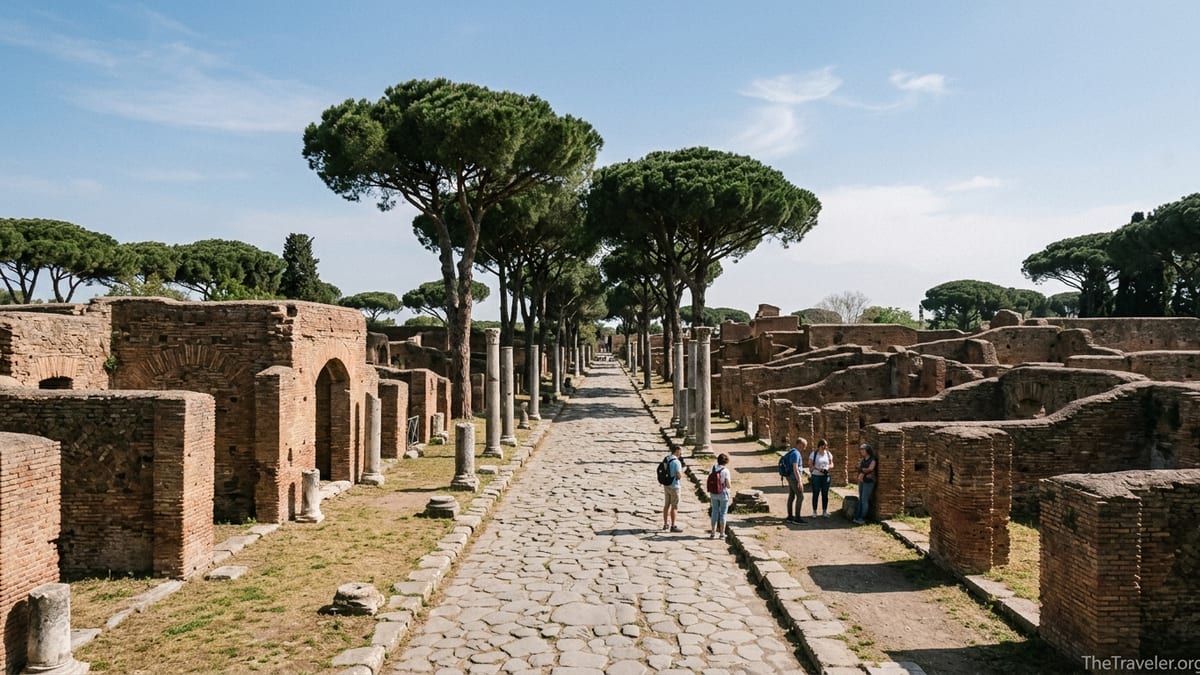
Ostia Antica is the archaeological site of ancient Rome’s port city, about 25 to 30 kilometers from the historic center. Today it is a vast park of ruins: apartment blocks, warehouses, bath complexes, a theater, temples, taverns and even a synagogue, spread over dozens of hectares. Unlike the Forum or Palatine Hill, the remains here feel like a complete town, with long straight streets, side alleys and courtyards you can freely wander through.
Central Rome, by contrast, offers fragments of antiquity woven into a dense modern city. At the Colosseum you see a single monument; at the Roman Forum you walk through the political and religious core of the empire; at the Pantheon you experience an almost intact ancient temple now used as a church. These are extraordinary, but they are set amid traffic, tour groups and modern buildings. You never forget that you are in a 21st‑century capital.
At Ostia Antica the experience is different in mood. Once you pass the ticket gate near the medieval Castello di Giulio II, you quickly find yourself on the ancient Decumanus Maximus, a broad stone-paved street lined with ruins and umbrella pines. The modern world largely disappears. You can climb staircases in old apartment blocks, walk into former bakeries where millstones are still in place, and stand onstage in the Roman theater looking out over empty rows of brick seats.
This contrast is at the heart of the decision. Staying in central Rome means concentrating your time on the city’s most famous sites and museums. Going to Ostia Antica means trading one of those slots for a more expansive, slower, and often quieter exploration of Roman daily life in situ.
Practicalities: Getting to Ostia Antica vs Staying in the Center
Reaching Ostia Antica is surprisingly straightforward by public transport. From central stations on Metro line B such as Termini, Cavour or Colosseo, you ride the metro to Piramide and then follow signs into the adjacent Porta San Paolo station. Here you board the Metromare (the Rome–Lido commuter rail) and get off at Ostia Antica, usually after about 25 to 35 minutes depending on waits. From the station it is roughly a 10‑minute walk over a pedestrian bridge and along a residential street to the archaeological park entrance.
The cost is low. As of early 2026, the Metromare line is integrated into Rome’s public transport fare system, so a standard urban ticket, which is typically around 1.50 euros, covers the journey for 100 minutes from validation. In practice, a couple staying near Termini might spend a bit under 6 euros total on transport to and from Ostia Antica, compared with 30 to 40 euros or more for two timed-entry Colosseum and Forum tickets through major online resellers.
The trade‑off is time and comfort. While the journey is not long on the map, you should allow at least an hour each way door to door, including walking to your local metro stop, the transfer at Piramide, and the final walk from Ostia Antica station. Trains on the Metromare line can be crowded at rush hour and in summer. Local commuters often describe the line as basic and sometimes hot, with limited air‑conditioning, so it is wise to travel outside peak times and carry water, especially from June to September.
By comparison, staying in central Rome keeps logistics simple. Many major ancient sites are clustered within a compact area: the Colosseum, Palatine, Forum and Capitoline Museums are all within a 10 to 15 minute walk of each other. You could easily spend a full day here without taking more than a short bus ride or metro hop. If you are staying near Piazza Navona, Campo de’ Fiori or the Monti neighborhood, you may be able to walk to most of your planned visits, breaking up sightseeing with espresso stops and long lunches instead of train connections.
Costs, Tickets and Crowd Levels
Admission to the Parco Archeologico di Ostia Antica is relatively straightforward. According to current information used for the Roma Pass network, a standard ticket for the archaeological park is around 18 euros, with a significantly lower reduced rate for eligible visitors and free entry on certain national museum days. On site, you can usually rent a basic audio guide for an extra fee if you want more context while wandering, or you can bring a guidebook or downloaded map instead.
This contrasts with central Rome’s flagship sites, where demand is extremely high and ticketing has become more complex. Colosseum entry with access to the Roman Forum and Palatine Hill is typically sold in timed slots, with mandatory reservations in high season and strict security checks. For a specific morning in May or September, for example, some travelers find official tickets sold out weeks ahead, leaving only third‑party tours at 60 to 100 euros per person. The Vatican Museums also require timed bookings, with dynamic pricing and surcharges for prime time entries or skip‑the‑line tours.
Crowd levels are where Ostia Antica stands out. On a sunny Saturday in April, you may share the Decumanus with a few tour groups and school classes, but you will often find yourself alone poking around the House of Diana or the communal latrines of the public baths. There are shaded lawns where people sit to sketch mosaics, and children can safely explore nearby without parents fearing traffic. In August, when the Colosseum area can feel packed from mid‑morning to late afternoon, Ostia Antica still tends to feel spacious, with room to breathe and take photographs without constant jostling.
In central Rome, by contrast, visitor density at major sites is high for much of the year. Security queues at the Colosseum commonly snake around the plaza; at the Vatican Museums there are separate lines for ticket holders and for those buying on the day, both of which can be long. Even places without formal entry times, such as the Trevi Fountain or the Spanish Steps, draw dense crowds from late morning onward. If you find crowds stressful or if anyone in your group has sensory sensitivities, substituting a few hours of Ostia Antica for yet another crowded monument in the center can make the trip significantly more pleasant.
What You Actually See and Experience in Ostia Antica
Ostia Antica offers a rare, almost cinematic sense of stepping into a Roman town. One of the first major buildings you encounter is the theater, a semicircular structure whose brick seating still stands in wide, concentric rows. Modern concerts are occasionally held here in summer in the open air. From the top row you can look back toward the ancient plaza, the so‑called Square of the Guilds, where around a central fountain stand dozens of small rooms whose floors are decorated with black‑and‑white mosaics advertising different shipping companies and trades that once operated in the port.
Farther along, as you wander the grid of streets, you may enter the remains of multi‑story apartment blocks, known as insulae. These are rare survivals; in central Rome, few complete residential buildings from antiquity remain. Here you can climb to a first‑floor level, look down into interiors, and imagine how densely people once lived along these corridors. In one former bakery, massive millstones are still set into the floor. In another complex, a small shrine with fading frescoes clings to a wall. The effect is less about a single postcard view and more about a continuous, immersive streetscape.
The site also contains an ancient synagogue, one of the oldest known in Europe, tucked near what used to be the riverfront, as well as numerous bath complexes with mosaic floors showing dolphins, ships and other marine imagery. These details help flesh out aspects of Roman social and religious life often mentioned only briefly in mainstream tours of the Forum. Because there are relatively few barriers, you can linger where you like: sit alone on a temple step, photograph a mosaic at your own pace, or walk quiet side paths away from any groups.
There are trade‑offs. Ostia Antica is largely ruins. Many walls stand only to chest height, roofs are mostly gone, and frescoes are weathered. Information boards are scattered but not exhaustive, and there is less dramatization than at the Colosseum or Vatican Museums. If you or your companions prefer highly curated experiences with reconstructions, films and dense signage, you may find Ostia visually repetitive after two or three hours. Hiring a private guide or joining a small‑group tour that meets at Piramide or the park entrance can help bring the site to life with stories and interpretations.
Time Management: When Ostia Antica Makes Sense in an Itinerary
The value of adding Ostia Antica depends heavily on how many full days you have in Rome. For shorter stays, the opportunity cost of leaving the center can be high. A first‑time visitor with only two full days in the city will probably be better served by focusing on central highlights: one day for the Colosseum, Forum, Palatine and Capitoline Museums, and one day for the Vatican Museums, St Peter’s Basilica, the Pantheon and key piazzas. In such a compressed schedule, carving out a half‑day for Ostia Antica could leave you rushed at marquee sites.
With three to four days, Ostia Antica becomes more attractive, particularly if you like to mix crowd‑heavy museums with quieter spaces. For example, on a four‑day trip in May, a couple might schedule: Day 1 for the Colosseum and Forum, Day 2 for the Vatican Museums and Trastevere, Day 3 for Ostia Antica in the morning followed by a relaxed evening around Piazza Navona, and Day 4 for the Appian Way or Borghese Gallery. This allows for one deep dive into ancient daily life without sacrificing Rome’s most famous landmarks.
For repeat visitors or longer stays of five days or more, Ostia Antica is often a highlight. Many travelers who have already seen the Colosseum interior once choose to skip going inside again and instead devote that time to Ostia or to another day trip like Tivoli or Orvieto. On a summer visit, you might even combine Ostia Antica with a stop at the modern seaside district of Ostia Lido for a late afternoon gelato on the lungomare, returning to the city after sunset when central streets have cooled and crowds have thinned.
Time of year also matters. From late June through early September, central Rome can feel particularly hot and congested in the middle of the day, with stone reflecting heat and long lines under direct sun at outdoor sites. Ostia Antica, while still warm, benefits from sea breezes and extensive tree cover. Planning a morning visit there, then retreating back to the city for a siesta and an evening passeggiata, can be kinder on your energy levels than standing in the mid‑afternoon Colosseum security queue.
Who Will Love Ostia Antica, and Who Should Skip It
Ostia Antica is especially rewarding for travelers who are genuinely interested in Roman history beyond a quick photo of the Colosseum. If you have ever wished you could walk freely through an archaeological site without constant rails and barriers, this is your chance. History buffs, photographers and independent travelers who enjoy exploring at their own pace tend to rave about it. Families with school‑age children who have studied ancient Rome often enjoy the tangible sense of a “real” Roman town, where kids can stand in an ancient theater, trace mosaics with their eyes and run along old streets.
It also suits those who dislike crowds. Solo travelers or couples who feel overwhelmed in the Vatican Museums’ tight corridors often describe Ostia Antica as a “reset” day: a chance to stay in the orbit of Rome’s history without queuing for metal detectors or being funnelled by ropes. Travelers in their 60s and 70s, especially those visiting outside the hottest months, often appreciate the slower pace and abundant benches under pine trees where they can rest while still surrounded by ruins.
On the other hand, Ostia Antica may be less compelling if your main goal is to tick off the capital’s “greatest hits.” If this is your first‑ever trip to Italy and you only have three days, you may feel short‑changed if you spend a morning in Ostia and then realize you never went inside the Vatican Museums or missed the view from the top of St Peter’s dome. Likewise, travelers who are lukewarm about archaeology in general, or who admit they find ruins “all looking the same” after an hour, might get more satisfaction from an extra neighborhood walk in Trastevere or a food tour in Testaccio.
Mobility and stamina are also important factors. Ostia Antica is spread out, and although paths are generally level, surfaces are often uneven stone or dirt. You can easily walk several kilometers without noticing. For visitors with limited mobility or those traveling with toddlers in simple strollers, the cobbles and distances can be tiring. In that case, a more compact and paved central site, such as the Forum and Palatine combined with a taxi ride back to your hotel, might be more manageable than a long rail trip and hours on your feet inside the park.
Balancing Ostia Antica With Central Rome: Example Scenarios
To decide whether Ostia Antica is worth it for you, it helps to imagine concrete scenarios. Suppose you are a couple arriving in Rome on a Thursday afternoon in October, staying near Campo de’ Fiori, with three full days before flying out Monday morning. You want to see the Colosseum, the Vatican Museums, the Pantheon, and “something less touristy.” In this case, blocking out Saturday morning for Ostia Antica could be ideal: you visit the Colosseum and Forum with a morning tour on Friday, decompress among the ruins of Ostia on Saturday, then tackle the Vatican Museums on Sunday when offices are closed but the museums are open by reservation.
Now imagine a family of four visiting in July with children aged eight and eleven. You have five nights in Rome as part of a longer Italy trip, and the kids have already seen Pompeii near Naples. Here, Ostia Antica might be a lower priority, because the children have recently explored a major ruins site. You might instead focus on the Colosseum, book an early‑morning Vatican Museum slot to beat the heat, then dedicate one day to Villa Borghese park with bikes and boating on the lake. The half‑day that might have gone to Ostia could instead be spent on gelato “research” between Piazza Navona and the Trevi Fountain.
Finally, consider a repeat visitor on a second or third trip to Rome, staying a full week in an apartment near Piramide. They have already toured the Colosseum, Forum, Vatican Museums and Borghese Gallery on previous visits. For this traveler, Ostia Antica is almost certainly worth it. They can walk to Porta San Paolo station after breakfast, explore the site from opening until early afternoon, have a simple lunch at the on‑site café or a nearby trattoria in the village of Ostia Antica, and still be back in their neighborhood in time for aperitivo at a wine bar in Testaccio.
Looking at these scenarios can clarify priorities. If visiting Ostia Antica means skipping a central Rome experience you are truly excited about, then it may not be the right call on this trip. If, instead, it replaces a vague “extra day of wandering” or yet another crowded museum, you are more likely to appreciate its distinctive atmosphere and educational value.
The Takeaway
Ostia Antica is worth visiting if you have at least three full days in Rome, a genuine interest in ancient history, and a desire for a calmer, more spacious complement to the city’s blockbuster sites. It offers an unusually complete picture of a Roman town, from apartment blocks and warehouses to baths and a synagogue, with far fewer visitors than central monuments of comparable importance.
If you are on a very short first‑time visit, or if ruins hold limited appeal, you are usually better off focusing on central Rome. Prioritize the Colosseum, Forum, Palatine, Vatican Museums, St Peter’s Basilica and the historic neighborhoods that knit them together. These define most travelers’ mental image of Rome and are difficult to replace.
Ultimately the decision comes down to what you want your Roman days to feel like. If you picture tight schedules, timed tickets and moving in step with many other visitors, then you may prefer to keep all your time in the center and lean into the city’s energy. If you like the idea of spending a morning wandering quiet Roman streets from two thousand years ago, hearing only the crunch of gravel and the rustle of pines, then carving out a half‑day for Ostia Antica is not a distraction from Rome but an extension of it.
The good news is that both choices are strong. Rome’s core will always reward deeper exploration, and Ostia Antica will remain an accessible, moderately priced escape just a short train ride away. Choosing between them is less a question of right or wrong and more about aligning your itinerary with how you personally like to travel.
FAQ
Q1. How long do I need to visit Ostia Antica from Rome?
Most travelers find that three to four hours inside the site is enough to see the theater, main streets, houses and baths without rushing. Including transport from central Rome, plan on a half‑day of about six hours door to door.
Q2. Is Ostia Antica suitable for children?
Yes, many families enjoy it because children can walk freely, climb low steps and explore without traffic. However, distances are large and there is little shade in some areas, so bring hats, sunscreen and water, and be prepared for frequent breaks.
Q3. Can I visit Ostia Antica and the beach on the same day?
It is possible. Some visitors spend the morning at the ruins, then continue by train to stations like Lido Centro or Stella Polare to reach the seafront. Just remember that summer beaches can be crowded and you will need extra time and energy for changing, swimming and returning to Rome.
Q4. Do I need a guided tour at Ostia Antica?
No, a tour is not required, and many people enjoy wandering with a map or audio guide. That said, a good guide can add context and stories that make similar‑looking brick walls more meaningful, especially if you are not already familiar with Roman history.
Q5. Is Ostia Antica included in the Roma Pass?
As of 2026, Ostia Antica is part of the wider network of sites recognized within Rome’s museum system, but specific inclusion and discounts can change. Always check the latest Roma Pass documentation or ask at official information points before relying on it for free entry.
Q6. How does Ostia Antica compare to Pompeii?
Ostia Antica is smaller and closer to Rome than Pompeii, with fewer crowds and more shade. Pompeii is larger, more dramatic in places and better known, but requires a longer train journey or organized tour from Rome. If you are already visiting Naples, Pompeii or Herculaneum, Ostia Antica is more of a complementary experience than a replacement.
Q7. What should I wear and bring to Ostia Antica?
Wear comfortable walking shoes with good grip, as paths can be uneven. In warm months, bring a hat, sunscreen, a refillable water bottle and light layers. In cooler seasons, a windproof jacket is useful because of the open, flat terrain and proximity to the coast.
Q8. Are there places to eat at or near Ostia Antica?
There is usually a simple café or snack bar inside or just outside the site offering sandwiches, coffee and cold drinks, but hours and quality can vary. Many visitors bring a picnic from Rome or eat at small trattorias in the adjacent village of Ostia Antica after their visit.
Q9. Is Ostia Antica accessible for visitors with limited mobility?
Access is mixed. The entrance area and some main paths are relatively level and may suit wheelchairs or folding mobility aids, but many side streets and interiors have uneven stones, steps and dirt surfaces. If mobility is a concern, it is wise to contact the park in advance and plan a shorter, more focused route.
Q10. If I only have two days in Rome, should I still go to Ostia Antica?
In most cases, no. With just two days, you will likely get more from focusing on central highlights such as the Colosseum area, Vatican Museums, St Peter’s Basilica and the historic center. Ostia Antica is best reserved for trips of three days or more, or for repeat visitors looking for a deeper cut.