


Walk a few minutes from the modern commuter train at Ostia Antica and you step into a Roman port town that feels abruptly abandoned. Streets still lined with bakeries, apartment blocks, bars and bathhouses fan out from the main gate toward the old Tiber riverfront. Unlike the curated grandeur of the Colosseum or the Forum, Ostia Antica preserves the ordinary places where people actually lived, worked, worshipped and relaxed. For anyone trying to understand daily life in ancient Rome, this half-forgotten harbour remains one of the most vivid, accessible and revealing sites in the Mediterranean.
Get the latest updates straight to your inbox!
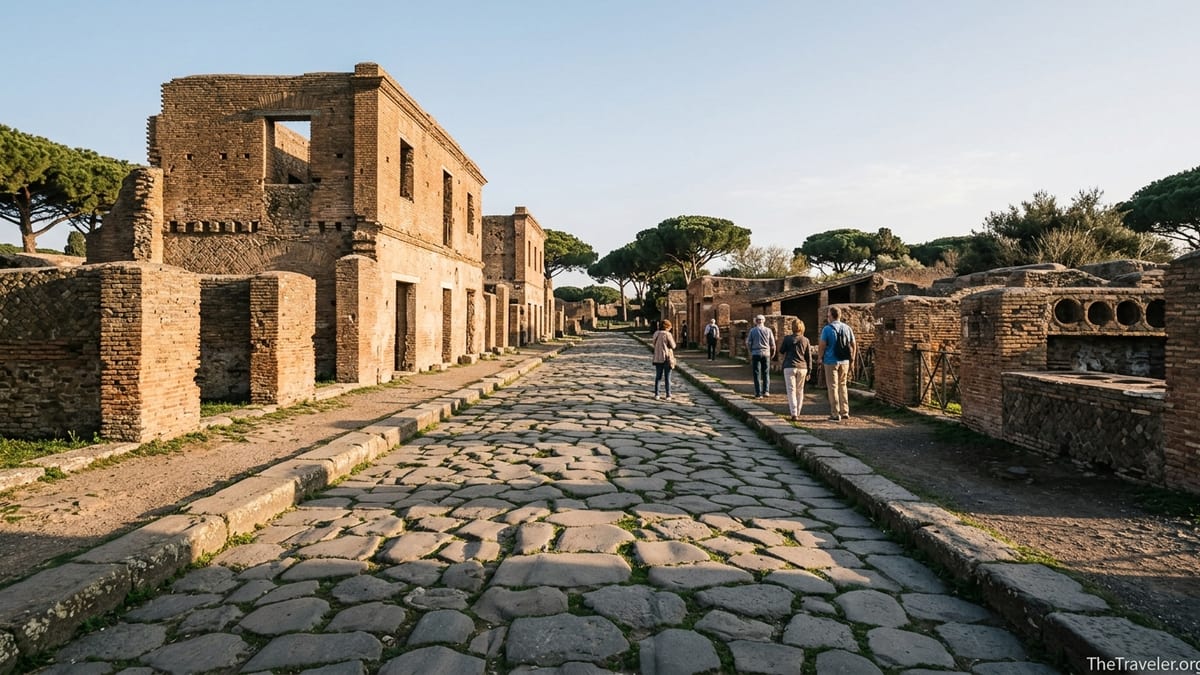
A Port City That Froze Everyday Rome in Place
Ostia began as a military colony guarding the mouth of the Tiber and evolved into Rome’s main seaport, funnelling grain, oil and goods from across the empire into the capital. When you walk along the basalt paving stones of the Decumanus Maximus today, you are following the same main street that dockworkers, sailors, grain merchants and slaves used two thousand years ago. The difference is that the modern visitor often has whole stretches of that street almost to themselves, with an intact urban fabric rising on either side.
Because Ostia silted up and declined as nearby Portus and later coastal developments took over its role, large parts of the town were simply abandoned rather than continuously built over. Excavations in the twentieth century revealed blocks of multi storey housing, workshops and religious buildings in situ. Unlike central Rome, where medieval and modern construction has sliced through the ancient layers, Ostia offers an almost continuous slice of a Roman town from the first to the fourth century. The result is a rare three dimensional snapshot of normal urban life that historians still mine for insights.
For travellers, this also means a more immersive experience. You can still walk into a bakery with its stone mill in the corner, step behind the counter of a thermopolium, or climb surviving staircases in an insula to look out over rooflines. This physical coherence, more than any inscription or literary text, is what makes Ostia essential for understanding how Romans organised their daily routines.
Insulae and Housing: How Most Romans Really Lived
One of the clearest reasons Ostia matters is housing. In Rome itself, elite townhouses and monumental forums dominate the remains. In Ostia, the stars are the insulae, the apartment buildings where most urban Romans actually lived. Several rise three or even four storeys high, with brick facades, rows of windows and internal courtyards that are still easy to read from street level.
Take the so called House of Diana, an insula where you can still see the ground floor shops opening onto the street and the upper level apartments set around a central courtyard. Stand there around midday when the sun cuts a rectangle of light into the space and it feels remarkably contemporary, like a 19th century courtyard block in Rome’s Trastevere. Archaeologists have identified latrines, water cisterns and small shrines, details that show tenants had access to shared facilities and brought their domestic religious practices into communal areas.
For historians of daily life, these Ostian insulae provide hard evidence to balance ancient literary complaints about dangerous, overcrowded tenements in Rome. The brickwork, staircases and layout of apartments suggest a spectrum of quality and comfort. Some units had mosaic floors and painted walls, others simple beaten earth. When travellers walk along Via delle Corporazioni or side streets off the Decumanus and look up at these buildings, they see the real scale of Roman urban living, not just the villas of the one percent.
Modern visitors staying in a mid range hotel or short term rental in Rome will find surprising parallels. Compact rooms opening onto a shared courtyard, noise rising from the street, neighbours living above and below: Ostia’s housing blocks demonstrate that dense, vertical living has been a Roman reality for millennia.
Shops, Bars and Bakeries: The Texture of Roman Commerce
Another reason Ostia Antica remains crucial for understanding daily life is the sheer density of commercial spaces. As you wander from the main gate toward the forum, you pass shop after shop: small doorways with raised thresholds, rear workrooms, built in counters and even traces of shelving niches. Many of these would have been run by artisans and traders whose names never appear in grand historical narratives.
Perhaps the most evocative is the thermopolium near the forum, a Roman equivalent of a snack bar or fast food counter. Its L shaped masonry counter still contains round openings where large storage jars once held hot dishes, wine or stews. A traveller today can stand behind that counter, look out toward the street and easily imagine a lunchtime rush of dockworkers ordering a quick meal. The setup is not far from a modern tavola calda in Rome, where you choose from trays of prepared food behind glass. Literary sources make clear that many Romans, especially those in insulae without full kitchens, relied on such establishments for hot food, and Ostia provides the physical confirmation.
Bakeries are equally telling. In one, a circular stone mill stands in the corner of the room, with the base for a turning arm that animals or slaves would have pushed. Nearby, a large built oven arches from the back wall. When visitors compare this to a contemporary Roman bakery, the continuity is striking: a large oven dominating the back of the shop, storage for flour and finished loaves near the front, a counter for sales on the street. For archaeologists, finding carbonised grain and bread moulds here has helped reconstruct typical loaf shapes, giving museums in Rome real objects to display instead of pure speculation.
Even the shopfront mosaics tell commercial stories tied to daily life. In the Piazzale delle Corporazioni behind the theatre, black and white floor mosaics in front of offices depict ships, grain sacks, dolphins and even place names from North Africa and the eastern Mediterranean. These images speak to a town where business identities and overseas networks were part of the everyday experience, something modern visitors can grasp more easily than an abstract trade statistic.
Baths, Toilets and the Social Side of Hygiene
Roman baths and sanitation are often described in textbooks, but Ostia Antica allows you to walk through them as ordinary people once did. The town has more than two dozen bath complexes of varying size. Some, like the Baths of Neptune, were monumental, with large halls and famous mosaics of marine scenes. Others were more modest, likely serving the residents of a couple of insulae. This variety shows that bathing was not just a luxury but a layered part of daily routine across social classes.
Step into a bath complex at Ostia and you can follow the route from changing room to cold plunge, warm room and hot room. The low brick pillars of the hypocaust system still dot the floors of some rooms, evidence of the underfloor heating that required constant fuel and labour. Wall niches would once have held oils and strigils; now they frame the sunlight that filters through broken vaults. It is easy to imagine people scheduling meetings here the way modern Romans do in coffee bars, or workers stopping in at the end of a shift on the docks.
The town’s public latrines add another layer to the picture of Roman hygiene and social life. In one large facility, rows of stone seats run along the walls, with a central water channel for washing. Visitors are often struck by the complete lack of privacy. For archaeologists, that design underscores how communal many aspects of daily life were in a world before individual bathrooms and enclosed cubicles. Sitting shoulder to shoulder in a latrine or chatting in the steamy air of a bath was part of the social fabric, just as informal conversations at a neighbourhood bar or gym might be today.
For the modern traveller, being able to walk directly from an apartment block to a nearby bath complex and then to a toilet area within a few minutes reinforces how closely integrated hygiene infrastructure was into the town plan. It also reminds us that access to water, heating fuel and maintenance labour shaped daily schedules in a way that tends to be invisible in the marble heavy ruins of central Rome.
Religion for a Diverse and Cosmopolitan Population
Ostia’s religious buildings reveal just how diverse a Roman port town could be and why that matters for our understanding of everyday belief. While the Capitolium and main temples echo the official cults seen in the Forum, Ostia also preserves shrines and sanctuaries for a wide range of deities and communities that do not always appear in grand political histories.
One of the most striking is the synagogue near the ancient shoreline, among the oldest known in the western Mediterranean. Its hall, benches, and traces of a Torah shrine testify to a Jewish community embedded in the town’s life. The location, on the outskirts near the road toward the sea, may have served Jewish traders and sailors who moved between Ostia and other Mediterranean ports. For modern visitors used to seeing Rome primarily through its Christian monuments, this building shows that late antique religious life was more pluralistic and that minority communities had visible, organised spaces.
Ostia is also rich in evidence for the cult of Mithras. Several mithraea, or Mithraic temples, have been found tucked behind ordinary buildings or beneath later structures. These small, cave like spaces with bench lined sides and imagery of Mithras slaying the bull suggest a more intimate, initiatory religious experience, very different from public festivals in the forum. The fact that mithraea are found near warehouses and commercial districts hints that groups of colleagues or guild members may have worshipped there together, blending work ties with spiritual ones.
For today’s traveller, walking from the forum past a mithraeum and on to the synagogue in less than half an hour provides a tangible sense of how different belief systems coexisted in the same urban space. It offers a corrective to simplified stories about a monolithic Roman religion, showing instead a town where people blended official cults, mystery religions and community based worship in the rhythm of daily life.
Fire Brigades, Guilds and the Machinery of an Ordinary Working Town
Ostia was not simply a collection of houses and temples but a working port town that needed organisation, security and labour. The Caserma dei Vigili, the barracks of the fire brigade, is one of the clearest windows onto that machinery. Its large courtyard with surrounding rooms, inscriptions mentioning vigiles and dedications to emperors tell us that professional firefighters and night watchmen were stationed here, tasked with protecting warehouses and densely built insulae from the ever present risk of fire.
Unlike in modern Rome, where fire stations are modern structures scattered through the city, in Ostia a visitor can still walk into the very barracks where the vigiles slept, stored equipment and perhaps drilled. This makes the abstract idea of ancient urban services concrete. It also reveals how Roman authorities tried to manage the vulnerabilities of a city built in brick and timber. References in inscriptions to officers and units posted to the port show that Ostia had its own security hierarchy, something essential for a town handling valuable cargoes from across the empire.
The offices and halls around the Piazzale delle Corporazioni further illuminate the world of work. Each small room behind the theatre likely served as the base for a shipping company or trade guild. Mosaics showing grain ships, rope, animals or tools symbolised the specialisation of each group. Imagine walking into a modern freight forwarder’s office near a container port, with logos and posters on the wall advertising routes to different regions: the Ostian mosaics functioned in a similar visual language, helping illiterate clients identify the right office.
For modern travellers, these spaces offer a counterpoint to the image of Rome as a city of emperors and senators. The economic life of the empire depended on places like Ostia, where guilds, stevedores, warehouse managers and customs officials managed the movement of food, oil and goods. Seeing their physical workplaces makes it much easier to imagine a typical weekday in the empire’s logistics chain.
Visiting Ostia Antica Today: A Practical Window onto the Past
Ostia Antica’s importance is not only academic. It is also one of the most practical places for travellers to grasp Roman daily life without the crowds and pressure of central Rome. Reaching the site from the city centre typically takes around 35 to 45 minutes. Visitors take the metro to Piramide and then switch to the suburban train toward Ostia Lido, getting off at the Ostia Antica stop. From there it is a short walk across a pedestrian bridge and along a tree lined road to the entrance.
The Archaeological Park of Ostia Antica sells a standard ticket that, as of early 2026, costs around 18 euros at full price, with reductions for EU citizens in certain age brackets and free entry days on some national cultural occasions. The site usually opens from 8:30 in the morning, with last entry in late afternoon; exact closing times shift seasonally, so it is worth checking locally once you arrive in Rome. Because the ticket office closes about an hour before the site itself, travellers aiming for a late afternoon visit should arrive with a comfortable margin rather than pushing to the last minute.
On site, there are basic services near the entrance, including toilets, a small bookshop and a café where you can buy drinks and simple snacks. Many visitors, however, prefer to bring a picnic from Rome and eat it in one of the quieter corners of the ruins, always respecting park rules about litter and protected areas. Good walking shoes, sun protection and water are essential. The site is expansive and much of it is exposed. Even in spring, a slow circuit from the main gate to the synagogue and back can turn into several kilometres of walking across uneven stone and patchy grass.
Spending at least half a day is advisable if you want to move beyond the central highlights like the theatre and forum. A full day allows time to linger in quieter residential areas, sit in the shade of pine trees beside the decumanus and let the details of daily life settle in. Hiring a licensed guide or renting the site’s audio guide can help make sense of the less obvious buildings, turning a collection of walls into bakeries, bars, laundries and guild offices that map directly onto the themes of everyday life.
The Takeaway
Ostia Antica still matters for understanding daily life in ancient Rome because it preserves the ordinary in extraordinary detail. Where central Rome dazzles with imperial forums and triumphal arches, Ostia gives us apartment staircases, snack counters, fire stations and modest bathhouses. Its insulae show how most urban Romans actually lived, packed into multi storey blocks with shared facilities. Its shops and thermopolia reveal how people grabbed lunch or bought bread on the way home. Its synagogue, mithraea and temples map a religious landscape far more varied than a simple list of official gods.
For travellers, a visit to Ostia is not just another box to tick on a Roman itinerary. It is a chance to walk through a town scaled to human lives rather than imperial ambition. Standing behind a stone bar counter, on the worn threshold of a bakery or in the quiet hall of the synagogue, you encounter echoes of routines that still shape city life today: commuting, shopping, eating out, worrying about fire, worshipping in small communities. In that sense, Ostia Antica is not just an archaeological park but a mirror, reflecting how much of our own urban everyday life was already in place on the edge of the Tiber nearly two millennia ago.
FAQ
Q1. How long should I plan to spend at Ostia Antica to appreciate daily life aspects?
Most visitors need at least four to five hours to move beyond the main monuments and explore residential streets, shops, baths and the synagogue at a comfortable pace.
Q2. Is Ostia Antica a better place than Pompeii to understand ordinary Roman life?
Ostia and Pompeii complement each other. Pompeii preserves a smaller provincial town, while Ostia shows a working port city with apartment blocks and port related guilds.
Q3. Can I see real examples of Roman apartments at Ostia Antica?
Yes. Several insulae, including multi storey blocks like the so called House of Diana, survive with staircases, courtyards and traces of interior decoration.
Q4. Are there visible remains of Roman shops and bars on site?
There are many. You can walk into bakeries with mills and ovens, stand behind the counter of a thermopolium and see shopfronts with thresholds and workrooms.
Q5. Does Ostia Antica have religious sites beyond typical Roman temples?
It does. The site includes an early synagogue near the ancient shoreline and several mithraea, alongside more conventional temples and shrines in the forum area.
Q6. How easy is it to reach Ostia Antica from central Rome on public transport?
It is straightforward. Travellers usually take the metro to Piramide, then a suburban train toward Ostia Lido and get off at Ostia Antica, walking a few minutes to the site.
Q7. What modern comforts are available inside the archaeological park?
Near the entrance you will find toilets, a small café and a bookshop. Deeper inside the ruins there are fewer services, so bringing water and snacks is sensible.
Q8. Is Ostia Antica suitable for children interested in history?
Yes. The open spaces, visible mosaics, theatre and easily recognisable shops and baths make it engaging for children, especially if you bring a guidebook or audio guide.
Q9. Can visitors still climb onto upper levels of buildings?
Access changes with safety regulations, but some stairways and raised viewpoints are occasionally open, allowing visitors to see how insulae and streets relate in three dimensions.
Q10. Do I need a guided tour to understand the daily life remains at Ostia?
You can visit independently, but a licensed guide or detailed audio guide can help you identify specific buildings such as laundries, bars and guild offices that are otherwise easy to overlook.