


Ask people from Antibes or nearby Juan-les-Pins where they go when the Riviera feels too busy, and many will point you toward the peninsula of Cap d’Antibes. Here, a wave-battered coastal path circles rocky headlands, hidden coves shelter in the pines and grand villas sit quietly behind stone walls. It is not showy in the way of Cannes or Monaco. Instead, Cap d’Antibes offers something locals prize far more: space, sea air and a sense of quiet luxury that still feels deeply, reassuringly Mediterranean.
Get the latest updates straight to your inbox!
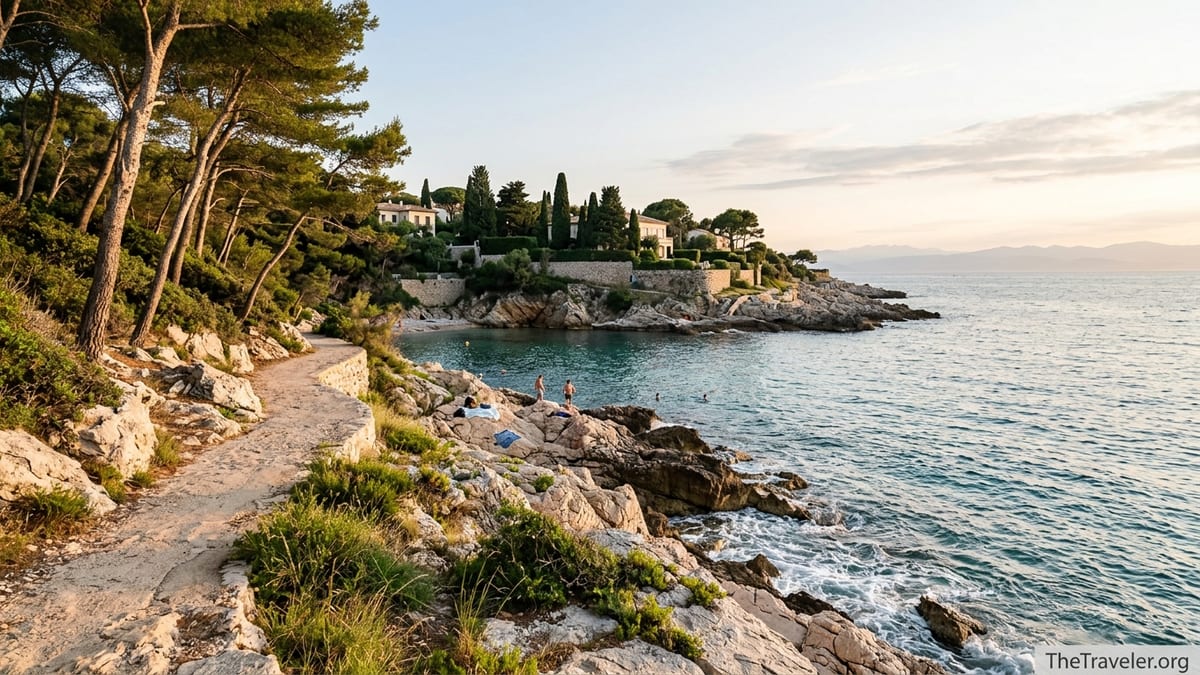
Where the Riviera Slows Down
Cap d’Antibes is a small peninsula that juts into the Mediterranean between Antibes and Juan-les-Pins. Just a 10 minute drive from Antibes Old Town, it feels unexpectedly tranquil. The main roads narrow to lanes lined with umbrella pines and stone walls, and the sound of scooters and traffic gives way to cicadas and surf. Locals come here to walk after work, to swim before breakfast, or simply to sit on a bench and watch the light change over the Baie des Anges.
Part of the appeal is how little has been built compared with other parts of the coast. Much of the southern shore is still wild rock and low scrub, protected by France’s coastal access laws. Instead of apartment blocks, you see terraced gardens falling to the sea, grand villas from the Belle Epoque period and small, whitewashed fishermen’s houses near the coves. Even in July, there are long stretches where you can walk and hear only the sea hitting the rocks.
For people who live in Antibes year-round, that contrast matters. In high season, the town beaches like La Salis and La Gravette are lively and fun, but they fill quickly with umbrellas and stand-up paddle boards. On the Cap, by contrast, you might share a rocky platform with just a handful of locals reading a book or slipping discreetly into the water with a mask and snorkel. The energy is softer, the pace slower, and that is exactly what keeps residents returning.
The peninsula is compact enough that you can explore most of it on foot in a day, yet varied enough that each cove and viewpoint feels different. One morning might mean a brisk two hour loop of the coastal path before the sun climbs too high. Another afternoon might be spent drifting from an early lunch at a beach club to a siesta under the pines, then down to a tiny cove for a late swim as the day-crowds are leaving.
The Sentier du Littoral: A Coastal Path Locals Never Tire Of
The star attraction for walkers is the Sentier du Littoral, also known locally as the Sentier de Tire-Poil. This stone path, roughly 3 to 5 kilometers depending on your start and end points, traces the wild southern edge of the Cap between Plage de la Garoupe and the gardens of Villa Eilenroc. Parts of it feel surprisingly remote for somewhere that lies between bustling Nice and Cannes.
Most locals start at Plage de la Garoupe, where there is a small parking area and bus stop. From there, the trail quickly leaves the road and drops to the sea. Concrete and stone sections cling to low cliffs, with iron railings where the path narrows. In calm weather, you walk just a few meters from the water, with spray sometimes drifting over the rail in winter swells. In summer, early risers set off here around 7 or 8 am to enjoy the cooler air and softer light.
The terrain is uneven, with steps and short rocky sections, so it feels like a proper walk without being technical. Most reasonably fit visitors take about 1 hour 30 minutes to 2 hours to reach the far end and loop back by quiet interior lanes. Locals often turn it into a regular routine, timing themselves or choosing favorite stretchs between landmarks such as the Graillon Tower, the lighthouse plateau or the gate of Villa Eilenroc.
On a practical level, the path is free to access, but it is wise to check sea conditions and bring sturdy trainers rather than flip-flops. In autumn and winter, strong swells sometimes send waves right over the trail, and sections can be closed temporarily for safety. In summer, by contrast, you are more likely to share the route with Antibes residents walking their dogs before breakfast or trail runners loping past at sunset.
Hidden Coves and Everyday Swimming Rituals
Beyond the famous sands of Plage de la Garoupe, Cap d’Antibes hides a string of smaller coves that locals treat almost like private swimming clubs. Some are named, such as Plage des Ondes on the western shore with its small stone tower standing just offshore. Others are unnamed cuts in the rock, reached by narrow stairways or gaps in low walls, where there may be only enough flat space for half a dozen towels.
For residents, these spots become part of daily ritual. A teacher in Antibes might finish class, catch Envibus line 2 toward the Cap, step off near a tiny set of steps in the rock and be in the water within minutes. In June and September, it is not unusual to see the same people at the same cove each afternoon: a retired couple with folding chairs, a teenager with a snorkel, an office worker in rolled-up shorts taking a quick plunge before heading home.
Plage de la Garoupe itself, although well known, still works like a neighborhood beach outside peak August weeks. The public section at the northern end is free and relaxed, with clear, shallow water ideal for children and for older locals who prefer a gentle slope underfoot. Early in the morning you see solitary swimmers crossing the bay or friends meeting for a quick dip before work. By contrast, the private beach clubs at the southern end do not open their parasols until later in the morning, so locals often enjoy the sand in relative peace from sunrise until about 10 am.
On the western side of the Cap, small harbors like Port de l’Olivette hide pebbly inlets where wooden pointu fishing boats bob at their moorings. Between the boats, people slip into the water from ladders on the quay or from the end of small jetties. There are no changing cabins or loud beach bars here, just a few locals arriving with a towel over the shoulder and leaving with wet hair and salt on their skin.
Quiet Luxury Behind Stone Walls
Cap d’Antibes has long been associated with wealth, from the Belle Epoque villas to the celebrated Hotel du Cap-Eden-Roc. Yet the luxury here is understated compared with the high-gloss displays in places like Monaco or Saint-Tropez. Most of the grand properties are hidden behind tall stone walls and thick hedges of cypress, and even the five star hotels keep a relatively low streetside profile.
For locals, this discretion is part of the charm. You can walk along Avenue du Cap or Chemin des Nielles and know that behind the gate you just passed there may be a historic estate with terraced gardens, yet from the road you see only pines and sky. Property prices in this area are among the highest on the Riviera, but the atmosphere on the streets remains surprisingly unpretentious. Joggers in simple running gear, parents pushing strollers and elderly residents with shopping trolleys share the same pavements.
Quiet luxury here often takes the form of services and experiences rather than spectacle. At Plage Keller on Garoupe, for example, a front row sun lounger with mattress and umbrella in high season typically costs in the region of 60 to 80 euros for the day, depending on the row and date, while a plate of grilled sea bass at the restaurant might be priced somewhere around 40 to 50 euros. For a local, this is a special-occasion spend, perhaps once or twice each summer, chosen for the attentive but unshowy service, linen napkins, and the view across the bay to the Alps rather than for celebrity-spotting.
Some residents prefer even quieter versions of luxury. They might skip the beachfront tables completely and instead book a terrace table at a more hidden address such as a simple bistro tucked near the lighthouse road, or organize a small boat day with friends to drop anchor off Billionaires’ Bay and swim from the stern. The pleasure lies in privacy, sea air and good company rather than in being seen.
Everyday Practicalities: How Locals Actually Use the Cap
Part of what makes Cap d’Antibes so beloved by residents of Antibes and the wider Côte d’Azur is how practical it is for daily life. It is not an isolated resort; it is woven into everyday routines. In the early morning, you see cyclists grinding up toward the Garoupe plateau to train on the short, sharp climbs. At lunchtime midweek, nurses and office workers from Antibes hospitals and businesses occasionally drive out for a quick swim and picnic, returning to their desks with sand still clinging to their feet.
Public transport plays a role too. The local Envibus network runs routes from Antibes center toward the Cap, with buses typically stopping near Plage de la Garoupe and other access points. Schedules can be sparse in the evening, which is why many locals who plan a sunset swim or dinner on the peninsula choose to come by car or scooter. Parking near the Garoupe beach is technically public and free, but spaces are limited in summer. Residents know to arrive before 9 am in July or August or to park farther back on residential streets and walk down under the shade of pine trees.
Grocery stops are similarly pragmatic. There is a small supermarket on the Cap where people pick up simple supplies like baguettes, fruit and bottles of water before heading to the path or the beach. In summer, it is common to see locals loading up on picnic-style lunches rather than relying solely on beach restaurants. A typical spread might include a 3 euro baguette, ripe tomatoes and local goat cheese, with perhaps a box of apricots from the weekly market in Antibes. Everything fits into a daypack along with a towel and sunscreen.
Because the Cap is close to town, days here often blend with other errands. Someone might drop children at a sailing course in Antibes Port Vauban, drive five minutes to the Cap for a walk or swim, then swing by a supermarket in town on the way home. That fluid connection between wild-feeling coastline and practical daily tasks helps explain why locals treat Cap d’Antibes less like a special excursion and more like an extension of their backyard.
Seasons, Light and the Best Times to Walk
Visitors often imagine the Riviera only in its high summer version, but locals love Cap d’Antibes in all seasons, and the experience changes dramatically with the light. In spring, mimosa and early wildflowers brighten the scrub along the Sentier du Littoral, and temperatures are cool enough to walk almost any time of day. By late May, sea temperatures begin to rise, and residents start bringing swimsuits on their walks for a quick plunge in one of the small coves.
In high summer, the timing becomes more precise. The coastal path has very little shade, and the rock reflects heat. Locals know to start early, often setting out before 8 am or waiting until after 6 pm when the sun slides lower and the rocks glow soft gold. This is also when the sea is most photogenic, with long bands of turquoise and deep blue stretching toward the horizon. In the middle of the day, residents often retreat to the shaded interior lanes of the Cap, where tall hedges and umbrella pines create pockets of cool air.
Autumn is many locals’ favorite season here. By late September and October, the crowds thin dramatically, yet the sea remains warm enough for comfortable swimming. The coastal path feels almost private on weekday mornings. You might pass a single dog walker or a pair of hikers, then walk for 20 minutes with only the sound of pebbles rolling in the surf. Sunset comes earlier, casting soft pink light on the white villas and lighting the Alps in shades of rose and violet.
Even in winter, the Cap retains its appeal. Strong winds bring dramatic waves that crash against the rocks, sending spray high above the path. On such days, the authorities sometimes close exposed sections of the trail, and locals content themselves with walks to the Garoupe lighthouse plateau instead, where they can look down on the churning sea from a safe distance. The air is exceptionally clear at this time of year, and on certain crisp days you can see snow on the distant peaks while standing under evergreen pines.
From Lighthouse Plateau to Billionaires’ Bay
Beyond the coastal path and coves, several specific locations on Cap d’Antibes hold special meaning for residents. One is the Garoupe plateau, a 75 meter high rise above the eastern side of the peninsula, crowned by the Garoupe lighthouse and the small church of Notre Dame de la Garoupe. Locals drive or walk up the steep lanes to this viewpoint for wide panoramas over the Baie des Anges toward Nice and, in the other direction, over Antibes Old Town and the snow-tipped Alps.
The plateau is a classic stop for Sunday strolls. Families might park near the top, visit the church with its maritime votive offerings, then let children run between the pines as parents gaze out to sea. On clear evenings, couples come up to watch the sunset and the gradual appearance of city lights along the coast. The lighthouse itself, one of the most powerful in the region, begins to flash as dusk falls, adding a sense of continuity to the landscape.
At sea level, another emblematic spot is the bay commonly nicknamed Baie des Milliardaires, or Billionaires’ Bay, on the southeastern side of the Cap. It is surrounded by imposing private estates and high cliffs, but boats of all sizes drop anchor here to enjoy the glassy water and shelter from the wind. Local boat owners often plan summer weekends around slow cruises from Antibes harbor to this bay, where they swim from the stern, paddle on inflatable boards or simply drift in the shade of the cliffs.
What might look like pure exclusivity from afar is in practice shared by many different people. You might see a sleek motor yacht anchored near a modest 6 meter family boat, each set of occupants content in their own floating world. From the coastal path above, walkers peer down into the bay and sometimes find small fisherman’s paths leading to narrow platforms at the water’s edge, where they can dip their feet and feel a little of the magic without owning a boat at all.
The Takeaway
Cap d’Antibes has a reputation shaped by historic villas and legendary hotels, yet locals love it for simpler reasons. It is where they come to walk beside rock and sea, to slip into clear water from low coves, to let children play under pines and to breathe for a while away from the busier strands of the Riviera. The quiet luxury here is not about display but about access: to clean water, space to move and long views across an open horizon.
For visitors, understanding that local perspective changes how you experience the peninsula. Instead of racing from one Instagram-famous viewpoint to another, you might adopt the slower patterns of residents: an early start on the Sentier du Littoral, a picnic from a neighborhood supermarket eaten in the shade, a swim at a small cove shared mostly with Antibes families rather than with tour groups. The Cap rewards that gentler pace.
Whether you come for a single afternoon or weave it into a longer stay in Antibes, approaching Cap d’Antibes as locals do reveals its real character. It is less a glamorous backdrop and more a lived-in landscape, one that offers everyone who reaches it the same simple privileges: a path by the sea, hidden places to swim and a feeling, however brief, of quiet and understated ease.
FAQ
Q1. How long does it take to walk the coastal path on Cap d’Antibes?
The main stretch of the Sentier du Littoral usually takes most people about 1 hour 30 minutes to 2 hours one way, depending on pace and where you join or leave the trail. Many locals turn it into a relaxed half day outing by adding a return via quiet interior lanes and stops for photos or a swim.
Q2. Is the Sentier du Littoral suitable for children and less experienced walkers?
The path includes uneven stone sections, steps and some narrow stretches with railings, so it is better suited to reasonably steady walkers and older children who can manage rocks and steps. It is not ideal for strollers or anyone who is very unsteady on their feet, but families with active kids often enjoy it if they take their time and wear proper shoes.
Q3. Can you swim from the coastal path, or only at the main beaches?
You can swim from both. There are several small coves and rocky platforms along the coastal path where locals climb down for a dip in calm weather, as well as more traditional access at beaches such as Plage de la Garoupe, Plage des Ondes and the small inlets near Port de l’Olivette. Always check the sea conditions before getting in, as swells can make some entry points unsafe.
Q4. Do you need to pay to enjoy the beaches on Cap d’Antibes?
No. While there are private beach clubs that charge for loungers and restaurant service, the public sections of beaches like Plage de la Garoupe are free, and many rocky coves along the Cap are also open access. Locals often mix both options, sometimes splurging on a day at a beach club and on other days simply bringing a towel and picnic for a free swim.
Q5. What is the best time of day to visit if I want to avoid crowds?
Early morning and late afternoon are usually the quietest. Many locals arrive at the coastal path or public beach areas before 9 am in summer to enjoy cooler temperatures and softer light. After about 5 or 6 pm, day visitors begin to leave and the atmosphere becomes calmer again, especially in September and early October.
Q6. How do I reach Cap d’Antibes without a car?
You can reach the Cap by local bus from Antibes center, with services that typically stop near Plage de la Garoupe and other access points. From Antibes Old Town, it is also possible to walk in about 40 to 45 minutes along the seafront and then up onto the peninsula. Many visitors do a combination, taking the bus out and walking part of the way back.
Q7. Are there places to buy food and water on the Cap, or should I bring everything?
There is a small supermarket and several cafes and restaurants on Cap d’Antibes, especially near the main roads and beaches such as Garoupe. However, stretches of the coastal path itself have no services at all. Locals generally buy water, snacks and picnic items in town or at the small supermarket on the Cap before heading to the trail or more secluded coves.
Q8. Is Cap d’Antibes a good snorkeling spot?
Yes. The clear water and rocky shoreline make many parts of Cap d’Antibes excellent for snorkeling, particularly around Garoupe and some of the smaller coves where fish shelter among the rocks. Visibility is often better here than on town beaches, and locals frequently bring masks and fins on their walks to enjoy a swim and snorkel along the cliffs.
Q9. Can visitors access Billionaires’ Bay, or is it only for boat owners?
The sheltered bay often called Billionaires’ Bay is easiest to enjoy by boat, and many local boats anchor there in summer. However, you can still appreciate it from the land. Sections of the coastal path and small fishermen’s tracks lead to viewpoints and narrow access points where walkers can look down into the bay and sometimes reach the water on calm days, without needing a vessel of their own.
Q10. What should I wear and bring for a typical day exploring Cap d’Antibes?
Locals usually wear light, breathable clothing, a hat and sturdy trainers or walking sandals for the coastal path. A small backpack with water, sunscreen, a swimsuit, a towel and perhaps a simple picnic is enough for most people. If you plan to visit a beach club or smarter restaurant after your walk, it is useful to pack a dry shirt or dress and simple sandals to change into.