


Nagorno Karabakh rarely appears on glossy travel bucket lists, yet it looms over any serious journey through the South Caucasus. For decades it was a disputed, mountainous enclave populated mainly by ethnic Armenians but recognized internationally as part of Azerbaijan. In September 2023, a lightning offensive by Azerbaijan led to the surrender of the self-proclaimed Nagorno Karabakh Republic and the near-total exodus of its Armenian population to Armenia. The unrecognized republic was formally dissolved on January 1, 2024. Today, no visitor can independently explore the "Karabakh of guidebooks" that existed before. Still, understanding what most people never fully grasp about Nagorno Karabakh is essential context for anyone traveling in Armenia or Azerbaijan, listening to local stories, or even glancing at a map whose borders hide a much deeper human drama.
Get the latest updates straight to your inbox!
A Place That Exists on Maps, but Not as It Once Did
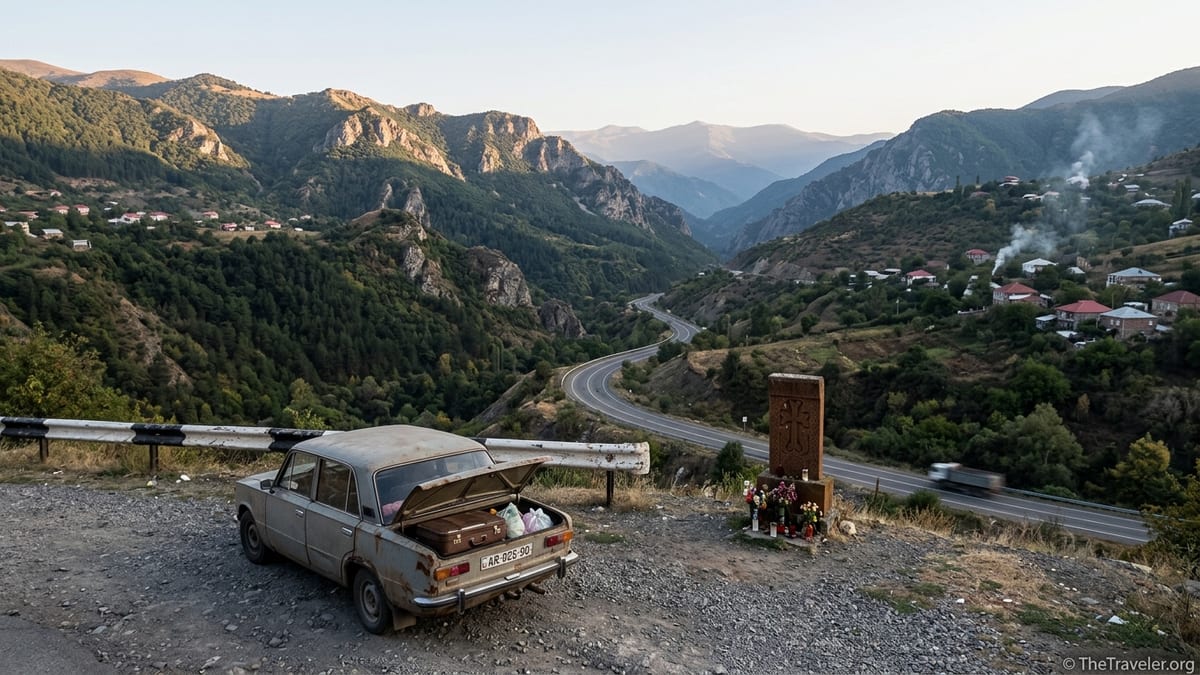
Most travelers still picture Nagorno Karabakh as a frozen conflict zone full of fortified hilltops, half-repaired Soviet-era hotels, and Armenian monasteries tucked into forested valleys. Until late 2020, small numbers of adventurous visitors could actually go there, usually entering from Armenia via the Lachin corridor, getting a paper permit in the de facto capital Stepanakert, and visiting sites like the Gandzasar Monastery or the ghost-town ruins around Aghdam. That reality has vanished. Since Azerbaijan’s September 19 to 20, 2023 offensive and the subsequent dissolution of the self-proclaimed republic on January 1, 2024, the region is fully under Azerbaijani control and effectively closed to independent tourism.
This is not simply a matter of a border shifting a few kilometers. In the space of roughly ten days after the offensive, more than 100,000 ethnic Armenians, nearly the entire population of Nagorno Karabakh, fled along a single mountain road toward Armenia. Their empty villages, schools, and churches now sit under a new administration. For a traveler, this means that any blog posts describing homestays in Armenian-run guesthouses near Shushi, or wine tastings in village backyards, are now historical snapshots rather than practical guides. Yet the place names endure on maps and in local conversations, which is why visitors to Yerevan, Baku, or border regions still hear “Karabakh” invoked constantly, even though the entity that many people imagine no longer exists.
On the ground, the closest most foreign visitors are likely to get is the Armenian town of Goris or the border-area villages of Syunik province, where many former Karabakh residents resettled. Travelers staying in guesthouses here might meet families who can point across the mountains and say “my village was there,” even while acknowledging they may never see it again. For many outsiders, it is hard to reconcile this overlapping geography: the same mountain ridge that one person calls home, another sees as a victory, and a third, reading a guidebook printed in 2018, still thinks of as a remote but visitable destination.
Why the Conflict Was Never Just “Ancient Hatreds”
One of the most persistent misconceptions about Nagorno Karabakh is that it is simply a case of ancient ethnic hatreds periodically erupting into violence. In reality, a traveler who digs into local accounts quickly hears about much more contemporary forces: Soviet-era borders, demographic engineering, and the collapse of an empire that left neighbors suddenly living on the wrong side of lines drawn decades earlier in Moscow. When locals in Armenia or Azerbaijan discuss the issue over tea, they rarely begin with medieval history; they more often start with the late 1980s and early 1990s, when the Soviet Union was unravelling and violence escalated on both sides.
During the first Nagorno Karabakh war in the early 1990s, more than half a million Azerbaijanis were displaced from surrounding districts and from within Nagorno Karabakh itself, while hundreds of thousands of Armenians fled Azerbaijan and other parts of the region. Many of these people or their children still live in cramped apartments in Baku’s suburbs or in Armenian towns like Vanadzor. A visitor who assumes only one group experienced displacement will quickly find that nearly every family in the South Caucasus has a story of loss tied to this conflict. Taxi drivers in Baku might point to a dilapidated building and say, “This used to house people who fled from Aghdam,” while in Yerevan an elderly shopkeeper might casually mention that she arrived from Baku in 1990 with a single suitcase.
The 2020 war and the 2023 offensive layered new traumas onto this history. For travelers, this means that conversations about Nagorno Karabakh are rarely abstract debates about international law. They are visceral, often emotional recollections of bombings, blackouts, missing relatives, and broken promises. Outsiders who come in with simplified narratives about aggressors and victims can easily offend, even unintentionally, because many locals see themselves as both at once: victims of violence and displacement, yet also citizens of states that have used force.
This complexity is why responsible travel writing about the South Caucasus increasingly urges visitors to listen more than they speak. Sitting in a café in Yerevan’s central Kentron district, you might overhear young Armenians debating whether to emigrate, referencing Karabakh as a turning point that shook their faith in security. In Baku’s Old City, an English-speaking guide might switch from discussing medieval caravanserais to proudly noting that Azerbaijan “restored control” over Karabakh. Neither perspective alone is complete; understanding the region means recognizing how both coexist, often uncomfortably, in the same geographic space.
The 2023 Exodus and the Human Cost Behind the Headlines
For many outside observers, Nagorno Karabakh briefly flashed across news alerts in September 2023 as “Azerbaijan launches offensive” and then faded. What most people never fully grasped was the speed and scale of the exodus that followed. Within roughly a week, nearly all Armenians of Nagorno Karabakh had crowded onto the mountain road through the Lachin corridor, heading to Armenia in convoys of cars, trucks, and buses. Reports from journalists and international organizations described traffic jams stretching for kilometers, families sleeping in vehicles, and people queuing for fuel, water, and basic aid.
Travelers who visited southern Armenia in late 2023 and early 2024 encountered the aftermath directly. In the small Armenian border town of Kornidzor, for example, school gymnasiums and community centers temporarily turned into reception points where new arrivals registered, received hot meals, and were assigned onward transport. Guesthouses that once catered to hikers exploring the Tatev Monastery and the Wings of Tatev cable car began housing displaced families. Even today, visitors checking into modest hotels in Goris or Kapan may find that staff quietly juggle tourists with long-term residents from Karabakh who are trying to rebuild their lives.
Individual stories bring this home in a way that maps and communiqués cannot. A former Stepanakert shop owner now selling fruit at a roadside stall near Sisian might tell you his entire inventory, savings, and apartment were left behind. A university student who had been studying in Yerevan but whose parents lived in Martakert might explain that they crossed the border with only their documents and a single suitcase, unsure whether relatives were safe after an explosion at a fuel depot near Stepanakert that killed and injured hundreds of people during the chaotic evacuation. Conversations like these, often occurring in taxis or over dinners in family-run guesthouses, reveal the lingering, everyday human cost that most international coverage, focused on ceasefire lines and diplomatic statements, only hints at.
Travel Realities: Borders, Advisories, and On-the-Ground Perceptions
For travelers planning a route through Armenia and Azerbaijan, one of the least understood aspects of Nagorno Karabakh is how it still shapes border policies and safety advice, even after the 2023 offensive. Officially, Nagorno Karabakh lies within Azerbaijan, and foreigners cannot legally enter from Armenia. Prior to 2020, some visitors did exactly that via the de facto authorities, later discovering that Azerbaijani border guards could see the Karabakh visa in their passport and deny them entry indefinitely. Even though those visas are no longer issued, old passport stamps still create complications for some travelers at Azerbaijani checkpoints today.
Major Western governments advise against travel near sections of the Armenia Azerbaijan border because of the risk of renewed fighting, unexploded ordnance, and unpredictable political tensions. This affects more than just obscure mountain passes. High-profile sites like Armenia’s Tatev Monastery or the wine-producing village of Areni lie within a few hours’ drive of sensitive frontier areas, and roadblocks or temporary closures are not unheard of after military flare-ups. Travelers who imagine they can improvise their route in real time may find that local tour operators in Yerevan or Baku insist on sticking to safer, well-monitored corridors, even when maps suggest enticing detours closer to the border.
On the Azerbaijani side, the government has spoken of ambitious reconstruction and resettlement projects in reclaimed territories, including the building of new airports and highways. However, access for foreigners remains tightly controlled, often limited to organized press trips or group tours with official oversight. Independent travelers turning up in Baku and asking for a bus to Shusha or Aghdam are likely to be met with polite but firm refusals, or offered only expensive, government-approved excursions. This controlled opening reflects a broader reality that Nagorno Karabakh is not an ordinary travel destination but a strategically sensitive area shaped by competing narratives of victory, loss, and historical justice.
Memory, Heritage, and the Fate of Cultural Sites
Another dimension most people underestimate is the immense concentration of cultural and religious heritage in and around Nagorno Karabakh, and the uncertainty over its future. For years, Armenian and Azerbaijani narratives have clashed over which churches, mosques, and cemeteries belong to which culture. In practice, this leaves travelers and heritage watchers worrying about the preservation of centuries-old sites in a zone that has changed control and demographics multiple times within a generation.
Before 2020, visitors entering Nagorno Karabakh from Armenia could tour medieval Armenian monasteries such as Gandzasar and Dadivank, exploring frescoed churches often staffed by a handful of monks and volunteers. They might also see crumbling Azerbaijani mosques in towns like Shusha, damaged or left unused during Armenian control. Today, the roles are reversed. Azerbaijan presents itself as a restorer of Islamic and Azerbaijani heritage in Shusha and other towns, while Armenians fear for churches and cemeteries they see as central to their historical presence in the region. Reports and satellite imagery periodically circulate on social media, alleging damage or alteration of religious monuments, though independent verification is often difficult due to restricted access.
For travelers interested in heritage, the most practical way to engage with this issue is indirectly, by visiting accessible sites in Armenia and Azerbaijan and listening to guides’ explanations. A visit to Etchmiadzin Cathedral near Yerevan or the cliff-top monastery of Tatev might include references to Nagorno Karabakh’s churches as part of a broader Armenian Christian landscape. In Baku or Ganja, guides may speak of reclaiming and restoring mosques and mausoleums in Karabakh as emblematic of national revival. Both narratives reveal how physical stones and carvings have become symbols in a much larger struggle over history, belonging, and international recognition.
It is important for visitors to recognize that photographs and social media posts about contested sites can be politically charged. Sharing images of certain monuments with partisan captions can inflame tensions or be used in propaganda by either side. Responsible travelers increasingly choose to focus on documenting the human experiences surrounding the conflict rather than treating religious sites purely as backdrops for dramatic images.
How Nagorno Karabakh Shapes Everyday Life Far Beyond the Front Line
Even though foreign visitors cannot freely roam Nagorno Karabakh itself, the conflict’s shadow stretches deep into the everyday lives of people across Armenia and Azerbaijan, and travelers often underestimate this. In Yerevan, for example, rents rose sharply in some districts after the 2023 exodus, as displaced families from Karabakh sought apartments in an already tight housing market. Cafés that once catered mainly to tourists and digital nomads began offering informal credit to regulars from Karabakh who were job-hunting. International volunteers and NGOs appeared in small towns to run language classes and psychosocial support sessions for children who had seen shelling or fled their homes.
In Azerbaijan, official messaging around the “liberation” of Karabakh pervades public life, from billboards in Baku to military parades marking territorial gains. Returning to recaptured areas is framed as a patriotic duty for displaced Azerbaijanis, many of whom spent decades in limbo in temporary housing or far from their ancestral villages. A visitor buying a train ticket at Baku’s main station might notice posters advertising future rail links to towns that currently function more as political symbols than as everyday destinations.
For younger generations on both sides, the conflict has also shaped career choices, media consumption, and even language skills. Some Armenian students who might previously have considered studying in Russia shifted their plans after feeling let down by Moscow’s response to the 2023 crisis, looking instead to Western universities. In Azerbaijan, students of international relations and law often frame their studies around arguments for the country’s territorial integrity, preparing for careers in diplomacy or advocacy. Conversations that outsiders might consider “political” are, for many locals, simply part of daily life shaped by a conflict that has outlasted multiple ceasefires and constitutional changes.
The Takeaway
For travelers exploring the South Caucasus today, Nagorno Karabakh is not a place to visit in the conventional sense. It is a prism through which to understand the fears, hopes, and frustrations of people you will meet in Armenia and Azerbaijan. The unrecognized republic that once printed its own stamps and issued its own visas ceased to exist on January 1, 2024, and its Armenian population left in a matter of days after the September 2023 offensive. Yet the region continues to live powerfully in memory, politics, and culture, shaping border controls, shaping where international aid flows, and coloring how locals talk about everything from foreign alliances to housing prices.
Most people outside the region will never fully understand Nagorno Karabakh because it defies neat stories. It is at once a site of displacement for both Armenians and Azerbaijanis, a stage for great-power maneuvering, and a landscape dotted with monasteries, mosques, cemeteries, and villages that mean very different things depending on who is speaking. For visitors, the most meaningful way to approach it is with humility: accept that you cannot see everything firsthand, listen carefully to those who lived its changes, and recognize that even a short trip through Yerevan or Baku touches a much deeper and more fragile history than first meets the eye.
FAQ
Q1. Can foreign travelers currently visit Nagorno Karabakh independently? No. Since Azerbaijan’s September 2023 offensive and the dissolution of the self-proclaimed Nagorno Karabakh Republic on January 1, 2024, the region is under full Azerbaijani control, and access is highly restricted. Independent travel is generally not possible; visits, if allowed at all, tend to be tightly organized and officially supervised.
Q2. Is it safe to travel to Armenia and Azerbaijan despite the conflict? Large parts of both countries remain calm and receive international visitors, including cities like Yerevan, Dilijan, and Gyumri in Armenia, and Baku, Sheki, and Ganja in Azerbaijan. However, border areas near the former Nagorno Karabakh front lines are sensitive, and governments often advise avoiding them due to potential skirmishes or unexploded ordnance. Travelers should check current advisories and follow local guidance.
Q3. What happened to the Armenian population of Nagorno Karabakh in 2023? After the September 19 to 20, 2023 offensive by Azerbaijan, nearly all of the roughly 120,000 ethnic Armenians living in Nagorno Karabakh fled to Armenia within about ten days. They left via the Lachin corridor in long convoys of vehicles, and many are now resettled in Armenian towns and villages, including Yerevan and the southern Syunik region.
Q4. Why do Armenia and Azerbaijan both claim Nagorno Karabakh? Nagorno Karabakh was an autonomous region inside Soviet Azerbaijan but had a majority ethnic Armenian population. As the Soviet Union collapsed, local Armenians sought unification with Armenia, while Azerbaijan insisted on its territorial integrity. War, displacement, and competing historical narratives followed, with both states presenting legal, historical, and moral arguments for their claims.
Q5. Can I enter Azerbaijan if I previously visited Nagorno Karabakh from Armenia? Travelers with old Nagorno Karabakh visas or entry stamps in their passports have historically been denied entry to Azerbaijan or questioned at the border. Even though those visas are no longer issued, it is safer to renew your passport before attempting to enter Azerbaijan if you previously visited the region from the Armenian side.
Q6. Are there still active minefields or unexploded ordnance in the region? Yes. Decades of conflict have left Nagorno Karabakh and surrounding areas heavily contaminated with landmines and unexploded shells. Demining work is ongoing but will likely take many years. This is one reason why access for independent travelers is so restricted and why nearby border zones on both the Armenian and Azerbaijani sides can be hazardous off established roads.
Q7. How can travelers learn about Nagorno Karabakh without visiting it? Visitors can speak with displaced families now living in Armenia, take guided walks with local historians in cities like Yerevan or Baku, visit museums and memorials, and attend cultural events featuring music, film, or photography from the region. Many guesthouse owners and taxi drivers are themselves from Karabakh or host relatives who fled, and they often share personal stories when asked respectfully.
Q8. Is tourism being developed in former Nagorno Karabakh areas under Azerbaijani control? Azerbaijan has announced large-scale reconstruction plans, including highways, airports, and new housing in former conflict zones. Some organized tours and media visits have taken place, but entry remains highly controlled, and independent backpack-style tourism is not generally allowed. For most travelers, these areas are not yet realistic destinations.
Q9. How should travelers talk about Nagorno Karabakh with locals? It is best to approach the topic with sensitivity, avoid taking sides, and recognize that nearly everyone has personal or family stories tied to the conflict. Asking open questions, listening more than speaking, and avoiding inflammatory language can lead to meaningful conversations without deepening pain or disagreement.
Q10. Does learning about Nagorno Karabakh really matter for casual visitors? Yes. Even if you only plan to stroll through Yerevan’s cafés or Baku’s seaside promenade, the legacy of Nagorno Karabakh shapes local politics, media, and daily life. Understanding the basic history and human impact helps you interpret what you see and hear, interact more respectfully with residents, and appreciate the region’s resilience amid ongoing uncertainty.