

The first time I landed in Tbilisi, I walked out of the airport with a wallet full of euros and the smug conviction that Georgia was “Asia-cheap.” A decade of budget travel across the continent had trained me to treat Eastern Europe as the last frontier of low prices. But as my taxi slid past glass towers and wine bars into a maze of 19th-century balconies, it was clear this city was no longer a backpacker secret. Tbilisi is still cheap by European standards in 2026, but you can feel the prices creaking upward with every new specialty coffee shop and boutique hotel.
A City Between Bargain and Boom
I spent a week in Tbilisi this spring, and each day felt like a tug of war between two versions of the city. On one side, there was the Tbilisi I had read about for years: a place where backpackers boasted of living on the cost of a single London brunch. On the other, there was the new Tbilisi: coworking spaces packed with remote workers, natural wine bars filled with locals and visitors, and a cost of living that quietly inches closer to the rest of Europe.
Compared with classic city-break favorites like Paris, Amsterdam, or Copenhagen, Tbilisi still looks like a steal. A night in a central three-star hotel in those cities can easily run 180 to 250 dollars or more. In Tbilisi, recent 2026 price checks put a decent three-star room closer to 55 to 75 dollars a night, with boutique properties in Old Town starting around 130 dollars. That is a substantial difference when you multiply it over a long weekend or a full week away.
And yet, the days of 10 dollar daily budgets are gone. Recent Georgia travel budget reports suggest that while backpackers can still scrape by on about 30 to 45 dollars a day, most visitors now fall into the 60 to 100 dollar range once you factor in private rooms, coffees, wine, and a couple of day trips. Prices here are still friendly; they are just no longer unbelievable.
The paradox is part of what makes Tbilisi so compelling right now. You can sip a glass of qvevri wine for what feels like pocket change by Paris standards, but you will do so in a bar that would not look out of place in Lisbon or Berlin. It is a European capital caught between its budget reputation and its growing ambitions.
What “Cheap” Actually Looks Like in 2026
On my first morning, I set myself a simple challenge: enjoy the city without treating it like a race to the bottom on spending. I walked from my guesthouse in Sololaki to a neighborhood bakery, ordered a still-warm adjaruli khachapuri, and handed over less than 4 dollars. At a cafe that would have fit perfectly in any hip district of Barcelona, a flat white cost around 8 to 10 Georgian lari, or roughly 3 to 4 dollars. For comparison, a similar drink in central Paris or Rome easily runs 4 to 6 euros.
The pattern repeated throughout the day. A hearty lunch for two at a local restaurant, with a shared salad, khinkali dumplings, and house wine, came to around 70 to 80 lari, or about 25 to 30 dollars total. A more polished dinner at a stylish spot in Vera, with small plates, a bottle of natural wine, and dessert, nudged the bill up to 150 to 200 lari, around 55 to 70 dollars. In a Western European capital, the same level of food and atmosphere would likely cost double.
Accommodation follows a similar curve. Budget travelers willing to sleep in hostel dorms can still find beds from about 8 to 15 dollars per night. Mid-range guesthouses and small hotels typically sit in the 30 to 75 dollar range, while design-forward boutique hotels or international chains in central Tbilisi now hover from 130 to 170 dollars a night. That puts Tbilisi at a fraction of the cost of places like Zurich or London, and still noticeably below mid-tier favorites such as Lisbon or Barcelona.
Even small daily expenses come in pleasantly low by European standards. A public transport ride on the metro costs less than 1 dollar. A ticket to the Georgian National Museum sits around 10 lari, or roughly 3 to 4 dollars, for a collection of artifacts that rivals much more expensive museums elsewhere. Entry to the public sulfur baths at Orbeliani, the ornate blue-tiled bathhouse you have likely seen in photographs, can be as low as a couple of dollars for the communal pool.
The New Wave of Visitors Is Changing the Bill
When I first visited Georgia years ago, the other foreigners I met were mostly backpackers and overlanders heading to the Caucasus. Today, Tbilisi’s streets echo with the chatter of remote workers, expats, and city-break travelers looking for “the next Prague” or “a cheaper Budapest.” Underneath the postcard-perfect balconies, there is a very modern story of supply and demand.
Digital nomad forums and expat cost-of-living reports consistently rank Tbilisi among Europe’s better-value capitals. Remote professionals praise monthly coworking passes that are still far cheaper than those in Berlin or Dublin, while enjoying high-speed internet and a growing cafe culture. International travel companies now bundle Tbilisi into multi-country Caucasus itineraries, and Western media increasingly describe Georgia as one of the last “affordable” European destinations.
That attention has consequences. Rents in central districts like Vera, Vake, and Sololaki have been climbing faster than local wages, putting pressure on long-term residents even as nightly prices remain appealing to tourists. Some Georgian commentators have pointed out that while Tbilisi is still affordable to visitors from Western Europe or North America, it no not feel particularly cheap to locals anymore, especially in supermarkets where food prices can rival or exceed those in parts of the European Union.
The contrast is stark when you talk to people who remember the city ten or fifteen years ago. They recall a Tbilisi where a taxi ride across town cost the equivalent of a bus ticket, and where wine was so inexpensive it almost felt wrong to put a price tag on it. Today, taxis booked through ride-hailing apps remain cheap by London or Paris norms, but they no longer feel like a rounding error on the daily budget. The city is still a bargain in European terms; it is just a more contested one.
How Tbilisi Compares With Other “Good Value” European Cities
To understand Tbilisi’s place in the current travel landscape, it helps to hold it up against other value darlings. Travelers looking for affordable European breaks mention cities such as Bucharest, Sofia, Tirana, or Chisinau, as well as mid-priced but popular destinations like Prague, Porto, or Valencia. Each offers a balance of culture and cost, but their price curves are not all moving at the same pace.
In classic Central European favorites, nightly hotel prices have risen steadily as tourism bounced back. A central room in Prague or Budapest might easily reach 120 to 180 dollars in high season, with meals in trendy districts edging closer to Western European levels. Balkans capitals such as Sofia or Bucharest often come in cheaper on food and local transport, but accommodation prices are catching up fast, especially in polished, tourist-oriented neighborhoods.
By comparison, Tbilisi still undercuts many of these cities, especially at the mid-range level. Intercity buses around Georgia remain far cheaper than rail journeys in Western Europe. A glass of local wine in a casual Tbilisi bar, often in the 3 to 6 dollar range, would be a rare find in most major EU capitals. Even coffee and casual lunches, though pricier than they were a few years ago, still feel gentler on the wallet than in Western or Nordic Europe.
At the same time, Georgia’s growing global profile, especially as a wine destination, hints at where things might be headed. The more it appears in lists of “best cities to live and work” and “cheapest European breaks in 2026,” the stronger the pull on demand. As we have seen in other once-cheap cities, from Lisbon to Krakow, that kind of attention rarely leaves prices untouched for long.
Living Like a Local, Spending Like a Visitor
One of the simplest ways to understand Tbilisi’s evolving affordability is to follow the locals. On my third day, a Tbilisian friend gently redirected my plans. Instead of another Old Town restaurant, he led me three streets away to a no-frills place filled with families and older men hunched over plates of lobio and khachapuri. The menu was almost identical to the tourist-facing spot I had scouted earlier; the prices, however, were nearly half.
The pattern played out repeatedly. On Shardeni Street, one of the city’s most photographed lanes, wine bars advertise curated Georgian labels at Western European prices. A five-minute walk into side streets lined with aging apartment blocks leads to simple wine shops where a bottle of decent local wine might cost 8 to 12 dollars. In the baths district, private rooms with elaborate tilework and Instagram-ready tubs can command fees that surprise unsuspecting backpackers, but the public section of Orbeliani Baths remains a fraction of the cost.
Travelers willing to adapt to local rhythms can still keep daily costs impressively low. Eating khinkali at neighborhood restaurants instead of high-design venues, using the metro instead of relying solely on taxis, and choosing guesthouses in less-hyped districts like Saburtalo or Didube can shave meaningful amounts off a weekly budget. In many ways, Tbilisi rewards curiosity over convenience: the more you stray from the obvious choices, the more the old “cheap city” reputation holds true.
For short-term visitors, this means you can choose your own adventure. It is entirely possible to treat Tbilisi like any other cosmopolitan European capital, staying in design hotels, drinking natural wine, and hopping between galleries and tasting menus, and still spend less than you would in Paris or Copenhagen. It is equally possible to approach it like the budget travelers of a decade ago, leaning into markets, street food, and guesthouses, and walk away with a daily spend that rivals Southeast Asian cities.
The Takeaway
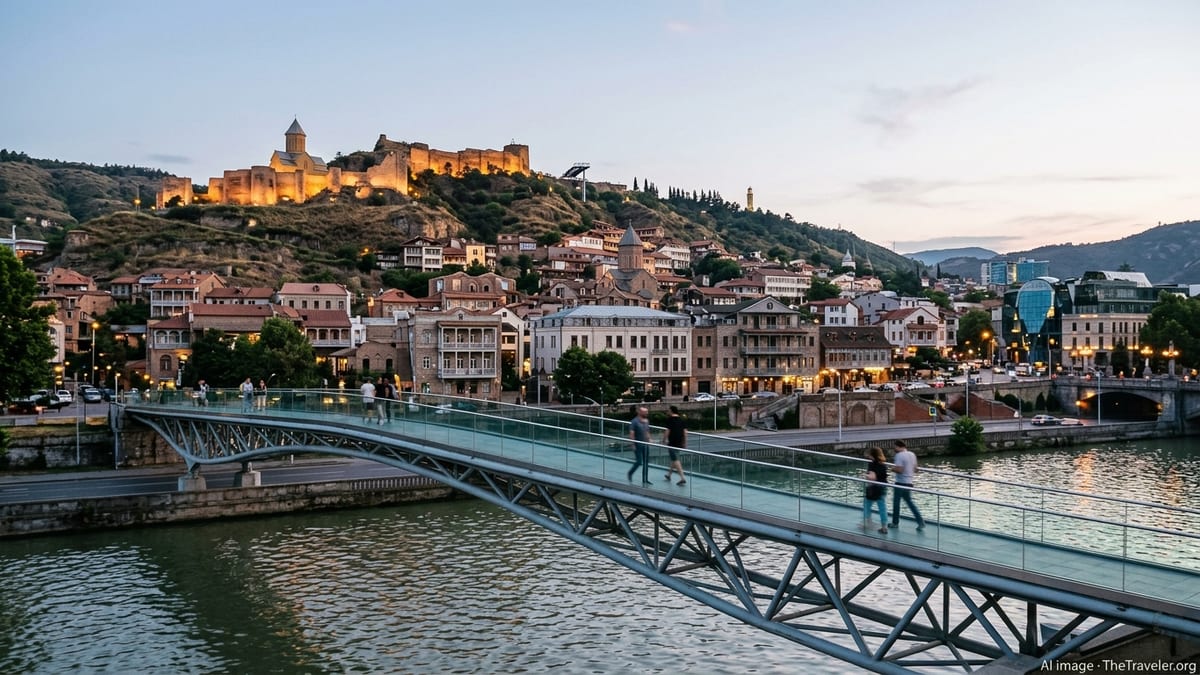
Standing on the Peace Bridge at dusk, the glass canopy catching the last gold light over the Mtkvari River, I watched a city that is clearly in transition. Luxury hotels flicker to life on one side of the river, while old wooden balconies sag charmingly on the other. The air smells faintly of sulfur from the baths and of freshly ground coffee from cafes that did not exist five years ago.
For now, Tbilisi is still cheap by European standards. A week here can cost less than a long weekend in many Western capitals, without any need to sacrifice comfort or culture. You can drink exceptional wine, soak in historic baths, ride clean, efficient public transport, and eat memorably well for less than the price of mediocre meals elsewhere.
But the window is narrowing. Rising demand from tourists, expats, and remote workers is slowly rewriting the city’s price tags, particularly in its central and most photogenic neighborhoods. The word is out, and every glowing article or social media post nudges Tbilisi a little further from its bargain-basement past.
If you have ever toyed with the idea of visiting Georgia, now is the time to do it. Come with realistic expectations, a flexible budget, and the humility to explore beyond the obvious. You will still find a city that feels like one of Europe’s better deals, but you will also see, in real time, what happens when a “cheap city” steps decisively onto the global stage.
FAQ
Q1. Is Tbilisi still a cheap city to visit in 2026?
Tbilisi remains inexpensive compared with major Western European capitals, especially for accommodation, food, and local transport, though prices have risen notably in recent years.
Q2. How much should I budget per day in Tbilisi as a typical traveler?
Most visitors who stay in private rooms, eat out, and enjoy some wine and activities should plan on roughly 60 to 100 US dollars per person per day.
Q3. Are accommodation prices in Tbilisi increasing quickly?
Yes. Central districts and stylish boutique hotels have seen noticeable price growth, though they still tend to be cheaper than equivalent options in Western Europe.
Q4. Is food and drink still good value in Tbilisi?
Generally yes. Local bakeries and neighborhood restaurants are especially good value, while high-design wine bars and tourist streets can feel closer to Western European prices.
Q5. How does Tbilisi compare to other affordable European cities like Sofia or Bucharest?
Tbilisi is broadly in the same “good value” tier, often cheaper for wine and intercity transport, but similar or slightly higher for some supermarket items and imported goods.
Q6. Can I visit Tbilisi comfortably on a backpacker budget?
Backpackers who choose hostels, local eateries, and public transport can still keep daily costs near 30 to 45 US dollars, especially outside peak summer.
Q7. Are taxis and ride-hailing still cheap in Tbilisi?
Ride-hailing and taxis remain inexpensive compared with Western European cities, though not as dramatically cheap as they were a decade ago.
Q8. Which neighborhoods offer the best value for staying in Tbilisi?
Areas just outside the main tourist core, such as parts of Vera, Saburtalo, or less-hyped streets in Sololaki, often balance lower prices with good access to sights.
Q9. Is Tbilisi a good base for remote workers looking for value?
Many remote workers find Tbilisi attractive thanks to relatively low living costs, growing coworking options, and strong cafe culture, though housing prices are climbing.
Q10. Will Tbilisi stay cheap for long?
It is hard to say, but rising popularity, increased tourism, and more long-term foreigners suggest that Tbilisi’s status as a “cheap” city may gradually fade in the coming years.