


More news on this day
Thousands of travellers across Europe are facing missed holidays, forced overnight stays and scrambling rebookings after a fresh wave of disruption delayed 2,918 flights and cancelled around 240 services in a single day, hitting major carriers including Lufthansa, KLM and British Airways at key hubs such as Frankfurt and Paris as well as airports in the Netherlands, Norway, Spain and beyond.
Get the latest news straight to your inbox!
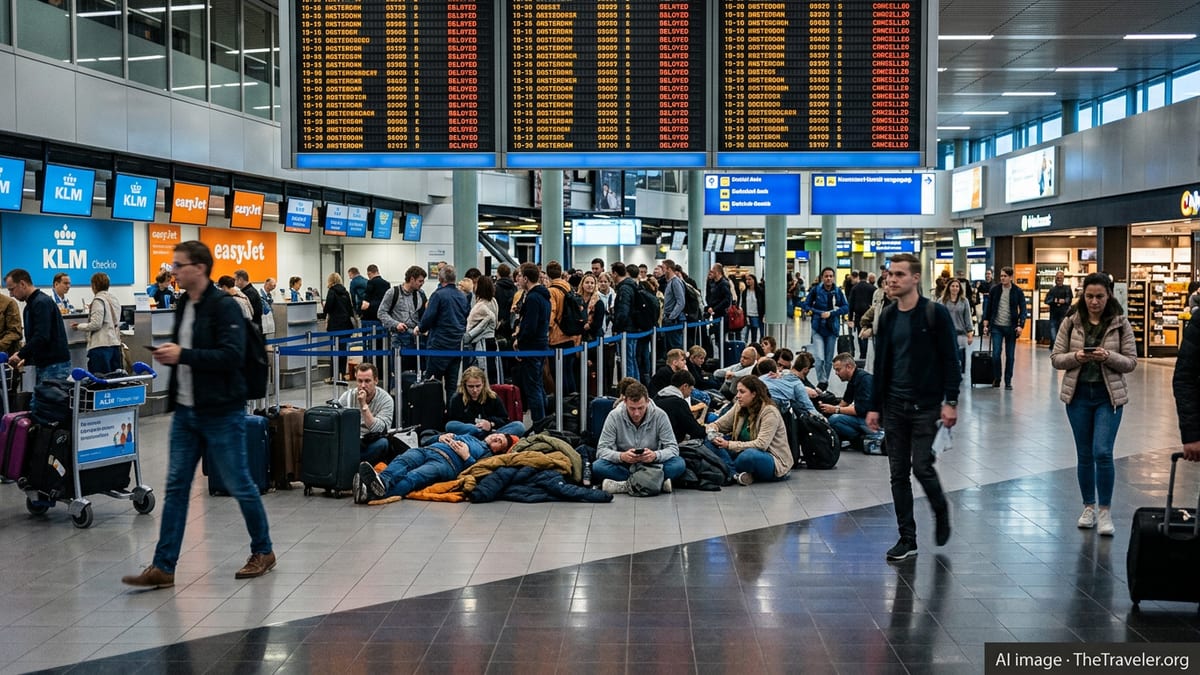
Network Wide Disruption From Netherlands To Norway And Spain
Data from flight tracking platforms and operational reports for early July 2026 show one of the most difficult travel days of the summer so far, with knock on disruption rippling across multiple European countries. The impact has been felt from Dutch and Norwegian gateways to busy Spanish holiday airports, leaving aircraft and crews out of position and passengers stranded far from their intended destinations.
Figures cited by industry and passenger rights services indicate that approximately 2,918 flights were delayed and around 240 were cancelled across Europe during the latest episode, affecting both short haul and long haul operations. While these numbers fluctuate during the day as schedules are updated, they point to a sharp spike in disruption compared with an average summer weekday.
Airports in the Netherlands and Norway, which serve as important connecting points for traffic to Northern Europe and the North Atlantic, have reported dense clusters of delays as airlines absorb earlier air traffic flow restrictions and weather related spacing. In Spain, which is in peak holiday season, delays at coastal and island airports have been compounded by heavy demand, leaving many passengers facing multi hour waits in terminal buildings.
Travel agencies and tour operators describe a patchwork of disruption, where some flights operate roughly on time while others are significantly delayed or cancelled with limited warning. The result is an uneven travel experience in which a seemingly minor schedule change at one hub can cascade into missed connections and overnight stays across the continent.
Frankfurt, Paris And Other Major Hubs Under Pressure
The latest wave of disruption has once again highlighted the vulnerability of Europe’s largest hubs. Frankfurt and Paris Charles de Gaulle, both central to the networks of Europe’s biggest airline groups, have been particularly exposed as delays elsewhere in the system arrive in already busy banks of connecting traffic.
Publicly available statistics for Germany’s six largest airports on 1 July 2026 showed 998 flight delays and 40 cancellations in a single day, with Frankfurt shouldering a substantial share of the impact. A mix of carriers, including Lufthansa and several international partners, saw schedules pushed back or cut, forcing many passengers into lengthy queues at ticket desks and customer service counters as they sought new routings.
Paris has faced its own pressures. Recent operational data for Paris Charles de Gaulle highlighted bursts of disruption in late June, with more than 100 delays and several cancellations concentrated over a few hours, particularly on routes linking France with Spain, Portugal, Switzerland and Norway. Those patterns have continued into July, with the latest network wide issues once again feeding into congested connection banks at the airport.
Capacity constraints in surrounding airspace also play a role. Air traffic management briefings for the current week point to continued bottlenecks over France and Spain, where staffing limitations, high traffic volumes and the introduction of new control systems have contributed to higher average delays per flight. When those constraints intersect with busy hub operations, even small interruptions can quickly propagate across the network.
Lufthansa, KLM, British Airways And Others Caught In The Turbulence
The disruption has not been confined to any single airline. Lufthansa, KLM and British Airways are among the most affected, alongside a broad mix of European and long haul carriers that rely on the same airspace and airport infrastructure. For passengers, the airline on the ticket often matters less than the fact that many carriers are dealing with similar constraints at the same time.
In Germany, Lufthansa and its partners have been managing the fallout from delays and cancellations at Frankfurt and Munich, where tight aircraft rotations and high summer loads leave little slack in the system. Earlier episodes of disruption linked to strikes, weather and routing changes in other regions had already reduced resilience in parts of the network, making it more difficult to recover when fresh operational challenges emerge.
KLM has also been under sustained pressure at Amsterdam Schiphol, its primary hub, where previous operational bottlenecks and weather related slowdowns have at times forced the airline to pre emptively cut flights to stabilise schedules. Recent analyses of European disruption patterns show that KLM, along with several partner airlines, has been involved in multiple waves of cancellations and delays stretching from mid June into early July.
British Airways, meanwhile, has faced a combination of congested airspace over Western Europe and storm systems affecting routes into and out of London. Passenger reports from recent days describe missed onward flights to continental hubs such as Paris and Frankfurt after earlier segments were delayed, leading to rerouted journeys that sometimes involve overnight stays or rebookings on partner carriers.
Weather, Air Traffic Control And Capacity Shortages Drive Chaos
While each incident of disruption has its own specific cause, analysts point to a familiar mix of factors behind this week’s widespread problems. Thunderstorms and changing wind patterns across Western and Northern Europe have required controllers to space aircraft further apart, cutting capacity on already busy routes. In some regions, including parts of France and Spain, reduced staffing levels and system transition work have added further constraints.
Network management briefings for the current week indicate that average air traffic flow management delay per flight is running significantly above last year, with more than one in five flights across the network experiencing some form of flow related delay. Airspace sectors over France, Spain and Greece are flagged as particular hot spots, but the operational consequences reach far into neighbouring countries when flights are rerouted or held on the ground.
At the same time, airports are heading into the busiest weeks of the summer with little spare capacity. Industry bodies have warned that new border control systems, staffing shortages in ground handling and security, and strong post pandemic demand are stretching terminal operations. Long queues at check in, security and passport control not only frustrate passengers but can also delay boarding and push back times, adding another layer of variability to departure schedules.
These structural pressures mean that even when weather improves or a particular technical issue is resolved, it can take many hours for schedules to recover. Aircraft and crews can end up in the wrong places, forcing airlines to cancel later flights or operate with tight turnaround times that are vulnerable to further shocks.
What Stranded Travellers Can Expect And How To Navigate The Disruption
For the thousands of travellers caught in this latest wave of disruption, the immediate priorities are rebooking, accommodation and basic care at the airport. Passenger rights organisations note that under European and UK regulations, airlines are generally required to offer rerouting or refunds when flights are cancelled, and to provide meals, refreshments and hotel rooms when passengers are left waiting for extended periods, regardless of whether the underlying cause is within the airline’s control.
Compensation payments, however, are more limited. When the primary trigger for delays and cancellations is considered outside an airline’s control, such as severe weather or direct air traffic control restrictions, many passengers will not qualify for fixed cash compensation, even if the practical impact on their trip is significant. Nonetheless, travellers are advised in public guidance to keep boarding passes, delay notifications and receipts for out of pocket expenses, as documentation may be needed for any claims.
Airlines and airports are urging customers through public channels to check the status of their flights frequently on official apps and information pages, rather than relying solely on printed boarding passes or third party tools. Same day schedule changes are common during periods of severe disruption, and some passengers may be able to secure earlier alternatives by accepting reroutings via less congested hubs or different alliance partners.
Consumer advocates also stress the importance of planning extra connection time when travelling through European hubs during the peak summer period. With air traffic flow restrictions, weather, and infrastructure challenges likely to continue into the coming weeks, the latest day of 2,918 delays and 240 cancellations may prove to be part of a longer stretch of difficult travel conditions rather than a one off shock.