


More news on this day
Scattered thunderstorms over North Texas Monday morning triggered dozens of cancellations and nearly 300 delays at Dallas Fort Worth International Airport, complicating the start of the workweek for thousands of travelers and rippling across airline networks nationwide.
Get the latest news straight to your inbox!
Storms Slow One of the Nation’s Busiest Hubs
Publicly available flight-tracking data for Monday, July 13, indicate that airlines at Dallas Fort Worth International Airport delayed nearly 300 flights and canceled around 40 departures and arrivals by late morning as thunderstorms developed over parts of the Dallas Fort Worth region. The disruptions placed DFW among the most affected large airports in the United States for weather-related delays to start the day.
Coverage from local news outlets in North Texas describes scattered thunderstorms moving through the metro area during the early hours, with rain, lightning and low clouds periodically affecting visibility and creating congestion in surrounding airspace. The unsettled conditions prompted airlines and air traffic managers to slow the flow of aircraft into and out of the airport, resulting in rolling delays that built throughout the morning schedule.
Flight-status dashboards show that the impact was not limited to a single carrier. American Airlines, which operates a major hub at DFW, regional affiliates and several other domestic and international airlines all reported delayed departures and extended arrival times. As schedules backed up, later flights were pushed further into the day, extending the disruption well beyond the period of heaviest rain over the airport itself.
Ground Stops and Flow Controls Manage Thunderstorm Risk
Federal aviation advisories for the Dallas Fort Worth area on Sunday, July 12, detailed a series of ground stops and a ground delay program tied to thunderstorms in the region’s airspace. Those measures, which are designed to meter air traffic into a congested or weather-affected hub, continued to influence Monday’s early operations as airlines worked through displaced aircraft and crews.
Aviation planning documents show that thunderstorms were listed as the primary impacting condition for both the ground stop and the ground delay program affecting DFW. Under these programs, flights destined for the airport are held at their departure points or assigned controlled departure times to avoid overwhelming arrival corridors during periods of reduced runway capacity, such as when storms force traffic onto limited approach paths.
Information from the Federal Aviation Administration’s national airspace system dashboard on Monday afternoon continued to highlight weather-related constraints in North Texas. Average arrival delays in the Dallas Fort Worth area approached an hour at times as air traffic controllers balanced safety requirements associated with thunderstorms against the high volume of summer passenger traffic.
Regional Weather Pattern Adds to Summer Travel Strain
Forecast discussions from the National Weather Service office serving North Texas indicated that scattered showers and thunderstorms were expected to affect much of the region as a moist, unstable air mass lingered in place. Meteorologists noted that slow-moving storms and weak upper-level winds could allow cells to redevelop over the same areas, periodically disrupting operations at major transportation hubs.
The storms over DFW formed as part of a broader pattern of convective weather across Texas, coinciding with separate ground stops and delays reported at airports in Houston. Coverage from regional media there described thunderstorms that temporarily halted departures and led to average delays of around three quarters of an hour, underscoring how quickly summer storms can affect several major airports at once.
Aviation research and recent industry analyses identify thunderstorms as a leading driver of flight delays across the national system, particularly during the warm season. Studies summarizing FAA data indicate that adverse weather accounts for a majority of delay minutes, with convective storms such as those that affected DFW ranking among the most disruptive phenomena because they can close approach paths, generate wind shear and force aircraft to divert around large storm cells.
Passengers Face Missed Connections and Overnight Disruptions
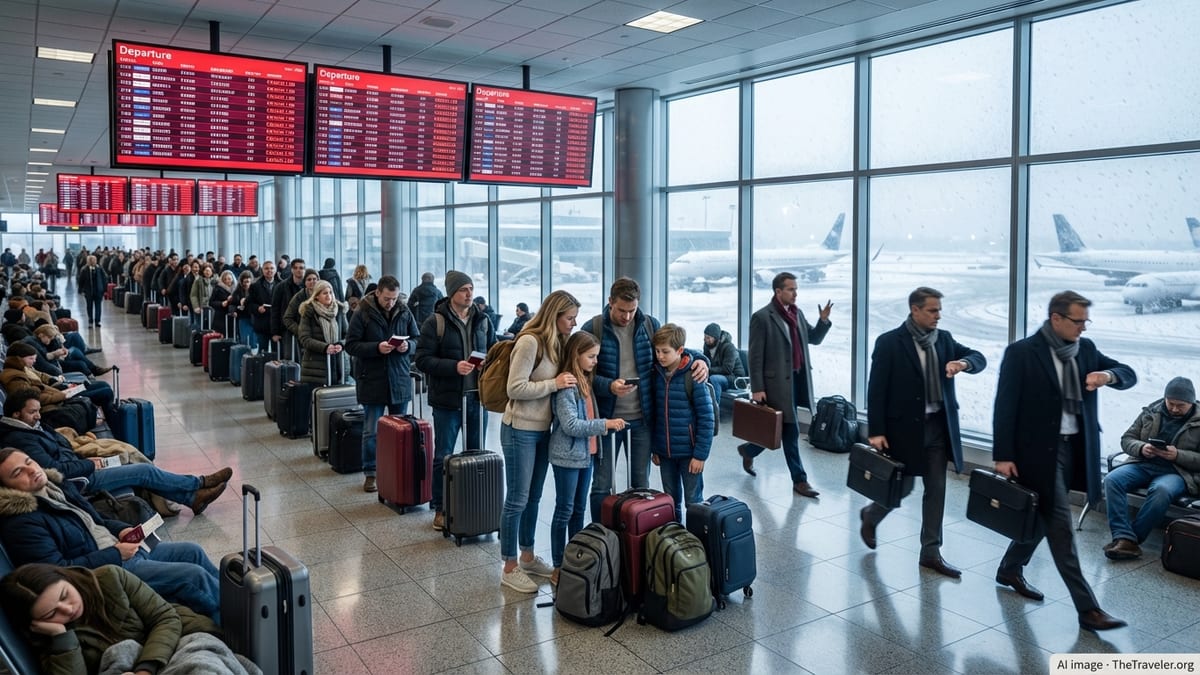
The combination of cancellations and nearly 300 delays at DFW created significant challenges for passengers, especially those relying on tight connections through the hub. Online traveler accounts and discussion forums frequently describe how even short periods of severe weather at a major connecting airport can cascade into missed onward flights, rebookings for the following day and unplanned overnight stays.
DFW’s role as a central transfer point for domestic and international routes amplifies the effect of any disruption. When aircraft and crews arrive late or are diverted to alternate airports to avoid thunderstorms, airlines often must reshuffle equipment, reassign crews approaching duty limits and consolidate lightly booked flights. These adjustments can convert what begins as a weather delay into a cancellation later in the day if aircraft and staff can no longer be positioned in time.
Travelers caught in Monday’s delays were advised through airline notifications and airport information screens to monitor their flight status, as departure times shifted in response to evolving weather and air traffic constraints. Standard guidance from airlines encourages passengers to make use of mobile apps, text alerts and self-service rebooking tools during such events, particularly when call centers and airport service desks experience heavy demand.
Summer Outlook: More Storm-Linked Disruptions Likely
Historical data and industry studies suggest that episodes like Monday’s disruption at DFW are likely to recur throughout the peak summer travel season. Analyses of past years show that clusters of thunderstorms near major hubs can trigger hundreds of delays and cancellations in a single day, as tightly scheduled networks leave little margin to absorb extended ground stops or reroutes around severe weather.
Climate and aviation researchers have warned that as heavy rainfall events and intense convective systems become more frequent in parts of the United States, large hub airports may face growing operational challenges. Case studies focusing on the Dallas Fort Worth region have found that significant storm and heavy rain episodes can delay or cancel a sizable share of scheduled flights, especially when they occur during already busy travel periods.
For travelers, Monday’s situation at DFW serves as a reminder that summer itineraries routed through storm-prone hubs can be vulnerable to last-minute changes. Travel planners often recommend building longer connection times, booking earlier flights in the day and remaining flexible with routing when severe weather is in the forecast for a major connecting airport.