


Timanfaya National Park lies in the south west of Lanzarote between the villages of Yaiza and Tinajo, a protected core of the vast lava fields created by the island’s 18th century eruptions. Those eruptions, which lasted from 1730 to 1736 with further activity in 1824, buried villages, reshaped the coastline and left a young volcanic landscape that is still geothermally active. Because the lava is fragile, relatively young and slow to recover from damage, access to the park’s interior is strictly controlled. Visitors cannot freely drive or hike across the lava: the standard visit is channelled through the Montañas del Fuego centre on the LZ‑67 road, using park buses for the Volcano Route, with limited options for guided walks and camel rides along the park boundary.
Get the latest updates straight to your inbox!
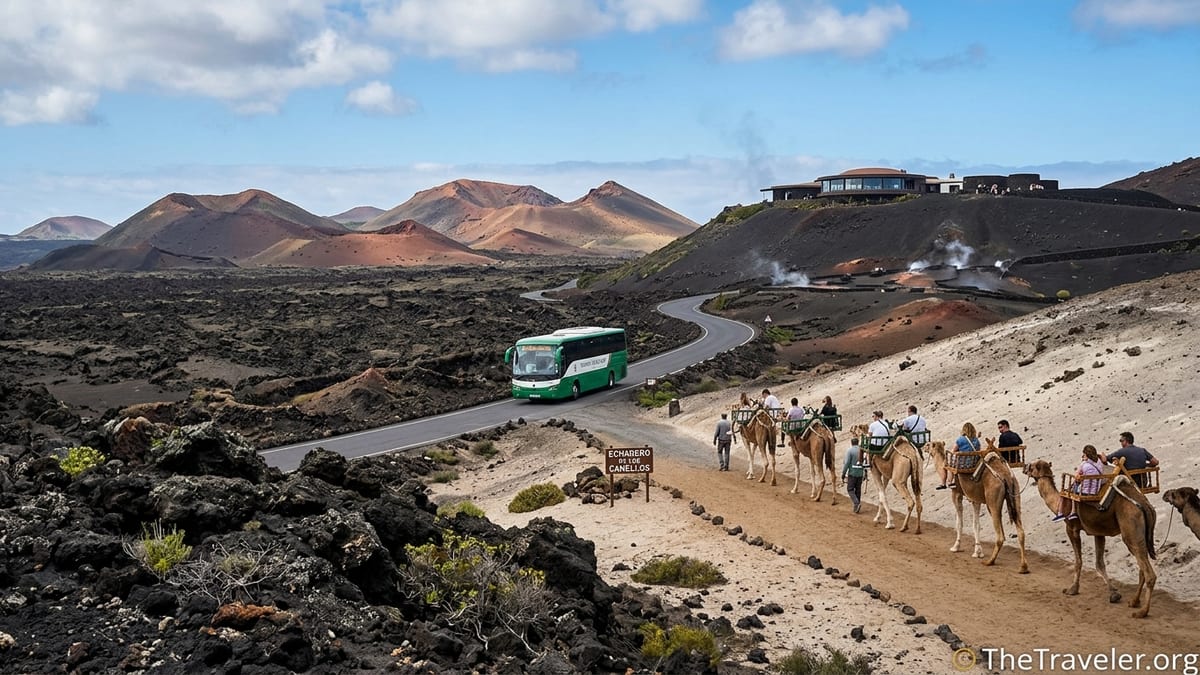
How visits to Timanfaya actually work
The most important thing to understand before you arrive is that Timanfaya is not a place where you can simply park and roam at will. The core of the national park is off limits except on official routes designed to protect both visitors and the delicate lava and ash. The vast majority of people experience the park through the Montañas del Fuego complex at Islote de Hilario, where private vehicles must stop and visitors transfer to official buses for a circuit through the most dramatic volcanic scenery.
For most independent travellers there are two practical ways to visit. One option is to hire a car and buy dated timed tickets in advance for Montañas del Fuego, driving yourself along the LZ‑67 between Yaiza and Tinajo and parking at the centre. The other is to book an organised excursion that includes transport from the main resorts and entry to the site, usually with a fixed timeslot and sometimes in combination with nearby attractions such as La Geria, El Golfo or Los Hervideros. Both approaches ultimately converge at the same Montañas del Fuego experience.
If you had imagined driving your own car along the Volcano Route inside the park, or setting off on unaccompanied hikes across the lava, it is important to reset those expectations. Private cars are not allowed beyond the car park at Islote de Hilario and there are no official open hiking trails in the park interior that you can follow on your own. Access to the inside of the national park on foot is limited to a small number of ranger‑led routes with advance reservation and strict group sizes.
Outside the strictly protected core of the park, the surrounding volcanic landscape continues into the wider Los Volcanes protected area, where commercial hiking companies operate guided walks on marked trails. These can feel equally spectacular in terms of scenery but are legally and practically distinct from the national park’s own guided routes.
Montañas del Fuego on LZ‑67: tickets, hours and what you see
Montañas del Fuego is the official tourist access point to Timanfaya National Park, located on the LZ‑67 road roughly midway between Yaiza and Tinajo. All standard visits pass through a checkpoint where the entrance fee is collected and cars are directed to parking areas. From there paths lead up to the main viewing area around the Islote de Hilario, where visitors board buses for the Volcano Route and watch short geothermal demonstrations that showcase residual heat just below the surface.
The park authority currently states core opening hours for Montañas del Fuego of approximately 9:00 to 17:00 daily, while the island’s centres of art and tourism sell dated entries with last admission typically in mid afternoon. Exact cut off times for sales and access can vary by season and demand, so it is prudent to check the latest timetable when you book and to arrive comfortably within your allocated slot. The entry price includes parking, the 30 to 40 minute Volcano Route bus tour and access to the lookout areas and demonstrations.
Once on board the official bus, you follow a one way circuit through the most dramatic lava fields and craters, with commentary and several slow sections at viewpoints. The road is narrow, carefully engineered and closed to private traffic, which preserves the sense of isolation and limits the physical impact of vehicles on the lava. You remain inside the bus for the duration of the tour, so photography is through the windows, but the route gives expansive views across the black lava seas and multi‑coloured volcanic cones.
Around the main terrace at Islote de Hilario you can watch staff demonstrate how dry brush bursts into flame in shallow pits and how water poured into boreholes erupts back as steam. There is a restaurant that uses geothermal heat for some cooking methods, a café, toilets and a gift shop. Facilities are modern but the site can be extremely busy at peak times, and queues for buses and demonstrations are part of the experience if you visit during late morning or midday in high season.
Getting there: self drive, tours, taxis and new shuttle services
For visitors staying in Lanzarote’s main resorts such as Puerto del Carmen, Costa Teguise or Playa Blanca, Timanfaya lies roughly 30 to 45 minutes away by road depending on traffic. A typical self drive visit from these resorts, including the bus circuit and time in the centre, usually takes between half a day and a long morning if you combine it with short stops at other viewpoints nearby.
Hiring a car gives the greatest flexibility. You can choose an early entry slot to avoid queues, stop at the free Mancha Blanca Visitor Centre on the way, and add coastal viewpoints like El Golfo and Los Hervideros or a wine tasting in La Geria. The trade off is that traffic on the LZ‑67 can be heavy at peak times, especially when several excursion coaches arrive together, and parking at Montañas del Fuego is finite. Local authorities and park management have publicly highlighted long car queues as a problem and have been working on mobility plans to reduce congestion.
Organised excursions by coach or minibus are a stress free option if you do not want to drive or secure your own tickets. These generally collect from resort hotels, include entrance to Montañas del Fuego and return in one package price. Some itineraries are focused purely on Timanfaya while others combine the park with La Geria, coastal stops and short walks. The downside is less control over timing and pace, and more time spent picking up and dropping off other guests, so door to door the outing may fill most of a day.
Taxis can be arranged from resorts to Timanfaya but recent local reports indicate that drivers are not always permitted to wait for clients at the Islote de Hilario parking area, which can make a simple there and back hire more complicated or expensive. If you plan to use taxis, ask locally how drivers currently handle waiting times and return pick ups. In parallel, new shuttle or lanzadera services on the LZ‑67 are being developed as part of a broader mobility plan that includes park and ride parking areas outside the most sensitive zones. These shuttles are intended to reduce private car pressure, but details of their final operating dates, seasons and frequencies may still be evolving. Before giving precise guidance in your own planning, verify whether the shuttles are running at the time of your trip, how often they operate and whether private cars are expected to park in designated outer lots.
Guided walking options: inside and around the park
Walking inside the core of Timanfaya National Park is strictly controlled. The flagship option is the Tremesana Route, a ranger led hike through part of the interior that allows a much quieter and more detailed experience of the lava fields than the bus circuit. Group sizes are small, places are limited and participation is free, but advance reservation through the national park’s official booking system is essential and dates can fill quickly, especially in cooler months.
The Tremesana walk is of moderate length, usually a few kilometres on uneven ground, and has minimum age requirements along with expectations of good general fitness. Meeting points and practical details are confirmed at the time of booking, and the guides focus heavily on explaining the geology of the 18th century eruptions, the plant and animal life that has begun to recolonise the lava, and the human history of the villages that once stood in these fields. Because conditions and policies evolve, travellers should always check the latest rules, age limits, language availability and footwear recommendations directly with the park authority before assuming they qualify.
Separate from the Tremesana interior route, the park authority manages other guided options in the wider protected area, including coastal walks that border the national park and routes that pass through the surrounding Los Volcanes landscape. These may have different meeting points and levels of difficulty but they share the same emphasis on small groups and environmental education. Again, capacity is limited and booking is normally handled through the official reservation platform, not through commercial tour agencies.
Commercial hiking companies operate additional walks outside the core national park boundaries, especially in the Los Volcanes Natural Park and other protected areas such as La Geria. These routes can be excellent for photography and allow more freedom in scheduling, but they do not grant access to the strictly controlled interior of Timanfaya. When comparing offers, pay close attention to whether a walk is described as inside the national park itself or in surrounding volcanic landscapes, and choose according to your expectations and fitness.
Mancha Blanca Visitor and Interpretation Centre
Just outside the official boundary of Timanfaya, on the same LZ‑67 road between Tinajo and Yaiza, stands the free Mancha Blanca Visitor and Interpretation Centre. This modern facility is run in cooperation with the national park authority and serves as the main point for understanding the geology, ecology and human history of Timanfaya and Lanzarote’s volcanic landscapes. Exhibitions explain how the island was built by eruptions, how the 1730 to 1736 events unfolded and how plants and animals gradually colonise new lava.
The centre features interpretive panels in several languages, scale models, audiovisual presentations and a dramatic simulation that recreates the noise and sensation of an eruption. There are also sections on local flora and fauna, the wider network of Spanish national parks and the cultural adaptation of Lanzarote’s communities to their harsh environment. For visitors with reduced vision or other accessibility needs, the centre incorporates sensory exhibits, tactile elements and materials in braille designed to make the experience more inclusive.
Current information indicates that the Mancha Blanca centre normally opens daily from around 9:00 to 16:00 and remains free of charge, although it may close on a handful of specific public holidays. Because staffing and hours can change, particularly during special events in the nearby village such as the annual craft fair, it is wise to confirm times shortly before your visit. Many experienced travellers recommend stopping at Mancha Blanca either before heading to Montañas del Fuego, to gain context, or afterwards, when you can relate the displays directly to what you have just seen on the Volcano Route.
Practical facilities at the centre typically include information desks, toilets and occasionally temporary exhibitions or small events. There is parking on site and space for buses, so both independent visitors and organised groups can integrate the visit into a half‑day Timanfaya itinerary without difficulty.
Weather, seasons, accessibility and park rules
Lanzarote enjoys a relatively stable subtropical climate but conditions in and around Timanfaya can still affect your visit. On the island’s west side, skies are often clear, sunshine is strong throughout the year and temperatures can feel hotter on the dark lava than the thermometer suggests. Trade winds are common and can be brisk, especially in winter and spring, which helps moderate the heat but can make exposed viewpoints feel cooler than expected. Occasional calima episodes bring hot, dry air and dust from the Sahara, reducing visibility and raising temperatures sharply for short periods; in severe cases local authorities issue heat or air quality alerts that may affect outdoor activities.
For lighter crowds, early morning entries to Montañas del Fuego are generally considered the most comfortable. Arriving around opening time typically means shorter car queues, easier parking and quieter buses, with softer light for photography across the lava fields. Late afternoon can also be calmer once the last excursion coaches have passed, although you must respect the final entry times and be ready to leave before closing. In high season and on weekends or public holidays, traffic on the LZ‑67 can still build up even at off‑peak hours, which is part of the reason the shuttle and park and ride projects are being pursued.
Accessibility at Timanfaya is improving but remains conditioned by the volcanic terrain. Visitors are required to stay on paved or clearly marked paths and cannot walk unaccompanied on the lava fields. The Montañas del Fuego buses include at least one adapted vehicle and the main facilities have ramps and designated viewing areas, but some viewing terraces and the interior of standard coaches involve steps. Camel rides are not suitable for people with significant mobility issues, back problems or limited balance. Wheelchair users or travellers with reduced mobility should confirm current provision directly with operators in advance, asking specifically about boarding the adapted bus, accessible toilets and any changes to procedures.
The park’s regulations are designed to protect both visitors and the environment. Common rules include not leaving marked paths, not collecting rocks or plants, not disturbing wildlife and not flying drones without explicit permission. Walking in the interior of the national park is only allowed on authorised guided routes, and visitors are not permitted to stray from those itineraries. Respecting these limits preserves the sense of wildness that makes Timanfaya special and ensures the lava, which weathers and erodes slowly, is not scarred by trampling and tyre tracks.
Camel rides at Echadero de los Camellos
Along the LZ‑67, outside the main Montañas del Fuego complex, the Echadero de los Camellos offers short camel rides across a sector of the volcanic slopes. These rides operate under agreements between local operators and the authorities and are expected to continue at least until 2027, although they can be suspended temporarily during severe weather, heat alerts or other safety concerns. Tickets are sold on site and availability is influenced by tour groups and peak visiting hours.
For many visitors, particularly families, the camel ride is a memorable way to experience the sensation of traversing the ash and lava while gaining elevated views of the landscape. However, the sideways seating position and swaying movement can be uncomfortable for those with back or joint issues, and there are weight and balance considerations that staff may apply at their discretion. Rides are relatively short, and there is usually a small interpretive area explaining the historic use of camels as working animals on Lanzarote.
In recent years animal welfare has become a more visible topic around camel rides on the island. Anyone with concerns is encouraged to research recent local debate, look for information from independent animal welfare groups and observe conditions on site before deciding whether to participate. Alternatives for experiencing the volcanic scenery without riding animals include spending more time at viewpoints, booking a guided walk in the surrounding protected areas or focusing on the interpretive material at Mancha Blanca.
As with other aspects of the Timanfaya visit, it is sensible to confirm current opening hours and any specific health or age restrictions for the Echadero de los Camellos shortly before your trip, since operating practices may evolve in response to regulations, weather patterns or public discussion.
Fitting Timanfaya into your Lanzarote itinerary
From the main resort areas, a straightforward visit to Montañas del Fuego alone typically occupies around half a day, including driving time, the bus circuit and a short pause for photos and demonstrations. If you add the Mancha Blanca Visitor Centre and one or two nearby coastal viewpoints such as El Golfo or Los Hervideros, the outing extends naturally into a full day, particularly if you also stop for lunch or wine tasting in La Geria. Cruise passengers with limited hours on the island can still visit on a carefully timed tour that prioritises the Montañas del Fuego experience and possibly one additional stop.
Different types of traveller will take different things from Timanfaya. Families with children often appreciate the geothermal demonstrations, bus commentary and camel rides, which turn the landscape into a vivid, story‑rich outing. Photographers and geology enthusiasts tend to value the early or late light, the contrasts between black lava and coloured cones, and the deeper context provided by a guided walk or the exhibits at Mancha Blanca. Visitors who are mainly seeking beaches and relaxation may prefer to treat Timanfaya as a focused half‑day highlight rather than devoting a full day to multiple stops.
Before you book, it helps to make a few key decisions. First, decide whether you prefer the independence of self drive or the convenience of an organised tour that bundles tickets, transport and timings. Second, consider whether you want to apply for a place on a guided walk such as the Tremesana route to experience the interior on foot, bearing in mind that places are limited and must be reserved well in advance. Third, think about timing: an early morning slot usually provides a calmer visit and clearer views, while a later afternoon visit may feel more relaxed once peak traffic subsides, provided you respect closing times.
Whichever option you choose, planning around the controlled access system and the reality that you will see the heart of Timanfaya primarily from an official bus will lead to a more satisfying experience. By combining Montañas del Fuego with the free Mancha Blanca centre and, if time allows, carefully chosen stops in La Geria or along the west coast, first‑time visitors can gain a rounded impression of Lanzarote’s extraordinary volcanic story without putting unnecessary pressure on this fragile landscape.