


Piatra Craiului National Park is one of Romania’s most dramatic mountain areas, yet its sharp limestone ridge and complex trail network can be intimidating for first time visitors. The safest way to discover it as a beginner is to base yourself in the small town of Zărnești, arrive on the short railway line from Brașov, and focus on waymarked valley and forest routes such as Prăpăstiile Zărneștilor gorge and the approach to Cabana Curmătura, while avoiding the exposed main ridge until you have more alpine experience.
Get the latest updates straight to your inbox!
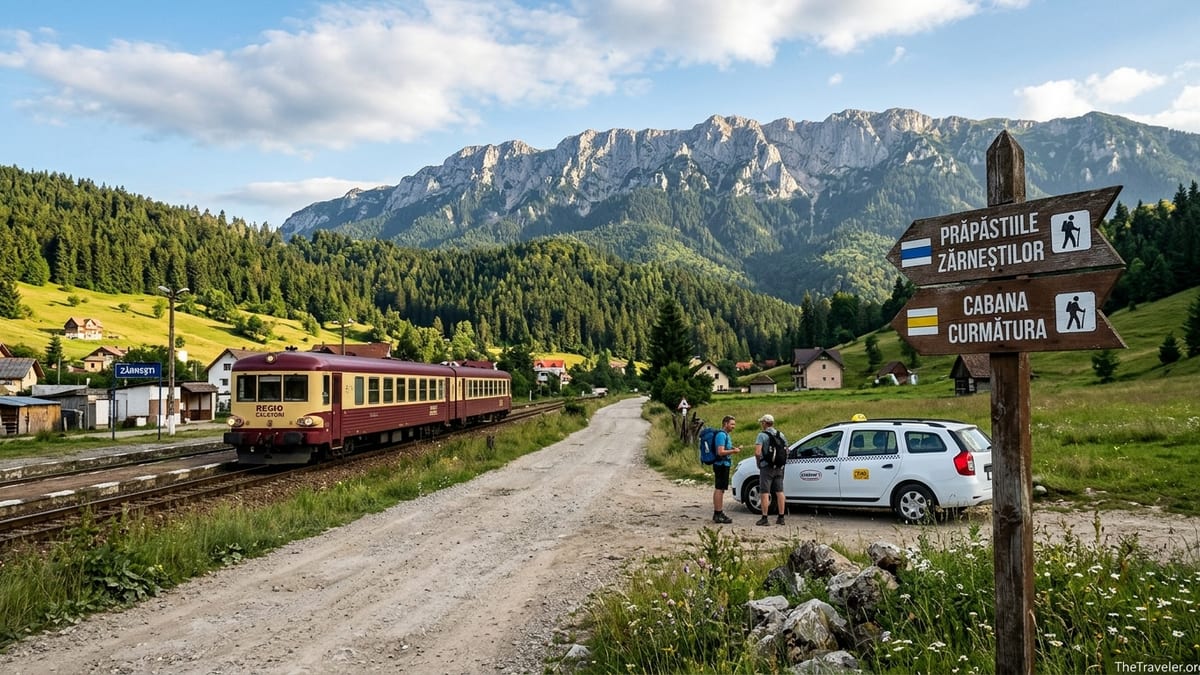
Getting to Zărnești and into the park
Zărnești is the main practical gateway to Piatra Craiului National Park. It sits about 27 to 34 kilometres southwest of Brașov, depending on the road or rail route. From Brașov’s main railway station you can travel on the Brașov–Zărnești branch line, operated by Regio Călători, with around a dozen to fourteen trains most days and a journey time of roughly 40 to 45 minutes. Recent timetables for late 2025 and 2026 show first departures before 5 a.m. and services spread through the day, which makes it realistic to do a full day hike and return to Brașov the same evening if you wish.
Trains to Zărnești normally leave from Brașov’s main station and stop at Bartolomeu and a few local halts before terminating in Zărnești. Advance tickets can be bought online from Romanian railway booking platforms, while many visitors simply buy at the station on the day because this is a short regional journey. Fares are modest by Western European standards, so rail is often the cheapest and least stressful way to reach the park if you are already staying in Brașov.
From Zărnești railway station you can reach the main trailheads by local taxi or by car if you have rented one. The most important access point for beginners is Fântâna lui Botorog, about 4 kilometres south of town on a partly surfaced road, where marked trails enter Prăpăstiile Zărneștilor gorge and climb toward Cabana Curmătura. Another access area is Plaiul Foii, roughly 11 kilometres west of Zărnești, which you can reach by taxi, private transfer or your own vehicle; this is the starting point for several forest and valley walks on the western side of the massif.
If you are driving from Brașov, expect about 45 minutes by car to Zărnești in normal traffic. From there you can follow signs to the park. Car hire is widely available in Brașov, but for many first time visitors the combination of train plus a short taxi ride to the trailhead offers better value and reduces the stress of mountain driving and parking.
Understanding official trails, markings and difficulty
Piatra Craiului is a national park with strict rules about staying on official, marked trails. The park’s management plan and visiting rules specify that access is only allowed on marked tourist routes that are formally declared open. Trail markings follow the standard Romanian mountain system, using coloured symbols such as blue stripe, yellow stripe, red stripe, blue triangle or red dot, painted on rocks and trees. For example, the route Zărnești – Prăpăstiile Zărneștilor – Cabana Curmătura is recorded in official annexes as a blue band trail between Cabana Gura Râului and Cabana Curmătura.
The park administration and mountain rescue services classify trails broadly as easy, medium or difficult, based on factors such as steepness, exposure and required experience. Gentle valley and forest routes like the lower section of Prăpăstiile Zărneștilor gorge are widely recommended for beginners, while climbs to the main limestone ridge are marked as demanding or very difficult. Before you hike, check the latest status of trails at the Zărnești visitor centre or on the park’s official map, as certain routes may be closed temporarily because of landslides, rockfall, forestry works or wildlife protection measures.
Do not rely solely on generic navigation apps, as they may show unmarked or forbidden paths. Instead, purchase an up to date printed hiking map of Piatra Craiului in Zărnești or Brașov, where scales around 1:30,000 or 1:40,000 are common, and verify that the route is marked and listed in park documents. When you see painted waymarks becoming sparse or obviously old, pay attention, as this can signal you are leaving the main trail or entering a less maintained sector where beginners should not continue.
In practical terms, for a first visit you should limit yourself to routes that local mountain guides and the park website describe as suitable for families or casual hikers, avoiding any description that mentions chains, cables, airy ridges or sections rated as alpine. If you are in doubt about a planned itinerary, ask at the visitor centre or talk with Salvamont, the Romanian mountain rescue service, before setting off.
Tickets, fees, parking and the visitor centre
Piatra Craiului National Park has an official admission system. Park documents and recent bulletins show that the standard visiting ticket was raised from 5 to 10 Romanian lei for an adult, valid for seven consecutive days. The same sources note that there is also an annual pass option around 40 lei for frequent visitors. The seven day ticket is good value for travellers who plan multiple walks. Children under 10 years of age and certain organized school groups that visit as part of park education programs are exempt from the visiting fee, according to the park rules.
The park administration explains that tickets can be bought through several channels: online payment, SMS, automated ticket machines managed by the park at main entry points, and from staff at entrances to the visiting area. Travellers report finding ticket machines in Zărnești and access points such as Prăpăstiile Zărneștilor and Plaiul Foii. If you buy a paper ticket at a gate, keep it with you as rangers may ask to see proof of payment on the trail, and the same ticket remains valid for one week.
The Zărnești Visitor Centre serves as both an information point and a small interpretive exhibition about the park’s geology, flora and fauna. Current tariff tables from the park administration show that the 10 lei park ticket formally includes access to this visitor centre, so you do not usually pay a separate entrance fee beyond the park admission itself. However, some activities such as guided programs or educational workshops may have their own charges, so check on site if you are interested in those.
Parking policies vary by trailhead. In and around Zărnești town, street parking is often free or charged at municipal rates. At Fântâna lui Botorog, travellers have reported a small informal parking area on the roadside that may be free or involve a modest local fee at busy times. At Plaiul Foii, there are guesthouses and restaurant complexes that offer parking to customers, and there may be a separate paid parking zone close to the main access to trails. Since local arrangements can change, you should verify current parking rules when you arrive, and always avoid blocking access for forestry vehicles, emergency services or residents.
Beginner friendly valley and forest routes
The classic beginner itinerary in Piatra Craiului is Prăpăstiile Zărneștilor, also known as Zărnești Gorge. This narrow limestone canyon begins just beyond Fântâna lui Botorog. From the parking area you follow a very gentle track between high walls of rock. The gorge itself is roughly 3.5 to 4 kilometres long one way, almost flat, and suitable for most visitors who can walk on a stony dirt road. It is one of the most visited sites in the park and is featured in films such as Cold Mountain, but you should still pay attention to conditions in wet weather, when puddles, mud and falling rocks can be a concern.
From the end of the gorge the surroundings open into a valley where forest paths branch toward alpine pastures and mountain shelters. Many beginners simply walk the gorge there and back from Fântâna lui Botorog, which creates an outing of about 8 kilometres round trip with minimal elevation change and a realistic walking time of 2.5 to 3 hours. This is a half day option that still feels wild and gives a good introduction to the park without steep climbing.
The forests around Plaiul Foii on the western side offer additional gentle routes. Starting from the accommodation complex and parking area, unhurried walkers can follow marked trails along forest roads and small valleys without committing to the more serious climbs toward the main ridge. These routes are popular with families and with visitors who want to enjoy the scenery and perhaps spot wildlife signs without spending hours on steep ascents. Ask the staff at Plaiul Foii or check at the visitor centre for up to date, marked lower level loop suggestions, as trail conditions can change after storms.
Another relatively low elevation option is to explore the pastoral villages of Măgura and Peștera, on the eastern side near the park boundary. Official marked paths connect Zărnești with these villages and then continue toward viewpoints at the edge of the park. These involve rolling hills rather than dramatic cliffs, but on clear days you can see the Piatra Craiului ridge on one side and the Bucegi Mountains on the other, creating a memorable but not overly technical day out.
Cabana Curmătura and why the ridge is off limits to beginners
Cabana Curmătura is a traditional mountain hut at about 1470 metres that many visitors treat as a first serious goal in Piatra Craiului. Official documents and hiking resources list several marked routes to the hut. For beginners based in Zărnești and arriving at Fântâna lui Botorog, the most classic route goes through Prăpăstiile Zărneștilor and then climbs through forest and meadows to Poiana Curmătura and the hut, on trails marked with blue stripe or yellow stripe. The total round trip distance is usually described as around 12 kilometres from Fântâna lui Botorog, with an elevation gain in the region of 650 to 700 metres.
For fit beginners in good weather, this is achievable as a full day outing of about 5 to 6 hours of walking, not counting breaks. It involves sustained uphill walking rather than technical climbing, and there are no chains or exposed drops on the main approach paths. However, the ascent is long and can feel strenuous, particularly on hot summer days or when the trail is muddy. You should treat this as a mountain hike rather than a casual stroll, bring sufficient water and food, start early enough to avoid descending in darkness, and be prepared to turn around if the weather deteriorates.
From Cabana Curmătura, more experienced hikers continue to viewpoints such as Piatra Mică or up to the main ridge of Piatra Craiului. These ridgeline routes are very different in character from the Curmătura approach. The main limestone crest is narrow, rocky and exposed, with sections that require scrambling and use of hands. Many parts are equipped with chains or cables, and the terrain involves loose limestone, steep drops and complex orientation. Local guides and experienced hikers consistently advise that these are not suitable for novices, especially not in wet, snowy or foggy conditions.
As a beginner, you should plan to stop at Cabana Curmătura or at nearby viewpoints reachable on non exposed paths. Enjoy a meal or hot drink at the hut, appreciate the views of the ridge from below, and leave the full crest traverse for a future trip once you have developed solid alpine skills, are comfortable with exposure and possibly have the support of a certified mountain guide.
Seasonal conditions, wildlife and staying safe
Piatra Craiului is a genuine mountain environment, and conditions change with the seasons. Spring and autumn can bring long stretches of mud on forest trails, particularly in April, early May and after heavy rains. Summer thunderstorms are common in the Carpathians, often building rapidly in the afternoon. Fog can reduce visibility even on marked trails, especially near saddles and clearings. Early snow can arrive on higher paths by late October, and shaded sections may stay icy into late spring. Daylight is limited in late autumn and winter, so you must plan your itinerary with enough margin to be off the trail well before dark.
The park’s visiting rules and safety advice page stress basic precautions such as checking official maps, matching routes to your fitness, and monitoring weather forecasts produced for the area. Loose limestone is a particular hazard in steep gullies and on the ridge, where rockfall can be triggered by people above you. For beginners sticking to valley routes, the main underfoot issues are mud, wet rocks and tree roots, so sturdy hiking shoes with good grip are strongly recommended.
The Piatra Craiului area is home to brown bears as well as wolves and lynx. Travel accounts and local hiking discussions suggest that bear encounters on the main tourist routes like Prăpăstiile Zărneștilor and the Curmătura path are uncommon, but possible, and that the wider Brașov region has one of the densest bear populations in Europe. The park’s own advice and responsible outdoor organisations emphasise avoiding close encounters rather than seeking them. You should walk in small groups when possible, speak in a normal voice or make occasional noise so that animals have time to move away, and avoid hiking silently at dawn, dusk or at night.
Safe food storage and behaviour are essential. Do not leave food scraps in the forest or near huts, and do not approach or feed any wild animal that appears habituated. If you stay overnight at Cabana Curmătura or in village guesthouses near the park, follow the host’s rules about trash and food waste. If you ever see a bear at a distance, do not move closer for photographs. Use binoculars or a camera zoom and back away calmly if you are on the same path. Some visitors carry bear spray bought from specialist outdoor shops in Brașov, but this is a last resort tool and does not replace sensible behaviour and awareness.
Where to stay, what to carry and how fit you need to be
Choosing where to base yourself affects how much effort is needed each day. Zărnești has a growing selection of guesthouses, small hotels and rooms in family homes, often at lower prices than equivalent accommodation in Brașov. Staying here puts you close to trailheads and the visitor centre, and you can sometimes arrange transfers to Fântâna lui Botorog or Plaiul Foii directly with your host. The trade off is a smaller choice of restaurants and evening activities compared to the city.
Plaiul Foii is quieter still, with accommodation concentrated in a few pensions and cabin complexes right at the foot of the mountains. This is ideal if you plan several days of walking on the western side and want to wake up surrounded by forest. However, without a car you will rely on prearranged transfers or taxis from Zărnești, and prices for on site meals can be higher than in town. Brașov, by contrast, offers a full range of hotels, hostels and apartments. It is the best base if you want urban comfort and plan only one or two day trips to Piatra Craiului, but you will spend extra time each day on the train or in the car.
For equipment, beginners should at minimum bring sturdy hiking footwear, breathable layers, a waterproof jacket, a sun hat, and a small daypack with 1.5 to 2 litres of water for a half day hike or 2 to 3 litres for a full day to Cabana Curmătura, depending on heat. Snacks and a packed lunch purchased in Zărnești or Brașov supermarkets are essential, although the hut and some trailheads may offer simple food and drinks. A basic first aid kit, headlamp with spare batteries, map, compass or GPS device, and a fully charged phone are all important safety items.
Realistic fitness expectations matter. If you can comfortably walk 10 to 12 kilometres on rolling terrain at home and climb a few hundred metres over several hours, you are likely to manage the Curmătura route in good conditions, provided you pace yourself. Less fit visitors or those recovering from injury might prefer to limit themselves to Prăpăstiile Zărneștilor and village walks around Măgura and Peștera. Families with young children should consider the gorge walk and short forest outings from Plaiul Foii as their main activities.
Guides, closures and when to choose easier options
Romanian regulations and park rules do not require a guide on every trail, but many of the more demanding routes in Piatra Craiului are genuinely better tackled with an experienced local guide or as part of an organised group. The main limestone crest, routes with fixed chains and long, committing traverses with complex orientation fall into this category. Mountain guide associations in Brașov and Zărnești can arrange certified guides who know current conditions, bear activity zones and escape routes in case of bad weather.
Trail closures are announced by the park administration, often because of maintenance, rockfall risk or conservation measures. For example, sections of certain ridge approaches or caves may be closed seasonally to protect nesting birds or bat colonies. Since online information can lag behind reality, always cross check route status shortly before your hike, either at the Zărnești visitor centre, your guesthouse, or by calling the park administration or Salvamont. Entering closed areas can result in fines and puts you and rescuers at unnecessary risk.
If, on the morning of your hike, weather forecasts indicate thunderstorms or dense fog on the ridge, shift to a valley or village walk instead of forcing a planned summit. Similarly, if you reach a signed junction where your intended trail continues steeply upward and you already feel tired, treat this as useful feedback and choose a shorter loop. There is no shame in turning back at the top of Prăpăstiile Zărneștilor or at a lower meadow below Curmătura, especially for your first experience of the park.
Emergency contacts are straightforward. The mountain rescue service Salvamont can be reached via the standard European emergency number 112, and in Romania there is also a dedicated Salvamont mobile application that allows sharing your location. Mobile coverage is generally good in valleys near Zărnești but can be patchy deeper in the park, so do not rely entirely on data connections. Make sure someone at your accommodation knows your planned route and expected return time.
Which hikes are genuinely suitable for beginners
For genuinely inexperienced hikers or those travelling with children, the safest and most rewarding options in Piatra Craiului are the low level routes. A half day walk starting at Fântâna lui Botorog along Prăpăstiile Zărneștilor and back is the top recommendation. It delivers spectacular canyon scenery with almost no technical difficulty, provided you watch your footing on stones and avoid the gorge during extreme weather or high rockfall risk. Short forest and meadow paths near Plaiul Foii and village circuits between Zărnești, Măgura and Peștera also fit into this beginner friendly category, with modest elevation gain.
For active beginners in solid physical condition, a full day walk from Fântâna lui Botorog to Cabana Curmătura and back is a logical next step. It combines the gorge with a sustained but non exposed climb of about 650 to 700 metres, rewarded by views of the main ridge and the comfort of the hut. This should be attempted only in stable weather, with adequate daylight, by people used to several hours of walking. It is not appropriate as a first ever hike for someone who rarely exercises or is nervous about rough paths.
By contrast, the main Piatra Craiului ridge, itineraries involving Piatra Mică beyond the easiest viewpoints, any route that mentions chains, cables or exposed scrambling, and long traverses between remote shelters such as Refugiul Grind are not suitable for beginners. These should be left to experienced mountain hikers, ideally accompanied by a certified guide, and tackled with full alpine equipment and a clear understanding of the risks.
If you keep this distinction in mind and base yourself conveniently in Zărnești, Piatra Craiului National Park can offer some of Romania’s most memorable landscapes in a way that feels adventurous yet controlled. Start with the gorge, progress to Cabana Curmătura when you are ready, respect the park’s rules and wildlife, and you will have a safe foundation for future explorations of the Carpathian high country.