


Calgary International Airport is the main gateway to the Canadian Rockies and a major WestJet and Air Canada hub. Yet most travelers treat YYC as a place to endure, not somewhere you can move through strategically. With a little local knowledge, you can cut your stress, shrink your wait times and even find a decent coffee before boarding without sprinting to the gate.
Get the latest updates straight to your inbox!
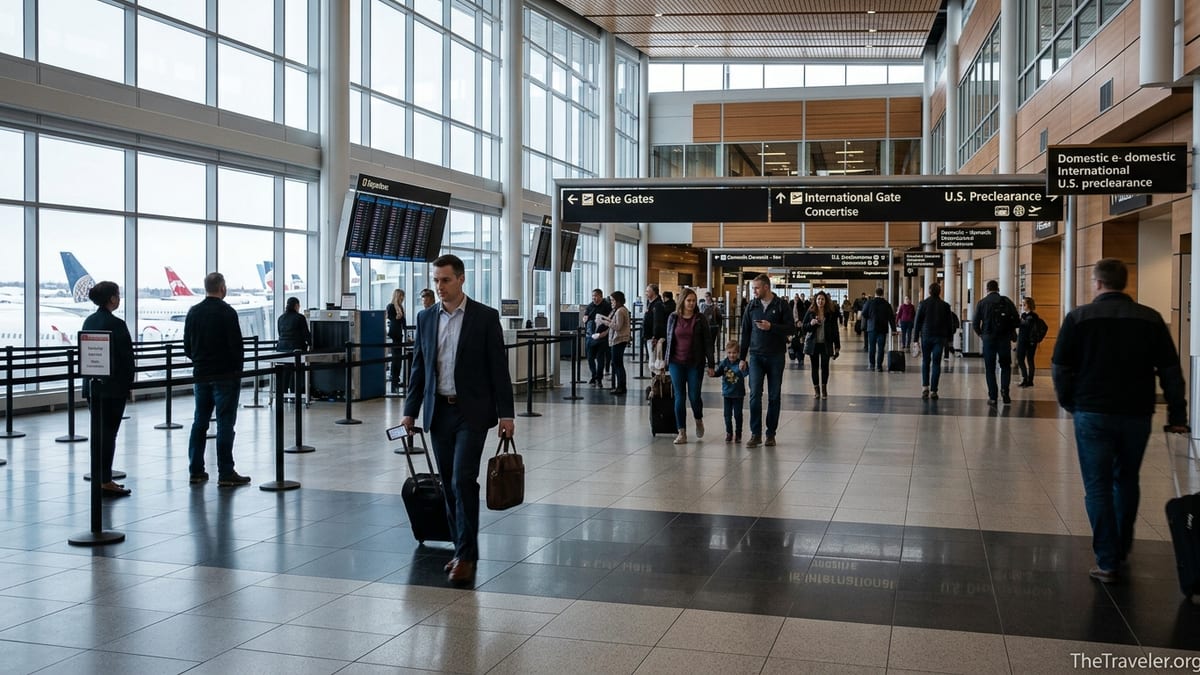
Know YYC’s Layout Before You Step Out of the Taxi
Calgary International Airport looks simple from the curb, but its single large terminal is divided into three main departure zones: A/B/C for domestic Canada flights, D for international (non U.S.) and E for U.S. departures. All of these sit under one roof but are separated by long concourses and security checkpoints. First-time visitors often assume they can change checkpoints at the last minute, only to discover a ten minute walk and another line stand between them and their gate. Spending two minutes looking at a current terminal map before you arrive can save you twenty minutes of wandering once you are inside.
Practically, this means you should match your drop-off point to your airline and destination. WestJet domestic departures usually use concourses A and B, while Air Canada domestic flights generally leave from C. International flights tend to leave from D, while E handles U.S. bound traffic through the preclearance facility. If you are taking a rideshare or taxi, tell the driver whether you are flying domestic, international, or to the United States rather than just saying “Calgary Airport.” They will know which upper level curb area to use, so you start your trip within a short walk of the right check-in zone.
Inside, moving walkways and overhead signage connect the concourses, and there is the YYC Link connection shuttle running airside between domestic and international areas. Walking between a domestic gate in concourse C and an international gate in D takes roughly 10 to 15 minutes at an average pace, and a bit less if you catch the shuttle. Building this walk time into your plan is crucial if you are arriving from Toronto or Vancouver and connecting straight to a long haul flight to Europe.
Many travelers discover too late that an “easy” self-transfer, like landing on WestJet from Edmonton and continuing on a separate booking to a U.S. city, can turn into a race across the terminal plus another round of security. If you have shorter than a 90 minute self-connection, assume you will need to move briskly and head straight to your next check-in or gate instead of stopping for duty free or a sit-down meal.
Beat Security Delays With Real-Time Tools and Smart Checkpoint Choices
Security is where most people lose time at YYC, yet the airport and Canada’s screening authority provide live information that frequent travelers use but casual visitors often ignore. Calgary Airport’s own website hosts a dashboard of current security wait times for the domestic, international, and U.S. preclearance checkpoints, updated throughout the day. The federal screening agency also reports current wait estimates for Calgary on its wait-times page, and third-party trackers aggregate these into simple “green, yellow, red” style guidance for each checkpoint. On a typical weekday morning, the domestic checkpoint might show a 5 to 10 minute wait, while the U.S. preclearance line can spike to 25 minutes before 8 a.m.
Before you leave your hotel or home, quickly check security wait times for YYC on an official or reputable tracker and then back-time your arrival accordingly. For example, if domestic is trending under 10 minutes and you are flying to Vancouver at 2 p.m., arriving 90 minutes before departure is usually sufficient if you are already checked in online and traveling with only a cabin bag. If the dashboard shows lines building past 25 minutes during busy holiday peaks, give yourself a full two hours even for a short domestic hop.
Once you enter the check-in hall, do not blindly follow whatever line you first see. Domestic security has multiple entry points, and overhead screens in the check-in area sometimes display approximate waits by checkpoint. Locals often walk an extra minute or two to a less obvious entrance to save 15 minutes standing still. If one queue appears full to the back of the stanchions while another looks shorter, it usually is. For U.S. flights, remember that security and U.S. Customs and Border Protection are combined in the preclearance area, and travelers can access those checks only within a defined time window before departure, not as early as they like.
Pay attention to special queuing options. Calgary participates in Canada’s Verified Traveller program, which gives people with certain trusted traveler cards, such as NEXUS, access to dedicated lanes at domestic checkpoints. If you qualify and have your physical card with you, you can usually use an expedited line where you keep more items in your bag and move faster through the scanners. For U.S.-bound flights, having NEXUS also lets you use benefits similar to TSA PreCheck at the American-style security point after you check in, provided the correct traveler number is attached to your booking. Using these programs can turn a 20 minute line into a 5 minute walk-through during busy times.
Understand U.S. Preclearance Rules So You Don’t Wait Twice
One of YYC’s biggest time savers for transborder travelers is the U.S. preclearance facility in concourse E. Instead of clearing immigration and customs after landing in the United States, you do it in Calgary before boarding. Once you arrive in your U.S. destination, you are treated as a domestic passenger and can usually walk straight to your next gate or the exit. This is especially valuable if you are connecting through airports like Denver or Dallas, where normal immigration queues can easily reach 30 to 45 minutes during peak hours.
The catch is that most travelers do not realize they cannot access U.S. preclearance whenever they choose. YYC and U.S. authorities generally allow security screening and U.S. customs for each flight to open only within about two hours of scheduled departure. Arrive at Calgary three or four hours before an early morning flight to Phoenix and you may find that, while you can drop your checked bag with your airline, you still have to wait landside in the main terminal because the entrance to the E concourse and its Preclearance area is not open for your flight yet.
The key is to time your arrival so that you reach the check-in desk about two and a half hours before departure. That gives you time to check bags, walk to the E concourse, pass through combined security and Preclearance, and still have 30 to 45 minutes in the gate area. If you are connecting from another Canadian city, check your itinerary to see whether your baggage is tagged through to your final U.S. destination. On a single through-ticket with an airline such as WestJet or Air Canada and their partners, your bag will usually transfer automatically and you only have to follow the “Connections to U.S.” signs. On separate tickets, you may have to pick up your bag in Calgary, walk to the main hall, check in again, and then go through Preclearance from scratch.
Travelers with NEXUS cards enjoy particularly large time savings at U.S. preclearance. They can often use a dedicated trusted traveler line at the security checkpoint and automated kiosks or special lanes for the U.S. immigration interview. If a regular-line traveler from Calgary to Los Angeles plans for 2 hours 30 minutes in Calgary, a NEXUS holder making the same trip can sometimes safely operate on a 90 minute connection, provided their inbound flight is on time and they are familiar with the terminal.
Use Connection Shortcuts and Avoid Common Missteps
Calgary has improved its airside connections in recent years, but unfamiliar passengers still waste time through small mistakes. The most important rule is to follow the “Connections” signage immediately after stepping off your plane, especially if you are coming from outside Canada. If you are arriving on an international flight into concourse D and connecting to a domestic destination such as Winnipeg or Regina on the same ticket, you will typically follow a route that leads you through immigration, a baggage re-check belt, and then straight back into the secure area near your next departure gate. In many cases you do not need to exit to the public arrivals hall or re-clear full security.
Self-connecting passengers have a different experience. If you flew in from London on one airline and booked a separate domestic ticket on another, expect to collect your baggage in Calgary, clear Canadian customs, then walk to the appropriate check-in island for your next flight. After you re-check your bag, you must go through security again and proceed to your gate. Travelers are often surprised by how long it takes for checked bags to appear when arriving from overseas. It is not unusual for the combination of immigration, customs, and waiting at the carousel to consume 30 to 40 minutes on a busy arrival bank, so booking a tight 1 hour 30 minute self-connection is risky.
One of YYC’s underused tools for tight domestic connections is the YYC Link shuttle, which runs airside between the domestic and international concourses. Rather than walking the entire length of the building, you can board one of these small shuttle vehicles directly in the secure area and be dropped much closer to your next gate. If you land in concourse A and realize you are boarding from concourse D with only 35 minutes left, follow signs to the Link instead of guessing your own route. You will still need to move promptly, but shaving five to ten minutes off your travel time across the terminal can be the difference between an orderly boarding and a final call sprint.
Another easy way to waste time is by stopping for a sit-down meal before fully understanding where your gate is and how far you have to travel. Some of the more attractive restaurants and coffee spots are located near the center of the building rather than at the distant ends of the concourses. Check the screens to confirm your gate and use the estimated walking times displayed on airport wayfinding signs or apps to decide whether you can enjoy table service or whether you should grab a takeaway sandwich from a quick-service brand near your gate instead.
Arrive Prepared: Check-in, Bags, and Parking Tactics
One of the simplest ways to save time at Calgary Airport is to arrive as “airport ready” as possible. Whenever your airline allows it, check in online or through the carrier’s mobile app before you leave for YYC. For WestJet and Air Canada, mobile boarding passes are widely accepted, and many domestic passengers can proceed directly to security if they are traveling carry-on only. If you do need to check a bag, most airline counters at YYC offer self-tagging kiosks combined with staffed bag drops. Printing and attaching your own tag before you reach the bag drop line can cut your time at the counter from ten minutes to two.
For liquids and electronics, Calgary follows the standard Canadian and international rules. Liquids must be in containers of 100 milliliters or less, placed in a clear one-liter bag, and laptops and large electronics often need to be removed from your carry-on at standard screening lanes. Pack in a way that makes removing these items easy. A common mistake is stuffing travel-sized toiletries into multiple pockets or burying a laptop under clothing, which leads to fumbling at the scanner and sometimes a secondary bag check. Use a single top-access pouch for liquids and keep electronics in a separate section so you can lay them out on the belt in seconds.
If you are driving to YYC, plan your parking with time savings in mind rather than simply following signs for the closest garage. On-site short-term parking is directly opposite the terminal, but daily rates are higher than economy lots slightly farther away. Off-airport operators near Calgary often run frequent shuttle buses that drop you right outside the check-in doors. During peak travel weeks, these lots can be both cheaper and quicker than circling the on-site parkades, where drivers sometimes waste 15 minutes searching for a free space. If a friend is dropping you off, suggest using the designated cell-phone waiting area rather than looping the terminal road. They can wait there at no charge until you text that you are ready at arrivals, cutting down on curbside confusion and potential parking fines.
Families and groups should also designate one person as the “documents captain” before they arrive at YYC. Having passports, boarding passes, and necessary forms easily accessible in a single pouch avoids delays at check-in and at security. Rather than having every member of a five-person family dig through their own backpacks at the front of the line, hand the pouch to each traveler in turn at the podium and then reclaim it. This small bit of choreography not only speeds your own group but also makes security staff more inclined to guide you to the most efficient lane.
Make Waiting Work for You With Lounges and Quiet Corners
Even the best time-saving strategy will leave you with some waiting at Calgary Airport, especially if you have padded your schedule to account for winter weather or potential delays. The trick is to turn that waiting into productive or genuinely relaxing time instead of aimless wandering from gate to gate. YYC has multiple airline lounges in the domestic, international, and U.S. areas, including branded options for WestJet and Air Canada as well as independent contract lounges accessible for a fee or through common credit card programs. Entry at the door typically costs in the range of what you might spend on an airport meal and a couple of drinks, but buys you quieter seating, stronger Wi-Fi, and abundant power outlets.
For travelers who do not wish to pay lounge fees, Calgary’s terminal still has a few underrated quiet zones. Look for seating clusters at the far ends of concourses, just beyond the busiest gate banks. In the domestic area, walking one or two gates past where most passengers stop can take you to rows of chairs with views of the runway and plenty of elbow room. These spots are ideal for catching up on email or letting kids unwind without bumping elbows with hundreds of other travelers. Charging towers and built-in power outlets are scattered along most newer gate seating areas, so once you find a quiet zone, you can usually plug in a laptop or phone.
If you need to freshen up between long flights, note that Calgary’s main terminal does not offer public shower facilities in the general departures area, but some airline and contract lounges include private showers for guests. Travelers arriving from an overnight international flight and continuing on within Canada can plan ahead by booking access to one of these lounges, then using the shower, changing into fresh clothes, and grabbing breakfast before boarding their domestic connection. Factoring this stop into your connection time planning makes a 3 hour Calgary layover feel much less stressful and far more productive.
Food options are clustered near the main “spine” of the terminal and around the intersections of concourses. If you are short on time, head for quick-service outlets that offer pre-made sandwiches, salads, and coffee rather than queuing at a full-service restaurant. Many of the major Canadian and international chains you would expect at a busy airport are present, so you can usually find a recognizable brand within a five minute walk of your gate. Watching the boarding status screens from your table and paying your bill as soon as you finish eating helps you avoid a last-minute rush when your flight switches from “boarding soon” to “final call.”
The Takeaway
Calgary International Airport rewards travelers who do a little homework. Knowing which concourse your flight uses, checking real-time security wait times before you leave home, and understanding how U.S. preclearance operates can easily save 30 to 45 minutes on a typical trip. If you are connecting, following the official “Connections” route and using the YYC Link shuttle where appropriate can turn a tight itinerary from nerve-wracking to manageable.
Beyond pure speed, arriving prepared with online check-in, smart packing for security, and a plan for where you will wait makes the entire airport experience less stressful. Instead of sprinting through crowded corridors or standing in avoidable lines, you can spend more of your time enjoying a quiet coffee, answering a few last emails, or simply looking out at the aircraft framed by the Alberta sky. The difference comes down to using the tools YYC already offers and avoiding the small mistakes most rushed travelers make.
FAQ
Q1. How early should I arrive at Calgary Airport for a domestic flight?
For most domestic flights, arriving about 90 minutes before departure is usually enough if you have checked in online and only have carry-on baggage. During peak holiday periods or if you need to check bags, plan for two hours to comfortably handle possible security lines.
Q2. How much time do I need at YYC for a U.S. bound flight?
Because of U.S. preclearance, it is wise to arrive about two and a half hours before a U.S. departure. This allows time to check bags, clear combined security and U.S. customs, and still reach your gate without rushing.
Q3. Is a 60 minute connection in Calgary enough?
A 60 minute connection can be workable for a domestic to domestic connection on a single ticket when flights are on time, but it leaves little margin for delays. For connections involving international or U.S. flights, aim for at least 90 minutes and preferably longer, especially if you have to collect and re-check baggage.
Q4. Does Calgary Airport have TSA PreCheck?
TSA PreCheck itself is a U.S. program, but YYC participates in Canada’s Verified Traveller system and recognizes NEXUS and certain other trusted traveler cards at security. U.S.-bound passengers with NEXUS can usually enjoy benefits similar to PreCheck at the preclearance security checkpoint.
Q5. Can I go through U.S. customs at YYC as soon as I arrive at the airport?
No. Access to the U.S. preclearance facility in concourse E generally opens only within a limited window before each flight, often about two hours ahead. If you arrive much earlier, you may be able to check bags but will likely have to wait in the main terminal until your screening window opens.
Q6. Is there baggage storage at Calgary International Airport?
YYC currently does not offer a standard left-luggage or baggage storage service inside the terminal. If you have a long layover, you will need to keep your bags with you or check them through on a single through-ticket wherever possible.
Q7. Does YYC have a shuttle between domestic and international gates?
Yes. The YYC Link shuttle runs airside between parts of the domestic and international concourses, allowing connecting passengers to cover the distance more quickly than walking the full length of the terminal. Watch for signage pointing to the shuttle stops once you clear security.
Q8. Are there quiet places to work at Calgary Airport without a lounge pass?
Yes. Some of the quietest spaces are at the far ends of concourses or in smaller gate areas away from major hubs. These zones often have seats facing the windows and nearby power outlets, making them good spots to work or rest without paying for lounge access.
Q9. Is free Wi-Fi available throughout YYC?
Calgary International Airport offers free Wi-Fi throughout most public and gate areas. Speed can vary with crowding, but it is generally adequate for email, basic browsing, and typical work tasks if you find a calmer corner of the terminal.
Q10. What is the best way to avoid long security lines at YYC?
Check live security wait times before you leave for the airport, arrive with your boarding pass ready, pack liquids and electronics for quick screening, and use Verified Traveller or NEXUS lanes if you are eligible. Choosing a less crowded checkpoint and moving through preparation smoothly can cut your time in line significantly.