


Calgary International Airport sits only about 17 kilometers from downtown, but the way you choose to cover that short distance can easily double or triple your arrival costs. With airport specials, surge pricing and confusing bus fares, it is easy to overpay if you grab the first option you see outside arrivals. This 2026 guide breaks down the real prices, routes and trade-offs so you can get from YYC to downtown Calgary quickly and comfortably without spending more than you need to.
Get the latest updates straight to your inbox!
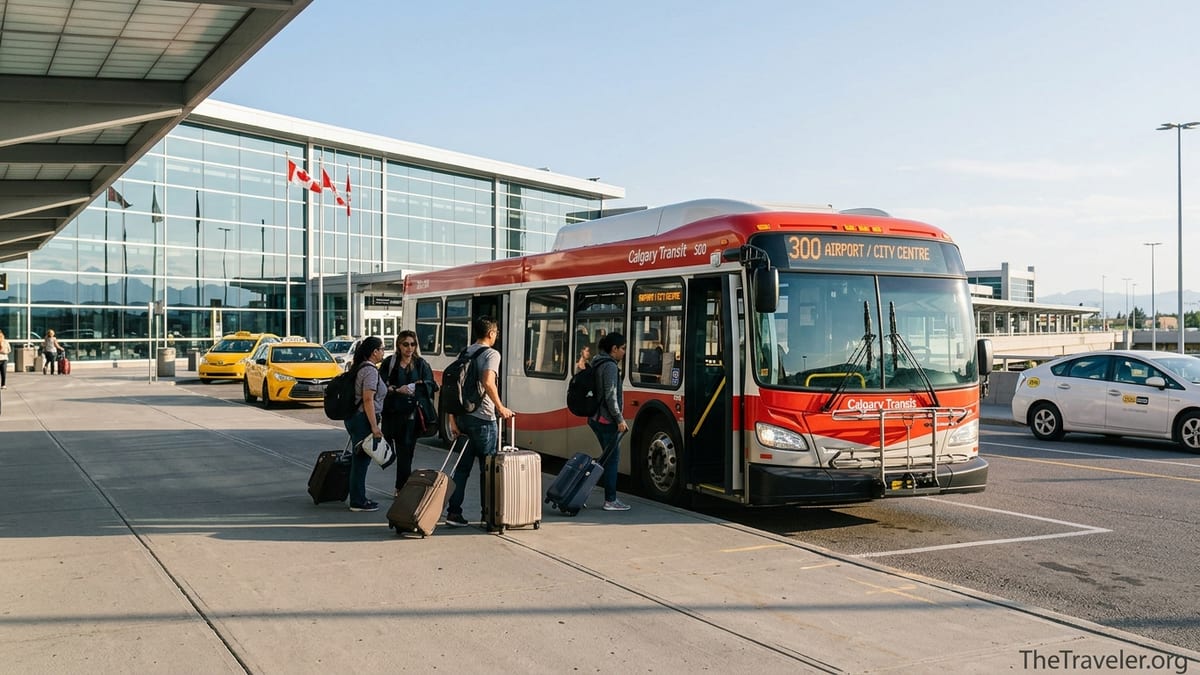
What You Need to Know Before You Leave the Terminal
Calgary International Airport is compact and well signed, but ground transport can still feel overwhelming when you step into the arrivals hall after a long flight. Taxis, rideshares, hotel shuttles and public buses all pick up on the arrivals level. If you follow the “Ground Transportation / Bus / Taxi” signs, you will end up at a line of marked bus bays and a separate taxi and rideshare area a short walk from the doors.
The airport is around 20 to 30 minutes by car from most downtown hotels in light traffic, though bad weather and rush hour can stretch that to 40 minutes or more. That distance keeps prices within a predictable band. In 2026, a metered taxi to downtown typically runs around 40 to 55 Canadian dollars, while an Uber or Lyft is often between 20 and 40 Canadian dollars depending on demand. Public transit is significantly cheaper, with a single adult fare on Calgary Transit set at about 4 Canadian dollars and valid across buses and the CTrain light rail network.
The biggest change visitors should be aware of is that Calgary Transit has phased out the older “airport boarding pass” surcharge that once made the airport bus much more expensive than regular routes. Today, the flagship Route 300 Bus Rapid Transit service between the airport and downtown uses standard Calgary Transit fares, which makes it one of the best-value airport links of any major Canadian city.
To avoid overpaying, it helps to decide on your preferred mode of transport before you leave the secure area, based on your arrival time, luggage, budget and comfort level with using city buses. The rest of this guide walks through each option with real-world numbers so you can make that decision quickly and confidently.
The Cheapest Option: Calgary Transit Route 300 Airport BRT
For most budget-conscious travelers, Calgary Transit’s Route 300 Airport / City Centre is the sweet spot between cost and convenience. This limited-stop bus route picks up directly outside the terminals and runs to downtown Calgary, stopping at key streets like Centre Street and ending near the City Centre and 9 Avenue SE area, which is a short walk or one CTrain stop from many downtown hotels.
In 2026, adult fares on Calgary Transit sit at roughly 4 Canadian dollars for a single ticket, with youth tickets slightly cheaper and children under five usually free. That fare now applies to Route 300 as well, replacing the older system where boarding the 300 at the airport cost significantly more than a regular bus. Instead of paying 10 or 11 dollars for a special “airport pass,” you now pay the same regular fare that locals use to ride across town. If you validate your ticket or tap your fare product when boarding, you get around 90 minutes of transfer time on the entire network, including buses and CTrain.
In practice, this means that a solo traveler arriving at YYC can walk out to the Route 300 stop at Bay 7 (domestic terminal) or Bay 32 (international terminal), pay roughly 4 Canadian dollars and ride directly toward downtown. The bus runs every 20 to 30 minutes for most of the day, and typical journey times to central stops are around 40 to 50 minutes depending on traffic. Many vehicles on this route are equipped with luggage racks near the front, which makes it easier to stash a suitcase without blocking the aisle.
As a concrete example, imagine you land from Toronto at 3 pm on a weekday and are staying near Calgary City Hall. Instead of paying 30 Canadian dollars or more for a rideshare, you can follow the signs to the bus bays, buy a transit ticket from the vending machine next to Bay 7, and board the next Route 300 marked “BRT Airport / City Centre.” Within about 45 minutes, you are stepping off on 9 Avenue SE, spending less than a tenth of what a late-afternoon taxi might cost. For a couple traveling together, your combined bus fare is still far below the price of a single car-based option.
Other Public Transit Routes and When They Make Sense
Route 300 is the flagship airport line, but it is not your only public transit option. Calgary Transit also operates Route 100, which links the airport to the McKnight–Westwinds CTrain station on the Blue Line. From there, you can ride the CTrain toward downtown for the same single fare if you are still within the transfer window. This combination can be useful if Route 300 frequencies are not ideal for your arrival time or if your final destination is along the northeast CTrain corridor rather than in the downtown core.
In terms of cost, Route 100 plus a CTrain ride does not save you money compared with Route 300, since both are covered by the same standard fare structure. The main advantage is flexibility. For example, a traveler staying in the Bridgeland or Renfrew neighborhoods just east of downtown might opt for Route 100 to the CTrain, then ride directly to Bridgeland Station instead of changing buses downtown. The fare is still roughly 4 Canadian dollars for the entire journey if you stay within your transfer time.
There are also local routes that serve areas around the airport but do not enter the terminal loop itself. These can occasionally be useful for travelers heading to nearby industrial parks or airport hotels that are not on the main hotel shuttle circuit. However, for anyone trying to reach downtown without overcomplicating things, Route 300 or a Route 100 plus CTrain combination are the only realistic public transit choices.
One more nuance worth knowing: Calgary’s CTrain system includes a short “free fare zone” in the heart of downtown, which allows you to ride between certain stations at no cost. If you arrive on Route 300 near 9 Avenue SE and then hop onto a CTrain heading a few stops within the core, the conductor will not expect a new ticket as long as you board and exit within that designated zone. This can shave a few minutes off your walk to hotels along 7 Avenue SW and 8 Avenue SW without adding to your total spend.
Rideshares and Taxis: How to Avoid Surprise Charges
While public transit is the budget champion, many travelers prefer the door-to-door convenience of a car, especially after a long-haul flight, with kids or bulky ski and snowboard bags. At Calgary International Airport you can choose between traditional taxis and app-based rideshares such as Uber and Lyft, both of which are widely available in 2026.
Taxis line up on the arrivals level just outside the terminal, and airport staff often direct passengers toward the next available cab. There is no fixed flat rate between the airport and downtown, so the meter governs your fare. Recent price ranges put a typical downtown trip somewhere between 40 and 55 Canadian dollars in normal traffic. That number can climb if congestion is heavy or if you are heading to the far edges of the central area. Most taxis accept major credit cards and contactless payment, which is helpful for international visitors who have not yet withdrawn Canadian cash.
Rideshares tend to be cheaper than taxis when demand is low, but they are also subject to surge pricing. In 2026, a standard UberX or Lyft trip from YYC to a central hotel like the Hyatt Regency Calgary or the Westin Calgary often falls between 20 and 28 Canadian dollars at quiet times. During peak arrival waves, major events or snowstorms, the same ride can jump into the mid-30s or even low 40s. Pickup areas are clearly marked at the airport, but you must use the app to request a vehicle and confirm the exact meeting point, as different vehicle classes may use different lanes.
To avoid overpaying, open your rideshare app while you are still in the baggage claim area and compare the quoted price to what you would expect to pay for a taxi. If surge pricing pushes the Uber or Lyft fare over about 40 Canadian dollars, you may be better off walking to the taxi queue and paying a metered fare instead. Conversely, if you see a quote of 22 or 24 Canadian dollars at 10 pm on a Monday, that is a strong value compared with a cab and only a modest premium over the cost of two Route 300 bus tickets.
Car Rentals, Hotel Shuttles and Private Transfers
Renting a car rarely makes sense purely for the airport-to-downtown leg, but it can be the right choice if Calgary is just a gateway to the Canadian Rockies. If you plan to drive to Banff, Canmore or Lake Louise the next day, picking up a rental car on arrival can be efficient. Major players such as Avis, Budget, Enterprise and National operate in-terminal desks at YYC, and daily rates fluctuate widely depending on season and demand. Even if you find a compact car at 60 Canadian dollars per day, add in insurance, fuel and parking at a downtown hotel and you will almost certainly pay more than using transit or a rideshare for a simple city stay.
For a short city break, renting a car only for the airport transfer is almost always a way to overpay. Downtown Calgary is reasonably walkable, and the CTrain and buses make it easy to get around without the hassle of parking. Unless you have very specific mobility needs or are traveling with a large group that requires a van, you will save money and stress by skipping a rental car until the day you actually leave town for the mountains.
Some airport-area hotels offer free or low-cost shuttles, but downtown properties generally do not operate their own buses to YYC. Shared shuttle services that run scheduled vans between the airport and downtown hotels have become less common over the last few years, partly because rideshares filled much of that niche. You may still encounter pre-booked private transfer companies selling door-to-door rides in sedans or SUVs for around 55 to 80 Canadian dollars into the downtown core, which can be worthwhile for small groups with lots of luggage who want a driver waiting with a sign in arrivals.
If you are traveling as a group of four adults with skis or snowboards and you value convenience over every last dollar, a pre-arranged transfer at roughly 70 Canadian dollars total may be good value. Split four ways, that comes to under 20 Canadian dollars per person, competitive with taxis and only slightly higher than Route 300, with the added benefit of personalized service and guaranteed space for your bags. For solo travelers, however, private transfers almost always cost more than necessary for the short trip downtown.
Choosing the Best Option for Your Situation
There is no single “right” way to get from Calgary Airport to downtown, but there are clear winners depending on your priorities. If keeping costs as low as possible is your main goal, and you are comfortable rolling a suitcase onto a bus, Route 300 is difficult to beat. At around 4 Canadian dollars for an adult fare, a couple can reach the city center for less than the price of a coffee and muffin in the terminal. The trade-off is a longer journey time and the need to handle your own bags on and off the bus.
Rideshares strike a middle ground between price and comfort. They are especially attractive for pairs or small groups arriving outside rush hour, when an Uber or Lyft can get you from baggage claim to a downtown hotel lobby for perhaps 22 to 30 Canadian dollars total. In those cases, the per-person cost stays reasonable while you enjoy a direct, private ride. Just remain alert to surge pricing; if the app shows unusually high fares, consider waiting a few minutes, checking the competing service, or reverting to Route 300 instead.
Taxis and pre-booked transfers are the most predictable but often the most expensive options. They make sense when time and simplicity outweigh budget concerns, when you land late at night and do not want to navigate public transit, or when your employer is covering the cost and you value a receipt and straightforward expense claim. A business traveler landing at 11 pm in winter, heading to a meeting the next morning near Stephen Avenue, may well decide that a 45 Canadian dollar taxi is a reasonable trade for getting to the hotel door with minimal effort.
Whatever you choose, remember that you are rarely locked in. If a snowstorm delays your flight and your pre-booked transfer becomes less appealing, you can always ride Route 300 or a taxi instead. Likewise, you might plan to take the bus but change your mind if heavy luggage or a sleeping child makes a door-to-door car seem much more attractive once you are actually at the airport curb.
The Takeaway
The distance between Calgary International Airport and downtown is short enough that there is little reason to overspend on the transfer. In 2026, the elimination of the old airport surcharge on Route 300 has turned Calgary Transit into a genuinely budget-friendly option, with a single adult fare of around 4 Canadian dollars getting you from the terminal to the heart of the city. For many visitors, especially solo travelers and couples arriving during the day, this is the smartest and cheapest way to go.
Rideshares and taxis remain excellent choices when convenience is more important than shaving off a few dollars. A typical Uber, Lyft or metered cab will have you in front of a downtown hotel in 20 to 35 minutes, with costs that are still moderate by North American standards. Just be sure to check real-time prices in your rideshare app and keep an eye on the taxi line to avoid long waits or unexpected surges.
Car rentals and private transfers are niche solutions that make sense when your plans extend beyond downtown, such as a ski trip to Banff or a family road trip through the Rockies. For a straightforward city visit, however, they often add unnecessary expense in the form of daily rental charges and downtown parking fees.
With a clear sense of the real-world costs, travel times and trade-offs, you can step off your flight at YYC, choose the right option for your situation, and reach downtown Calgary without overpaying or second-guessing your decision.
FAQ
Q1. What is the absolute cheapest way to get from Calgary Airport to downtown?
The cheapest option for most travelers is Calgary Transit’s Route 300 Airport / City Centre bus, which uses the regular adult fare of roughly 4 Canadian dollars for a one-way trip.
Q2. How long does the Route 300 bus take to reach downtown?
Typical journey times on Route 300 from the airport to central downtown stops are around 40 to 50 minutes, depending on traffic and the exact stop where you get off.
Q3. Is there still a special airport surcharge on the Route 300 bus?
No. Calgary Transit has phased out the old airport boarding surcharge, so Route 300 now uses the same standard fares as other bus routes and the CTrain.
Q4. Where exactly do I catch the airport bus at YYC?
Route 300 and other Calgary Transit services leave from marked bus bays on the arrivals level, commonly Bay 7 at the domestic terminal and Bay 32 at the international terminal.
Q5. Are rideshares like Uber and Lyft cheaper than taxis from the airport?
Often they are, especially outside peak hours, with many rides falling in the 20 to 30 Canadian dollar range, but surge pricing can make them as expensive as or more expensive than a taxi.
Q6. How much should I expect to pay for a taxi from Calgary Airport to downtown?
A metered taxi ride between YYC and most downtown hotels usually costs around 40 to 55 Canadian dollars in normal traffic, with the exact fare depending on distance and conditions.
Q7. Is public transit safe and easy to use for first-time visitors?
Yes. Calgary Transit buses and the CTrain are straightforward to navigate, and Route 300 in particular is designed with airport passengers in mind, including clear signage and luggage space.
Q8. Can I use the same transit ticket on both the bus and CTrain?
Yes. A standard Calgary Transit ticket or fare product is generally valid for about 90 minutes across buses and CTrain, so you can transfer from Route 300 to the CTrain within that period without paying again.
Q9. Do downtown hotels offer free shuttles from the airport?
Most central Calgary hotels do not operate their own airport shuttles. Visitors usually rely on public transit, rideshares, taxis or private transfers to reach downtown properties.
Q10. Should I rent a car just to get from the airport to downtown?
For a simple city stay, renting a car solely for the airport transfer is rarely cost-effective, as you will pay for the car, insurance and downtown parking when transit or rideshares are much cheaper.