


Tokyo’s Haneda Airport is one of the world’s most efficient gateways, but its mix of biometric systems, electronic customs gates, and new digital forms can still surprise first-time visitors. Whether you are landing on a late-night long-haul flight or departing on an early-morning hop to Seoul, understanding how security, immigration, and customs work at Haneda will make your arrival or departure smoother and far less stressful.
Get the latest updates straight to your inbox!
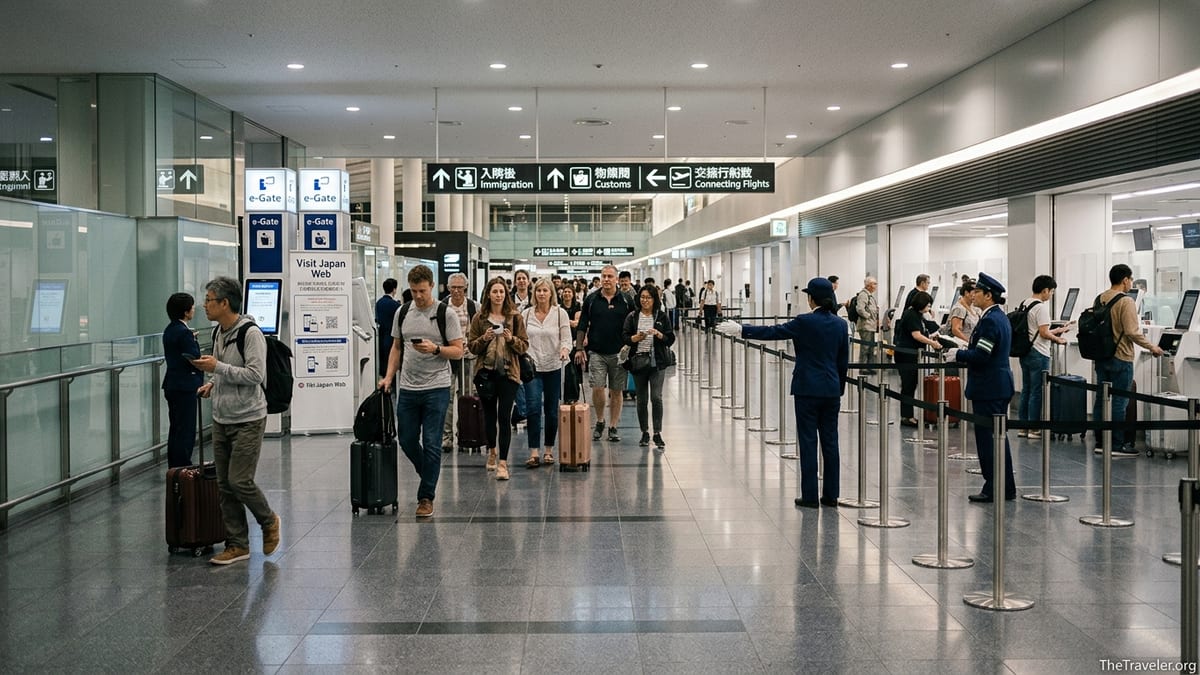
Understanding Haneda’s Terminals and Layout Before You Fly
Haneda Airport sits much closer to central Tokyo than Narita and handles an enormous share of the city’s international traffic through Terminal 3, as well as some international flights from Terminal 2. In practice, almost all long-haul flights from North America and Europe still arrive and depart at Terminal 3, so most international travelers will clear security and immigration there. Terminal 1 is mainly for domestic flights on Japan Airlines and its partners, while Terminal 2 is the domestic base of All Nippon Airways with a smaller international wing.
For a typical itinerary, such as a nonstop flight from Los Angeles or London arriving into Terminal 3 early in the morning, you will disembark directly into the arrivals flow, which delivers you first to quarantine checks if required, then immigration, baggage claim, and finally customs. If you are connecting to a domestic flight in Terminal 1 or 2, you will clear immigration and customs at Terminal 3, then transfer landside via the free shuttle bus, the Tokyo Monorail, or the Keikyu line. Monorail and Keikyu trains depart from underground stations directly connected to each terminal, and travel time to Terminals 1 and 2 is around five minutes, plus walking.
Because the arrival flow is tightly controlled, you will not pass through traditional security screening immediately after landing. Instead, you encounter security when departing Haneda or when re-entering the secure area for a connecting flight. This means you should mentally separate your arrival experience (immigration and customs) from your departure experience (check in, security, and outbound passport control), even if you are doing both within a few hours on a through-ticket.
It helps to look at your booking and boarding passes before you fly to understand exactly where you will arrive and depart. For example, a traveler flying in from San Francisco on Japan Airlines and connecting to a domestic JAL flight to Sapporo will arrive at Terminal 3, clear immigration and customs there, and then transfer to Terminal 1 for the domestic leg. By contrast, someone flying ANA from Singapore to Tokyo and then onward to Osaka might arrive and depart from Terminal 2’s international and domestic sections respectively, staying within one building after clearing formalities.
Arrival: From Aircraft Door to Immigration Counters
On arrival in Terminal 3, signage appears in Japanese and English almost immediately as you exit the jet bridge. Long-haul flights from North America and Europe often land in early morning banks, so you may find yourself walking with several hundred passengers from different flights toward the immigration hall. The corridor leads you past restrooms and occasionally a small seating area, but you cannot access shops or restaurants until after you pass immigration and customs.
Before 2020, travelers frequently queued to hand-completed paper forms to officers. Today, Japan relies heavily on the Visit Japan Web system, a government-run online portal where you can pre-enter your immigration and customs details and receive a single QR-style 2D code that is scanned at the airport. Visit Japan Web is not mandatory, but Japanese authorities actively encourage its use and airlines such as Delta, ANA, and JAL now prompt passengers during online check-in to complete it. If you have filled it out, keep a screenshot or opened browser tab ready as you walk to immigration, and ensure your phone is charged.
At the entrance to the immigration area, staff separate Japanese citizens and foreign passport holders into different lanes. Foreign nationals with biometric passports are directed either to manned counters or to automated gates, depending on staffing levels and crowding. Children and passengers who require assistance are usually funneled to staffed desks. In busy periods, such as cherry blossom season in late March or the New Year holidays, queues for foreign passports can extend back toward the corridor, but the actual processing at the counter is typically under two minutes per traveler, provided paperwork is in order.
Travelers who did not complete Visit Japan Web can still enter by filling in paper forms provided near the queue. However, this adds an extra step at a moment when many passengers are jet-lagged and impatient. As a real-world comparison, a family arriving from New York with Visit Japan Web ready might move from aircraft door to the front of the immigration line in 20–30 minutes in moderate crowds, while a similar family who needs to stop and fill out multiple paper forms could easily add 10–15 minutes to that timeline.
Immigration: Biometrics, Automated Gates, and What Officers Ask
Japan requires most foreign visitors to provide fingerprints and a facial photograph on entry. At Haneda, these biometrics are usually captured at the immigration counter using a small fingerprint reader and an attached camera, or via an automated gate that handles both scanning and biometric capture. You place your passport on the reader, step onto the marked footprints, and follow instructions in English on the screen while an officer supervises nearby.
Questions from immigration officers are generally brief and practical. Expect to be asked for your length of stay, accommodation address for your first night, and sometimes your planned itinerary. For example, a solo traveler arriving from Seattle for a two-week holiday might answer “14 days” and show a hotel reservation in Shinjuku on their phone. Officers can also ask about your occupation or the amount of cash you are carrying, particularly if you are staying for an extended period or on a visa type other than tourism. Having hotel confirmation emails, return tickets, and a rough itinerary saved offline on your phone is useful if your mobile data does not work immediately.
Frequent visitors and certain categories of residents can register to use Japan’s automated immigration gates for faster processing on subsequent trips. Registration is done separately at immigration offices or designated airport counters and allows you to bypass manned desks in favor of self-service lanes, similar to trusted traveler programs at other major airports. For casual tourists, however, the standard lanes at Haneda are usually efficient enough that this extra step is not necessary, particularly when arriving outside peak periods.
Immigration officers have broad discretion and can refer passengers to secondary inspection if something in their answers or documents raises concerns. Secondary inspection may involve detailed questions about your work, finances, or purpose of visit, and can take anywhere from 30 minutes to several hours. While such cases are rare relative to total arrivals, travelers carrying large sums of undeclared cash, those on one-way tickets without clear plans, or people who have previously overstayed visas in Japan or elsewhere are more likely to be questioned. Being honest, calm, and organized is the best strategy if you are selected.
Customs and the Visit Japan Web E-Gate System
Once past immigration, you descend an escalator into the baggage claim hall. Overhead monitors show your flight number and assigned carousel, and luggage from long-haul flights typically begins appearing within 15–30 minutes of arrival. Haneda staff often remove unclaimed bags after several loops and place them neatly beside the belt, so if you arrive late to baggage claim, check the surrounding area as well as the carousel itself.
While you wait for luggage, you will see signs and terminals for Japan’s electronic customs declaration gates, known as e-Gates. At Haneda, these systems work in tandem with Visit Japan Web, which now generates a unified code covering both immigration and customs details. If you completed the customs declaration section online before departure, you can scan the same code at a kiosk near the baggage belts, confirm your answers, and have your photo taken. This process allows you to use the e-Gate exit after collecting your bags, walking through a facial-recognition gate rather than presenting a paper form.
In practical terms, the e-Gate saves time when the customs hall is busy. Imagine two couples arriving from Sydney during a midday rush. The first couple, who used Visit Japan Web, scan their QR code at the kiosk, collect their bags, then walk straight through the dedicated electronic gate in under a minute. The second couple, who skipped the online form, must pick up paper declaration cards from a stand, fill them in by hand, and then wait to present them to an officer at a manned counter. The manual route may still be relatively quick, but when multiple flights land together, the difference between a two-minute e-Gate exit and a 15-minute line is noticeable.
Even if you use e-Gates, customs officers have the authority to pull random passengers aside for baggage inspection. This is relatively common, especially for travelers carrying many shopping bags or large suitcases. For instance, a traveler returning from a shopping trip in Osaka with multiple electronics purchases might be asked to open their luggage for inspection, while someone with a single medium suitcase and a backpack is more likely to be waved through. Japan’s duty-free allowances for alcohol, tobacco, and certain goods are similar to those of other countries, and penalties for smuggling drugs or large quantities of restricted items are severe, so always declare anything that could fall into a gray area.
Security Screening When Departing from Haneda
Security screening at Haneda takes place only when you depart or when you re-enter the secure zone during a connection. The process is familiar to anyone who has flown internationally: you place your carry-on baggage, electronics, and coats on a conveyor belt for X-ray screening and walk through a metal detector or body scanner. Liquids must generally be in containers of 100 milliliters or less and fit into a transparent, resealable one-liter bag, in line with international norms, although enforcement can feel slightly less aggressive than at some North American airports.
For departing international flights from Terminal 3, Haneda’s operator recommends arriving well in advance, especially during busy waves. Public notices from the airport warn that security at Terminal 3 can be particularly congested during 7 am to 11 am, 1 pm to 4 pm, and 7 pm to 9 pm, and urge passengers to come early during those windows. In real terms, that means aiming to arrive at the airport at least three hours before scheduled departure for long-haul flights, and at least two hours before regional flights, with extra padding during peak holiday periods such as Golden Week in late April or Obon in mid-August.
Despite these warnings, many travelers report relatively brisk security lines during ordinary weekdays. For example, a traveler flying out on an evening ANA flight to Singapore on a Tuesday might check in around 7 pm and encounter only a 10–15 minute wait at security. By contrast, someone departing on a Sunday morning to London during cherry blossom season could face a 30–40 minute queue, even with all lanes open. The safest approach is to budget more time than you think you need, then enjoy Haneda’s restaurants, souvenir shops, and observation decks once you are airside.
Haneda has gradually introduced biometric technology to streamline departure procedures as well. A system known as Face Express allows eligible passengers to register their facial image at check-in or a kiosk, then proceed through baggage drop, security, and boarding without repeatedly showing passports and boarding passes. Participation is voluntary and depends on airline participation, but it reflects a wider trend toward touchless processing in Japanese airports. Even if you do not opt in, keeping your passport and boarding pass ready in a jacket pocket or travel wallet will help you move through security efficiently.
Transit and Domestic Connections: Timing Your Transfers
Many travelers use Haneda to connect between long-haul international flights and domestic services to cities like Sapporo, Fukuoka, or Okinawa. Because immigration and customs for arriving international passengers occur at the first point of entry, you must allow enough time in your schedule for these steps before boarding a domestic connection. Airlines commonly sell itineraries with connections of two to three hours at Haneda, which is usually sufficient if your inbound flight is on time.
A concrete example helps illustrate this. Consider a passenger flying from Vancouver to Haneda, landing at 4:30 pm and scheduled to depart at 7:30 pm on a domestic flight to Hiroshima. After disembarking, it may take around 20 minutes to reach immigration, 15–30 minutes to clear the immigration queue depending on traffic, and another 15–20 minutes to collect baggage and pass customs. That already uses up around 60–70 minutes. The passenger then needs about 5–10 minutes to walk to the monorail or shuttle bus, 5 minutes transit to Terminals 1 or 2, and 10–15 minutes to reach the domestic check-in and security area. The resulting total transfer time of roughly two hours is comfortable in normal conditions but leaves limited buffer for major delays.
Self-planned connections using separate tickets require even more caution. If you buy one-way tickets on different airlines, such as arriving on a low-cost carrier from Taipei and then flying a separate ticket to Osaka, you are fully responsible if immigration or customs delays cause you to miss the second flight. In such cases, treat Haneda like any other major hub: plan at least three to four hours between scheduled arrival and departure, particularly during high season or if you are unfamiliar with the airport layout.
Transit passengers who remain airside between international flights may have a very different experience. If your itinerary is on a single ticket and your airline checks bags through to your final destination, you may never go through Japanese immigration at all. Instead, you will pass a security checkpoint in the transit area and proceed directly to a departure lounge. Staff will guide you from the arrival gate to the transfer security line, which is usually shorter than the main departures checkpoint. However, pure international-to-international transits at Haneda are still less common than at larger hub airports, so you should always confirm with your airline beforehand whether you will enter Japan or remain airside.
Practical Tips for a Smooth Experience at Security and Immigration
Preparation before you land or depart will make the biggest difference to your experience at Haneda’s security and immigration points. Completing Visit Japan Web at home and taking screenshots of your QR code and confirmation pages ensures you are not relying on unstable in-flight Wi-Fi or roaming data signals as you approach the immigration hall. Many travelers store these screenshots in a dedicated album on their phone, alongside hotel confirmations and return flight details, so they can open them quickly when asked.
Think carefully about what you pack in checked and carry-on luggage in light of Japanese customs rules. Common problem areas include bringing large quantities of prescription medication, carrying expensive electronics for friends and family, or transporting food items like meat products or fresh fruit. For instance, a traveler bringing ADHD medication such as Vyvanse should check in advance whether it is allowed in Japan and, if so, carry a doctor’s letter and keep the medicine in original packaging. If there is any doubt about an item, it is safer to declare it on your customs form and explain it to an officer than to risk seizure or penalties.
When departing, wear easily removable jackets, avoid belts with large metal buckles, and place laptops and tablets in easily accessible compartments of your carry-on. Although security staff at Haneda are generally efficient and polite, they will still require you to remove certain electronics and liquids for separate screening, and fumbling with tightly packed bags slows both you and everyone behind you. Business travelers often rely on dedicated laptop backpacks with top-loading compartments, which allow them to place their computer on the belt in one motion.
Finally, build in buffer time. Trains from central Tokyo to Haneda are usually punctual, but unexpected delays or crowded carriages during rush hour can slow your journey. Travelers staying in neighborhoods like Shinjuku or Shibuya often leave their hotels three to four hours before an evening international flight, giving themselves time to navigate station transfers, find their check-in counter, and still enjoy a relaxed meal at the airport after clearing security. Using a prepaid IC card such as Suica or PASMO or a QR-based smartphone ticket simplifies your ride to the airport and eliminates the need to queue at ticket machines with luggage in tow.
The Takeaway
Haneda Airport’s reputation for efficiency is well deserved, but it rests on travelers understanding how today’s digital tools, biometric systems, and traditional checks fit together. On arrival, most of your time will be spent walking from the gate, queuing at immigration, and waiting for bags, not arguing with officials. Completing Visit Japan Web before you fly, carrying organized documents, and answering simple questions clearly will make the immigration process at Haneda straightforward, even during busy travel seasons.
On departure, treating security and check-in like any other major international airport, and allowing generous extra time during known congestion periods, is the smartest approach. Whether or not you use optional systems such as Face Express, having your boarding pass and passport ready, packing liquids and electronics sensibly, and arriving early enough to absorb surprises will turn an anxious rush into an unhurried stroll through one of Asia’s most pleasant terminals.
Ultimately, the key to a smooth Haneda experience is not special insider tricks but realistic expectations and a few simple habits. Understand that immigration and customs are methodical rather than aggressive, use Japan’s online tools where possible, and keep a buffer in your schedule. Do that, and Tokyo’s closest international airport will feel less like a bureaucratic obstacle and more like a polished gateway into and out of one of the world’s great cities.
FAQ
Q1. How long does it usually take to clear immigration and customs at Haneda?
In typical conditions, many travelers clear immigration and customs in 45 to 75 minutes from aircraft door to the arrivals hall, assuming no major delays and that Visit Japan Web is completed in advance. During peak seasons or if several large aircraft arrive together, it can take longer, so it is wise to plan onward transport with some buffer.
Q2. Do I have to use Visit Japan Web, or can I still use paper forms?
Visit Japan Web is strongly encouraged but not legally mandatory. If you do not complete it, you can still enter Japan by filling out paper immigration and customs forms at the airport. However, you will not be able to use the fastest electronic customs gates, and you may face longer queues at busy times while you complete paperwork.
Q3. What questions will immigration officers ask me on arrival?
Officers typically ask about the purpose of your visit, length of stay, and where you are staying for your first night. They may also ask to see your return or onward ticket, and occasionally ask about your job or how much money you have to support your stay. Having hotel bookings and flight confirmations ready on your phone helps keep the interaction brief.
Q4. Is Haneda’s security screening very strict compared with other airports?
Haneda’s security is thorough but not usually aggressive. Rules on liquids, sharp objects, and electronics are similar to those in Europe or North America. Staff are generally polite and efficient, and lines often move quickly, but during peak hours or holiday periods queues can still build, which is why the airport recommends arriving early for international flights.
Q5. How early should I arrive at Haneda for an international flight?
As a general guideline, aim to arrive at least three hours before departure for long-haul international flights and at least two hours for regional routes. If you are flying during known busy windows, such as early morning or evening banks, or major holidays, add an extra 30 to 60 minutes to be safe and to allow time to enjoy the terminal after clearing security.
Q6. Can I connect from an international flight at Haneda to a domestic flight on a separate ticket?
Yes, but you should allow plenty of time. Because you must clear immigration, collect your baggage, pass customs, transfer to the domestic terminal, check in again, and clear security, a minimum of three to four hours is sensible when using separate tickets. With a through-ticket on the same airline, two to three hours is usually enough, as long as your incoming flight is on time.
Q7. Are there special lanes for families, elderly travelers, or people with disabilities?
Haneda generally offers assistance lanes or priority processing points for travelers who need extra help. Airline staff can request wheelchair assistance and guide you through immigration and security. Families with small children are often directed to specific queues to reduce waiting time. It is best to inform your airline in advance if you or a companion requires mobility or medical assistance.
Q8. What should I do if my phone battery dies before I can show my Visit Japan Web code?
If your phone fails or you cannot access your Visit Japan Web code, you can explain the situation to staff and use paper forms instead. Charging points are available in many parts of the terminal, but they may be crowded, so carrying a small power bank is a good idea. Taking printed screenshots of your QR code as backup is also helpful, though not strictly necessary.
Q9. Will I have problems bringing prescription medication through customs?
Most common prescription medications for personal use are allowed, but some medicines that are routine in other countries are tightly controlled in Japan. It is important to check regulations in advance, keep medication in original packaging, carry a copy of your prescription, and declare anything that might be questionable. If customs officers have concerns, they may ask additional questions or inspect the medicine before allowing you to proceed.
Q10. Is Haneda easier to navigate than Narita for first-time visitors?
Many travelers find Haneda more compact and easier to navigate than Narita, especially because it is closer to central Tokyo and has fewer separate terminal buildings for most international arrivals. Signage in English is clear, staff are accustomed to helping overseas visitors, and transfers to trains or domestic flights are straightforward once you pass immigration and customs. That said, both airports are modern and well signed, so preparation matters more than which airport you use.