


The Hokuriku Shinkansen connects Tokyo and Kanazawa in a single, direct ride with no need to change trains. The faster Kagayaki services usually take around two and a half hours and stop at fewer stations than the Hakutaka services, which are slightly slower but offer more flexibility and some non-reserved seating. For a first-time visitor, understanding the differences between these trains, how reservations work and whether a rail pass actually saves money can make the journey smoother and better value.
Get the latest updates straight to your inbox!
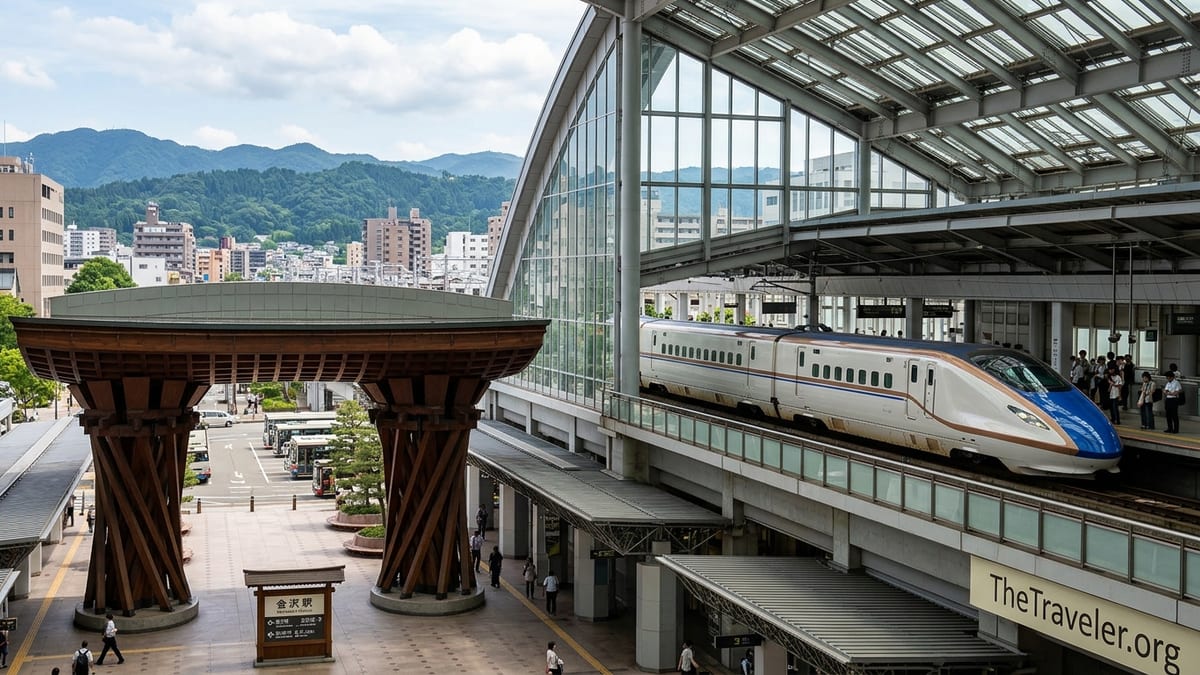
Understanding the Hokuriku Shinkansen Route and Train Types
The Hokuriku Shinkansen is a joint JR East and JR West high-speed line that runs from Tokyo north through Ueno and Omiya, then across Nagano and Toyama to Kanazawa and onwards to Tsuruga. Tokyo and Ueno are the main departure stations for visitors staying in central Tokyo, while Kanazawa is the terminus for most tourists heading to the city’s historic districts. Trains are modern E7/W7 series sets with Ordinary, Green and in some formations Gran Class, offering a consistent onboard experience whichever departure you take.
Kagayaki services are the fastest and most limited-stop trains on this route, running mainly between Tokyo and Kanazawa or Tsuruga. Recent timetables show typical Tokyo to Kanazawa journey times of about 2 hours 30 minutes on Kagayaki, depending on the specific train and date. Kagayaki generally stops only at key stations such as Ueno, Omiya, Nagano and Toyama before reaching Kanazawa, which is why they are favoured by time-pressed travelers.
Hakutaka services also connect Tokyo and Kanazawa but stop at more intermediate stations such as Karuizawa, Itoigawa and Kurobe-Unazukionsen. This adds some travel time, so Tokyo to Kanazawa on Hakutaka is usually closer to 2 hours 50 minutes to 3 hours. In return you gain more departure options through the day and, crucially, some non-reserved seating cars that can be used with appropriate rail passes or same-day tickets without prior seat selection.
As of late 2026, Kagayaki trains between Tokyo and Kanazawa are all-reserved services, so every passenger must hold a reserved seat ticket in Ordinary, Green or Gran Class. Hakutaka trains on the same section generally have a mix of reserved and non-reserved cars, which is useful for travelers who want flexibility or who hold certain passes that allow boarding without advance reservations.
Departure, Arrival, Fares and Frequency
From central Tokyo, Hokuriku Shinkansen trains depart from the Shinkansen platforms at Tokyo Station and also from Ueno Station to the north. Many visitors staying in Asakusa, Ueno or Yanaka find it easier to board at Ueno, while those based around Tokyo Station, Ginza or Shinjuku usually connect into Tokyo Station. All Tokyo–Kanazawa Kagayaki and Hakutaka services call at Tokyo Station; a subset also stop at Ueno.
On the Kanazawa end, all Hokuriku Shinkansen trains arrive at Kanazawa Station, which functions as the city’s main transport hub. The Shinkansen platforms sit in the upper level of the station complex, with straightforward escalator and elevator access down to the wide concourse, ticket gates and bus stops. This compact layout is convenient for travelers with luggage or mobility needs and makes tight connections between train and bus realistic with a sensible time buffer.
Typical daytime operation offers multiple Tokyo–Kanazawa departures each hour when you combine Kagayaki and Hakutaka services, though exact frequencies vary by time of day and season. Kagayaki tends to be more concentrated in the morning and late afternoon peaks, while Hakutaka fills the timetable across the day. JR East and JR West publish updated timetables each spring and autumn; because minor time adjustments are common, travelers should always confirm specific departure and arrival times close to their travel date at a JR ticket counter or via official digital timetables.
Base fares for a one-way Tokyo–Kanazawa journey consist of a distance-based basic fare plus an express surcharge and any seat reservation or class upgrades. Exact yen amounts shift with fare revisions, but in late 2026 an Ordinary reserved seat on the Hokuriku Shinkansen for Tokyo–Kanazawa typically costs in the high teens to low twenty-thousands of yen one way. Green Car is noticeably higher, and Gran Class higher again. It is important to check current prices at the time of purchase because JR has implemented several fare and pass price changes since 2023.
Reservations, Booking Channels and Changes
For Kagayaki, reservations are compulsory in all cars, including Ordinary Car. You cannot simply show up and sit in a non-reserved car because none exist on these services. Hakutaka trains, by contrast, usually include several non-reserved cars at one end of the train with numbered but unallocated seats. This allows passengers to board with an appropriate ticket or pass and take any free seat in those cars, which is particularly useful on quieter days or for travelers whose plans may change at short notice.
Foreign visitors can make advance reservations through official online systems such as JR East Train Reservation for eligible Hokuriku Shinkansen services and through JR West’s online ticket services for sections under its control. These platforms allow you to select your departure, train type (Kagayaki or Hakutaka), class and seat preference. After booking, you can either pick up physical tickets at designated JR ticket machines and counters using the same credit card and reservation number, or, on some routes and services, use a QR code style e-ticket to pass through dedicated gates. Precise availability of QR entry and pickup locations depends on the company and station, so you should check the guidance on the reservation site you use.
Travelers using discounted products such as the Japan Rail Pass or the Hokuriku Arch Pass must show their passport at purchase or pickup. These passes are only sold to foreign visitors on short-term stays, and passport checks confirm your eligibility. If you hold such a pass, you usually still need to make seat reservations for Kagayaki (at no extra charge in Ordinary Car in the case of the nationwide pass, within its rules) and can optionally reserve seats on Hakutaka. Reservations can be changed before departure free of charge in many cases if you adjust to another train in the same class and section, but some online systems have cut-off times for web changes, after which changes must be handled at a station.
Cancellation rules vary by ticket type. Standard reserved-seat tickets bought without passes can usually be refunded for a partial amount if you cancel before departure, with a small handling fee deducted. After the departure time, refunds may be severely limited or not available. If you miss a reserved-only Kagayaki departure, it is common practice that you can still use the basic fare portion of your ticket later that day but may lose the reserved surcharge or be required to purchase a new seat reservation. Because specific conditions do change, the safest approach is to ask at purchase what happens if you need to change or cancel and keep the printed receipt that states the conditions.
Ordinary vs Green Car: Comfort, Layout and Cost
Ordinary Car on the Hokuriku Shinkansen is equivalent to standard class on European high-speed trains, with 2+3 seating across the carriage, reclining seats and overhead racks. On a roughly 2.5 to 3 hour Tokyo–Kanazawa journey, most travelers find Ordinary comfortable enough, particularly if they reserve early and select window or aisle seats away from high-traffic door areas. Power outlets are increasingly common at seats in recent E7/W7 formations, though exact placement may differ.
Green Car is JR’s first-class style product on these trains, with a 2+2 seating layout, more legroom, wider armrests and a generally quieter environment. For a daytime Tokyo–Kanazawa trip, Green Car is popular with business travelers and visitors who value extra space or are carrying work devices. The price difference between Ordinary and Green on this route is usually several thousand yen one way, which can feel worthwhile if you prioritize comfort, are traveling during a peak holiday period when Ordinary cars are crowded, or simply want a calmer environment.
Gran Class, where offered, is a premium cabin at the front of some trains with even more spacious seats and at-seat service. However, for many visitors this is a luxury rather than a necessity and can cost as much as a domestic flight upgrade. Since the focus here is on value and practicality for first-time riders, most will weigh the choice primarily between Ordinary and Green.
In deciding, consider not only the extra cost but also your schedule. For example, a couple traveling in November with medium luggage, taking a mid-morning Kagayaki from Tokyo to Kanazawa on a weekday outside major holidays, would probably be perfectly satisfied in Ordinary reserved seats and might prefer to spend the price difference on a special dinner in Kanazawa. During Golden Week, New Year or Obon, however, upgrading to Green on a popular Kagayaki departure can significantly improve comfort if seats remain available.
Luggage Rules and Practical Storage Options
A key point for Hokuriku Shinkansen riders is that the oversized baggage reservation system widely used on the Tokaido, Sanyo and Kyushu Shinkansen does not apply in the same way to Hokuriku trains. On those other lines, passengers with very large suitcases above a certain linear dimension must reserve specific oversized baggage seats. On the Hokuriku Shinkansen, JR has taken a lighter-touch approach. There are still expectations about safe storage and not blocking aisles or doors, but there is not the same mandatory oversized baggage seat category on Kagayaki and Hakutaka at the time of writing.
Overhead racks above the seats are designed for smaller suitcases and backpacks. Typically, carry-on style cases up to around international cabin size fit easily, and slightly larger soft-sided bags can also be accommodated if not overstuffed. Heavier or very large suitcases should not be forced into overhead racks for safety reasons. Instead, look for the space behind the last row of seats in each car, which is often used as informal standing luggage storage. Early boarding helps secure this space.
Trains also include designated wheelchair spaces and priority seating areas, usually near doors. These areas are not general luggage storage and should be kept clear unless the crew explicitly guides you to place items there. Families with strollers can generally wheel them on board through level-access doors, park them in the vestibule space near the doors when safe, or fold them and store them above or behind the seats. If you are traveling in a group with multiple full-size suitcases, or combining Tokyo–Kanazawa with further rail travel, using a same-day or overnight luggage forwarding service between hotels can be more convenient. Forwarding one or two large suitcases from a Tokyo hotel to a Kanazawa hotel allows you to travel with only a small carry-on, making boarding and alighting much easier.
Because rules and on-board layouts can be updated, especially as the Hokuriku Shinkansen extension to Tsuruga beds in, it is sensible to check any luggage notices at the platform or on the official JR English-language pages shortly before travel, particularly if you know you will be carrying very large or unusual items such as ski equipment.
Single Tickets vs Japan Rail Pass vs Hokuriku Arch Pass
The national Japan Rail Pass offers unlimited travel on most JR lines, including the Hokuriku Shinkansen, for consecutive days. After major price revisions, current official prices for the ordinary nationwide pass are around 50,000 yen for 7 days, 80,000 yen for 14 days and 100,000 yen for 21 days for adults, with Green Car passes costing significantly more. These figures come from JR Group official materials and travel-agency listings reflecting the post-October 2023 fare structure, and there are further modest increases scheduled around October 2026 for passes bought outside Japan, so travelers should always verify the exact amount for their purchase date.
The Hokuriku Arch Pass is a separate 7-day product jointly marketed by JR East and JR West that allows unlimited travel between Tokyo and the Kansai region via the Hokuriku Shinkansen and related lines, but explicitly does not allow travel on the Tokaido Shinkansen between Tokyo and Kyoto or Osaka. Promotional materials and later updates show that its price has risen over time to around 30,000 yen for adults, reflecting additional value from the Hokuriku Shinkansen extension to Tsuruga and general fare inflation. This pass is valid on Ordinary Cars, including Hokuriku Shinkansen segments between Tokyo and Tsuruga, and a network of limited express and local JR lines forming an “arch” through Kanazawa between Tokyo and Kansai.
To judge value, consider a concrete example. A simple Tokyo–Kanazawa return by Hokuriku Shinkansen in Ordinary reserved seats might cost in the region of the mid- to high-30,000s of yen for an adult when buying two single tickets at current fares. Compared to a 7-day nationwide pass at about 50,000 yen, the pass is more expensive if you only make this return journey and perhaps a couple of short JR trips in Tokyo and Kanazawa. In this scenario, single tickets almost always make more financial sense unless you are adding at least one more long-distance JR trip of similar distance within the same 7-day window.
Now consider a more ambitious route: Tokyo to Kanazawa, then onward to Kyoto and Osaka before returning towards Tokyo. Since March 2024 the Hokuriku Shinkansen continues beyond Kanazawa to Tsuruga, where you change to limited express trains into Kyoto and Osaka. If you structure this as Tokyo–Kanazawa–Tsuruga–Kyoto–Osaka within seven days, plus perhaps a return to Tokyo via the same Hokuriku route, the cumulative cost of single tickets can climb towards or even beyond the price of a Hokuriku Arch Pass. However, compared to the nationwide Japan Rail Pass, the Arch Pass is still cheaper and can be good value if all your long-distance travel is within the Hokuriku and Kansai corridor and you do not need the Tokaido Shinkansen direct Tokyo–Kyoto route.
Evaluating Real Itineraries and When Passes Pay Off
For a first-time visitor planning a focused Tokyo–Kanazawa trip of three or four days, possibly with some JR local rides in Tokyo and Kanazawa, buying individual Hokuriku Shinkansen tickets is usually the most economical choice. In this case you might take a morning Kagayaki from Tokyo to Kanazawa on day one, spend two nights in Kanazawa and return to Tokyo by Hakutaka on day three, using IC cards or small local tickets for connecting urban travel. The nationwide Japan Rail Pass would almost certainly cost more than the combined value of these tickets.
Suppose instead you are planning a 10-day itinerary: arrive in Tokyo, travel on to Kanazawa, continue by Hokuriku Shinkansen to Tsuruga and then onwards to Kyoto and Osaka, with a final long-distance return to Tokyo by Tokaido Shinkansen. In this scenario a 7-day Japan Rail Pass could be activated on the day you leave Tokyo for Kanazawa, then cover Tokyo–Kanazawa, Kanazawa–Tsuruga–Kyoto, Kyoto–Osaka and Osaka–Tokyo within seven calendar days. Given current fares and planned increases, cumulative regular ticket costs for those four intercity legs are likely to approach or exceed the 7-day pass price, especially if you use additional JR urban lines. Here the nationwide pass can make sense despite its high headline price, particularly if you want maximum flexibility to change trains and routes.
The Hokuriku Arch Pass fits a slightly different pattern. It shines when your trips are all or mostly within the loop between Tokyo, Hokuriku and Kansai, and when you do not need the faster Tokaido Shinkansen. One realistic use is a one-way progression from Tokyo to Kanazawa to Kyoto and Osaka without returning to Tokyo at the end. In that case, the nationwide pass may be overkill, while the Arch Pass can undercut the sum of individual tickets. Travel-planning sites and community reports note, however, that after price rises, even the Arch Pass is no longer a guaranteed money-saver and is best evaluated against a concrete day-by-day route on current fares before purchase.
Because JR ticket and pass prices have gone through multiple adjustments since 2023 and further small changes are announced into 2026, all of the comparisons above should be treated as indicative rather than exact. Before committing, enter your actual dates and trains into an up-to-date fare search tool or ask at a major JR station for a printed fare breakdown, then compare the total to current pass prices shown on official JR and national tourism organization pages.
Accessibility, Peak Seasons and Booking Strategy
Hokuriku Shinkansen stations at Tokyo, Ueno and Kanazawa are equipped with elevators, escalators and tactile paving, and trains provide accessible toilets and spaces for wheelchair users. When booking with mobility needs, it is wise to reserve early and specify that you require a wheelchair space or step-free boarding assistance. Staff at Shinkansen gates are accustomed to escorting passengers who need help and can coordinate with destination stations so that assistance is waiting on the platform.
Japan’s major peak travel periods significantly affect reservation availability. These include New Year (roughly December 29 to January 3), Golden Week in late April and early May, and Obon in mid-August, plus some three-day weekends and festival dates. During these times, Kagayaki Ordinary and Green cars on popular morning and evening departures between Tokyo and Kanazawa can sell out days in advance. First-time visitors planning to travel during any of these periods should aim to reserve as soon as their desired train becomes available in the online systems, typically 1 month before the departure date.
On normal weekdays outside peak holidays, same-day reservations are often possible, especially on Hakutaka services. Travelers holding passes that allow free seat reservations can therefore remain somewhat flexible by targeting Hakutaka, which not only has non-reserved cars but often has more remaining seat inventory. If your schedule is tight, though, locking in a specific Kagayaki train in advance reduces stress and helps with planning onward connections in Kanazawa.
A practical compromise is to reserve at least the outbound morning Kagayaki from Tokyo to Kanazawa, particularly if you want to arrive around lunchtime to maximize sightseeing, while leaving the return open on a Hakutaka and deciding the exact train closer to the day. This approach balances certainty with flexibility and works well for many first-time visitors building Kanazawa into a longer Japan itinerary.
From Kanazawa Station to the City’s Main Sights
On arrival at Kanazawa Station, the most convenient way to reach key attractions is the loop bus network departing from the bus terminal just outside the East Exit, under the Tsuzumi-mon gate. The right-hand loop and left-hand loop city buses circulate between Kanazawa Station, Kenrokuen Garden, Kanazawa Castle Park, Higashi Chaya District and other central sights. A single ride costs only a few hundred yen, and day passes are sold at the station’s tourist information office, making multiple hops affordable.
For Kenrokuen Garden and Kanazawa Castle, most visitors board a loop bus at the station and alight near the Kenrokuen entrance, from where it is a short walk uphill. The garden and castle grounds are adjacent, so you can easily explore both in a single morning or afternoon. Higashi Chaya District, known for its preserved teahouses and narrow lanes, is also on the loop route, and from its bus stop it is just a few minutes’ walk to the heart of the district.
Omicho Market lies closer to the station and is within walking distance for many travelers. A level walk of around 15–20 minutes from Kanazawa Station East Exit takes you through commercial streets to the market, or you can ride a short city bus hop if carrying luggage or traveling in bad weather. For travelers packing light, it is possible to arrive in Kanazawa by Shinkansen, leave suitcases in station coin lockers or an overnight luggage counter, sample fresh seafood at Omicho Market and then continue on to your accommodation later in the day.
Walking is an attractive option in Kanazawa’s compact historic core. For example, you might walk from Omicho Market to Kanazawa Castle and Kenrokuen, then on to Higashi Chaya District, eventually returning by bus or taxi. However, some streets are hilly or cobbled, and weather can be wet in winter, so those with mobility concerns may wish to rely more on the bus network. Taxi ranks are located near the station and major attractions and can be convenient for late evenings or heavy luggage.
Sample Travel Day and Two-Day Kanazawa Itinerary
A realistic travel day from Tokyo to Kanazawa might begin with an 8:24 Kagayaki departure from Tokyo Station, arriving in Kanazawa just before 11:00. To make this work smoothly, plan to arrive at Tokyo Station at least 30–40 minutes before departure, especially if you are unfamiliar with the station layout. This buffer allows time to collect tickets if needed, buy snacks for the journey and navigate to the correct Shinkansen platform. Once on board, you can enjoy views of the Kanto plain, the mountains around Nagano and the Sea of Japan side as you approach Kanazawa.
After arrival around 11:00, give yourself 20–30 minutes to exit the Shinkansen area, drop luggage in your hotel or in station storage and reach Omicho Market by foot or bus. An afternoon could be spent wandering the market, then heading to Kanazawa Castle Park and Kenrokuen Garden, finishing with sunset views over the garden’s ponds and pines. An evening stroll in the Nagamachi samurai district or a kaiseki dinner rounds out the day before returning to your accommodation.
On a second day, start with a bus ride from the station or your hotel to Higashi Chaya District for a quieter morning exploring teahouses before crowds build. From there, you could cross the Asano River, visit smaller museums or craft workshops and return to the station by mid-afternoon. Taking a late-afternoon or early-evening Hakutaka back to Tokyo gives you flexibility; if you are using single tickets, you might reserve a specific departure once you know how your day is unfolding, while pass holders could target non-reserved seats on a suitable Hakutaka train.
Building station buffers into both ends of your day is important. Aim to be on the platform at least 10–15 minutes before your Shinkansen departure, particularly with luggage, and allow a similar cushion at Kanazawa Station when connecting from city buses that might be delayed by traffic. This reduces stress, protects you from minor mishaps and makes the experience feel measured rather than rushed.
Final Verdict: Kagayaki vs Hakutaka and Pass vs Single Ticket
For most first-time visitors traveling between Tokyo and Kanazawa, Kagayaki is the best choice when you want the fastest, simplest journey and are prepared to commit to a reserved seat. It cuts journey time to around two and a half hours, offers a smooth ride and aligns well with morning departures from Tokyo that put you in Kanazawa by lunchtime. Combined with an Ordinary reserved seat, this offers an excellent balance of cost and comfort. Green Car is a worthwhile splurge when traveling at peak times, during holidays or if you particularly value quiet and space.
Hakutaka shines when flexibility matters. Its slightly longer journey time is offset by more frequent departures across the day and the presence of non-reserved cars, which can be a lifesaver for pass holders or travelers making last-minute decisions. If you tend to change plans, or if advance online reservations feel daunting, building your trip around Hakutaka while still reserving seats for busier dates offers a relaxed alternative.
On the question of rail passes, current pricing means that a simple Tokyo–Kanazawa return rarely justifies a nationwide Japan Rail Pass. Single tickets or, at most, a regional product like the Hokuriku Arch Pass provide better value for focused itineraries. The Japan Rail Pass comes into its own only for travelers stringing together multiple long-distance JR journeys within 7 or 14 days, such as a combined Tokyo–Kanazawa–Kyoto–Osaka–Tokyo loop. Even then, you should run the numbers carefully using up-to-date fares and consider whether the flexibility and simplicity of a pass outweigh potential small cost savings from individual tickets.
In the end, the Hokuriku Shinkansen offers one of Japan’s most rewarding high-speed journeys, linking the capital with Kanazawa’s historic streets and gardens in just a few hours. By choosing the right train type, making sensible reservations, managing luggage smartly and selecting tickets or passes that match a realistic itinerary, first-time visitors can enjoy a smooth, efficient and memorable ride between Tokyo and Kanazawa.