


Isla Holbox has become one of Mexico’s most talked about beach escapes, promising turquoise water, swinging hammocks and car free sandy streets. What social media rarely shows is the three to four hours of travel from Cancún, the sometimes flooded roads, patchy services and higher prices that come with being on a small island at the edge of a protected reserve. This guide uses the latest transport and ferry information to help you decide, in a realistic way, whether Holbox is worth the extra time and expense compared with staying on the Riviera Maya.
Get the latest updates straight to your inbox!
Where Isla Holbox Is and How It Differs From the Riviera Maya
Isla Holbox sits just off the northern tip of the Yucatán Peninsula, where the Caribbean Sea meets the Gulf of Mexico. The island runs roughly parallel to the mainland coast, separated by a shallow lagoon and extensive mangroves that form part of the Yum Balam Flora and Fauna Protection Area. Compared with Cancún’s hotel zone or the urban sprawl of Playa del Carmen, Holbox feels geographically and psychologically remote. There are no bridges, limited paved streets and only small clusters of development at the western end of the island around Holbox town.
Environmentally, Holbox is defined by sandbars, shallow sand flats and tidal lagoons rather than the steep drop off and coral reef walls that frame Cozumel. Much of the island’s interior and eastern coastline remains off limits to casual visitors to protect nesting birds and fragile dunes. Long sand spits such as Punta Mosquito change shape with storms and tides, and large stretches of beach remain undeveloped. Visitors accustomed to manicured resort fronts in Tulum or Puerto Aventuras can be surprised by the more natural, sometimes messy feel of Holbox’s beaches, with patches of sea grass, exposed sand flats at low tide and occasional sargassum depending on the year.
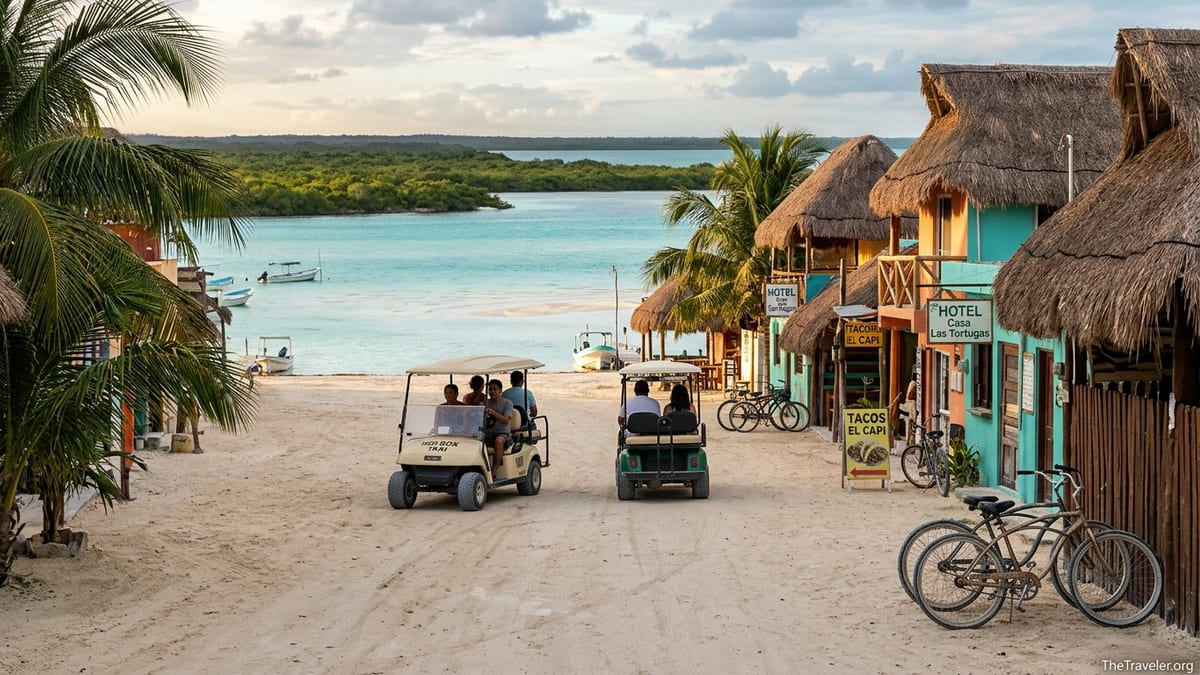
Holbox’s character also contrasts sharply with Isla Mujeres and Cancún. There are no big high rise resorts, no four lane hotel zone boulevard and no conventional private cars for visitors. Instead you find sandy streets, small guesthouses, boutique hotels and a network of golf cart style taxis. Nightlife tends to revolve around bars in and around the plaza and a handful of beach clubs rather than giant clubs. Compared with Cozumel, which receives multiple cruise ships in high season and has a port city feel in San Miguel, Holbox remains more of a relaxed village where sidewalks may be uneven, dogs wander freely and the pace is slower.
This laid back atmosphere is part of the appeal, but it is closely tied to the island’s practical limitations. Electricity cuts do happen, potable water has to be managed carefully, and heavy rains can quickly turn unpaved streets into deep mud or standing water. Choosing Holbox over the Riviera Maya means trading easy access and urban comforts for a quieter, more rustic island environment at the edge of a protected natural area.
Getting to Holbox: Routes, Buses, Shuttles and Driving
Reaching Holbox requires combining land transport to the mainland port of Chiquilá with a passenger ferry across the lagoon. From Cancún International Airport, the most common options are shared shuttle, private transfer or a combination of airport bus and onward bus. Several companies currently advertise shared shuttles from the airport to Chiquilá for about 850 Mexican pesos per person one way, with prebooked pickup times that match flight arrivals. These shuttles typically use vans seating 10 to 12 passengers and include use of the toll highway where available, cutting total travel time to around two and a half to three hours depending on traffic.
Travelers watching costs often combine the airport ADO bus into downtown Cancún with a separate ADO or similar coach onward to Chiquilá. As of late 2026, one way tickets from Cancún bus terminal to Chiquilá on ADO and related brands appear around 350 to 450 pesos in online searches, with a journey time listed at about two and a half to three hours. Same day departures typically start early in the morning, around 4:30 to 6:00, and run several times through late morning and early afternoon. Because schedules and prices can change, it is sensible to check close to your travel date and allow a safe buffer in Chiquilá before the last ferry to Holbox.
From Playa del Carmen and Tulum, there are usually at least one or two direct buses per day to Chiquilá on ADO or partner lines, alongside private transfers and shared shuttles marketed by local agencies. In practice, many visitors coming from Tulum connect via Playa del Carmen or Cancún if a direct bus does not match their schedule. For example, you might take a morning ADO from Tulum to Playa del Carmen, walk to the main bus terminal and board a mid morning bus to Chiquilá. Travel time from Playa del Carmen to Chiquilá is often quoted at around two and a half hours. From Tulum, allowing four to five hours total including connections is prudent.
Valladolid, inland in Yucatán state, is another frequent starting point, especially for travelers visiting Chichén Itzá or nearby cenotes. Recent ADO promotional material suggests one way fares from Valladolid to Chiquilá in the range of roughly 300 to 350 pesos, with travel times close to three hours and at least one daily departure. Because services are less frequent than along the coast, advance planning is more important. Whichever route you choose, keep in mind that schedules are designed primarily for locals and workers rather than international connections, so building in an extra hour between modes reduces stress and the risk of missing the last boat.
Driving to Chiquilá, Parking and the Holbox Ferry
For visitors renting a car in Cancún, Playa del Carmen or elsewhere on the peninsula, driving to Chiquilá can be straightforward. The route usually follows Highway 180D or the older free road toward Mérida before branching north through small towns. The drive from Cancún takes roughly two and a half hours in light traffic, from Playa del Carmen about three hours and from Tulum closer to three and a half to four. At Chiquilá there is no vehicle ferry for ordinary visitor cars, so you must leave the car on the mainland and continue on foot by passenger ferry. Over the past few years, numerous fenced parking lots have opened in and around Chiquilá’s small grid of streets, offering day and overnight parking.
Typical daily parking charges reported by recent travelers range around 100 to 150 pesos per 24 hours for an outdoor lot within a short walk of the pier, sometimes a bit more for covered or partially shaded areas. Staff in these lots are accustomed to Holbox tourism and often help with luggage or point you toward the correct pier entrance. Payment is usually in cash, often at the end of the stay, so keeping small bills available is useful. During peak seasons such as Easter week, Christmas and New Year, spaces can fill up, so arriving earlier in the day provides more choice.
Two passenger ferry companies currently operate the short crossing between Chiquilá and Isla Holbox: Holbox Express and 9 Hermanos. Each runs boats approximately every hour through most of the day, and because their schedules are staggered, the combined frequency is often roughly every 30 minutes from early morning until early evening. Example timetables checked in November 2026 list first departures from around 5:00 or 6:30 in the morning from each side, with last regular departures around 8:30 to 9:30 at night, though specific times vary slightly by operator and season.
Recent published fare tables show adult one way tickets in the range of about 250 to 300 pesos, with discounted rates for children and local residents. Luggage rules are relatively relaxed compared with airlines: ordinary suitcases and backpacks are accepted, but very bulky items or sports equipment may incur extra fees and must be manageable by staff. In strong winds or rough seas, ferries can be delayed or temporarily suspended. While complete shutdowns are relatively rare, especially outside hurricane events, travelers with same day flights should not rely on the last ferry. Advance online reservations are available through some operators and agencies, but in practice many passengers still buy tickets in person at the pier on the day of travel. During peak holiday weeks, securing tickets earlier in the day, or booking a transfer that includes them, can be reassuring.
Arrival on Holbox: Getting Around a Car Free Island
Arriving at Holbox’s small port, you step directly into the island’s slower rhythm. There are no private rental cars or conventional taxis allowed for visitors in the town area, and streets are mostly compacted sand with only limited paving on the busiest stretches. Outside the pier terminal, you will usually find a cluster of licensed golf cart taxis waiting, each with a posted price board or standard fares set by the local union. A short ride into the town plaza area often costs in the region of 50 to 80 pesos, while trips to hotels further along the beach road or toward Punta Cocos can be somewhat higher depending on distance and time of day.
Walking is viable for many visitors, especially if staying within 10 to 15 minutes of the central plaza and traveling with light luggage. However, sidewalks can be narrow or absent, and under hot midday sun the short distances can feel longer. Bicycle rentals are common around town and at many hotels, with daily rates that are often roughly equivalent to a few hundred pesos, sometimes including lights and locks. Cycling can be an enjoyable way to reach more distant stretches of beach, but riders must share the same sandy, rutted streets as carts and pedestrians, and after rains some sections can be challenging or impossible to cross without dismounting.
One of Holbox’s practical realities is water. Heavy downpours, especially in the rainy season from roughly June through October, can flood low lying streets and create deep muddy pools that linger for days. Photos from recent seasons show golf carts half submerged in brown water and visitors wading ankle deep along certain corners near the plaza. Hotels often place wooden pallets or planks at entrances to create makeshift walkways. Closed shoes or sandals that tolerate mud, along with a sense of humor, go a long way in these conditions. Travelers with mobility challenges may find these street conditions particularly difficult, so it is important to research hotel access and consider how you will move between your accommodation, beach and dining areas.
Authorized local transport options beyond taxis and bicycles include rented golf carts for personal use, typically by the hour or day. These are often priced high by mainland standards, reflecting both strong demand and limited supply. They can be handy for families or groups staying away from the center, but driving them requires attention to pedestrians, uneven surfaces and puddles. Independent scooters and motorbikes are less common for visitors, and in most cases the island works best if you are comfortable relying on walking, bikes and occasional taxi rides rather than expecting urban style door to door convenience.
Where to Stay: Town Center, Beachfront and Quiet Zones
Accommodation on Holbox clusters in three broad areas: the streets around the main plaza, the beachfront strip immediately north of town, and quieter stretches further west toward Punta Cocos or east toward the wilder end of the island. Staying near the plaza is usually the most budget friendly option and offers the best access to inexpensive tacos, small supermarkets and casual cafes. Simple guesthouses, hostels and small hotels here might start somewhere around the lower end of Holbox’s price spectrum for a basic room with fan or air conditioning, though even these often cost more than equivalent rooms in inland towns due to island logistics and tourism demand.
Beachfront properties along the main north shore offer the postcard views that dominate social media: palapas, hammocks and loungers set directly on the sand with shallow turquoise water a few steps away in good conditions. Rates here frequently run significantly higher than in town, particularly at boutique hotels with pools, stylish design and on site restaurants. Staying on the beach makes sunrise walks and sunset swims effortless, but dining options may be mostly midrange to upscale beach restaurants and bars, with prices that reflect both location and transportation costs. Many travelers choose to have a beachside base while walking or cycling into town for more varied or affordable meals.
For quieter nights, properties closer to Punta Cocos or outer stretches of beach can feel more secluded, with fewer people passing by and darker skies for stargazing. The trade off is distance from the plaza and most shops, which means more reliance on golf cart taxis or longer bike rides. In these areas, mosquitoes and sandflies can feel more intense, especially around mangroves or still water. Bringing or buying strong repellent and light long sleeves for evenings is sensible. With any stay on Holbox, checking recent guest reviews for comments about noise, construction work, water pressure, Wi Fi reliability and insect levels gives a more realistic picture than promotional images alone.
Across all zones, travelers should budget more per night than in many parts of mainland Mexico. While it is still possible to find modest rooms in shoulder season, Holbox has moved well beyond its backpacker secret days. High season periods such as Christmas, New Year, Easter and many weekends see prices spike sharply, and minimum stay requirements become common. Booking early for those dates is strongly recommended for anyone with specific preferences or accessibility needs.
Experiences and Wildlife: What Holbox Really Offers
Holbox’s main attractions revolve around its shallow coastline, sandbars and surrounding nature. Punta Mosquito, reached by walking several kilometers east along the beach when tides allow, is known for its sandbank extending into clear, knee deep water. At low tide, visitors can sometimes walk on firm sand with water on both sides, although in recent years local authorities and conservation groups have occasionally restricted access to protect bird nesting areas and dunes. Punta Cocos, at the western end near town, is popular for shallow swimming during the day and glowing sunsets, with a few small beach bars and a quieter vibe than the central zone.
Boat excursions sold in town, often labeled as the “classic three islands” or similar, typically visit a combination of nearby islets, birdwatching spots and natural springs on the mainland. Prices vary by operator and whether trips are shared or private, but visitors can expect to pay the equivalent of several hundred pesos per person at current exchange rates for a half day group outing, more for private charters. Kayak tours in the mangroves, stand up paddle sessions at sunrise or sunset, and birdwatching trips focusing on species such as flamingos, herons and osprey are also widely marketed. When comparing offers, it is worth asking about group size limits, safety equipment, bilingual guiding and whether national park or reserve fees are included.
Holbox is closely associated with whale shark tourism. These large, plankton feeding fish migrate through the broader region, and licensed boats from Holbox, Isla Mujeres and other ports offer seasonal tours to areas where aggregations are most likely. Peak sightings off Holbox are usually reported in the warmer months, roughly from mid May or June through September, though exact timing changes year to year with water temperature and plankton blooms. It is critical to understand that no operator can genuinely guarantee whale shark encounters on a specific day. Responsible companies will cancel or reroute trips when conditions or sightings are poor, and they are required to follow regulations such as limiting swimmers per shark at a time, prohibiting touching, avoiding flash photography and keeping boat distances under control.
Bioluminescence is another phenomenon heavily featured in Holbox marketing, with photos of neon blue waves rolling onto the sand at night. In reality, the intensity of visible bioluminescence depends on the density of plankton, moonlight, water movement and recent weather. On some nights, swimmers may see bright sparkles around their hands and legs with each movement, while on others only faint glimmers appear. Organized nighttime tours to relatively dark stretches near Punta Cocos or further afield aim to maximize chances, but again, no one can promise a specific level of glow. Setting realistic expectations makes any visible bioluminescence feel magical rather than disappointing.
Weather, Seasons, Sargassum and Choosing Dates
Holbox shares the general tropical climate of the northern Yucatán. The dry season typically runs from about late November through April, with lower rainfall, more consistent sunshine and, in many weeks, clearer water. The rainy season from roughly June through October brings higher humidity, more frequent afternoon storms and the possibility of prolonged rain events that contribute to the island’s flooding issues. The official Atlantic hurricane season spans June through November, with the highest risk for storms near the Yucatán historically concentrated between August and October. While a direct hit is still statistically uncommon for any given week, travelers booking in those months should consider the potential for disruption.
Sargassum, the drifting brown algae that has affected many Caribbean beaches in recent years, tends to impact the Riviera Maya’s east facing coast more heavily than the north facing shorelines of Holbox and parts of Isla Mujeres. Press reports in 2026 noted exceptionally high sargassum volumes along much of the Mexican Caribbean, but also highlighted relatively lower levels on the northern coast around Holbox and Punta Cancún. This does not mean Holbox is completely immune. There are years and weeks when noticeable sargassum does arrive, and local crews may rake it from popular swimming areas. Choosing dates outside the historical peak sargassum months of late spring and early summer can slightly reduce risk, but there are no guarantees.
Wind and water clarity also shape the Holbox experience. Because much of the nearshore water is very shallow over sand, waves are often gentle, which is ideal for wading and families with children. However, strong winds, especially from the north, can stir up sediment and make the water appear milky or choppy. After heavy rain, runoff can also affect clarity. Travelers whose priority is crystal clear snorkel conditions around coral reefs might be better served by Cozumel or certain sites on Isla Mujeres, where reef structure and depth create more classic Caribbean snorkeling.
Mosquito and sandfly levels fluctuate with rainfall and wind. Calm, humid evenings near mangroves and standing water can feel intense, while breezy afternoons on open beach may feel almost bug free. Packing strong repellent, after bite cream and light long sleeves for dusk is essential. When choosing travel dates, some visitors aim for shoulder months such as late November, early December, February or early March, trying to balance lower rain and storm risk with slightly cooler temperatures and somewhat lighter crowds and prices than peak holiday weeks.
Money, Food, Daily Costs and Sample Budgets
Holbox’s small scale and island logistics mean that everyday costs are generally higher than on the mainland. Many businesses accept credit and debit cards, especially midrange and upscale hotels and restaurants, but technical outages and card machine failures are not rare. ATMs on the island have a history of running out of cash at busy times or being offline. For that reason, arriving with enough pesos from Cancún, Playa del Carmen or Valladolid to cover at least a few days of expenses is wise. Exchanging large amounts of foreign currency on the island can be difficult or unfavorable.
Restaurant prices on Holbox cover a broad range. A simple breakfast of coffee and eggs at a local café near the plaza might cost a moderate sum by Mexican standards, while beachfront brunch at a boutique hotel can be significantly higher. Casual taco stands and small seafood comedores offer more affordable meals such as fish tacos, ceviche or grilled octopus, but even these often price above inland equivalents due to supply costs. On the other end of the spectrum, multi course dinners at fashionable spots featuring catch of the day, craft cocktails and imported wines can rival prices in North American resort towns. Small groceries in town stock basics such as bottled water, fruit, bread, snacks and beer, but selection and pricing reflect the logistics of bringing goods by ferry.
For a realistic midrange budget, a couple staying three nights might account for transport from Cancún Airport to Holbox and back, ferries, accommodation, food, and a selection of activities. Using recent public figures as reference, ground transport from the airport to Chiquilá and back could add up to the equivalent of perhaps 1,700 pesos per person using shared shuttles each way, less if combining buses. Round trip ferry tickets for two might fall in the 1,000 to 1,200 peso range. Accommodation could easily become the largest line item: a well reviewed midrange hotel near the beach might run several thousand pesos per night, meaning upward of 9,000 to 12,000 pesos or more for three nights in high season.
Daily spending on meals, drinks and incidentals for two might range from a modest amount if relying on simple breakfasts, taco stands and supermarket snacks, to several times that figure if dining at beach clubs and ordering cocktails or wine. Adding one or two organized excursions such as a boat tour, kayak outing or bioluminescence trip can add another few thousand pesos over several days. Altogether, a comfortable but not extravagant long weekend for two can easily reach into the tens of thousands of pesos, while budget conscious travelers using buses, simpler rooms inland from the beach and cooking some meals from groceries can compress costs considerably. Comparing those figures with what the same money would buy in Cancún, Isla Mujeres or Bacalar is an important part of the decision.
Sample Itineraries: Two, Three and Five Days on Holbox
A two day Holbox visit from the Riviera Maya is feasible but rushed. One common pattern is to leave Cancún or Playa del Carmen very early, reach Chiquilá by mid morning, take a late morning ferry and check into a hotel around noon. The afternoon might be spent exploring town, relaxing on the main beach and watching sunset from a beach bar near Punta Cocos. The second day could squeeze in a morning boat tour or kayak outing and an evening bioluminescence excursion before departing on a late afternoon ferry and onward transport. This works best for travelers focused on sampling the island atmosphere rather than attempting every activity, and it requires careful attention to bus and ferry schedules to avoid missed connections.
A three day itinerary allows a more relaxed pace. Day one resembles the two day arrival, but with no pressure to leave the next afternoon. On day two, you might walk or bike toward Punta Mosquito at low tide, returning to town for lunch and a lazy afternoon in hammocks. Day three could be reserved for a wildlife experience such as a whale shark tour in season or birdwatching and kayaking outside that window, with plenty of buffer for weather disruptions. Even with three days, it is wise not to over schedule. Building in at least one unplanned half day to recover from travel, linger over meals and simply stroll the beach often leads to a more satisfying experience.
With five days, Holbox can shift from a side trip to a true base. After arrival and a decompression day, visitors can alternate between organized activities and low key beach time. One day might be dedicated to a long walk across sandbars and photography, another to a full or half day on the water in search of wildlife, and another to sampling different cafes and restaurants around town. Extra time also helps absorb inevitable small disruptions, whether a sudden thunderstorm that cancels an evening tour or a power cut that closes certain businesses for a few hours. For travelers flying in and out of Cancún, pairing five nights on Holbox with two or three nights in Valladolid, Isla Mujeres or Bacalar can create a balanced Yucatán itinerary.
In practice, visitors who leave Holbox feeling it was truly worth the effort often either commit to at least three nights or adjust their expectations for a shorter stay to focus on atmosphere rather than ticking boxes. Those attempting a simple overnight from Tulum or Cozumel frequently report spending as much time in transit as on the island itself, which can leave the experience feeling more stressful than serene.
Safety, Swimming Conditions, Services and Practical Preparation
Holbox’s main swimming areas are generally shallow with soft sandy bottoms, which can be welcoming for families and less confident swimmers. However, currents, sudden drop offs and sharp shells or stingrays can still be present, so basic caution remains important. Lifeguard presence is limited or absent on many stretches of beach, particularly outside the central zone. Beach access is mostly open along the north shore, but pathways may cross in front of hotels or beach clubs that set out chairs and palapas for paying guests. Walking a bit further in either direction often reveals quieter spots for those bringing their own towels or lightweight travel chairs.
Accessibility can be challenging compared with modern resorts. Many small hotels lack elevators, and ramps or wide doorways are not universal. Sandy streets, uneven pathways and the likelihood of puddles after rain complicate movement for wheelchair users or anyone with reduced mobility. Visitors in these situations should contact properties directly with detailed questions about room access, bathroom layouts and distance to the beach, and consider whether a more built up destination such as Cancún’s hotel zone or parts of Isla Mujeres might better meet their needs.
Medical facilities on Holbox are limited to basic clinics and pharmacies capable of handling minor injuries, common infections and routine issues. For serious emergencies, patients are normally transferred to hospitals on the mainland, typically in Cancún. This transfer requires coordination by boat and ambulance and can be slowed by weather. Comprehensive travel insurance that includes medical evacuation coverage is strongly recommended, particularly for families, older travelers and anyone with preexisting conditions. Carrying personal medications in original packaging and a small kit with essentials such as rehydration salts, pain relievers and antiseptic can reduce stress.
Before arriving, visitors should also prepare for Holbox’s sometimes unreliable services. Short term electricity or water outages are not unknown, though many hotels now invest in backup systems to mitigate them. Mobile data coverage varies by provider, and while most tourist businesses offer Wi Fi, speeds can fluctuate noticeably at peak times. Downloading offline maps, key documents and entertainment in advance is wise. Packing a power bank, microfiber towel, waterproof bag for electronics, and footwear suitable for both sand and mud can make the difference between inconvenience and real frustration.
Holbox vs Isla Mujeres, Cozumel and Bacalar: Honest Comparisons
When deciding if Holbox is worth the detour, it helps to compare it directly with other Mexican Caribbean and Yucatán destinations that might deliver some of the same benefits with different trade offs. Isla Mujeres, a short ferry ride from Cancún, offers pretty north facing beaches with often clearer water than much of the Riviera Maya, a compact town, plentiful restaurants and easy access from the airport. It also has more concrete infrastructure, paved streets and reliable services, plus a broader range of budgets from simple guesthouses to upscale hotels. At the same time, it is busier, more urban and more commercialized than Holbox, with golf carts and scooters buzzing along paved roads and cruise excursion crowds at certain viewpoints.
Cozumel, accessible by frequent ferries from Playa del Carmen, is best known for exceptional diving and snorkeling on its western reef walls. It combines a sizeable town, a cruise port and long stretches of mostly undeveloped coastline. For travelers whose top priority is underwater visibility and structured excursions rather than barefoot sandy streets, Cozumel may offer better value and easier logistics. Beaches there can vary in quality, and some areas have rocky entries, but beach clubs and day passes to resort facilities provide comfortable setups with pools and services. Cozumel is not car free, and traffic in town and on the coastal road reflects its larger population and tourism infrastructure.
Bacalar, though not an island and not on the sea, often appears in the same conversations as Holbox because of its scenic lagoon with multiple shades of blue and a more relaxed atmosphere than major resorts. Reaching Bacalar from Cancún or Tulum takes a long overland journey, and its recent growth has brought more hotels, cafes and Instagram ready viewpoints similar to Holbox’s swings and hammocks. However, Bacalar’s activities center on kayaking, sailing and swimming in freshwater rather than marine wildlife or sandbars. For those most interested in calm water, lake views and cenotes, Bacalar can be a compelling alternative without the ferry step, but it does not replace a coastal island experience.
In terms of value, Holbox today tends to sit at the higher end relative to its level of infrastructure. You often pay resort town prices for village level services, which is acceptable to many visitors seeking its specific mood, but frustrating to those expecting premium polish. Isla Mujeres and parts of Cozumel may offer more predictable comfort at similar price points, sacrificed for more crowds and less sense of remoteness. Bacalar frequently delivers strong value in shoulder seasons for travelers willing to trade the sea for a lake. Being honest about your priorities helps clarify whether Holbox’s combination of atmosphere, nature and informality is worth the premium and the extra transport hours.
Drawbacks, Expectations and a Decision Framework
Holbox’s popularity has grown faster than its infrastructure. Visitors in recent seasons have reported ongoing construction as new hotels and rentals rise along the beaches and in backstreets, bringing daytime noise and altering previously open views. High demand, coupled with the costs of shipping materials and goods by ferry, pushes up prices for everything from coffee to construction, which flows through to room rates and restaurant bills. Power cuts, inconsistent water pressure and slow or intermittent internet remain part of the reality in a way that would be unusual in Cancún’s hotel zone or large resorts near Playa del Carmen.
Seasonal flooding of sandy streets, limited medical facilities, and the very real possibility that wildlife encounters or bioluminescent displays will be modest on a given visit can clash with the flawless images seen on social media. Many promotional photos are taken at perfect low tide, after raking sea grass, in the dry season and sometimes several years ago. Travelers arriving in September during a rainy stretch, or during an atypical sargassum year, may find the water cloudy, the air humid and streets messy. This does not make Holbox a poor destination, but it reinforces the need for realistic expectations about a living island rather than a curated set.
To decide if Holbox suits your vacation, begin with your tolerance for extra travel. If adding three to four hours each way from Cancún, plus a ferry and potential waiting time, feels burdensome for a short trip, then allocating those days to Isla Mujeres, Cozumel or the Riviera Maya may yield more relaxation. Next, consider how much you value a car free, small town environment with rustic edges over polished convenience. Holbox rewards those who enjoy barefoot walks in the sand, casual beach bars and unstructured time more than travelers seeking extensive shopping, nightlife or spa facilities.
Budget and season also matter. If your total budget is tight and you are aiming for peak holiday dates, Holbox’s room and dining costs may limit what else you can do in Mexico. In that case, a day or two on a closer island and more time in inland towns or less expensive coastal spots might be wiser. Conversely, if you are willing to invest in several nights, travel in a shoulder month, and accept some logistical quirks in exchange for sandbars, sunsets and a slower rhythm, Holbox can absolutely be worth the effort. Approached with clear eyes, it becomes less a secret paradise and more a thoughtfully chosen corner of the Yucatán that either fits your style or does not.