


On my first afternoon on Passeig de Gràcia in Barcelona, I did what most visitors do: I kept my eyes glued to the shop windows. Handbags gleamed under spotlights, a new-season sneaker drop pulled a small crowd, and a queue snaked outside a luxury fashion house. It took me a full hour to realize that the real spectacle was not at eye level at all. It was above me, layered into balconies, chimneys and rooftop silhouettes. That slow realization, step by step along this famous boulevard, taught me to look up more often, not only on Passeig de Gràcia but in every city I visit.
Get the latest updates straight to your inbox!
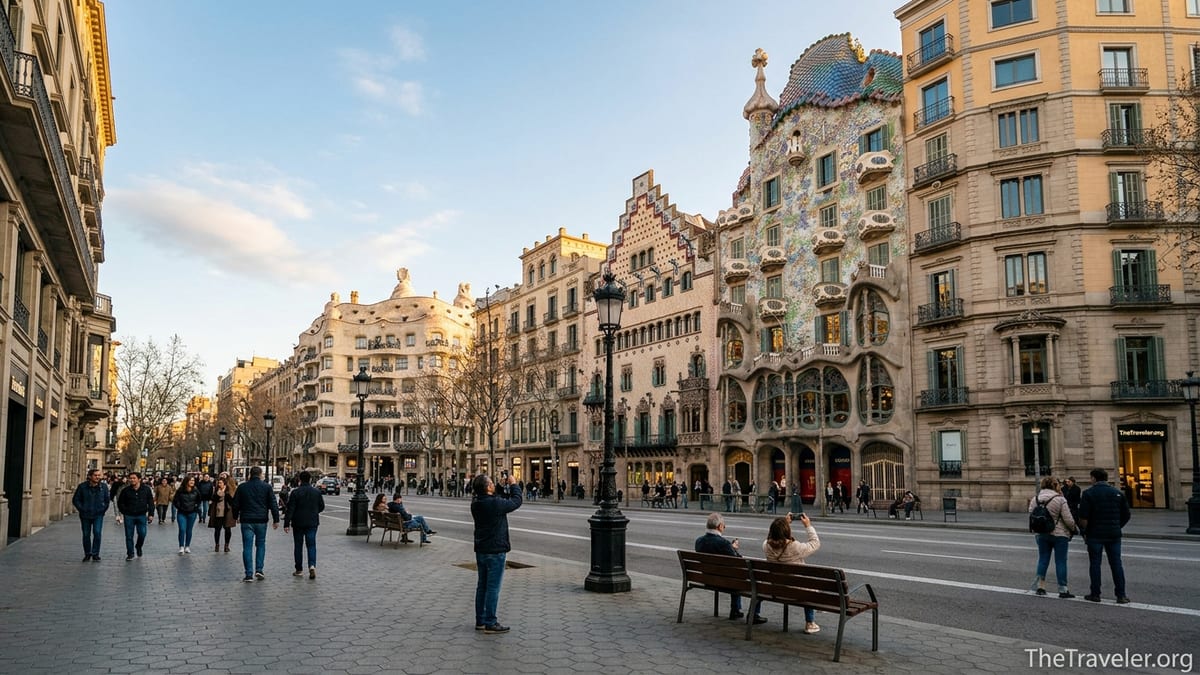
A Boulevard That Rewards Slowness
Passeig de Gràcia runs through the heart of Barcelona’s Eixample district, a broad avenue where the city’s most prestigious architecture mingles with some of its most expensive retail space. Locals will tell you that it is as much an open-air museum as a shopping street. Walking it from Plaça de Catalunya toward Avinguda Diagonal, you can feel the city’s history unfolding in the facades: from 19th-century mansions and Modernisme masterpieces to sleek glass-fronted flagships for international brands.
I started my walk near the Apple store at the lower end of the boulevard, where commuters emerged from the metro and tourists clustered around digital maps. Around me, people hurried with purpose, eyes down on their phones. I was doing the same, scanning for the nearest cafe and checking the time. It was only when I reached a break in the crowd and paused at a pedestrian crossing that I finally looked up and saw, in one glance, the stone waves of Casa Milà at one end and the shimmering roof tiles of Casa Batlló nearer by. The sense of discovery was instant and almost disorienting. I had been walking inside a postcard without noticing.
Later that day, a local guide explained that Passeig de Gràcia was deliberately designed as a grand promenade, wide enough for carriages and, later, cars, but also generous to pedestrians with its tiled sidewalks and ornate lamp posts. It was never meant to be rushed. That original intent still reveals itself if you slow down, step away from the curb and give your eyes permission to wander upward. What looks like another luxury address at ground level often hides an extraordinary story in the floors above.
Discovering Gaudí by Tilting My Head
The clearest proof of this came when I reached Casa Batlló, at number 43. At street level it is a ticket office, souvenir shop and entrance queue. People took selfies against the lower windows, focusing on the sinuous shapes just above the doorway. But when I stepped back, tilted my head and really looked, the building came alive as a complete organism: the bone-like balconies stacked like vertebrae, the pillars that resemble femurs, and the roof that curves like the spine of a dragon asleep on the skyline.
From the sidewalk, you do not need a ticket to appreciate why Casa Batlló is considered one of Antoni Gaudí’s defining works. High up near the roof, ceramic tiles shift from deep blue to green to gold in the sunlight, forming scales that glitter differently from morning to late afternoon. The cross-topped turret, easily missed if you stay focused on the entrance, suddenly dominates the view when you look up from the opposite side of the street. Even the chimneys at the back, invisible from the front, are hinted at in the way the roofline ripples and then drops.
Standing there, I watched first-time visitors repeat the same gesture: they would arrive chatting, glance at the queue, and only then raise their eyes. Within seconds they would fall silent, faces tilted skyward, phones lifted to capture the full facade. It is a physical, almost choreographed moment of perspective change. Looking up is not just about noticing pretty details. It changes how you feel in the space. Casa Batlló stops being a tourist attraction and becomes an encounter with a wild, imaginative mind that decided urban housing could look like a living creature.
Inside, the lesson continues. In the central light well, Gaudí graded the blue tiles from dark at the top to pale near the bottom so light is distributed evenly over all floors. If you walk the staircase focusing only at eye level, you see a narrow shaft. If you pause on a landing and look straight up, the well turns into an underwater tunnel of graduating blues. That single act of looking upward transforms what could be a simple circulation space into a quiet, contemplative experience.
The “Block of Discord” and a Lesson in Contrast
Just next door to Casa Batlló sits another of Passeig de Gràcia’s treasures: Casa Amatller. Together with nearby Casa Lleó Morera and a handful of other buildings, they form the so-called “Block of Discord,” where some of the most famous Catalan Modernisme architects tried to outdo one another on the same stretch of pavement. At street level you see chocolate on display in Casa Amatller’s ground-floor shop and souvenir trinkets in neighboring windows. Above, though, there is a different story of ambition and rivalry carved into stone.
I remember standing in the middle of the crosswalk, waiting for the light to turn green, and tracing the stepped gable of Casa Amatller as it cuts into the sky. Its Neo-Gothic flourishes and ceramic tiles create a jagged profile that clashes delightfully with the sinuous lines of Gaudí’s work next door. On the upper floors, small sculpted figures, window surrounds and floral motifs appear that are invisible from the sidewalk if you only glance straight ahead. Looking up, you see the conversation between buildings: one playful and organic, another historically romantic, each staking its claim in the skyline.
A few minutes farther along, Casa Lleó Morera stands with a more delicate elegance. What caught my eye first was not the entrance but the crown: a sculpted tower and ornate balconies surrounded by carved stone garlands. The building’s most intricate details are several floors above the luxury boutiques beneath, where shoppers inspect watches and jewelry. I watched one couple compare two watches through a glass case without ever seeing the floral capitals directly above their heads, each one unique. It felt like a quiet metaphor for how often we miss beauty while absorbed in consumption.
From then on, whenever I approached a new facade on Passeig de Gràcia, I made it a habit to pause and scan from bottom to top. Rusticated stone at the base often gave way to lighter materials and richer ornament as my gaze climbed. Balconies that seemed standard at first glance revealed curved iron railings, mosaics or tiny heraldic shields. By the time I reached La Pedrera at number 92, with its undulating stone facade and wrought-iron balconies that twist like seaweed, I had trained my eyes to search the upper floors first, letting the shops come second.
Shops, Flagships and the Hidden Life Above
Passeig de Gràcia is widely recognized as Barcelona’s luxury showcase, with occupancy rates reported around 98 percent and a roster of international names that would not look out of place on Fifth Avenue or the Champs-Élysées. Walking past the Louis Vuitton flagship, the sleek Cartier boutique and the grand windows of Santa Eulalia, the century-old Barcelona fashion institution, you enter a world of marble floors, soft lighting and meticulous window displays. Prices are rarely on show, and when they are, they can feel like museum labels more than shopping tags.
Inside one boutique, I watched a sales assistant present a small leather wallet to a visitor who had been eyeing the display for several minutes. The price, mentioned quietly, was more than many travelers’ weekly accommodation budget. Yet outside, on the upper floors that same visitor never noticed, laundry hung from a balcony and plants spilled over wrought-iron railings. Street-level luxury coexisted with ordinary domestic life only a few meters above, divided by a line of stone.
Along the avenue, new flagship openings are regular news. When a heritage jewelry brand unveils a redesigned store or an international fashion house launches a multi-story flagship, the transformation is most visible at ground and first-floor levels. Glass fronts are replaced, signage updated and interiors completely overhauled. Yet often the upper floors remain almost untouched. Original shutters, carved reliefs and even faded painted friezes survive above the polished storefront. If you only look into the windows, you see global brand uniformity. If you look up, you see Barcelona.
One afternoon I sat at a streetside cafe near the intersection with Carrer de Mallorca, nursing a cortado that cost only a few euros compared to the prices displayed in the designer windows nearby. From that low metal chair I had a perfect angle to observe how the architectural and commercial lives of the street intertwine. Delivery vans double-parked, tourists queued for Casa Batlló, and residents walked small dogs under balconies once built for aristocratic families. Above a cosmetics store, a pair of teenagers had turned their narrow balcony into a miniature garden of succulents and mismatched chairs. Watching them, it was impossible not to feel that the true stories of Passeig de Gràcia unfold vertically, not just along the sidewalk.
Practical Ways to Train Yourself to Look Up
My realization on Passeig de Gràcia was emotional, but it also became practical. By the time I left Barcelona, I had developed a small set of habits that any traveler can use to see more on this boulevard. The first is simply to stop walking every few blocks, step closer to the curb or even to the center of a pedestrian crossing when the light is red, and give yourself ten seconds to scan the buildings from bottom to top. On Passeig de Gràcia, those ten seconds can reveal sculpted faces, tiled panels or ironwork you would never see while in motion.
A second habit is to compare corners. At intersections like Passeig de Gràcia with Consell de Cent or Aragó, stand on one corner and look diagonally across at the opposite building’s upper floors. From that angle, bay windows and rooftop terraces appear in profile, showing depth and layering that vanish when you stand directly in front. I used this at the junction near La Pedrera and noticed a roof terrace with potted olive trees and a shaded pergola that were completely invisible from the main entrance side.
Time of day also matters. Early morning, when the light is lower and traffic lighter, is ideal for spotting texture: the chisel marks on stone blocks, the shadows cast by relief sculptures, the lines of wrought iron. Late afternoon, especially in winter, throws many facades into warm side light that emphasizes balconies and cornices. I once passed Casa Batlló at around 5 pm and saw the dragon-back roof lit from the side, each tile catching a slightly different shade, turning the building into a giant, iridescent mosaic that looked entirely different from its midday version.
Finally, it helps to consciously separate shopping from sightseeing, even if you plan to do both. One morning I walked the length of Passeig de Gràcia focusing only on architecture, ignoring every display window. In the afternoon, I returned to browse a few shops. The experiences felt less rushed and more intentional. Looking up became my way of honoring a place before deciding whether to buy anything from it.
Balconies, Benches and the Human Scale of a Grand Avenue
It is easy to think of Passeig de Gràcia in terms of monuments and brands, but looking up also reveals something more intimate: how people actually inhabit the avenue. The balconies that stack over the street tell small stories if you give them time. Some are strictly decorative, with ornate railings and careful flower boxes. Others are improvisations, cluttered with bicycles, drying towels and improvised shade cloths. In the evening, you might see someone watering plants high above a jewelry store or leaning on the railing to talk on the phone, the glow of their screen briefly illuminating their face.
I became particularly fond of spotting small details that hinted at daily life in these grand buildings: a football scarf draped over a chair, a child’s drawing taped to the inside of a window, a pair of shoes left to dry in the sun. They did not match the polished aesthetic of the luxury storefronts below, but they grounded the street in reality. Passeig de Gràcia is not an open-air shopping mall built from scratch. It is a lived-in avenue where families, students and retirees share walls with fashion houses and five-star hotels.
At ground level, even the benches and pavements reward attention. The famous hexagonal sidewalk tiles, with their marine-inspired patterns of shells and tentacles, are often photographed from above. Yet I found that by sitting on one of the wrought-iron and stone benches and slightly tilting my gaze, I could see how those patterns subtly catch the light, echoing the organic motifs on nearby facades. Looking up does not only mean craning your neck. It means shifting your usual angle of attention, whether that is a few degrees or ninety.
On one late evening, the avenue transformed again. Streetlamps flickered on, car headlights drew soft streaks along the asphalt and the crowns of the buildings glowed against a deepening sky. Hotel rooftops and private terraces lit up as people gathered for drinks above the noise. From the sidewalk, by simply directing my gaze upward, I could see silhouettes moving behind rooftop balustrades and hear snippets of laughter carried by the breeze. The city revealed a second layer of life that would have been invisible if I had kept my focus strictly at eye level.
The Takeaway
My time on Passeig de Gràcia changed not just how I experienced Barcelona but how I move through cities in general. This single boulevard, lined with architectural icons like Casa Batlló and La Pedrera and flanked by some of Europe’s most coveted storefronts, functions as an ongoing invitation to look up and look deeper. The most memorable moments were not tied to any purchase or ticket, but to small acts of attention: noticing a tiled roof catch the late sun, spotting a hidden balcony garden, or realizing that the facades above the flagship stores still carry the fingerprints of another century.
In an age where our gaze is constantly pulled toward screens and shopfronts, Passeig de Gràcia quietly suggests another way to travel. Walk a little slower. Pause at the crossings. Let your eyes climb the buildings before you step inside them. Whether you are planning a dedicated Gaudí pilgrimage, a day of shopping, or simply a stroll between meetings, this avenue will reward any effort to look beyond the obvious. Learning to look up here is not just a travel tip. It is a modest but powerful recalibration of how to pay attention, one that you can carry with you long after you leave Barcelona’s grandest street.
FAQ
Q1. Where exactly is Passeig de Gràcia and how long does it take to walk? Passeig de Gràcia runs through Barcelona’s central Eixample district between Plaça de Catalunya and Avinguda Diagonal. Walking the full length at a relaxed pace, with time to stop and look up at buildings, typically takes around 30 to 45 minutes one way.
Q2. What are the must-see buildings on Passeig de Gràcia if I am short on time? If you have only an hour, focus on Casa Batlló, La Pedrera (Casa Milà) and the so-called Block of Discord where Casa Amatller and Casa Lleó Morera stand. Even from the street, their upper facades and rooftops offer plenty to admire without going inside.
Q3. Do I need to pay to enjoy the architecture on Passeig de Gràcia? No. The most transformative part of the experience, especially learning to look up, is completely free. You can appreciate the facades and rooftops of iconic buildings like Casa Batlló and La Pedrera from the sidewalk. Paid tickets are only necessary if you want to visit interior spaces and rooftops.
Q4. What time of day is best for photographing the buildings when looking up? Early morning and late afternoon tend to be best. At these times, the lower sun casts softer, angled light that brings out textures in stone and tile. Midday light can be harsher, but it can also make colorful ceramic facades like Casa Batlló’s appear very bright and vivid in photos.
Q5. Is Passeig de Gràcia a good place to stay while visiting Barcelona? Yes, if your budget allows. The avenue and nearby streets host several upscale and boutique hotels, and staying here puts you within walking distance of major Modernisme landmarks, shopping and public transport connections. Budget-conscious travelers might prefer nearby neighborhoods and visit Passeig de Gràcia on day trips.
Q6. Are there affordable places to eat and drink on or near Passeig de Gràcia? Despite its luxury reputation, you can still find relatively affordable cafes, bakeries and tapas bars on side streets just off the main avenue. Prices directly on Passeig de Gràcia are generally higher, but stepping one or two blocks into the grid of Eixample often reveals more local spots with moderate menus.
Q7. How can I avoid getting overwhelmed by the crowds and shops? Try visiting early in the morning on weekdays, when commuter traffic has eased but tour groups have not yet fully arrived. Decide in advance which buildings you most want to see, and plan a short architectural walk where you intentionally ignore shop windows for a while and focus on facades and rooftops instead.
Q8. Is it safe to walk around looking up and taking photos? Passeig de Gràcia is generally considered one of Barcelona’s safer central streets, with plenty of people around throughout the day. As in any busy city, keep an eye on your belongings, especially if you stop to take photos, and be mindful of traffic when stepping closer to the curb or into crosswalks to look up.
Q9. Can I combine a visit to Passeig de Gràcia with other nearby sights? Absolutely. From the lower end of Passeig de Gràcia you are a short walk from La Rambla and the Gothic Quarter, while the upper end connects toward Avinguda Diagonal and other Eixample attractions. Many travelers pair a walk here with visits to Sagrada Família, which is a few metro stops away.
Q10. What is one simple habit I can adopt to “look up more often” while traveling? A useful habit is to stop at every major intersection, turn in a slow circle and deliberately look at the upper three or four floors of the surrounding buildings before moving on. On Passeig de Gràcia and in many other cities, that ten-second pause often reveals details and stories you would otherwise miss.