


More news on this day
An early investigation into the fatal Midland Main Line collision near Bedford indicates that a London-bound commuter train passed a red signal moments before striking a stationary intercity service, raising urgent questions about signalling protections and train safety systems on one of Britain’s busiest rail corridors.
Get the latest news straight to your inbox!
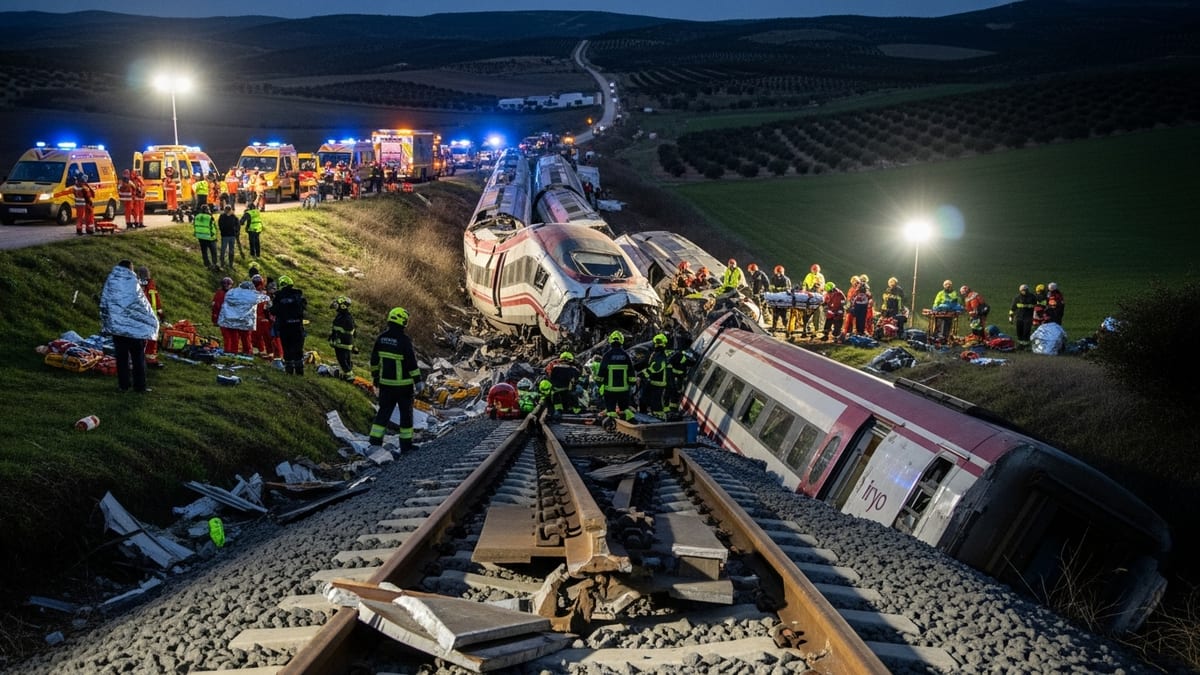
Early RAIB findings shed light on Bedford collision
According to initial information released by the Rail Accident Investigation Branch (RAIB), the Corby to London St Pancras service was travelling south on the Midland Main Line on Friday when it ran into the rear of a halted Nottingham to London train near Bedford. The impact killed the driver of the rear train, 60-year-old Shaun Burton, and injured more than 100 passengers on board the two services.
Publicly available summaries of the RAIB’s early work state that forward-facing CCTV from the commuter train shows a key signal near the collision site displaying a red aspect as the train approached and then passed it. Data indicates that the brakes were applied only seconds before impact, suggesting the red aspect was not acted upon in sufficient time to prevent the crash.
The stationary Nottingham service had reportedly stopped after its onboard Automatic Warning System experienced a fault, leaving it at a standstill on the fast line south of Bedford. The following train should have been held at a protecting signal set at danger. Instead, early technical analysis points to a signal passed at red, a type of incident known in UK rail terminology as a “signal passed at danger.”
RAIB has emphasised that the findings are preliminary and that many factors, including signalling equipment, train data recorders and operational procedures, are still under detailed examination. A full report is expected to follow once investigators have reconstructed the sequence of events in greater depth.
What the initial evidence reveals about the sequence of events
Information compiled from RAIB releases and industry coverage indicates that the crash occurred around the evening peak on a busy stretch of the Midland Main Line just south of Bedford. The Nottingham service, formed of a new intercity train operating for East Midlands Railway, had been brought to a stop after an Automatic Warning System fault required the driver to halt and follow safety procedures before proceeding.
Behind it, a four-car electric unit working a Corby to London commuter run was routed onto the same line. The line-side signal protecting the stationary intercity was reportedly set to red, instructing the following train to stop. Forward-facing camera footage examined by investigators shows the red aspect clearly displayed as the commuter train approached the signal, yet the train continued past it and into the occupied block ahead.
Data released so far indicates that brakes on the rear train were applied only a few seconds before the collision, limiting the reduction in speed before impact. The rear train then struck the intercity service from behind, causing significant damage to both trains and leading to the derailment of at least one vehicle, according to multiple media reports summarising the RAIB’s early assessment.
Emergency responders transported dozens of injured passengers to local hospitals, with published figures indicating that more than 100 people required medical assessment and that several remained in serious condition in the days after the collision. The driver of the following train died at the scene, while staff and passengers from both services were evacuated from damaged carriages.
Signals, safety systems and the question of protection
The focus on a signal passed at red immediately places attention on the layers of protection designed to prevent such incidents on Britain’s main lines. On the Midland Main Line, a combination of lineside colour-light signals, the Automatic Warning System and the Train Protection and Warning System is intended to alert drivers to restrictive aspects and apply brakes automatically if certain conditions are met.
Published coverage of the early RAIB findings notes that the commuter train passed a yellow aspect signal leaving Bedford, which should have indicated to the driver that a red signal was ahead and that the train needed to be driven in a way that allowed it to stop safely. As the train approached the subsequent signal, the aspect shown was red, yet the train continued into the section where the Nottingham service was stopped.
The investigation is expected to analyse whether the Automatic Warning System and Train Protection and Warning System operated as intended, and whether there were any technical anomalies affecting the onboard equipment or the trackside infrastructure. RAIB will also review driver training, workload, visibility of signals and any potential distraction or fatigue factors that could have influenced the response to the caution and stop signals.
Observers point out that while the United Kingdom’s rail network has a strong overall safety record, previous RAIB reports into collisions following signals passed at danger have often highlighted a combination of human, technical and systemic contributors. The Bedford collision is likely to be examined within that broader safety context, including ongoing plans to introduce more advanced in-cab signalling and continuous speed supervision on key main lines.
Impact on services and scrutiny of Midland Main Line operations
The crash has had a substantial operational impact on the Midland Main Line, a crucial route linking London St Pancras with major cities including Leicester, Nottingham, Derby and Sheffield. Services through the Bedford area experienced days of disruption as damaged rolling stock was removed, track and signalling equipment were inspected, and temporary speed and routing restrictions were introduced.
East Midlands Railway and other operators on the corridor have been running reduced and amended timetables around Bedford, with some services diverted or terminated short of their planned destinations. Independent coverage of the disruption reports crowding, extended journey times and ongoing advice for passengers to check schedules before travelling while infrastructure repairs and inspections continue.
Publicly available statements from the operator and infrastructure manager have expressed sympathy to those affected and highlighted cooperation with investigators. At the same time, transport commentators note that the collision has intensified scrutiny of the pace of safety upgrades on the Midland Main Line, including the long-term transition to digital signalling and enhanced automatic train protection.
For regular users of the line, the incident has prompted renewed discussion of service reliability, the integration of new rolling stock such as the intercity trains involved, and how infrastructure constraints interact with efforts to increase capacity and speed on the busy north–south route.
What happens next in the RAIB investigation
The RAIB’s next steps will involve a systematic review of technical, operational and human factors. Investigators will download and analyse data from onboard event recorders, signalling logs and control centre records to build a detailed timeline of the minutes leading up to the collision. They will also examine the condition of braking systems, wheel-rail adhesion and the physical evidence at the crash site.
As with previous major rail accidents, RAIB is expected to publish an interim update if significant safety issues are identified that require rapid action. The final report will contain formal safety recommendations aimed at rail operators, infrastructure managers and regulators, potentially covering signalling design, protection systems, training, rules and risk management.
Until that report is released, analysts caution against drawing firm conclusions about underlying causes. The early indication that a train passed a red signal provides an important starting point, but the eventual findings are likely to cover a complex interaction of systems and decisions. For passengers and communities along the Midland Main Line, the central questions will be how the lessons from Bedford are translated into concrete measures to reduce the risk of a similar collision in future.