


More news on this day
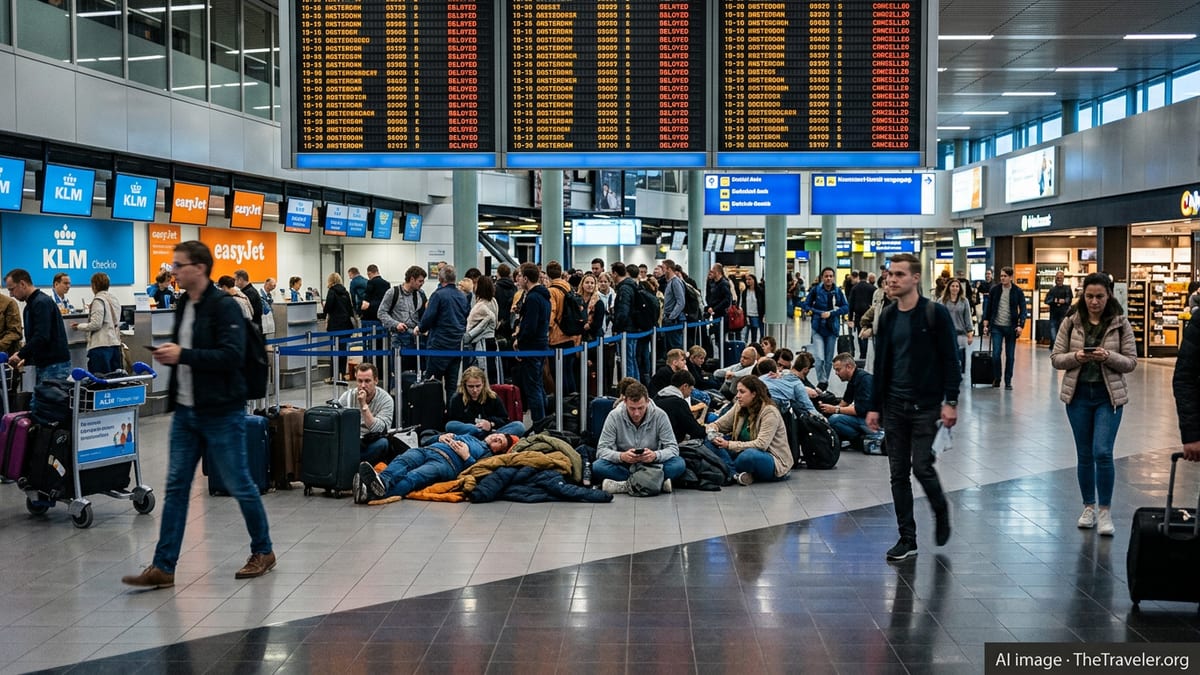
Travel across central Europe faced severe disruption after more than 70 flights at Basel–Mulhouse EuroAirport were delayed or cancelled in rapid succession, triggering rolling cancellations on major routes that link France, Germany and Switzerland with the wider continent.
Get the latest news straight to your inbox!
Tri-border hub under pressure
Basel–Mulhouse EuroAirport, a joint French–Swiss facility located just west of the tripoint where France, Germany and Switzerland meet, functions as a compact but strategically important gateway for short-haul European traffic. The airport serves around 100 direct destinations in peak season, with a route network that fans out to major hubs in France, Germany, the United Kingdom, Italy and beyond. Its location next to the Rhine and integrated access to three national transport systems mean that disturbances at the airport can quickly spread across borders.
According to publicly available flight-tracking and passenger-compensation data, a sharp spike in cancellations and long delays has developed around the airport’s early summer schedule. Services operated by low-cost carriers and network airlines alike have been affected, including departures to Berlin, Mediterranean leisure destinations and key German and French hubs. On some mornings, multiple early-wave departures were listed as cancelled within hours of each other, putting pressure on later rotations.
The airport entered the 2026 summer season already in a sensitive position after months of runway refurbishment and airside works. While the main runway was reopened earlier than initially forecast, the compressed construction calendar and the shift between primary and secondary runways have reduced operational flexibility. Any subsequent strain from weather, air-traffic flow restrictions or airline crewing issues has therefore had a magnified impact on the small tri-border hub.
Local aviation observers note that EuroAirport has historically marketed itself as an efficient alternative to larger hubs, with short walking distances and relatively quick security processing. Recent social media posts from travelers, however, describe longer queues at peak times and confusion around rapidly changing departure boards, as rolling cancellations force passengers to rebook or reroute through airports such as Zurich, Frankfurt and Paris.
Rolling cancellations ripple across European routes
Information compiled from airline schedules and real-time tracking platforms shows that more than 70 flights linked to EuroAirport’s operations were either significantly delayed or cancelled within a short period, disrupting rotations across Europe. In several cases, early morning cancellations on routes such as Basel–Berlin removed aircraft and crews that were due to operate onward flights later in the day. This created a knock-on effect that spread to other airports, including secondary cities in Germany, France and the United Kingdom.
Network planners point out that Basel–Mulhouse is heavily used for so-called out-and-back rotations, where an aircraft flies from a base to a destination and returns the same day. When disruptions occur at the tri-border airport, the returning sector may be cancelled or heavily delayed, reducing aircraft availability at the larger base. As airlines attempt to consolidate passengers on the few remaining services, airports as far away as Amsterdam, Barcelona and London can experience additional load and minor schedule shifts.
The timing of the disruption is particularly sensitive. Airlines have been ramping up frequencies for the peak summer period, with published schedules indicating dense patterns to holiday destinations in southern Europe as well as business routes to major financial centers. Even a short-lived spike in cancellations at a secondary hub can therefore collide with high demand, leaving fewer options for same-day rebooking and driving up load factors on unaffected flights.
Available coverage on European aviation performance also highlights a broader backdrop of persistent congestion, staffing shortages and airspace constraints, especially in core air-traffic control sectors. Against this environment, the tri-border disruptions at EuroAirport act as another point of stress in a system that has limited spare capacity to absorb unexpected shocks.
Structural constraints at a complex border crossing
EuroAirport’s governance and physical layout add further layers of complexity when disruptions hit. Although the airport lies entirely on French territory, it is jointly operated under a post-war state treaty that grants Switzerland extensive rights and its own customs sector. The terminal is effectively divided into French and Swiss sides, with separate road access, customs corridors and onward ground transport links to each country.
In normal conditions, this arrangement allows travelers to exit directly into France or Switzerland and connect onwards to Germany, taking advantage of cross-border tram, bus and rail services. During heavy disruption, however, the split terminal structure can slow down passenger handling. Travelers rebooked onto flights from the opposite sector may need to navigate additional security and border formalities, while ground handling teams coordinate with both French and Swiss authorities on aircraft stands, passenger flows and overnight accommodation.
Local resident groups have also drawn attention in recent years to environmental and noise constraints around the airport, leading to calls for stricter limits on late-night and early-morning movements. Although the recent wave of cancellations is primarily linked to operational and network factors, tighter rules on night operations restrict the ability to run late recovery flights that might otherwise help clear backlogs. Once evening curfews approach, airlines have fewer options to reposition aircraft or operate extra sections from the tri-border field.
Industry analyses of European disruption patterns point to an emerging debate over shared accountability between airlines, airports and air-navigation providers. Basel–Mulhouse, with its cross-border governance structure and small physical footprint, illustrates how infrastructure limitations, regulatory constraints and airline scheduling decisions can interact to amplify the impact of even a relatively small number of operational failures.
Passenger impact and rights under EU261
For passengers caught in the tri-border travel chaos, the immediate consequences have been missed connections, extended layovers and, in some cases, forced overnight stays far from the original destination. Travelers heading to or from neighboring cities such as Freiburg, Mulhouse and Basel itself often rely on tight connections to make same-day business or holiday plans. When early flights are cancelled without viable alternatives, they may be left to replan journeys via Zurich, Geneva, Frankfurt or Paris, combining rail and air at short notice.
Under the European Union’s air passenger rights regulation, commonly referred to as EU261, many travelers affected by cancellations and long delays departing from Basel–Mulhouse are potentially eligible for assistance and compensation. Publicly available guidance explains that, depending on flight distance and delay length, passengers may be entitled to meals, hotel accommodation, rerouting or refunds and, in some cases, cash compensation when disruptions are not caused by extraordinary circumstances such as severe weather or airspace closures.
Consumer-rights organizations and compensation platforms have reported sustained demand from travelers seeking to understand their entitlements after the recent wave of disruptions. Tools that allow passengers to check previous flight records against legal thresholds for compensation have become increasingly visible in search results and social media discussions linked to the airport. While each case is assessed individually, the concentration of cancellations around certain days and time slots suggests that many claims will center on operational and scheduling decisions rather than external shocks.
Travel advisers are encouraging passengers using Basel–Mulhouse over the coming weeks to monitor their bookings closely, allow extra time at the airport and consider flexible tickets where possible. With European airspace already under tension from geopolitical reroutings and capacity constraints, even relatively small secondary hubs like the tri-border EuroAirport can become focal points for wider disruption when schedules are finely balanced.
Outlook for the summer travel season
Looking ahead to the core summer months, published schedules from airlines and the airport indicate an ambitious program of services from Basel–Mulhouse, comparable to or exceeding pre-pandemic levels in several leisure markets. Carriers are targeting strong demand from both French and Swiss catchment areas, particularly for Mediterranean beach destinations and city-break routes. The successful completion of runway works is intended to support this growth, but the recent spike in disruptions raises questions about how resilient the operation will be under peak loads.
Aviation analysts note that many European carriers are already operating with tight margins on fleet, crew and maintenance capacity after several years of restructuring. Planned summer timetables often leave little slack to recover from episodes of bad weather or air-traffic restrictions. At a compact facility like EuroAirport, turnaround delays on a single aircraft can cascade quickly through a day’s program, especially when a high proportion of flights are operated by the same handful of airlines.
Regional stakeholders monitoring the situation around the France–Germany–Switzerland border area will be watching closely to see whether the recent wave of disruptions proves to be a short-lived spike or an early warning of a more fragile summer season. Any sustained pattern of cancellations could encourage travelers to shift bookings towards larger hubs, while also reinforcing scrutiny of how airlines communicate schedule changes and manage passenger care obligations at the tri-border airport.
For now, passengers planning to use Basel–Mulhouse are being advised by travel intermediaries and consumer groups to build contingency time into itineraries and to familiarize themselves with their rights in the event of disruption. With European aviation systems still adjusting to shifting demand and evolving airspace constraints, the experience at this small but strategically situated airport underlines how quickly pressure can build at key nodes in the network.