


Tivoli, a hill town just east of Rome, is home to two of Italy’s most celebrated UNESCO World Heritage Sites: Hadrian’s Villa (Villa Adriana), the vast country retreat of a Roman emperor, and Villa d’Este, a 16th century cardinal’s palace wrapped in cascades and fountains. Both are extraordinary. Yet most travelers with limited time ask the same question: which Tivoli landmark offers the better experience? The answer depends less on prestige and more on your travel style, interests, and how you plan your day.
Get the latest updates straight to your inbox!
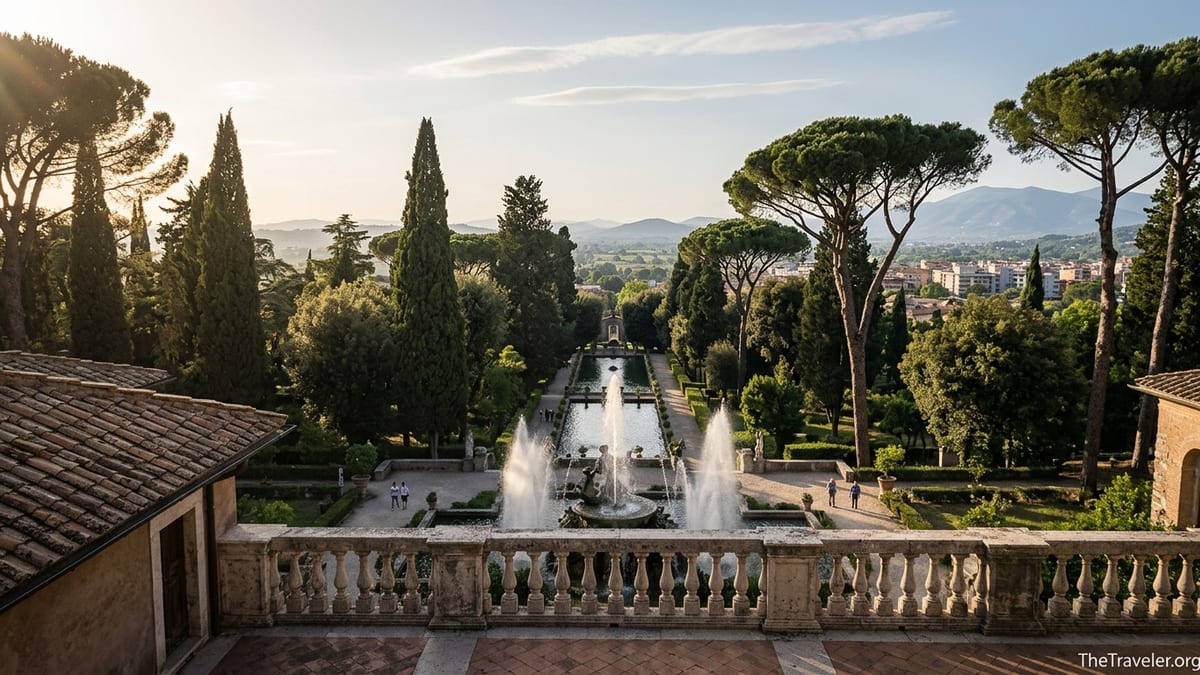
Two UNESCO Giants With Very Different Personalities
Hadrian’s Villa and Villa d’Este sit only a few kilometers apart on the edge of modern Tivoli, but they deliver very different experiences. Hadrian’s Villa, inscribed as a UNESCO World Heritage Site in 1999, sprawls over roughly 80 hectares of countryside. It is the ruined but still imposing residential complex of Emperor Hadrian, begun around 120 AD, a place where he tried to recreate his favorite corners of the empire in one retreat. Walking here feels like stepping into an open air history book: hypocaust heating systems, baths, libraries and artificial lakes reveal how an emperor lived outside Rome.
Villa d’Este, added to the UNESCO list in 2001, is compact by comparison but far more theatrical. Commissioned by Cardinal Ippolito II d’Este in the mid 1500s, it pairs a frescoed Renaissance palace with one of Europe’s most influential gardens. Terraces plunge down the hillside in a sequence of basins, cascades and jetting fountains, all powered by gravity and meticulously engineered water channels. It is less about ruins and more about spectacle and atmosphere, especially in the late afternoon or during seasonal evening openings when the gardens are lit and the fountains are at full force.
For the average visitor coming from Rome for a day, that difference in personality is key. Hadrian’s Villa rewards patience, comfort with ruins and some imagination. Villa d’Este is immediately photogenic and emotionally engaging, even if you know little about the Renaissance. Deciding which is “better” is really about which kind of experience you want your Tivoli excursion to deliver.
Most organized day tours from Rome now offer combined visits, often with about two hours at each site and an included lunch stop in Tivoli’s historic center. That can be a good compromise if you have only one day, but it also means you will see both places at more of a highlights pace rather than having time to linger in either.
Visitor Experience: Layout, Atmosphere and Walking Effort
Hadrian’s Villa is, by almost any measure, enormous. Local tourism authorities warn that a thorough visit can easily take the better part of a day, even at a brisk walking pace. The site is spread across artificial terraces connected by broad paths and stairways. From the modern entrance you typically follow a loop that passes the so called Canopus canal, the Maritime Theater, grand baths and various residential and service complexes. It feels more like exploring a small archaeological park than visiting a single “villa.”
The atmosphere at Hadrian’s Villa tends to be quiet, sometimes almost meditative, particularly outside peak summer weekends. You may find yourself standing alone under umbrella pines with only the sound of cicadas and distant traffic from the Tiburtina road. That space and relative solitude appeal strongly to travelers who dislike crowds at sites like the Colosseum and the Roman Forum. The tradeoff is that signage can be patchy in places and distances between key structures are substantial, so the experience is more physical and less “curated” than at Villa d’Este.
By contrast, Villa d’Este’s palace and gardens are intensely choreographed. You usually start inside the 16th century residence, passing through salons decorated with lively frescoes of classical myths and landscapes, before stepping out to a loggia that frames the garden like a theater set. From there, all paths lead down: steep stone stairways and gravel ramps zigzag past the Hundred Fountains, the grand Fountain of Neptune and smaller grottoes. Every corner seems designed for a view, whether back toward the palace or over the Roman Campagna toward the outskirts of Rome.
The walking experience at Villa d’Este is shorter in distance but steeper. The vertical drop from palace to lowest terrace is significant, and visitors with knee problems may find the return climb challenging. Benches are placed at some strategic points, and many travelers choose to descend all the way to the bottom, linger by the fish ponds, then ascend slowly, stopping at intermediate terraces and fountains. For someone with limited mobility, Villa d’Este’s concentrated slopes can feel harder than the long but more gently graded paths at Hadrian’s Villa.
Tickets, Practicalities and Crowd Levels
Both sites are managed by the Italian Ministry of Culture and use similar ticketing systems. As of mid 2026, a standard adult ticket for either Hadrian’s Villa or Villa d’Este typically falls in the low to mid teens in euros, with reduced prices for EU youths and occasionally free or discounted entry on certain national culture days. There is also a combined ticket that includes both villas at a modest saving compared with buying each separately, a sensible choice for independent travelers planning to see both in the same 24 hour period.
Opening hours vary by season. In broad terms, both sites open in the morning and close before or slightly after sunset, with last admission usually around an hour before closing. From late spring through early autumn, Villa d’Este sometimes offers special evening openings on selected days, with an extra fee and slightly different ticket structure. These nights can be magical, with the main cascades illuminated and cooler air making the steep garden paths more pleasant, but they also attract more visitors than an ordinary weekday morning.
Crowd patterns are markedly different. Villa d’Este, thanks to its compact layout and strong social media presence, often feels busier, especially between late morning and mid afternoon when coaches from Rome arrive. The narrow garden paths can bottleneck around the most famous fountains when large tour groups cluster for photos. Hadrian’s Villa does see group visits and combined tours, but its scale means people disperse quickly. Even on a busy Sunday in May or June, you can usually find quiet corners among the baths and porticoes.
In terms of advance planning, online booking for Villa d’Este is increasingly recommended in high season, partly because some travelers report occasional issues with the official site loading from outside Italy and prefer to use aggregator platforms or buy a combined day tour from Rome. For February or other low season months, tickets are generally available on the day, but there is a catch: the most dramatic fountains at Villa d’Este may be switched off for winter maintenance or because of regional water restrictions, so expectations need to be adjusted if you visit in the depths of winter. Hadrian’s Villa, by contrast, is less dependent on seasonal water features, although shorter daylight hours limit how much of the immense site you can reasonably cover.
History and Interpretation: Which Site Tells Its Story Better?
Hadrian’s Villa has the deeper antiquity. This was the country seat of one of Rome’s most cosmopolitan emperors, a ruler who traveled widely and left his mark from Britain’s Hadrian’s Wall to temples in Athens and beyond. In Tivoli he built a residence that folded his favorite landscapes and monuments into a single complex: the long colonnaded pool known as the Canopus echoes an Egyptian canal, while the Maritime Theater’s circular island residence hints at private retreat and experimentation with curved architecture. For Roman history enthusiasts, urban planners and architecture students, these remains are endlessly rewarding, even if much of the original decoration has long been removed to museums.
Yet in terms of clear storytelling for a general audience, Hadrian’s Villa can feel demanding. Many walls stand only to a few meters, mosaics are fragmentary, and you often need a good guide, audio tour or background reading to turn the foundations and brickwork into a coherent narrative. On site information boards exist but are unevenly distributed, and the site’s vastness dilutes interpretive focus. Travelers who describe themselves as “not really into ruins” sometimes report feeling overwhelmed here after an hour or two, particularly in summer heat.
Villa d’Este, by contrast, wears its narrative on its sleeve. From the moment you enter the palace, you are surrounded by Renaissance fresco cycles that celebrate the power and taste of the d’Este family and weave in classical mythology. When you step into the gardens, the story shifts to water technology, symbolism and theatrical display. Even without reading a single panel, you can intuit that this was a place designed to impress visiting princes and ambassadors, a showpiece of culture and engineering. Guided tours and audio guides tend to do a good job explaining how gravity fed channels from the Aniene River power every cascade, and how different terraces correspond to allegories of virtues and planets.
In practice, that means Villa d’Este is better suited to travelers who want immediate impact and a relatively clear sense of “what I am looking at” without extensive preparation. Hadrian’s Villa is more like an open invitation to dig deeper into imperial history. Many repeat visitors to Rome say they only truly appreciated Hadrian’s Villa on a second or third trip, when they had more context and were eager to spend several hours wandering in detail.
Photography, Scenery and Seasonal Considerations
For photography, Villa d’Este almost always wins for instant drama. The view from the main loggia, where the palace opens onto the garden and the Roman countryside beyond, is a classic postcard shot: plane trees framing marble balustrades, water jets catching the light and the soft haze of the Campagna in the distance. The long Hundred Fountains alley, with masks dribbling water into a narrow channel, is another favorite, as are the grand cascades of the Fountain of Neptune. In late afternoon, when side light creates contrast on the stonework and soft shadows in the cypresses, even phone cameras capture striking images.
Hadrian’s Villa rewards a different eye. Here the drama lies less in individual features and more in vast perspectives: a colonnade reflected in still water at the Canopus, the curve of the Maritime Theater’s moat, the way ruined brick arches frame distant hills. On a clear spring morning, golden light picks out details of ancient masonry and the fresh green of surrounding fields. Photographers interested in architectural forms, textures and large space compositions often favor Hadrian’s Villa precisely because it is less manicured and more open ended than the tight terraces of Villa d’Este.
Season matters greatly. In high summer, Villa d’Este’s shaded paths and proximity to Tivoli’s gelato shops make it a pleasant late day escape from Rome’s heat, though crowds are thick in July and August. Hadrian’s Villa can feel punishing under a midday sun because shade is limited between major clusters of ruins, and much of the walking is on exposed gravel or dirt. Many travelers sensibly time Hadrian’s Villa for the cooler morning and Villa d’Este for the later afternoon or evening.
In winter, the roles partly reverse. Low angled light and thin crowds make Hadrian’s Villa atmospheric, especially if you are happy to wrap up against the chill. Villa d’Este can be less impressive if major fountains are switched off or partially drained for maintenance, and some flower beds may look bare. That does not mean it is not worth visiting in January or February, but travelers who have seen summer photos on social media sometimes feel surprised by the garden’s more subdued off season look.
Access, Transport and Time Management From Rome
Most visitors base themselves in Rome and treat Tivoli as either a day trip or part of a longer stay in the Lazio region. Independent travelers typically reach Tivoli by regional train from Roma Tiburtina or Roma Termini to Tivoli station, or by Cotral bus from near Ponte Mammolo on Rome’s Metro line B. Travel time is usually between 45 minutes and an hour depending on connections. From Tivoli’s historic center, Villa d’Este is within an easy walk, while Hadrian’s Villa sits a few kilometers out of town on the lowlands and requires a local bus or taxi ride.
If you rely on public transport and want to see both sites in one day, the most efficient pattern is often to visit Hadrian’s Villa first. From Rome, you can take a bus that stops near the archaeological park entrance on the way into Tivoli. After several hours there, continue up to Tivoli town, have lunch in a trattoria off Piazza Garibaldi, then tour Villa d’Este in the afternoon before catching an evening train or bus back to Rome. This route minimizes backtracking and ensures you tackle the more physically demanding site earlier in the day.
Organized coach tours from Rome simplify logistics but constrain your flexibility. A typical small group excursion, often priced in the low hundreds of euros per person when including transport, guiding and lunch, might allocate about two hours each at Hadrian’s Villa and Villa d’Este. That is enough time to see headline features but not to explore either site in depth. For first time visitors short on planning time, such tours can still be excellent value, especially when they include a knowledgeable guide who can decode the more complex parts of Hadrian’s Villa on the spot.
Travelers driving themselves have the most freedom. Free or inexpensive parking is usually available near Hadrian’s Villa along the access roads and in designated lots, though signage can be slightly confusing. Villa d’Este, set in Tivoli’s medieval core, requires using municipal parking lots on the town’s outskirts and walking up historic streets. Locals often recommend arriving early to secure parking, particularly on Sundays and Italian public holidays when Romans flock to Tivoli for family outings.
Which Tivoli Landmark Suits Which Traveler?
If you love classical history, archaeology and quiet exploration, Hadrian’s Villa is likely to be the better fit. Imagine a traveler who has already marveled at the Colosseum, the Roman Forum and the Pantheon and now wants to see where an emperor went to escape the capital’s pressures. At Hadrian’s Villa, that person can stand by the Canopus at opening time, when morning mist still lingers over the water, and contemplate how Hadrian imported Egyptian and Greek motifs into his private garden. They might spend 20 minutes tracing the curve of the Maritime Theater, thinking about Roman experimentation with concrete domes and circular courtyards. For this profile, the chance to walk through a semi rural landscape filled with ruins is the core appeal.
By contrast, travelers who crave visual lushness, romance and a sense of enchantment usually favor Villa d’Este. Picture a couple celebrating an anniversary in Rome who want a day trip that feels like a continuation of their Trevi Fountain and Spanish Steps stroll, rather than a deep dive into ruin fields. For them, Villa d’Este’s garden terraces, musical fountains and shaded benches make a perfect setting. They can wander hand in hand along the Hundred Fountains, take photos under overhanging ivy, and linger on the lower terrace as the last tours thin out and the palace facade glows in golden hour light.
Families with children often find Villa d’Este more immediately engaging, since moving water and sound hold kids’ attention better than masonry. However, parents should be prepared for steps, slippery surfaces when fountains spray nearby paths, and occasional need to hold hands near railings. Hadrian’s Villa can work for older children and teens, especially if primed with stories about emperors, baths and banquets, but younger kids may tire quickly amid long walks and relatively repetitive looking ruins.
Solo travelers balancing budget and time may base their choice on logistics. If you are spending just half a day in Tivoli and traveling by train, Villa d’Este, a short walk from Tivoli station via the upper town, is the more straightforward option. If you can devote a full day and are comfortable figuring out local buses, combining both sites offers the richest snapshot of how elite life evolved in central Italy from the 2nd century AD to the Renaissance.
The Takeaway
Deciding whether Hadrian’s Villa or Villa d’Este offers the better Tivoli experience comes down to what you want your day to feel like. Hadrian’s Villa is spacious, contemplative and historically dense, ideal for travelers who relish ruins and do not mind walking long distances under open sky. Villa d’Este is compact, theatrical and sensorial, with manageable walking but steeper slopes, perfect for visitors seeking beauty, fountains and immediate wow factor.
If you have the time and energy, seeing both in one well planned day from Rome gives an unparalleled perspective on how power, taste and landscape design evolved over 1,400 years in the hills east of the capital. Start early at Hadrian’s Villa for history and space, break for lunch in Tivoli, then descend through the cascades of Villa d’Este as the afternoon light softens. If you must choose only one, let your instincts guide you: follow the fountains if you want romance and spectacle, or follow the ruins if you crave depth and quiet.
FAQ
Q1. If I have time for only one site, should I choose Hadrian’s Villa or Villa d’Este?
For most first time visitors, Villa d’Este has the more immediately rewarding experience thanks to its dramatic fountains, frescoed palace and central location in Tivoli. Choose Hadrian’s Villa instead if you are particularly interested in Roman history, enjoy long walks through ruins and prefer quieter, more expansive sites.
Q2. How long should I plan for each villa?
Plan at least two to three hours for Villa d’Este if you want to see the palace and walk slowly through all main garden terraces. For Hadrian’s Villa, allow a minimum of three hours and up to five if you enjoy exploring in detail, as the archaeological park covers a large area and distances between key structures are substantial.
Q3. Is it realistic to visit both Hadrian’s Villa and Villa d’Este in one day from Rome?
Yes, it is realistic if you start early and accept a highlights approach. Many organized day tours fit both sites plus lunch into about eight to nine hours. Independent travelers coming by train or bus can do the same by visiting Hadrian’s Villa first, then moving up to Tivoli town and Villa d’Este in the afternoon, returning to Rome in the early evening.
Q4. Which site is better for travelers with limited mobility?
Neither site is completely flat, but Hadrian’s Villa generally has longer, more gently sloping paths, while Villa d’Este concentrates most of its experience on steep stairways between terraces. Travelers with knee issues might find the repeated climbs at Villa d’Este challenging. In both places, those with mobility concerns should allow extra time, use available benches for rests and consider focusing on the areas closest to the main entrances.
Q5. Are the fountains at Villa d’Este always running?
The fountains usually operate reliably in the main visitor season from roughly spring through early autumn, though specific hours and sequences can vary. In winter, some fountains may be partially drained for maintenance or affected by local water management decisions, so visitors in January or February should be prepared for a less dramatic display than summer images suggest.
Q6. Do I need to book tickets in advance?
Booking ahead is strongly recommended in peak periods such as late spring, summer and holiday weekends, especially for Villa d’Este, which has a relatively compact capacity and attracts many day tours. In lower season months, tickets are typically available at the door, though buying online can still save queuing time and help you plan a specific entry window.
Q7. Which villa is better for photography?
For classic, shareable images, Villa d’Este usually wins, thanks to its grand cascades, long alleys of fountains and sweeping views from the palace loggia over the Roman countryside. Hadrian’s Villa can be equally rewarding for photographers interested in wide open spaces, reflections and the geometry of ancient architecture, but its beauty is more subtle and requires more time to frame.
Q8. Can I visit Tivoli’s villas on my own or should I take a guided tour?
You can easily visit either villa independently using public transport from Rome and on site signage, especially at Villa d’Este. However, a good guide can significantly enrich the experience at Hadrian’s Villa, where the scale and fragmentary remains can be difficult to interpret without expert context. Many travelers choose a guided day tour for their first visit, then return independently on a later trip to linger in their favorite site.
Q9. What should I wear and bring for a day visiting the villas?
Wear comfortable walking shoes with good grip, as both sites involve uneven stone, gravel and occasional wet surfaces near fountains. In warm months, bring a hat, sunscreen and a refillable water bottle, particularly for Hadrian’s Villa, where shade can be limited. In cooler months, a windproof layer is useful, as both sites are exposed to breezes on their open terraces.
Q10. Are there places to eat near the villas?
Around Hadrian’s Villa there are a few cafés and simple restaurants along the access roads, but options are more limited than in Tivoli’s historic center. Near Villa d’Este and Tivoli’s main squares, you will find many trattorias, pizzerias and gelato shops, making it convenient to combine a visit with lunch or dinner before or after exploring the gardens.