


More news on this day
The Transportation Security Administration is linking its next quarter-century of investments to a long-range vision that emphasizes smarter checkpoints, advanced identity technology and a more predictable, less stressful passenger experience across U.S. airports.
Get the latest news straight to your inbox!
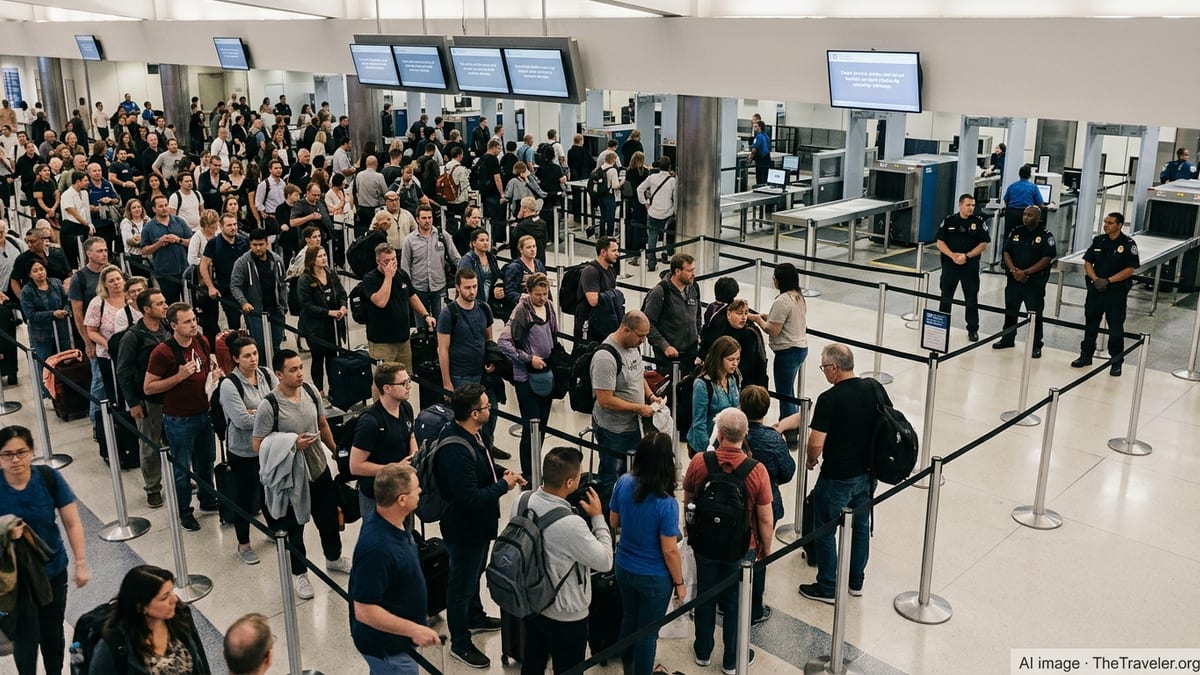
A 25-Year Horizon for Checkpoint Modernization
Publicly available congressional testimony and budget documents indicate that TSA is now framing checkpoint upgrades on a roughly 25-year timeline, with full deployment of several core technologies not expected until the 2040s under current funding structures. In remarks summarized by congressional committees and trade media, agency leadership has pointed to credential authentication systems, computed tomography scanners and facial recognition tools as programs that will take decades to reach nationwide coverage if fee diversion and budget constraints persist.
That long horizon is reshaping how the agency talks about strategy. TSA’s overarching 2018–2026 strategy describes an end-to-end, risk-based planning process that feeds into a multi-year capital investment plan, intended to drive security and technology modernization across checkpoints and other parts of the system. Within that framework, roadmaps for checked baggage, identity management, cybersecurity and open architecture now function as stepping stones toward an envisioned future in which many processes at the checkpoint are automated, touchless and data-driven.
Rather than a single, discrete program, the 25-year vision is emerging as a layered portfolio of incremental upgrades. Industry announcements and government planning documents reference phased rollouts that begin with large hub airports and expand to smaller fields as equipment is tested, certified and funded. To travelers, that means a continuation of the current patchwork in the near term, with some airports offering fully modernized lanes long before others catch up.
Smarter Checkpoints Built on Open Architecture and Biometrics
A central piece of TSA’s future concept is the smarter checkpoint, designed to use advanced imaging, automation and machine learning to identify threats more accurately while reducing the number of manual bag checks and ID verifications. TSA roadmaps on open architecture and cybersecurity describe a move toward screening systems that can share data across platforms, allow third-party algorithms and make it easier for airports to integrate new tools without overhauling entire lanes.
According to published coverage of recent hearings, facial recognition and digital identity are expected to be key elements of these smarter checkpoints, with the agency projecting that full deployment of its facial recognition solution could stretch to 2049 on current revenue projections. In parallel, the expansion of credential authentication technology aims to validate IDs in real time, detect fraud and eventually enable more travelers to pass through without handing documents to an officer, especially in dedicated trusted traveler lanes.
Aviation security reports suggest that computed tomography scanners at carry-on screening positions will also be a cornerstone of the future checkpoint. These scanners generate three-dimensional images that can be rotated and analyzed with automated detection algorithms, potentially allowing passengers to keep more items inside their bags. Taken together, these technologies point to a lane in which the primary interaction is between the traveler and a suite of connected systems, with officers focusing more on exceptions and behavior rather than routine checks.
Passenger Experience Moves Closer to Center Stage
For much of its history, TSA has been defined in the public eye by lines, restrictions and unpredictable rules, but recent strategic documents and federal customer experience initiatives show a shift toward incorporating traveler satisfaction metrics into security planning. Government-wide customer experience efforts highlight TSA’s pilots with mobile IDs, digital identity wallets and streamlined bag-drop processes for enrolled trusted travelers, noting significant time savings and more consistent throughput in early trials.
TSA’s own strategy materials frame this as a cultural change as well as a technological one, emphasizing the need to build a workforce that can adapt quickly to new tools while maintaining clear, courteous communication with passengers. Innovation-focused reports describe efforts to test new concepts in controlled environments and then transfer successful ideas into active airports, with the goal of reducing wait times, limiting repeat screenings and cutting down on confusing or redundant procedures.
From the traveler’s perspective, the 25-year vision points toward an experience where security feels more like a continuous, largely automated flow than a series of discrete bottlenecks. If the plan unfolds as described in public documents, frequent flyers and eventually the general population could see more predictable processing times, fewer instructions to unpack electronics and liquids, and greater use of digital credentials that reduce the need to handle physical documents at every stage.
Funding Gaps and Policy Choices Shape the Timeline
While the technical building blocks for this vision are already in use at some airports, reports to Congress and coverage by government technology outlets underscore that the pace of national rollout will be determined as much by funding and policy as by engineering. A recurring theme in these documents is the diversion of aviation security fees to non-aviation purposes, which limits the resources available for checkpoint modernization and lengthens the timeline for full deployment of key systems.
Congressional budget justifications detail how TSA’s capital investment plan prioritizes technology life-cycle management, from research and development through acquisition and installation. These materials note that the agency is attempting to synchronize investments across multiple programs so that identity tools, scanners, networks and software evolve together instead of in isolation. However, they also acknowledge that large-scale replacement of legacy equipment is expensive, and that choices about where to install next-generation systems first involve balancing risk, passenger volumes and infrastructure constraints.
The result is a future that arrives unevenly. Larger hubs, which can justify higher upfront costs and support complex integration projects, are likely to see the most advanced checkpoints sooner, while smaller airports may adopt pieces of the new model as budgets and facility upgrades allow. For travelers planning trips over the next decade, that means that a flagship terminal might showcase the long-term vision years before it becomes standard nationwide.
What Travelers Can Expect in the Coming Years
For now, the 25-year vision remains a roadmap rather than a fixed schedule, but open-source information offers some signals about what travelers might notice first. Identity innovations, including expanded use of mobile driver’s licenses and digital IDs, are moving from limited pilots to broader availability, especially for trusted traveler program members. Early deployments of computed tomography scanners and automated lanes are also gradually changing how passengers prepare for screening at major hubs.
At the same time, internal innovation programs highlighted in public reports are exploring how to refine lane layouts, signage and staffing patterns to reduce congestion and confusion. As these efforts coalesce, passengers may see more clearly designated lanes for different traveler types, more consistent procedures from airport to airport and better integration between airline check-in, baggage handling and checkpoint screening.
The long-range nature of TSA’s planning suggests that transformative changes will be measured in years rather than months, but it also signals a sustained commitment to modernizing airport security. For travelers, the key message in the emerging 25-year narrative is that security and experience are no longer treated as opposing goals. Instead, the smarter checkpoint of the future is being designed with the expectation that stronger, data-enabled security can coexist with a journey that feels faster, clearer and less stressful.
TSA Strategy and Planning Overview
House Homeland Security Committee Hearing Summary