


More news on this day
Air New Zealand is sharpening its messaging on in flight turbulence at the same time Auckland Airport reports a steep decline in long haul traffic linked to Middle East tensions, a convergence of safety concerns and geopolitical risk that is beginning to redirect how travelers from Australia, the United States, China, the United Kingdom and India reach New Zealand and connect across the globe.
Get the latest news straight to your inbox!
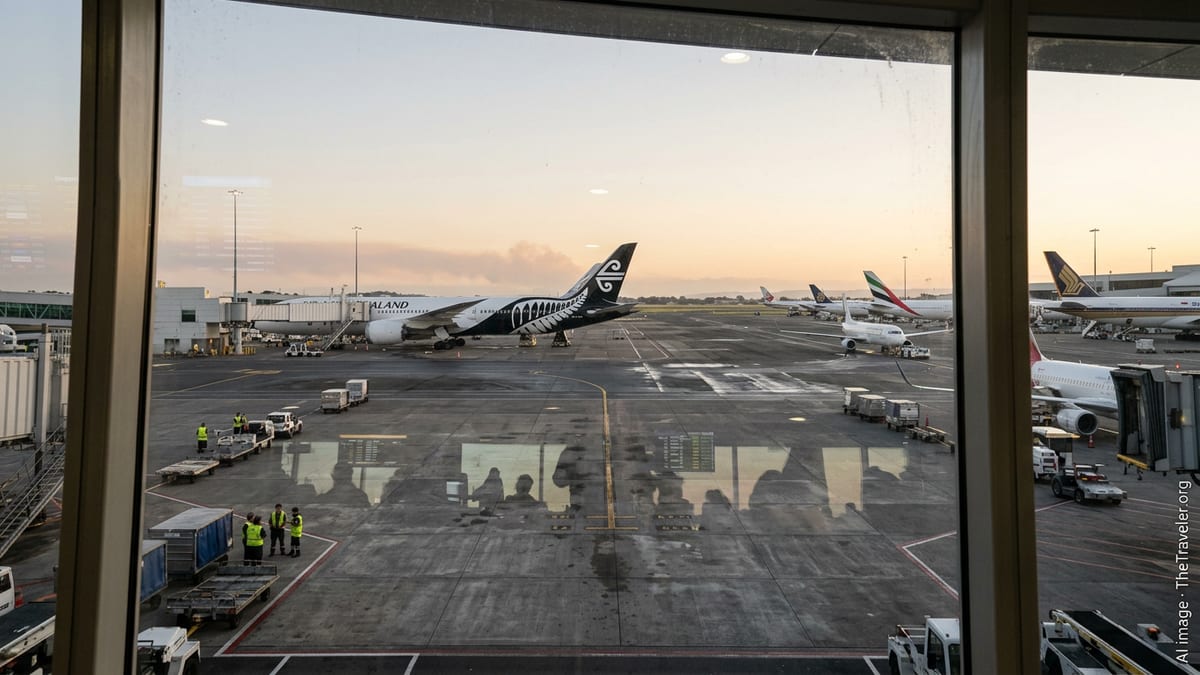
Auckland’s Long Haul Slide Exposes Global Fault Lines
Recent traffic updates from Auckland Airport indicate that long haul recovery has stalled even as domestic and short haul services strengthen. Publicly available data shows domestic passenger numbers rising about 5 percent year on year, supported by increased seat capacity, while some key international long haul flows are weakening.
The sharpest deterioration is on routes linked to the Middle East. Passenger volumes on Middle East services are reported down roughly 80 percent year on year, with seat capacity on these routes dropping more than 70 percent. The figures coincide with ongoing tensions involving Iran and wider conflict in the region that have complicated airspace use and reduced the attractiveness of traditional one stop connections via Gulf hubs.
For New Zealand, which sits at the far edge of most global networks, Middle East carriers have long provided efficient links between Auckland and Europe, Africa and parts of Asia. The sudden thinning of these services is forcing travelers to rely more heavily on Australian, Asian and North American hubs, with Sydney, Melbourne, Singapore, Hong Kong, Tokyo, Vancouver, Los Angeles and San Francisco absorbing flows that once moved through Dubai, Doha or Abu Dhabi.
The shift is particularly visible in arrival statistics. According to recent summaries of passenger mix, arrivals from the United States, China and the United Kingdom to New Zealand are all lower than a year earlier, despite healthy global demand for travel. Analysts suggest that higher fares, longer routings and diminished schedule choice through the Middle East are weighing on discretionary long haul trips into Auckland.
Air New Zealand Joins Global Carriers Spotlighting Turbulence Risk
At the same time that geopolitics is reshaping network flows, turbulence has moved back into the spotlight for airlines operating to and from New Zealand. Air New Zealand has faced several well publicized incidents in recent years involving sudden clear air turbulence, including a 2024 Boeing 787 service between Denpasar and Auckland in which a passenger suffered a serious leg injury after the aircraft encountered severe vertical movement at cruise altitude.
Coverage of a June 2024 Airbus A320 domestic sector, where turbulence during cabin service led to injuries and hospital checks for some on board, reinforced the sense that even routine regional flights over New Zealand’s rugged terrain and volatile weather patterns can produce abrupt jolts. Safety reports and aviation databases describe these as clear air events often occurring without the classic visual cues of storm clouds or towering cumulus formations.
In response, Air New Zealand has been strengthening its public guidance around seat belt use and is increasingly aligning its language with that used by major international peers. Qantas, Emirates and Singapore Airlines have all updated or intensified passenger communications on turbulence following high profile events on long haul flights in other parts of the world, highlighting the importance of keeping belts fastened whenever seated, even in apparently smooth conditions.
A growing body of research referenced in industry commentary links the rising prevalence of clear air turbulence to climate change, with faster wind shear in the jet stream expected to produce more frequent and more severe jolts at typical cruise altitudes. For airlines serving New Zealand’s long, oceanic sectors, where deviations around weather systems are already common, this adds another layer of operational complexity just as traditional routings via the Middle East are being disrupted.
Australia And US Travelers Face Longer Routings And Price Pressure
For travelers from Australia and the United States, Auckland’s changing role is producing a mix of inconvenience and opportunity. For Australians, New Zealand remains a core leisure and family market, and trans Tasman schedules are broadly healthy. However, for those using Auckland as a springboard to the Americas or as part of round the world itineraries, fewer Middle East options and more cautious turbulence management can mean longer flight times, earlier boarding cutoffs and tighter enforcement of seating policies during forecast rough air.
US based travelers are seeing similar impacts in reverse. Nonstop links from cities such as Los Angeles, San Francisco, New York and Chicago to New Zealand remain the most straightforward path, but these flights are among the longest in the world and increasingly intersect regions where clear air turbulence is more common. Industry data on east west flows between Asia Pacific and Western markets shows that regional conflicts and risk zones near the Red Sea and surrounding airspace have already stripped a noticeable share of capacity from traditional corridors, pushing more US New Zealand traffic onto polar and Pacific routings.
As capacity tightens, especially during peak southern summer and northern holiday periods, publicly available fare trackers show elevated prices on many US New Zealand city pairs compared with pre conflict benchmarks. Airlines cite higher fuel burn from rerouting around restricted or high risk airspace and the need to build in greater margins for turbulence avoidance as structural factors that limit the ability to add seats quickly.
Network planners in North America and Australasia are therefore more heavily weighting reliability and controllable risk when designing seasonal schedules. That is likely to preserve nonstop US New Zealand routes that can avoid conflict zones and make best use of sophisticated turbulence forecasting tools, even if it means fewer cheap one stop deals via third country hubs.
China, UK And India Passengers Lose One Stop Gulf Connections
The most profound structural change is being felt by travelers connecting between New Zealand and long haul markets in China, the United Kingdom and India. For more than a decade, Gulf carriers and their partners offered relatively simple one stop itineraries linking Auckland with dozens of cities across these regions, using Dubai, Doha, Abu Dhabi or other Middle East gateways as bridges between hemispheres.
With Middle East related tensions and airspace risks prompting airlines to pare back or suspend some services, and with Auckland Airport data showing deep declines in Middle East passenger volumes, many of these flows are now being rerouted through alternative hubs. Chinese travelers are increasingly channelled through East Asian hubs such as Singapore and Hong Kong or via Australian gateways, while UK passengers rely more on Southeast Asian and North Asian connections or on North American transits.
For India, which had been one of the fastest growing outbound markets globally, the implications are significant. Historically, a combination of Gulf airlines and alliance partners allowed Indian travelers to reach New Zealand and the wider Pacific with a single connection. Capacity reductions and circuitous diversions around high risk corridors have eroded that simplicity. Itineraries that once relied on a single Middle East stop now often involve two changes of aircraft, additional security checks and longer elapsed journey times.
Published coverage of global capacity trends suggests that these reroutings are contributing to softer arrival numbers for Chinese and UK visitors into New Zealand and are likely suppressing potential growth from India. Higher average fares and longer travel times also make it harder for New Zealand to compete with closer Asia Pacific destinations for limited holiday budgets.
How Global Flight Patterns Are Being Redrawn
The combined effect of turbulence concerns and Middle East tensions is a gradual but measurable redraw of global flight patterns touching New Zealand. Instead of a neat web of options radiating through Gulf hubs, more traffic is bending south and east, concentrating on trans Tasman bridges, East Asian connectors and trans Pacific nonstops. Auckland’s role is shifting toward that of a strong regional and point to point hub, with fewer ultra long range connections than might have been expected before recent geopolitical strains.
For airlines such as Air New Zealand, Qantas, Emirates and Singapore Airlines, this environment encourages investment in aircraft capable of flying longer detours efficiently, in advanced turbulence detection and in real time route optimization tools that can weave between storm systems and risk zones without adding excessive fuel burn. It also underlines the value of alliances and code shares that can stitch together multi hub journeys for passengers from Australia, the United States, China, the United Kingdom and India even when direct Gulf options are constrained.
For travelers, the new reality is more complex. It may require accepting higher fares on certain long haul sectors, building in longer connection buffers, and taking turbulence guidance more seriously, including remaining belted whenever seated and being prepared for unexpected seatbelt sign activations. Yet the overall network remains resilient, with Asia Pacific and Middle Eastern carriers redirecting capacity rather than withdrawing it entirely.
Industry analysts note that if regional tensions ease and airspace restrictions are relaxed, some Middle East capacity to and from Auckland could return. However, the current period of disruption is likely to leave a lasting legacy in the form of redesigned routings, a stronger emphasis on turbulence risk management and a greater dispersion of connecting hubs that collectively reshape how the world reaches New Zealand.