


More news on this day
Turkey is racing to expand rail and port capacity as freight flows between Asia and Europe reroute across its territory, turning long-discussed logistics maps into concrete tracks, terminals and timetables.
Get the latest news straight to your inbox!
Middle Corridor surges as traffic bypasses traditional routes
Freight volumes along the so-called Middle Corridor, which links China and Central Asia to Europe via the Caspian Sea, the South Caucasus and Turkey, have risen sharply over the past three years. Public data on the route’s operators and regional economic bodies indicates that traffic climbed from well under 1 million tons in 2021 to around 4.5 million tons in 2024, with projections of further growth in 2025 and beyond. That shift has put Turkey at the centre of an emerging terrestrial alternative to traditional northern rail routes and the Suez Canal.
The diversion is driven by a mix of geopolitical and commercial pressures. Maritime trade through the Red Sea and Suez remains below pre-crisis levels despite some resumption of container traffic, and shippers continue to weigh higher insurance premiums and longer sailing times against overland options. Rail and multimodal services across the South Caucasus and Turkey have become more attractive for higher-value and time-sensitive goods, especially when paired with shorter sea legs across the Black Sea or eastern Mediterranean.
Analysts following Eurasian logistics note that the Middle Corridor has shifted from an emergency workaround into a route that logistics groups and investors now treat as a structural part of their networks. For Turkey, that means freight is no longer a future opportunity but an immediate operational challenge, demanding faster handling at borders, better coordination between rail and ports, and more capacity on lines that have historically prioritised passenger traffic.
Halkali–Kapikule high-speed freight spine nears key milestones
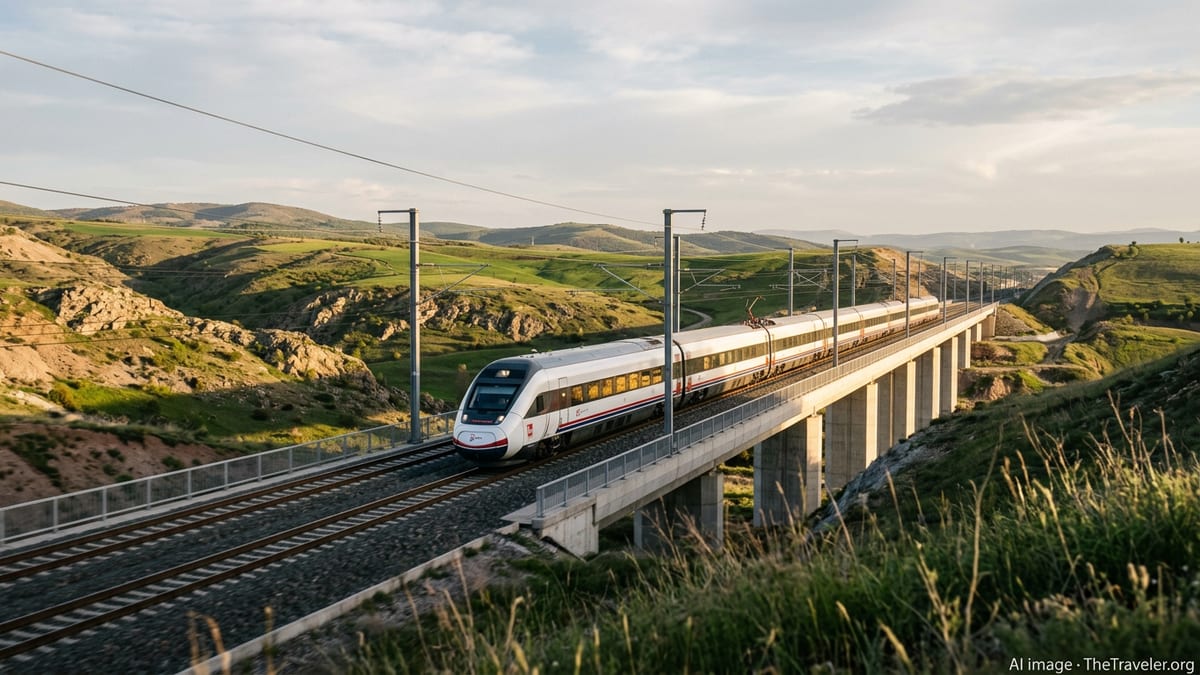
One of Turkey’s flagship responses is the Istanbul–Kapikule railway, a 229 kilometre high-speed line under construction between the suburban hub of Halkali and the Bulgarian border. Official project documentation describes a double-tracked, electrified corridor designed for both passenger and freight trains, with the first section between Kapikule and Cerkezkoy targeted for completion around late 2025 and the full route envisaged toward the end of this decade.
The line is being implemented in phases with substantial support from European institutions and international lenders. Progress reports from Turkey’s Ministry of Transport and Infrastructure and partner banks highlight that civil works on the Kapikule–Cerkezkoy segment are approaching final stages, while tenders and contracts for systems such as rigid catenary and signalling on the remaining sections continue to move forward. Once complete, the corridor is expected to raise freight capacity on the European side of Turkey by close to half compared with the legacy alignment, while also reducing travel times for cross-border goods trains.
Travel time reductions are central to the project’s freight value. Estimates published by Turkish and European agencies suggest that journey times between Halkali and Kapikule for freight trains will be cut from around eight hours to about three and a half, a change that allows more frequent rotations of locomotives and wagons and more reliable slotting of services into busy European timetables. For exporters in Thrace and importers moving containers from Black Sea and Marmara ports into the Balkans, that reliability can be as important as headline speed.
Marmaray tunnel turns Istanbul into a through-corridor, not a terminus
The biggest structural change to Turkey’s rail geography has already happened beneath the Bosporus. The Marmaray rail tunnel, which fully opened to intercity and freight traffic in 2019 and 2020, converted what were once commuter lines into a continuous standard-gauge route from Europe through central Istanbul to Anatolia. Engineering and operations data released about the project describe three-track sections that allow passenger services to run alongside long-distance and freight trains, with dedicated capacity windows for cargo.
This configuration allows freight that enters Turkey at Kapikule to travel across the Marmara region and into the industrial heartlands of Kocaeli, Sakarya and beyond without transshipment. Combined with the planned high-capacity works on the Halkali–Kapikule corridor, Marmaray effectively transforms Istanbul from a bottleneck into a bridge. For eastbound flows, that includes trains feeding into lines toward Ankara and onward to logistics platforms linked with the Middle Corridor’s Caspian crossings.
Urban factors still complicate the picture. Istanbul’s suburban growth and intense commuter demand require careful timetabling to prevent freight movements from clashing with passenger peaks. Publicly available timetables and user reports show that freight slots are often concentrated at night, which can constrain the flexibility of just-in-time supply chains. Even so, logistics specialists view Marmaray as a foundational asset that makes virtually all other rail freight investments in Turkey more valuable.
Road-heavy freight mix pushes shift toward rail and intermodal
Despite the new emphasis on rail, Turkey’s freight system remains dominated by trucking. International financial institution assessments and national transport statistics indicate that more than 85 percent of inland freight moves by road, a significantly higher share than in many comparable upper middle income economies. That imbalance has become more costly as fuel prices, road congestion and carbon reduction pressures reshape corporate logistics strategies.
Several recent project documents underline Ankara’s goal of raising rail’s share of inland freight by investing in dedicated logistics centres, upgrading signalling on legacy lines and supporting private freight operators. Initiatives in eastern Turkey, co-financed with multilateral banks, aim to strengthen the continuity of the Middle Corridor and provide additional capacity for bulk commodities and containers moving between Central Asia and Mediterranean export terminals. These schemes often include sidings, intermodal yards and customs facilities designed to cut waiting times for cross-border trains.
For shippers, the immediate question is not whether Turkey will expand rail, but how quickly that additional capacity will translate into day-to-day reliability and competitive pricing. Public analyses of past corridor performance highlight issues such as uneven infrastructure quality, slow processes at some land borders and a lack of harmonised digital documentation. Industry observers argue that fixing these operational frictions may yield faster gains for freight customers than headline-grabbing megaprojects alone.
Lingering maritime disruptions keep pressure on Turkish gateways
Conditions at sea continue to shape the urgency of Turkey’s freight build-out. Trade and logistics commentary shows that container lines have only partially restored direct Red Sea and Suez routings after the security crisis that escalated in late 2023. While some major carriers resumed transits in late 2025 under new security arrangements, aggregated traffic data suggests that volumes through the Red Sea are still markedly below 2023 levels, keeping schedules fragile and rates volatile.
That volatility has pushed more cargo into alternative combinations of short-sea and overland transport. Ports along Turkey’s Aegean and Marmara coasts have seen increased activity as transshipment hubs and as gateways for cargo that completes the rest of its journey by truck or train. Reports on Turkish port throughput in 2024 point to rising container and ro-ro volumes, with logistics providers marketing Turkey as both a nearshoring base for European manufacturers and a flexible staging point for Asian goods waiting for clearer maritime conditions.
Researchers studying recent chokepoint disruptions note that adaptive rerouting can cushion the immediate economic blow for some regions while creating knock-on congestion in others. For Turkey, that means the current window of high freight demand is an opportunity but also a test. If rail and port upgrades keep pace, the country could consolidate a durable role as Eurasia’s freight hinge. If delays and capacity gaps persist, cargo owners may revert to sea routes as soon as conditions normalise, leaving some new tracks and terminals underused.