


More news on this day
Stricter baggage checks and a standard 7 kilogram cabin limit are reshaping how passengers fly within India in 2026, as airlines increasingly monetize extra kilos and tighten enforcement at check in and boarding gates.
Get the latest news straight to your inbox!
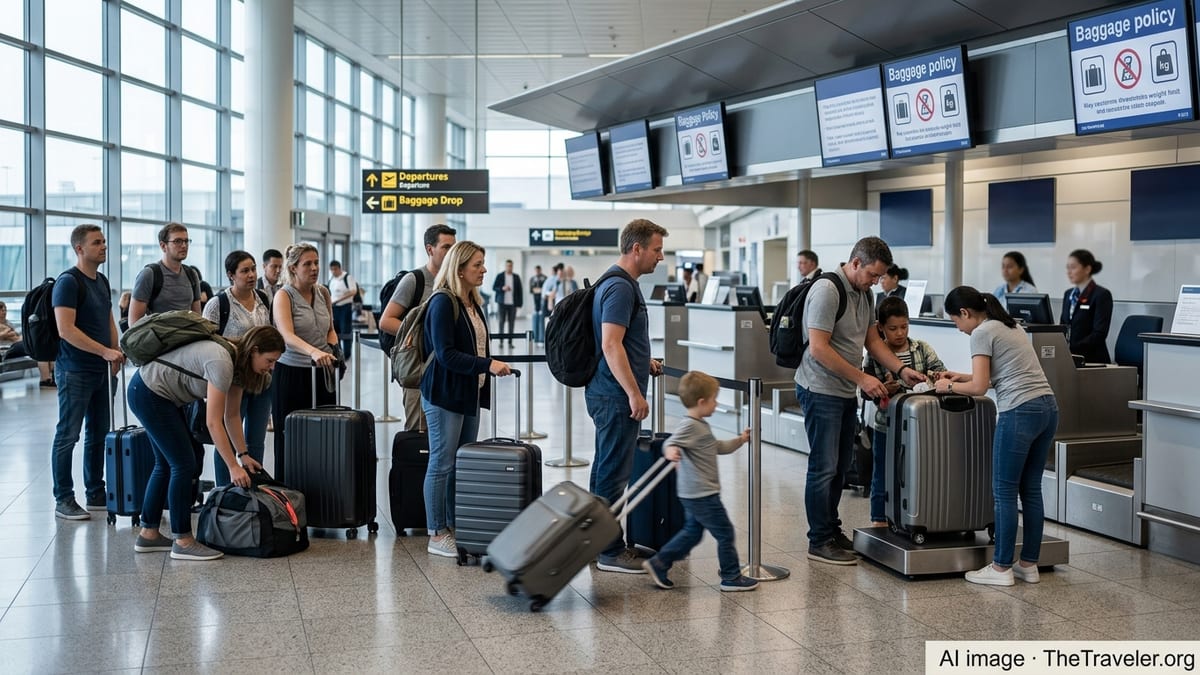
The New One Bag Cabin Rule Across India
Domestic flyers in India now face a much more uniform approach to cabin baggage. Publicly available guidance from the Bureau of Civil Aviation Security introduced a one cabin bag policy on domestic flights in 2024, and airlines have spent the past two years aligning their rules and airport procedures with that standard. The practical result in 2026 is that most economy passengers are limited to a single cabin piece weighing up to 7 kilograms.
Travel industry guides summarising current policies indicate that the typical cabin size ceiling is around 55 by 35 by 25 centimetres, a limit used by carriers such as IndiGo, Air India Express, SpiceJet and Akasa Air. Security staff and airline agents are making more frequent use of sizer frames and weighing scales at both check in and boarding, particularly on full flights where overhead-bin space is tight.
The one bag policy has created confusion for travellers used to carrying separate laptop bags and handbags in addition to a wheelie. Consumer reports and online discussions suggest that at many airports, staff now treat all items taken through security as part of the 7 kilogram allowance, even if a laptop bag is kept under the seat. Enforcement, however, can vary by airport and airline, which adds uncertainty for passengers who pack close to the limit.
Passengers on premium cabins and certain international tickets may still receive a higher cabin allowance, but they are not exempt from the one piece rule at domestic security checkpoints. For those trips, the advantage is usually an extra few kilograms rather than permission to carry multiple large bags into the cabin.
Checked Baggage: The 15 Kg Benchmark and Key Airline Differences
For domestic economy tickets, a 15 kilogram checked baggage allowance has emerged as the benchmark across much of the Indian market. Travel advisories and airline policy summaries note that IndiGo, SpiceJet, Akasa Air and Alliance Air typically offer 15 kilograms of free checked baggage on standard fares, with variations for hand baggage only deals, business cabins and government or student concessions.
Full service carrier Air India often prices domestic fares with a slightly higher allowance on some fare families, commonly around 20 kilograms for certain economy products, while still capping each individual bag at 15 or 23 kilograms depending on route and aircraft. On international sectors, Air India and other carriers may follow a piece based system where a single checked bag can weigh up to 32 kilograms, but that entitlement does not automatically carry over to a separately booked domestic ticket.
Regional operator Alliance Air and flights using smaller aircraft may restrict the physical size of bags even when weight is within the limit. Industry guidance points to a total dimension cap of around 158 centimetres when length, width and height are added together, which is a long established standard across many airlines. Travellers connecting through smaller airports are being advised to pay particular attention to both the weight and the bulk of their luggage.
Special categories such as students, defence personnel and certain government travellers sometimes enjoy extra checked baggage, typically in increments of 5 to 10 kilograms. These benefits usually require proof of eligibility at check in and may only apply on specific airlines or fare types, so it is important for passengers to verify conditions at the time of booking.
How Excess Baggage Fees Add Up
As base fares remain competitive, Indian airlines have leaned more heavily on ancillary charges, and excess baggage is one of the most lucrative. Travel blogs and passenger accounts indicate that paying for additional kilos at the airport can cost two to three times more than purchasing extra baggage in advance online. In some cases, travellers report last minute charges that rival or exceed the original ticket price when several bags are involved.
Most major airlines now sell prepaid baggage in fixed slabs, such as 3, 5, 8, 15 or 30 kilograms, which can be added during booking or via manage booking tools. These advance-purchase rates are widely described as significantly cheaper than airport counters, particularly on budget carriers where the difference per kilo can be substantial. Several airlines also offer discounted baggage for passengers connecting to or from international flights, provided the connection meets published time limits and the traveller can show an onward ticket or boarding pass.
The growing presence of bag sizer frames and weighing stations at boarding gates has introduced another layer of potential fees. When overhead bins are close to capacity, gate agents may require oversized or overweight cabin bags to be checked. Aviation consumer sites note that once a bag is tagged at the gate, airlines often apply standard excess baggage charges at walk up rates, a scenario that can be especially costly because it offers passengers little opportunity to repack.
In addition to weight based fees, some airlines charge extra for additional pieces of checked baggage over and above the first free bag, even if the total weight remains within the allowance. Published policies show that combination pricing is common: a passenger might pay a flat fee for a second bag plus a per kilo cost for any weight above the limit attached to the ticket.
Strategies to Avoid Heavy Charges and Fly Smarter
With enforcement tightening and pricing structures becoming more complex, informed planning has become the most effective way to avoid unnecessary baggage costs on Indian flights. Travel advisers consistently recommend starting with the specific airline and fare type, rather than relying on generic assumptions about a 15 kilogram or 7 kilogram standard, because hand baggage only fares and basic economy products may provide much less.
Checking the full itinerary is especially important for mixed domestic and international trips. Passengers holding a single through ticket often enjoy a harmonised baggage allowance carried across all segments, whereas travellers on separate domestic tickets generally fall back to the lower domestic entitlement. Publicly available airline guidance suggests that even when discounted “international connection” baggage bundles are offered, they still need to be purchased in advance and are subject to time and documentation conditions.
Weighing bags at home and using compact digital scales has become a common recommendation from frequent flyers, particularly for travellers moving between cities where enforcement practices may differ. Reports from Indian airports indicate that some carriers now weigh cabin bags during check in as well as at security, leaving little room to redistribute items once at the gate. Keeping a margin of one or two kilograms below the stated limit can help buffer against differences between home and airport scales.
Another recurring piece of advice is to keep valuable electronics and batteries in cabin baggage while shifting dense but low value items, such as clothing, into checked bags. Security regulations and safety advisories restrict power banks and loose lithium batteries from checked luggage, and moving them at the last minute to avoid a gate check can be stressful. Packing with these rules in mind from the beginning reduces the risk of delays at screening points.
What to Watch Next in India’s Baggage Landscape
Analysts of India’s aviation sector expect baggage policies to remain an important competitive tool through 2026 and beyond. Budget airlines are likely to continue using low base fares combined with strict baggage enforcement and high airport fees, while full service carriers may differentiate by offering slightly more generous allowances or bundled extras on select routes.
At the regulatory level, the Directorate General of Civil Aviation retains responsibility for passenger rights and core safety standards, while the Bureau of Civil Aviation Security oversees screening rules such as the one cabin bag policy. Industry commentary suggests that any future changes to the number of permitted cabin bags or screening procedures would originate from these agencies, with airlines then updating their published policies.
Separately, travel technology companies are rolling out tools that help passengers track their personalised baggage allowance based on airline, route and fare type, reflecting the growing complexity of the system. These tools commonly incorporate real time information from airline websites and customer support materials to provide tailored guidance before travellers reach the airport.
For now, the clearest pattern is that improvising at the check in desk has become an expensive habit. Passengers who take a few minutes to confirm their allowance, weigh their bags and purchase any needed extras before travelling stand the best chance of flying within India without being surprised by heavy baggage fees.