


More news on this day
Britain’s long-promised rail modernisation is gaining momentum as GPS-based Pay As You Go ticketing trials in the Midlands and North notch up tens of thousands of journeys, strengthening expectations that smartphone-based fares will move from regional experiments to a central pillar of a future Great British Railways.
Get the latest news straight to your inbox!
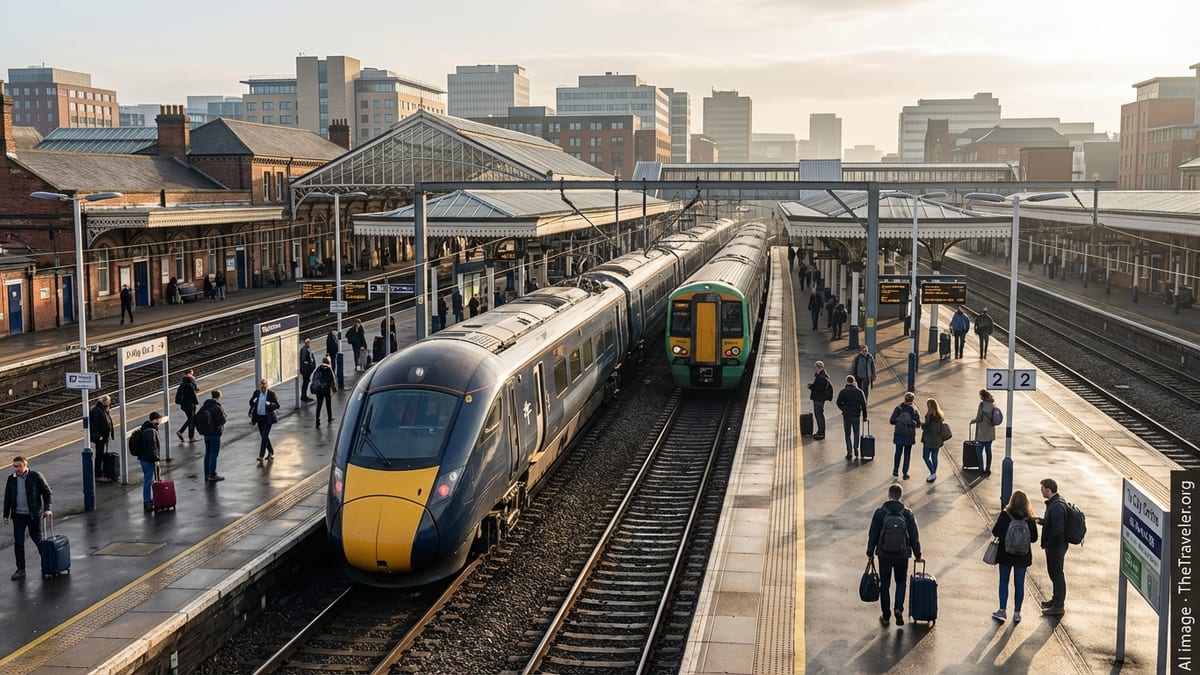
From regional trials to a template for Great British Railways
The current generation of digital Pay As You Go pilots builds on long-running contactless schemes in London, but goes further by using GPS and geofencing rather than ticket barriers to record journeys. In pilot areas, passengers check in and out through a dedicated app, which tracks their route in the background and calculates the correct end-of-day charge without the need to buy a ticket in advance.
Government releases and industry briefings describe the technology as a key plank in wider plans to simplify a fares system widely viewed as confusing and poor value. The Williams-Shapps plan for rail envisaged Great British Railways acting as a single guiding mind for timetables, fares and ticketing, with Pay As You Go presented as a way to give passengers a “best fare on the day” without navigating complex product names and restrictions.
Recent contract notices and staff guidance indicate that digital Pay As You Go on mobile is scheduled to run through 2025 and 2026, aligning with the run-up to Great British Railways’ expected launch. Industry documents outline ambitions for a future in which a single account-based system could work across multiple train operators and eventually integrate with buses and trams in major city regions.
Observers note that the trials are unfolding alongside a broader expansion of traditional contactless Pay As You Go using bank cards and phones at barriers, particularly around London and on routes in the South East and West. The GPS pilots are seen as a complementary track that could extend “tap in, tap out” style simplicity to stations and rural stops that lack modern gate lines.
How GPS-based Pay As You Go works for passengers
Unlike conventional contactless Pay As You Go, which relies on physical ticket barriers or platform validators, the new system uses a smartphone’s location services to detect when a passenger is at or near a participating station. Travellers open the operator’s app, check in before boarding and check out at the end of the trip, with GPS and geofencing used to verify that a rail journey has taken place.
Behind the scenes, the app compiles a log of journeys throughout the day and then applies a fare engine that is designed to ensure the passenger pays no more than the best-value combination of singles, returns or caps. Publicly available information about the trials emphasises that the goal is to mirror the simplicity of urban Pay As You Go systems, where customers do not need to plan ticket types in advance to avoid overpaying.
Reports on the ongoing pilots highlight features such as barcode generation for on-train and platform inspections, giving staff a visual confirmation that a passenger has checked in. Some pilots also allow users to see their real-time journey history and indicative day’s spend in the app, a transparency measure aimed at building confidence in a system that operates largely in the background.
The design is intended to help travellers who make flexible or short-notice trips, including commuters who no longer travel five days a week. By linking fares directly to actual journeys, the GPS model seeks to bridge the gap between occasional users and traditional season ticket holders, a key challenge for the railways since pandemic-era shifts in working patterns.
Northern and East Midlands at the forefront
The most advanced GPS-based Pay As You Go pilots are currently concentrated on routes in Yorkshire, the North and the East Midlands. Northern has reported more than 30,000 journeys made using digital Pay As You Go on selected lines such as Leeds to Harrogate and Sheffield to Doncaster, describing the trial as a glimpse of the “future of ticketing.”
On East Midlands Railway, a location-tracking trial between cities including Leicester, Derby and Nottingham began in 2025, using an app that requires passengers to check in before boarding and check out at the end of their journey. Coverage of the scheme notes that the system automatically selects the cheapest applicable fare at the end of the travel day, avoiding situations where customers could accidentally buy a more expensive ticket than necessary.
Government announcements describe these routes as test beds for a model that could eventually be replicated on other regional lines. The trials are backed by dedicated funding for modern ticketing in the Midlands and North, intended to support economic growth and encourage people back to rail after years of disruption and fluctuating demand.
Officials and operators involved in the programmes have presented early uptake figures as evidence that passengers are willing to adopt smartphone-based ticketing beyond metropolitan networks such as Transport for London. The trials are also seen as an opportunity to test how GPS-based systems cope with complex real-world conditions, such as poor mobile coverage in cuttings or tunnels and interchanges between operators.
Balancing convenience with privacy and reliability
The use of GPS inherently raises questions about data protection, surveillance and system reliability. Publicly available FAQs for the pilots stress that the apps process location data only when a journey is active, or within station geofences, and that information is retained in line with privacy and data protection law. Some documentation emphasises that if a user enters a station but does not activate the app’s train mode, their personal location data is not recorded as a rail journey.
Consumer advocacy commentary has focused on the need for clear consent, easily accessible settings and robust safeguards against misuse of travel histories. Campaigners argue that any national rollout would have to give passengers simple options to view, download or delete their records, and provide meaningful alternatives for those who are unable or unwilling to use smartphone-based systems.
Reliability is another key concern. GPS accuracy can be affected by tall buildings, tunnels or poor mobile signals, leading to fears of incomplete journeys or incorrect charges. Trial operators have responded by using a combination of GPS, cell-tower data and station geofences, backed by customer support routes for correcting errors and refunding mistakes.
Industry watchers say the lessons from these pilots could shape national technical standards, covering how apps detect station proximity, handle partial data and interface with existing rail back-office systems. Getting these details right is seen as essential if digital Pay As You Go is to win public trust and become a mainstream alternative to paper or barcode tickets.
Next steps toward a nationwide Pay As You Go network
Recent government publications, parliamentary debates and procurement documents point to a phased expansion of Pay As You Go across the rail network over the next few years. Staff briefs shared within the industry set out plans to extend traditional contactless Pay As You Go to dozens more stations, while digital Pay As You Go on mobile is scheduled to continue through at least 2026.
The vision outlined in policy papers is of a more unified system, in which passengers can travel across multiple train operators and modes using a single account or app, with price caps and best-fare guarantees applied automatically. While details of how quickly GPS-based Pay As You Go will move from pilot to standard offering remain fluid, the accumulation of trials and infrastructure investment is widely seen as a signal that account-based ticketing is becoming central to Britain’s rail strategy.
Industry analysis suggests that the eventual shape of the system will depend on the interplay between government funding, the establishment of Great British Railways and the role of private-sector partners such as technology suppliers and retailers. Train operators and ticketing companies are already positioning themselves to supply back-office technology, journey-planning tools and customer-facing apps that can plug into national Pay As You Go platforms.
For passengers, the most visible changes in the coming years are likely to be the spread of “just travel” messaging, reduced reliance on ticket office queues and a gradual shift from physical tickets to digital accounts. If the GPS-based trials in the Midlands and North continue to perform strongly, they are expected to form a blueprint for how Pay As You Go could function on busy intercity corridors as well as local lines, reshaping how millions of people pay for rail travel across the UK.