


More news on this day
Two passenger trains collided on a busy commuter route north of London on Friday afternoon, leaving at least one person dead, many others injured and causing severe disruption to services into the capital.
Get the latest news straight to your inbox!
Collision on busy Bedford corridor
According to published coverage, the collision occurred shortly after 5 p.m. local time on June 19 near Bedford, a major junction on the Midland Main Line that links towns and cities in the East Midlands with London St Pancras. The trains involved were operating southbound services toward the capital when they came into contact on the same stretch of track.
Reports indicate that both services were operated by East Midlands Railway and were running from Nottingham and Corby respectively to London St Pancras. Rail tracking data cited in local coverage places the crash between Bedford and Luton, an especially busy section of the route used by long-distance, airport and commuter services.
Images shared on social media and reproduced in UK news reports show at least one train with significant damage to the leading car, with some carriages appearing to have derailed or shifted off the track. Passengers can be seen standing on adjacent roads and embankments while emergency vehicles line a service road parallel to the line.
Publicly available information from regional police and ambulance services describes the event as a major incident, with one person confirmed dead and a number of passengers and staff reported injured. The full extent of injuries was still being assessed on Friday evening.
Emergency response and passenger evacuation
Coverage from national and local outlets shows that a large-scale emergency response was deployed to the scene, including crews from multiple ambulance trusts, specialist hazardous-area teams and an air ambulance. Fire and rescue services were also pictured along the line, working with rail staff to assess damage and make the scene safe.
Passengers posting online described a sudden impact that threw people against seats and fittings, followed by smoke and debris in the carriages. Several accounts referenced fellow travelers with visible fractures and heavy bleeding, although others were able to walk away with only minor injuries or shock.
Rescue teams guided passengers along the train and out through doors or emergency exits, before leading them down to the adjacent roadway. Video from the area shows dozens of people gathered near emergency vehicles while medical teams triage the injured. Some were treated at the roadside, while others were taken to hospital for further care.
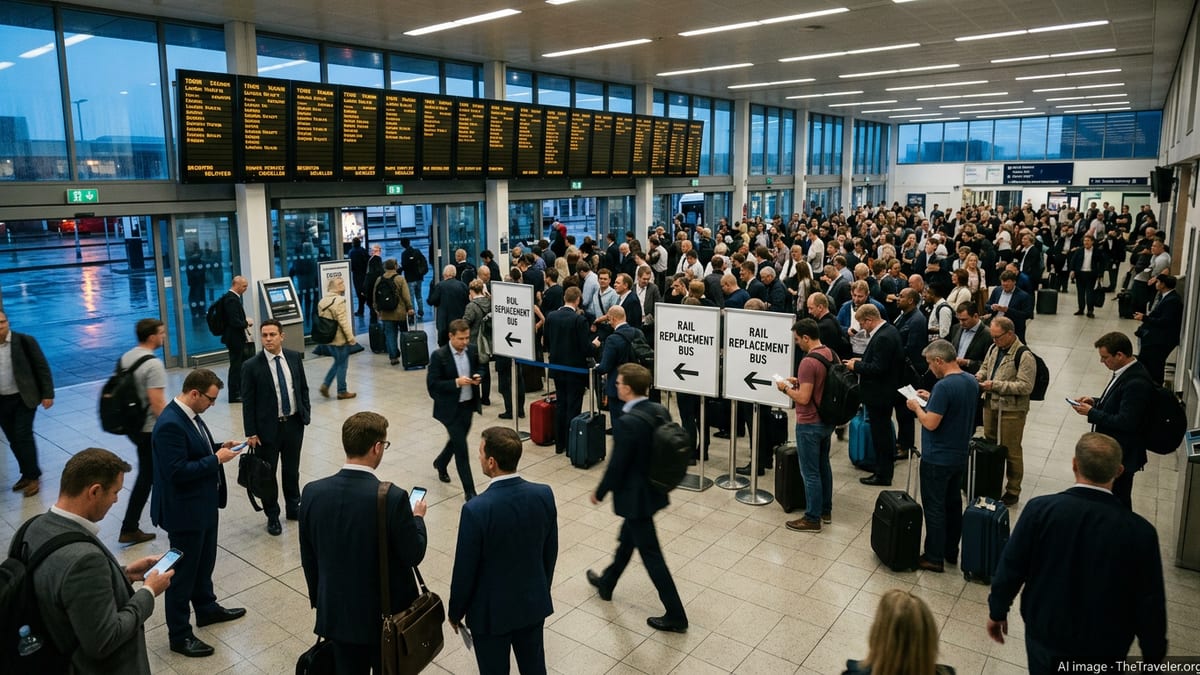
Rail operators began arranging onward transport for stranded passengers, though many were advised to seek alternative routes or delay journeys because of the scale of the disruption. With the incident occurring during the evening peak, thousands of commuters faced extended delays returning to London and destinations across the Midlands.
Major disruption to East Midlands and airport services
The collision has caused severe disruption across one of the United Kingdom’s key intercity and commuter corridors. East Midlands Railway stated in public updates that all services to and from London St Pancras on its main routes were suspended for the rest of Friday, including trains to Nottingham, Sheffield and Corby.
Reports indicate that knock-on disruption also affected Thameslink and Luton Airport services that share parts of the route, with trains halted or turned back short of the affected section. Passengers traveling to and from Luton Airport experienced significant delays, with some services cancelled outright while the line remained blocked.
Network Rail engineers and incident officers were reported to be on site to assess damage to tracks, signalling and overhead power equipment. Early images suggest that while the carriages remained largely upright, the impact and subsequent derailment may have damaged infrastructure over a considerable distance, complicating efforts to restore normal operations.
Rail planners warned that services on Saturday could also be affected while investigations continue and repairs are carried out. Travelers were advised, through operator statements and journey planners, to check for the latest information before setting out and to expect extended journey times or diversions.
Early focus on signalling and safety systems
While it remains too early for any definitive conclusion, attention has quickly turned to how two southbound passenger services came to collide on a modern, signal-controlled main line. Commentators and rail specialists quoted in early coverage highlighted several possible areas of focus, including signalling performance, communication between control and drivers, and the functioning of train protection systems.
Some rail enthusiast forums and social media posts, cited in news reports, have suggested that one train may have stopped because of an on-board protection alert, with the following service then striking it from behind. These accounts have not been formally confirmed and investigators are expected to test multiple scenarios, including equipment failure and potential human error.
Britain’s rail network is equipped with layers of safety systems designed to prevent such collisions, including line-side signals, automatic warning systems and, on some sections, in-cab train protection technology. The incident near Bedford is likely to prompt close examination of how those defences operated at the time of the crash and whether any vulnerabilities were present on that stretch of the Midland Main Line.
Rail unions and passenger groups have already begun to call for a thorough and transparent investigation, noting that two in-service passenger trains making contact on an open main line is a rare but serious event. They argue that understanding any root causes is essential both for public confidence and for the prevention of future crashes on similarly busy corridors into London.
Local and national reaction
The crash has resonated strongly in Bedfordshire and across the East Midlands, where many residents rely on the St Pancras route for work, education and leisure travel. The line is one of the principal rail links between the region and central London, and any prolonged disruption can have a wide economic impact.
Publicly available statements from local representatives describe the collision as a shocking event on a heavily used line at one of the day’s busiest periods. Many messages shared online expressed sympathy for the victims and gratitude toward emergency responders, rail staff and members of the public who assisted injured passengers at the scene.
Nationally, the incident is likely to feed into a broader discussion about rail safety following other high-profile crashes in Europe in recent years. Analysts point to growing pressures on aging infrastructure, the rollout of new rolling stock and increasing passenger volumes as factors that can test even well-established safety regimes.
For now, attention remains on the condition of those injured, the restoration of services and the early stages of the technical investigation. As more information emerges, the Bedford collision is expected to become a key reference point in ongoing debates about investment priorities, signalling upgrades and resilience across the UK’s intercity rail network.