


More news on this day
Travel across large parts of eastern China was severely disrupted on Sunday as Typhoon Bavi made landfall in Zhejiang province, prompting the evacuation of close to two million people, widespread flight cancellations and rail suspensions, and renewed concerns over flooding in an already waterlogged summer season.
Get the latest news straight to your inbox!
Powerful Landfall in Zhejiang After Days of Warnings
According to publicly available meteorological updates, Typhoon Bavi came ashore late Saturday near the coastal city of Taizhou in Zhejiang, bringing violent winds and intense rainfall to one of China’s most densely populated coastal corridors. The storm, described in regional coverage as the most powerful to reach the mainland this year, moved inland on Sunday while gradually weakening to a severe tropical storm.
Reports indicate that the landfall followed several days of tracking across the western Pacific, with Bavi passing near Japan’s southern islands and skirting northern Taiwan before turning toward China’s east coast. Forecasts had signalled a broad impact zone stretching from Fujian and Zhejiang north toward Shanghai and the Yangtze River Delta, a cluster of economic hubs closely tied to global aviation and shipping networks.
China’s national observatory had maintained an orange typhoon alert, the second highest in its four-tier warning system, ahead of landfall. Local governments across eastern provinces stepped up emergency preparations, ordering schools and outdoor attractions to close and advising residents in low-lying or coastal zones to move to safer ground as the storm approached.
Early visual evidence from coastal communities in Zhejiang showed large waves battering sea walls, uprooted trees and localized flooding, underscoring the force of Bavi’s initial impact even as it began to weaken inland.
Mass Evacuations and Heightened Flood Concerns
Published government tallies and state media reports indicate that nearly two million people were evacuated across Zhejiang and neighboring provinces before Bavi’s landfall. Many of those relocated were residents of coastal fishing villages, river estuaries and mountainous districts vulnerable to landslides and flash floods.
The evacuations come against a backdrop of weeks of heavy rain across southern and central China, which had already swollen rivers and reservoirs. Hydrology briefings cited in domestic coverage describe Bavi as adding a new layer of risk, with forecasters warning that the system’s vast rain shield could deliver prolonged downpours well beyond the immediate landfall zone, including into parts of Jiangsu, Anhui, Jiangxi and the broader Yangtze basin.
Flood control authorities have activated emergency responses in multiple regions, with reservoirs adjusting discharge volumes to create capacity for incoming runoff. In northern areas, including around Beijing, publicly available information points to preemptive relocations of residents living downstream of major water-control structures as officials brace for potential spillover from Bavi’s rain bands.
While detailed damage assessments are still emerging, early accounts reference landslides, inundated fields and rural roads cut off by high water, renewing concern that the storm could exacerbate seasonal flooding and complicate recovery in agricultural areas.
Flights Suspended and Airports Struggle With Disruptions
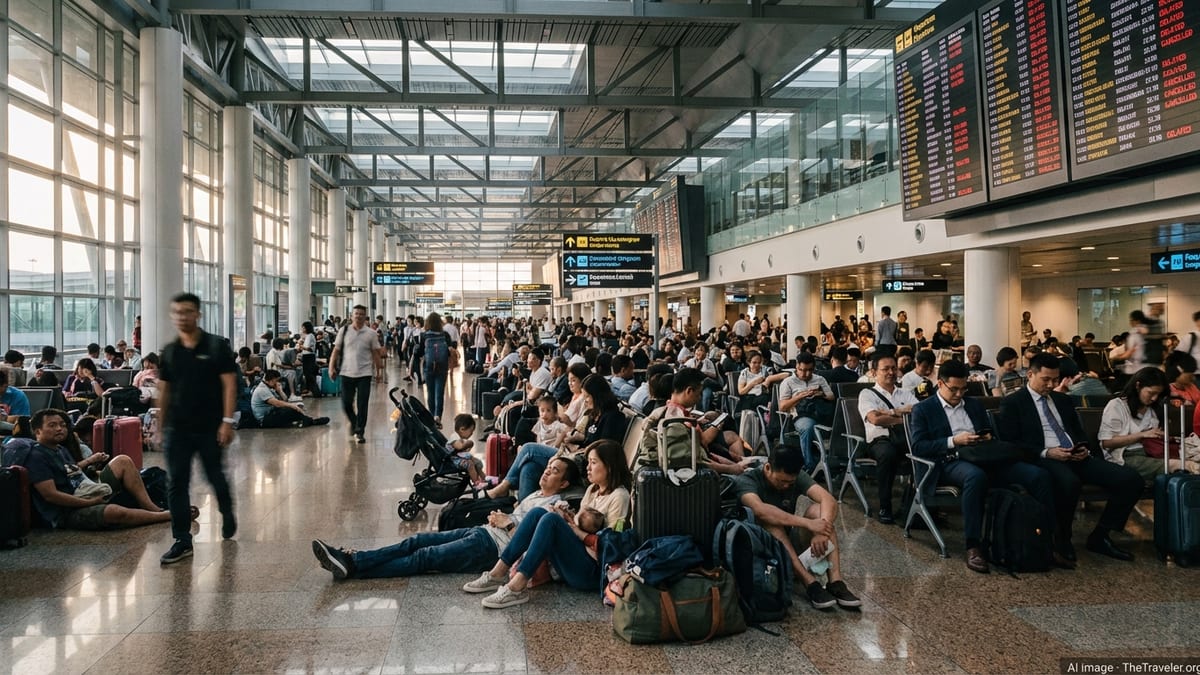
Air travel has borne the brunt of Bavi’s immediate impact on mobility. Airlines and airport operators across eastern China announced large-scale cancellations beginning late Friday and intensifying through the weekend as the typhoon drew closer.
According to figures cited in regional and international media, hundreds of domestic and international flights were cancelled at key hubs in Zhejiang and Fujian even before landfall, with additional suspensions reported in Shanghai as the storm’s outer bands approached the megacity. Some reports describe more than 400 flights scrapped in Zhejiang alone ahead of Saturday night, while aviation authorities later noted further cancellations and delays rippling northward to Beijing’s two major airports as thunderstorms associated with Bavi disrupted traffic.
Major Chinese carriers introduced flexible rebooking and refund policies for affected passengers, and some international airlines issued travel waivers covering journeys to and from the region during the storm window. Nonetheless, travelers have reported significant challenges in securing new itineraries, with social media posts and travel forums describing long queues at service counters, jammed call centers and multi-day waits for the next available seats on popular routes.
With Bavi’s remnants expected to continue affecting weather patterns across eastern China for several days, aviation planners caution that residual delays and schedule changes are likely to persist even as winds ease and airports gradually reopen more runways and slots.
Rail, Road and Sea Transport Brought to a Standstill
Beyond the skies, Typhoon Bavi has disrupted virtually every major mode of transport across its path. High speed rail lines in eastern China curtailed or suspended services in and out of Zhejiang and adjacent provinces over the weekend, according to domestic media coverage, as operators cited safety concerns related to high winds, potential debris on tracks and the risk of landslides along some mountain corridors.
In the provincial capital of Hangzhou, local reports said major railway stations temporarily halted departures at the height of the storm, while coastal cities limited or cancelled intercity services. Shanghai’s extensive suburban and metro network reduced speeds on exposed elevated sections, with transport bulletins warning that further restrictions or partial closures could be imposed if conditions deteriorated.
On the roads, authorities across several provinces advised residents to avoid nonessential travel, noting hazards such as waterlogged underpasses, falling branches and reduced visibility. Sections of coastal highways were intermittently closed due to storm surge and scattered debris, complicating ground transfers for stranded rail and air passengers.
Maritime links were equally affected, with ferry routes across the Taiwan Strait and within the East China Sea suspended in many locations. Shipping industry notices and logistics advisories described temporary terminal closures and vessel schedule adjustments at some container ports in Zhejiang and around the Yangtze estuary, a development that could create short term backlogs in regional supply chains.
Travelers Confront Ongoing Uncertainty as Storm Weakens
By Sunday afternoon, meteorological updates indicated that Bavi had weakened as it moved inland, but the storm’s wide circulation continued to generate heavy rain and strong gusts across eastern and northern China. Transport operators have begun to signal a gradual resumption of services, particularly in areas no longer under the most severe weather alerts, but the pace of normalization remains uneven.
Some airports and railway stations in regions on the periphery of the storm’s core have started reinstating limited operations, prioritizing flights and trains that can help clear backlogs of stranded passengers. However, aviation and rail planners are also navigating complex logistical challenges, including the need to reposition aircraft and train sets that were moved out of harm’s way before landfall.
For travelers, this has translated into a patchwork of options. While a subset of passengers has managed to rebook for departures within a day or two, others report only being able to secure seats several days out, particularly on international routes or trunk lines linking major cities. Tourism operators in coastal destinations have also warned of possible cancellations or shortened stays as visitors reassess plans in light of the storm’s aftermath and lingering flood concerns.
Forecast discussions suggest that Bavi’s remnants will continue to influence weather over a broad swathe of eastern China early in the week, sustaining the risk of further localized flooding and landslides. As a result, travel specialists are advising passengers with upcoming itineraries in affected provinces to monitor carrier announcements closely and to build additional flexibility into their plans while the region works to restore full transport capacity.