


More news on this day
Americans planning international trips this season are facing a dense patchwork of security and health alerts, with a growing cluster of destinations on the U.S. government’s highest “Do Not Travel” tier and a standing worldwide caution urging increased vigilance.
Get the latest news straight to your inbox!
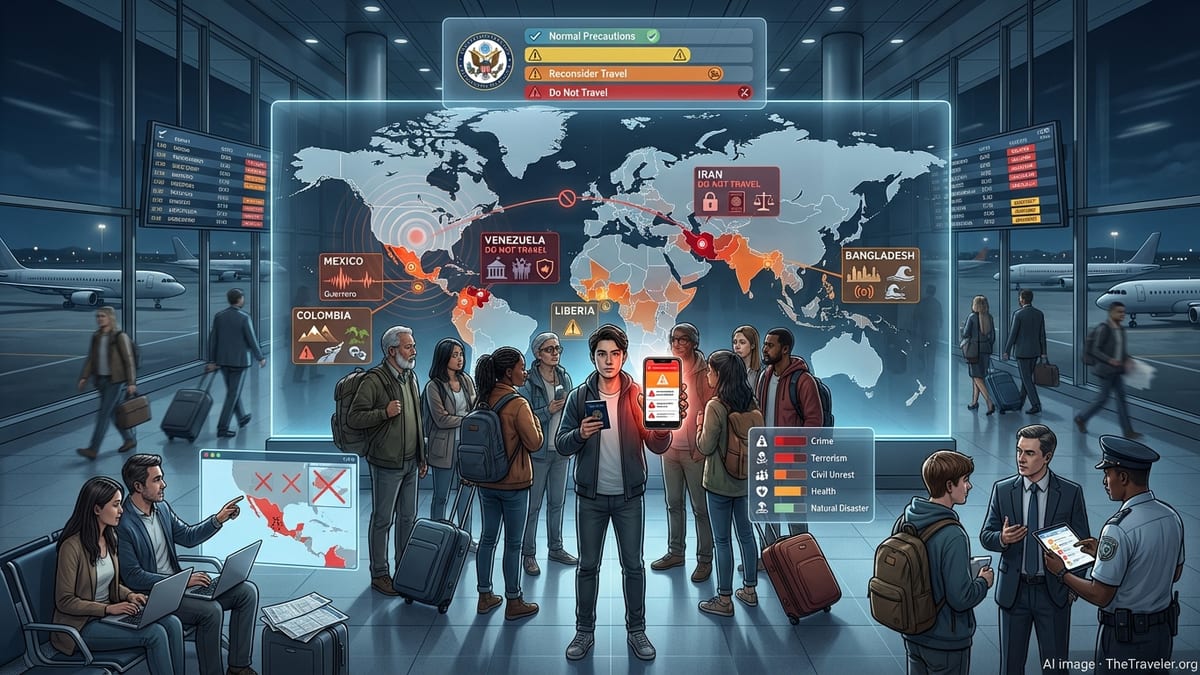
How the U.S. Red Alert System Works
The U.S. Department of State assigns every country a travel advisory level from 1 to 4, with Level 4 marked in red and described as “Do Not Travel.” Publicly available material from the department explains that this is the highest warning category, reserved for places where the likelihood of life‑threatening risks is significantly elevated and where the U.S. government may have limited or no ability to assist citizens during a crisis.
Advisories are based on several standardized risk indicators, including armed conflict, terrorism, crime, civil unrest, wrongful detention, health emergencies, and natural disasters. A country can reach Level 4 because of one severe factor, such as an active war, or a combination of overlapping threats that collectively create an unstable environment for visitors.
In parallel, the State Department maintains a Worldwide Caution, most recently updated in May and reiterated through later security alerts, advising Americans everywhere overseas to exercise increased caution because of an elevated global threat environment. The broad notice is not a ban on travel, but it sets the backdrop for more stringent country‑specific warnings.
Other agencies contribute to the overall risk picture. The Centers for Disease Control and Prevention publishes Travel Health Notices, with Level 3 notices urging travelers to reconsider nonessential trips where serious disease outbreaks are underway. Universities and multinational companies often overlay these government advisories with their own risk tiers, sometimes restricting institutional travel to red‑listed destinations altogether.
Where Travel Is Riskiest Right Now
The current red alert landscape is dominated by active conflict zones and states with chronic instability. Afghanistan remains on the Level 4 list following years of political upheaval and militant activity. The advisory highlights widespread security concerns, limited infrastructure, and constrained consular access for foreign nationals.
Myanmar, still referred to as Burma in U.S. advisories, is another prominent Level 4 country, with travel strongly discouraged because of armed clashes between the military and opposition groups, sporadic airstrikes, and arbitrary enforcement of local laws. Similar concerns shape the warning level for parts of the Middle East, where ongoing hostilities and the risk of cross‑border attacks continue to unsettle travel plans.
North Korea stands out as a special case. U.S. regulations prohibit most American passport holders from traveling to, in, or through the country unless they obtain a rare, specially validated passport. Public information notes that, beyond political tensions, the risk of arbitrary detention and the absence of normal consular support are central to the restriction.
Beyond these headline destinations, aggregated data from advisory trackers show that more than twenty countries and territories worldwide are currently flagged at Level 4. Several are in Africa and the Sahel region, where fragile governments, insurgencies, and sporadic terrorist attacks have led to prolonged red‑status warnings. In some cases, neighboring states sit at Level 3, illustrating how risks can shift rapidly across borders.
Regional Flashpoints and Escalating Security Concerns
Regional flare‑ups can quickly move a destination up the advisory scale. Recent reporting on Yemen‑aligned Houthi attacks, for example, has underscored how missile and drone strikes beyond an immediate conflict zone can disrupt air traffic and raise concern for civilian travelers. In Saudi Arabia, a series of deadly incidents attributed to Houthi fighters prompted the closure of Riyadh’s King Khalid International Airport earlier in October and led to a partial drawdown of U.S. diplomatic staff, a step often reflected in heightened travel warnings for the surrounding area.
Elsewhere, parts of the Eastern Mediterranean and Red Sea corridors have seen shipping disruptions and sporadic security incidents that complicate cruise itineraries and flight paths. Even when an entire country is not at Level 4, specific regions, border areas, or transport hubs can be singled out in advisory text as places where the risk of violence, kidnapping, or sudden road closures is significantly higher.
In the Western Hemisphere, chronic gang violence and political instability in some Caribbean and Latin American states continue to attract strong cautionary language. Country‑wide Level 4 classifications remain more common in nations where central governments struggle to control key urban centers or highways, and where crimes against visitors are less likely to be investigated or prosecuted effectively.
Travelers are also watching for any expansion of wrongful detention warnings. Publicly available analyses note that several destinations, including some with complex relations with Washington, carry explicit risk indicators for arbitrary arrest or exit bans, which can contribute to a rapid shift from Level 3 (“Reconsider Travel”) to Level 4.
Health Emergencies and the Overlap With Security Risk
Health‑related alerts add an additional layer to the red‑zone map. The CDC’s latest Travel Health Notices include Level 3 warnings for serious outbreaks such as Ebola‑related diseases and yellow fever in defined regions. In mid‑October, for instance, the agency issued a notice about yellow fever transmission in Ghana’s Upper West Region, advising travelers to be vaccinated at least ten days before arrival and to take stringent mosquito‑bite precautions.
Separately, a recent CDC order on Bundibugyo virus disease, a form of viral hemorrhagic fever detected in the Democratic Republic of the Congo, emphasized how interconnected air routes can enable rare infections to cross borders. While such health notices do not automatically trigger Level 4 status by themselves, they can tip the balance where medical systems are already strained or conflict has damaged hospitals and supply chains.
Countries experiencing both armed conflict and disease outbreaks are often among the riskiest destinations in practical terms. Hospitals may be overwhelmed, humanitarian corridors can be disrupted, and evacuation options may be severely limited. These intersecting hazards help explain why some states remain at Level 4 for extended periods, even when front‑line fighting ebbs and flows.
For travelers, the key takeaway is that the U.S. “red list” is not solely about violence or terrorism. Health system capacity, vaccination requirements, and the feasibility of medical evacuation all weigh into advisory language, especially where outbreaks occur far from major urban centers with advanced care.
Navigating the Red List When Planning a Trip
For Americans trying to make sense of the current red alert landscape, the official State Department advisory page remains the baseline reference, offering country‑by‑country descriptions that are updated as conditions change. U.S. government portals also guide travelers to the Smart Traveler Enrollment Program, which allows citizens to register itineraries so they can receive security updates and be easier to contact in an emergency.
Because advisory texts can distinguish between national and regional risk, it is important for travelers to read the full narrative rather than relying solely on the numeric level. In some countries, capital cities or major resort zones are specifically described as having different risk profiles from border areas, conflict zones, or remote rural regions, even though the overall national level remains elevated.
Many universities and international employers cross‑reference State Department advisories with independent security assessments produced by private risk firms. These combined lists often categorize destinations as restricted, elevated, or unrestricted for work and study travel, and they can be more conservative than federal guidance, particularly for travelers whose roles might attract unwanted attention.
Ultimately, the U.S. red alert list is only one part of the risk calculation. Travelers considering trips to or near Level 4 destinations are encouraged by public guidance to monitor both security and health bulletins in real time, plan evacuation contingencies, and think carefully about whether nonessential travel can be deferred until conditions improve.