


More news on this day
The U.S. State Department’s highest Level 4 “Do Not Travel” advisories now cover a widening mix of war zones, fragile states and politically tense destinations, creating a de facto red alert list that travelers are urged to examine before booking flights.
Get the latest news straight to your inbox!
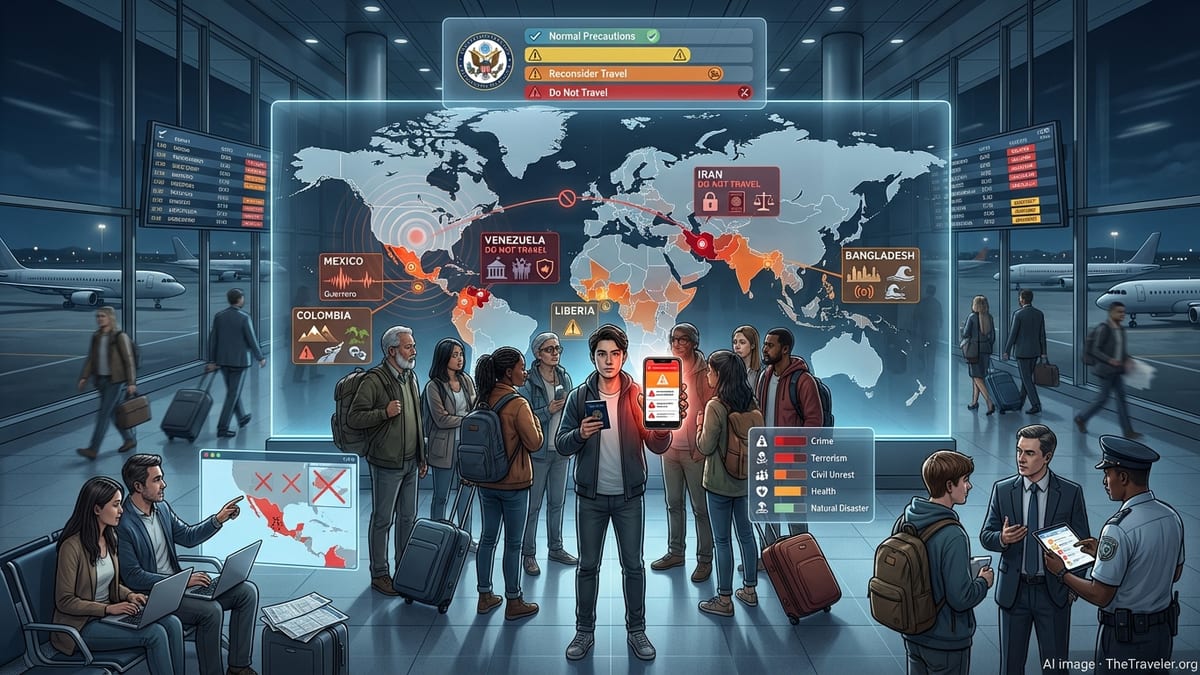
How the U.S. Red Alert System Works
The U.S. Department of State assigns every destination an advisory level from 1 to 4, with Level 4 representing the highest alert. Publicly available guidance explains that Level 4 is used when there is a greater likelihood of life threatening risks and when the U.S. government may have very limited ability to assist citizens in an emergency. In plain terms, a Level 4 notice serves as a strong recommendation not to go, or to leave as soon as it is safe to do so.
Travel advisories combine several risk indicators, including armed conflict, terrorism, crime, civil unrest, health concerns, kidnapping, wrongful detention and natural disaster exposure. Current advisory pages list letter codes next to each destination to show which threats are most prominent, such as T for terrorism, K for kidnapping or D for wrongful detention. Recent updates to Afghanistan’s advisory, for example, show all of these risk symbols at once, underscoring how complex and overlapping the dangers have become.
The State Department maintains a central, continuously updated list of advisories on its travel website. External trackers that mirror this feed report that roughly two dozen places worldwide currently appear at Level 4. Independent comparative analyses that line up U.S., Canadian and United Kingdom warnings indicate that about a dozen countries are rated at the strictest level by all three governments, reflecting broad international concern over conditions there.
Officials do not rank Level 4 countries against one another, and there is no official list of the “most dangerous” destination. Instead, each advisory describes specific scenarios that travelers could face, from drone and rocket fire to targeted kidnappings, arbitrary arrests or the collapse of basic medical and transportation services.
Active Conflict Zones and Areas of Widespread Violence
Several of the most prominent Level 4 advisories relate directly to open or recent conflict. Published guidance on Afghanistan, last reissued in February 2026, warns against travel because of terrorism, crime, civil unrest, health system collapse, kidnapping, wrongful detention and the risk of natural disasters. The advisory stresses that normal consular services are not available, as the U.S. Embassy in Kabul suspended operations in 2021 and has not reopened, leaving citizens with very limited channels for assistance if they enter the country.
Russia and Ukraine remain flashpoints in the advisory system as fighting and long range strikes continue to affect infrastructure far from frontline areas. Monitoring sites that summarize official notices report that both countries still carry full Level 4 warnings from Washington, with particular attention on cross border shelling, drone attacks that periodically disrupt airspace and rail corridors, and broad restrictions on the movement and assembly of foreign nationals. Travelers considering flights that transit nearby airspace are advised in public notices to watch for last minute schedule changes or rerouting when tensions spike.
In the Middle East, the U.S. has issued distinct Level 4 guidance for the Gaza area and continues to flag parts of neighboring countries for their proximity to fighting and rocket fire. An advisory reissued for Gaza in late August 2026 reflects ongoing hostilities and the near complete breakdown of civilian infrastructure, including reliable access to medical care, clean water and secure crossings in or out. The notice emphasizes that U.S. citizens in the area may have no realistic prospect of evacuation if violence escalates.
Some Level 4 listings in Africa also center on armed conflict and widespread violence. Publicly accessible mapping of advisories shows a cluster of countries where insurgencies, coups or long running civil wars have created a patchwork of insecure roads, heavily armed checkpoints and areas that foreign governments advise their citizens not to enter at all. In these places, travel disruptions can extend far beyond immediate combat zones, closing airports, cutting off fuel supplies and triggering sudden curfews in major cities.
High Crime, Kidnapping and Cartel Violence
Not every red alert destination is a war zone. Several are on the list largely because of crime, kidnapping and the reach of armed non state groups. Mexico, one of the most visited countries by U.S. travelers, illustrates how nuanced this can be. The national advisory currently sits at Level 2 overall, but the State Department publishes a detailed state by state breakdown that includes Level 4 warnings for certain border and interior states where cartel violence, roadblocks and abductions are persistent risks.
The Mexico advisory describes violent crime such as homicide, kidnapping, carjacking and robbery as widespread in several regions, and highlights limitations on the movement of U.S. government employees. For example, guidance indicates that official travelers may not drive between most Mexican border cities and the country’s interior, with only a few exceptions on heavily used toll highways. These restrictions are intended as a signal to the wider public that particular corridors are judged too dangerous even for staff with security support.
Elsewhere in Latin America, repeated updates for Haiti have maintained a nationwide Level 4 warning as gangs tighten their control over major roads and neighborhoods in the capital. Public reports describe port blockades, mass kidnappings and prolonged closures of key fuel terminals that have paralyzed transportation and hospital operations. Commercial airlines have occasionally reduced or suspended flights into Port au Prince during spikes in violence, making it harder for remaining foreigners to leave quickly.
Travelers researching destinations also encounter Level 4 advisories where kidnapping for ransom, banditry and piracy are significant revenue sources for armed groups. Government notices for parts of the Sahel and Gulf of Guinea, for instance, point to documented cases in which foreign nationals, including aid workers and contractors, have been seized on highways or in coastal waters and held for prolonged periods while negotiations unfold out of public view.
Wrongful Detention and Political Tension
Alongside conflict and crime, the State Department now applies a wrongful detention indicator to destinations where U.S. citizens face an elevated risk of arrest for reasons viewed as politically motivated. Recent coverage of this policy shift highlights seven countries, including China and several states already under broader Level 4 warnings, where the advisory text makes specific reference to detentions for bargaining or diplomatic leverage.
In these locations, local legal systems may allow lengthy pre trial detention, restricted access to lawyers and limited consular contact. Public explanations of the wrongful detention indicator note that foreign criminal and national security laws can be applied very broadly, capturing social media posts, private messages or contact with non governmental organizations that host governments consider sensitive. Travelers who enter despite the warnings may find that behavior normally treated as a minor infraction elsewhere can carry severe penalties.
Iran remains another focal point of concern. External travel risk dashboards that track the U.S. advisory feed show that Iran is currently listed at Level 4, citing risks from terrorism, kidnapping, civil unrest and wrongful detention. Separate news coverage this month has documented a pattern of threats to American interests in the region, including warnings over attacks on commercial shipping and tighter security measures at U.S. diplomatic facilities across several Gulf states following operations involving Iranian linked groups.
The travel advisory system distinguishes between a country level warning and additional alerts focused on particular cities or events. In the Gulf region, for example, the Level 4 designation for Iran is complemented by a series of regional alerts for neighboring states that stop short of recommending against all travel but still highlight the possibility of spillover attacks, drone strikes and disruptions to air traffic along key corridors.
Using the Red Alert List to Plan Travel
For travelers, the presence of a destination on the U.S. red alert list does not make trips there illegal, but it does carry significant practical consequences. Some travel insurance policies exclude coverage for Level 4 destinations, or apply strict conditions and higher premiums. Airlines may cut schedules on short notice when security deteriorates, stranding travelers without easy alternatives. In the most serious situations, charter flights arranged by private operators can cost many thousands of dollars per seat, and there is no guarantee that local authorities will clear them to operate.
Universities, corporations and non governmental organizations typically treat a Level 4 designation as a hard stop for official travel. Publicly available risk management policies from U.S. institutions show that staff and students are often prohibited from visiting Level 4 countries on sponsored programs, or must obtain special waivers. Some organizations also maintain their own internal red lists that mirror or go beyond the State Department advisories, particularly for staff whose work might attract political attention.
Travelers who still decide to go to a high risk destination are urged in open source guidance to register their plans with the State Department’s enrollment systems, review evacuation options and consider how they would shelter in place for days without external help. Advisory pages consistently emphasize the importance of having secure communication channels, multiple payment methods, and contingency arrangements if banks, mobile networks or internet service fail during a crisis.
The travel landscape in late 2026 illustrates how quickly conditions can shift. In the past year, some destinations have seen their advisories lowered as ceasefires take hold or health systems recover, while others have been pushed up to Level 4 after coups, new offensives or waves of attacks on civilians. For travelers, that volatility is the central message: the red alert list is not fixed, and checking the latest official wording just before departure has become an essential part of planning any trip that ventures beyond the most stable routes.