


More news on this day
The United Kingdom has tightened its Middle East travel guidance, highlighting security risks, airspace disruptions and insurance implications for trips involving 16 states across the region as conflict linked to Iran and its rivals continues to unsettle international travel corridors.
Get the latest news straight to your inbox!
Heightened UK focus on a conflict-affected region
Publicly available Foreign, Commonwealth and Development Office information shows that the UK is maintaining heightened travel guidance across a broad swathe of the Middle East, reflecting the impact of the 2026 Iran conflict and related instability. While advisory levels differ from country to country, the pattern spans much of the Gulf, the Levant and states bordering key air and sea routes.
According to recent travel-industry summaries drawing on the official advisories, the UK currently advises against all travel to Iran, Syria, Yemen, Gaza and specified parts of Iraq, Lebanon, Israel and the West Bank. Other states, including Saudi Arabia, Jordan and some Gulf countries, are subject to warnings against all but essential travel in certain areas or to heightened vigilance due to the regional security environment.
Conflict-related risks remain closely tied to U.S. and Israeli strikes on Iran earlier in 2026, which prompted retaliatory attacks and a series of airspace closures and flight suspensions. Aviation safety bulletins from European regulators and notices from the UK Civil Aviation Authority have repeatedly urged passengers to check FCDO advice and their flight status before traveling, underscoring how quickly the situation can shift.
Regional statements and analyses note that at least 16 countries have been directly affected by the war in some form, whether through direct hostilities, missile and drone incidents, or large refugee movements. This has reinforced London’s emphasis on careful risk assessment for any journey that passes through or near the conflict zone.
Which 16 Middle East countries are in the spotlight
Different governments and organisations define the Middle East slightly differently, but widely used geographic references list 17 United Nations member states as belonging to the region, alongside one British Overseas Territory. Within that group, recent travel advisories and associated insurance notices consistently highlight 16 states where conditions are being monitored especially closely.
These typically include Bahrain, Egypt, Iran, Iraq, Israel, Jordan, Kuwait, Lebanon, Oman, Qatar, Saudi Arabia, Syria, the United Arab Emirates, Yemen and the Palestinian territories of Gaza and the West Bank. Some classifications also bring in Turkey or Cyprus when describing the wider conflict-affected area, although these are sometimes treated separately in UK travel advice.
Insurance industry guidance that relies on FCDO warnings has drawn particular attention to these destinations when explaining where standard policies may no longer offer cover. One specialist travel insurer, for example, lists a cluster of Middle East countries for which policies cannot be used if the UK government is advising against all, or all but essential, travel, and urges customers to cross-check the official pages for Bahrain, Kuwait, Jordan, Oman, Qatar and the United Arab Emirates before booking.
The grouping of 16 states also broadly aligns with external assessments of how widely the 2026 Iran war has rippled across the region. Humanitarian briefings and foreign ministry statements in Europe describe a belt of countries affected by displacement, attacks on infrastructure, cross-border strikes and the knock-on effects of disrupted trade routes.
Impact on flights, hubs and airspace over the Gulf
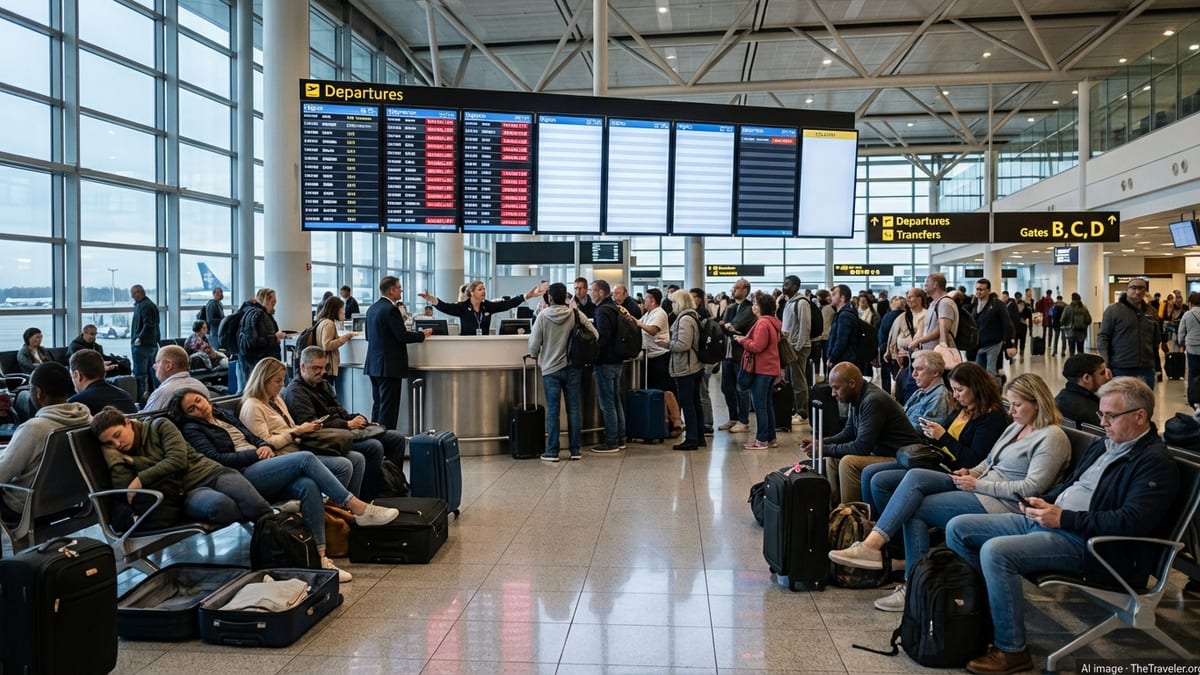
One of the most immediate consequences for travelers has been disruption to air corridors over the Gulf and neighboring states. After large-scale strikes on Iran earlier in the year, multiple countries temporarily closed or restricted their airspace and key hubs in Dubai, Abu Dhabi and elsewhere saw large numbers of cancellations and diversions, according to international news coverage and aviation data.
A passenger bulletin from the UK Civil Aviation Authority in March highlighted that airspace over Iran, Israel, Qatar, Bahrain, Kuwait, Iraq, Syria and the United Arab Emirates had been closed or partially closed, with major knock-on disruption reported in Saudi Arabia, Oman, Jordan, Lebanon and Egypt. The advice urged travelers to confirm their flight status with airlines and to monitor FCDO pages closely before setting out for the airport.
More recently, industry travel updates have pointed to continued caution from European regulators, with conflict-zone information bulletins recommending that airlines avoid or carefully manage operations in defined parts of Saudi airspace and surrounding flight information regions. As a result, many long-haul routes between Europe and Asia have been rerouted, adding time to journeys and increasing the risk of missed connections.
Travel associations in the UK have also warned that passengers using Gulf hubs as transit points may face late-notice changes even if their final destination is outside the Middle East. Guidance from trade bodies encourages travelers heading to destinations in Asia, Africa or Australasia to build in extra connection time and to register for airline and embassy alerts in case of sudden airspace closures.
Insurance limits and what UK travelers need to check
The tightening of UK travel guidance for parts of the Middle East has direct implications for travel insurance. Multiple providers stipulate that their policies do not offer cover in any country or region where the FCDO advises against all, or all but essential, travel. Some travel insurers have updated their online FAQs specifically in response to the Middle East conflict, listing affected destinations and explaining that claims may not be paid if travelers ignore official warnings.
Policy summaries available to UK consumers now frequently cite Middle East examples, explaining that trips to certain areas of Iran, Iraq, Israel, Lebanon, Syria, Yemen and Gaza would fall outside standard cover while current warnings remain in place. For nearby destinations such as Turkey, Cyprus or Egypt, insurers stress that cover may still apply in mainstream tourist areas but not in zones close to borders with conflict states, and they advise customers to review maps and local area restrictions carefully.
Corporate travel guidance issued by UK-based organisations also reflects the sharper tone of official advice. Internal documents seen in the public domain recommend that employers carry out detailed risk assessments for any staff deployment to Gulf energy hubs or projects near conflict-affected borders, taking into account potential evacuation routes, dedicated security arrangements and specialist insurance covering war and terrorism risks.
Travel experts writing for consumer-facing platforms suggest that UK holidaymakers planning to transit via the Gulf check three elements before committing: the latest FCDO advisory level for every country on their itinerary, the fine print of their insurance policy in relation to those advisories, and the flexibility of their airline ticket in case they need to reroute or defer travel at short notice.
Practical steps for Britons with Middle East itineraries
Publicly available UK government guidance urges British nationals in, or planning to travel through, the wider Middle East to be prepared for possible flight cancellations, airspace closures and wider travel disruption. Travelers are encouraged to sign up for email alerts on the official foreign travel advice pages, so that changes for specific countries such as the United Arab Emirates, Saudi Arabia, Jordan or Qatar are delivered automatically.
Airlines and airports are also advising passengers to allow extra time for security checks and possible rerouting. Notices from travel agents and tour operators emphasise that even where a particular resort destination remains open and is not subject to an “advise against travel” notice, connecting flights may still be affected if they normally route over or through high-risk airspace.
For those who decide to proceed with travel, industry guidance suggests keeping flexible arrangements wherever possible. Fully refundable fares, hotel bookings with free cancellation, and the ability to change transit points away from the most affected hubs can provide additional protection in an unpredictable environment.
Analysts following the conflict note that advisory levels can tighten or relax within days as ceasefire efforts advance or stall. Against that backdrop, UK travelers heading anywhere near the 16 highlighted Middle East states are being encouraged to treat the government’s foreign travel advice as a live document rather than a one-off pre-departure check.